PEPE Whale Activity Jumps 60%, Among Highest In Market

bitcoinistPublished on 2026-03-20Last updated on 2026-03-20

Abstract

According to on-chain data from Santiment, PEPE has experienced a significant increase in whale activity, with its Whale Transaction Count surging 61% week-over-week, ranking it eighth among cryptocurrencies with market caps over $500 million. This metric tracks transfers exceeding $100,000, indicating heightened interest from large investors. Such spikes in whale activity often precede market volatility, as these substantial transactions can impact asset prices. PEPE’s price was around $0.00000334 at the time of writing, down 3% in 24 hours, following a period of recent pullback. Other notable assets on the list include Mantle (MNT), which saw a 600% increase, and stablecoins like USDT and USDC, which also recorded significant jumps in large transactions.

On-chain data shows Pepe is among the cryptocurrencies that have seen the largest week-over-week increases in the Whale Transaction Count.

Pepe Whale Transaction Count Has Witnessed A 61% Jump

In a new post on X, on-chain analytics firm Santiment has shared the top 10 list of digital assets that have seen the largest jumps in the Whale Transaction Count over the past week.

The Whale Transaction Count here refers to an indicator that keeps track of the total number of transfers occurring on a given network that involve a value of more than $100,000. Generally, only the whale entities are capable of making such large moves, so the metric represents the activity of these big-money hands.

When the value of the Whale Transaction Count rises, it means whales are ramping up their activity. Such a trend may be a sign that the large investors have increased their interest in the cryptocurrency.

On the other hand, the indicator going down suggests big-money attention may be moving away from the asset as large entities are lowering their number of transactions.

Now, here is the table shared by Santiment that shows how the assets with a minimum market cap of $500 million compare based on the weekly percentage change in the Whale Transaction Count:
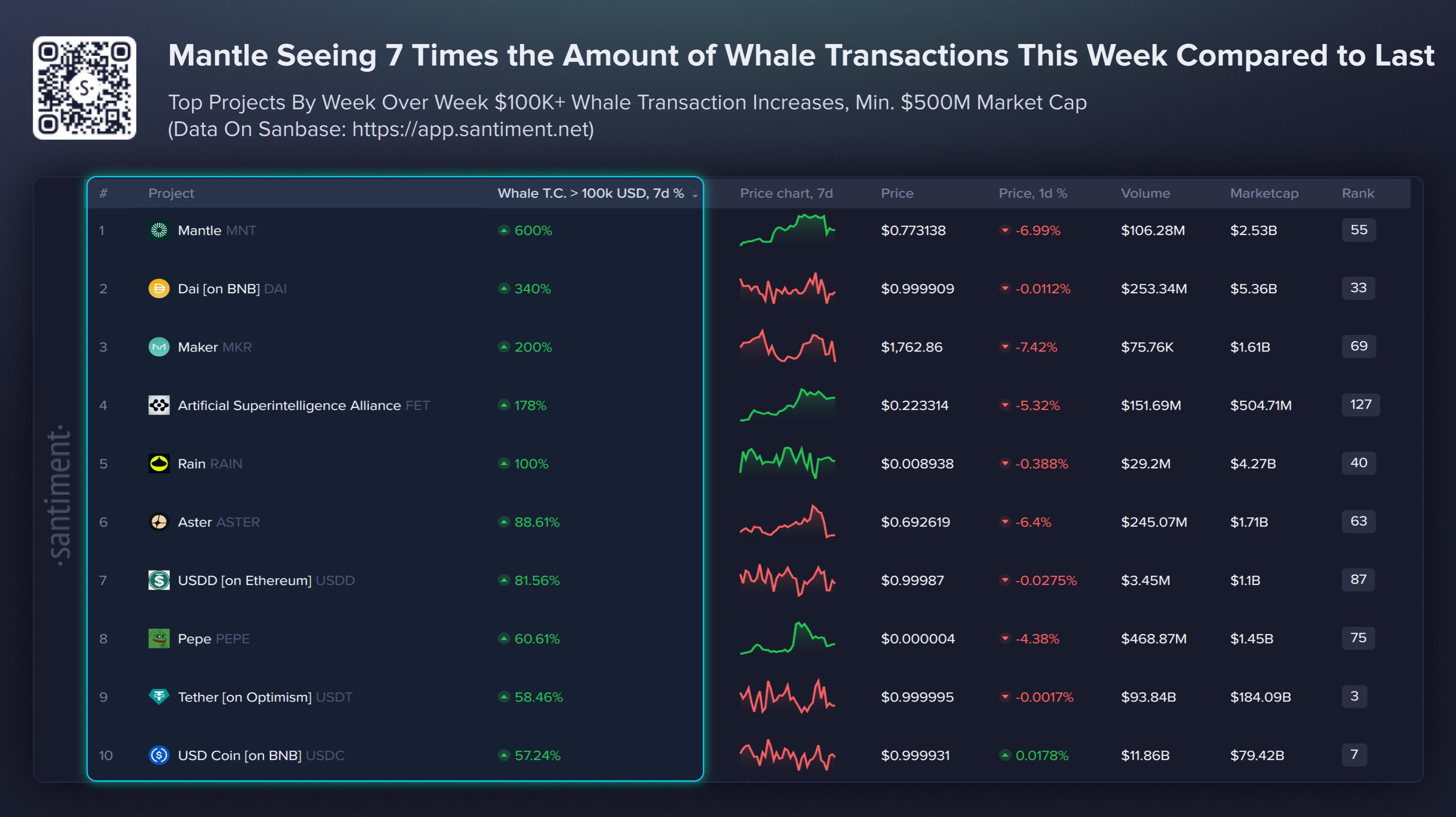
Looks like Mantle topped the list this week | Source: Santiment on X

As displayed above, Mantle (MNT) was the cryptocurrency that saw the strongest jump in the Whale Transaction Count over the last seven days: an increase of 600%. The BNB version of Dai (DAI) ranked second with an indicator rise of 340%, while Maker (MKR) came third with 200%.

Another prominent coin on the list is the memecoin Pepe (PEPE), which ranks eighth with a Whale Transaction Count of more than 60%. Earlier, the asset gained popularity due to the widely-known internet frog meme it’s associated with, but lately, the coin hasn’t been making much rounds in the news. As such, it’s interesting that whale interest in the memecoin has seen a sudden spike.

In the past, whale activity spikes have tended to proceed market volatility, as these humongous entities can create ripples big enough to shake the asset. Pepe and other assets have seen some sharp price action over the past few days, so it’s possible that the elevation in whale activity could be a factor behind it.

The largest assets by market cap on the list are USDT (on Optimism) and USDC (on BNB), garnering Whale Transaction Count jumps of 58% and 57%, respectively. Investors store capital in stablecoins when they want to avoid the volatility associated with the wider market, so these spikes could correspond to big-money hands either preparing capital for deployment into Bitcoin and other volatile assets or stashing it away in safety.

Pepe Price

At the time of writing, Pepe is floating around $0.00000334, down 3% in the last 24 hours.

The price of the memecoin seems to have pulled back over the last few days | Source: PEPEUSDT on TradingView


Related Questions

QWhat does the Whale Transaction Count measure in the context of cryptocurrency?

AThe Whale Transaction Count is an indicator that tracks the total number of transfers on a network involving a value of more than $100,000, representing the activity of large investors or 'whales'.

QWhich cryptocurrency saw the largest percentage increase in Whale Transaction Count over the past week, and by how much?

AMantle (MNT) saw the largest increase in Whale Transaction Count over the past week, with a jump of 600%.

QWhat was the percentage increase in Whale Transaction Count for the memecoin Pepe (PEPE)?

AThe memecoin Pepe (PEPE) saw a 61% jump in its Whale Transaction Count over the past week.

QAccording to the article, what has historically tended to follow a spike in whale activity for an asset like Pepe?

AHistorically, spikes in whale activity have tended to precede market volatility, as these large entities can create significant price movements.

QWhat was the price of Pepe (PEPE) at the time the article was written, and how much had it changed in the last 24 hours?

AAt the time of writing, Pepe was trading around $0.00000334, down 3% in the last 24 hours.

Related Reads

"King of Shilling" Hayes Strikes Again, This Time Setting His Sights on Deribit

On June 29, BitMEX co-founder Arthur Hayes acquired approximately 6.16 million SYN tokens via OTC platform Flowdesk, valued at around $2.2 million. Subsequently, Hayes publicly endorsed SYN on X, calling it one of the most asymmetric investments he's seen since HYPE and declaring it time for an on-chain options DEX to challenge industry leader Deribit, naming Hypercall as that challenger. The article details the evolution of the Synapse Protocol, originally launched in 2021 as a cross-chain messaging and liquidity network. While its TVL peaked above $1 billion during the last bull market, it has since declined. The protocol's team has since built Hypercall, an on-chain options trading platform on Hyperliquid's HyperEVM, which supports trading options on "any asset" with features like 24/7 trading and defined risk limited to the premium paid. Deribit, founded in 2016, is highlighted as the dominant centralized crypto options exchange, commanding roughly 85% market share in BTC and ETH options. Its strengths include deep liquidity and professional tools, though it faces critiques over custody risk, KYC requirements, and regulatory uncertainty. The analysis suggests Hypercall's potential lies in decentralization, permissionless access, and transparency, potentially carving a niche in DeFi-native and emerging asset options. However, it faces significant challenges competing with Deribit's established network effect and liquidity depth. The piece concludes by noting Hayes's recent and mixed "call" history, referencing his previous promotion and subsequent sale of HYPE, as well as a controversial price target report for CARDS from his family office, Maelstrom, which was followed by a significant price drop for the asset. This activity has drawn criticism, with some accusing Hayes of creating exit liquidity for his followers.

Foresight News20m ago

"King of Shilling" Hayes Strikes Again, This Time Setting His Sights on Deribit

Foresight News20m ago

One Year After the Crash of Crypto Treasury Companies, Copycats Are Already Making a Comeback

One year after the collapse of digital asset treasury (DAT) companies, which wiped out up to 99% for early investors, the scheme has returned in a new guise. Recently, Triller Group announced it would become a "SpaceX treasury company," causing its market cap to surge. This follows the rebranding of another firm, LGHL, now targeting a token called HYPE. The original model, popularized by MicroStrategy (MSTR) and its "Bitcoin yield" narrative, saw companies trading at massive premiums to their underlying crypto holdings. However, most followers like TwentyOne, Metaplanet, and Nakamoto have crashed 80-95%+ from their peaks, erasing nearly all value for late investors. The author argues these structures have no fundamental reason to trade at premiums when low-fee Bitcoin ETFs or direct ownership exist. The cycle persists due to speculative demand driven by FOMO, gamification, and a belief the system is rigged, met by insiders and promoters who profit from the pump-and-dump dynamics. Drawing a parallel to the 1637 Tulip Mania, the piece concludes that such frenzies are not a bug but a recurring product of markets, where greater fools provide demand and insiders supply the schemes. Despite holding Bitcoin personally, the author condemns this specific packaging of assets into leveraged corporate vehicles marketed as innovation, a cycle seemingly unstoppable until a major crash.

marsbit31m ago

One Year After the Crash of Crypto Treasury Companies, Copycats Are Already Making a Comeback

marsbit31m ago

Trading

Spot
活动图片