Peeking Through Windows, Precision Hijacking? Two Giants of Prediction Markets Engage in Corporate Espionage

foresightnews_apiPublished on 2026-06-05Last updated on 2026-06-05

Abstract

Polymarket, a prediction market platform, is investigating a suspected corporate espionage case involving its main rival, Kalshi. Polymarket accuses Kalshi of stealing business information and copying product launches through potentially illicit means, compiling a "plagiarism file" documenting over a dozen suspiciously coincidental product releases and marketing campaigns. Key incidents include a February 2026 free-grocery pop-up event, where Kalshi launched an almost identical campaign just nine days before Polymarket's scheduled launch, seemingly to siphon attention. Furthermore, an article leaked Kalshi's plans for a perpetual futures trading product merely an hour before Polymarket's own planned announcement for a similar tool in April 2026. Polymarket executives suspect either an internal mole or physical surveillance, noting that the office of Paradigm—a Kalshi investor—directly faces their Manhattan workspace, leading them to install dark window film. Both Paradigm and Kalshi have dismissed the allegations as baseless and ridiculous. Kalshi claims its product developments are independent and coincidental timing is merely market-driven. The rivalry intensifies as both companies secure significant funding, with Polymarket seeking a $15 billion valuation and Kalshi valued at $22 billion amid growing regulatory scrutiny of the prediction market industry.


By: Marc Vartabedian, New York Post

Compiled by: Luffy, Foresight News


The prediction market platform Polymarket is investigating a suspected case of corporate espionage by a competitor. The platform allows users to place bets on sports events, weather, and geopolitical conflicts. The company alleges its top rival, Kalshi, used improper methods to steal business information and copycat its products.


Led by its 27-year-old CEO Shayne Coplan, the New York-based prediction platform has compiled a "copycat file," documenting over a dozen suspicious incidents: the launch times and product designs of several Kalshi new offerings were strikingly similar to Polymarket's, with coincidences in release timing being alarmingly abnormal.


Matthew Modabber, head of markets at Polymarket, said in a phone interview that the coincidences were simply too many and too abnormal, suggesting a deliberate and aggressive effort to copy their business.


Polymarket CEO Shayne Coplan speaking at the New York Stock Exchange on November 13 last year


The executive did not disclose further details, but people familiar with the matter revealed the company internally suspects two possibilities: one is a mole planted inside Polymarket; the other is a more bizarre suspicion of surveillance.


In recent months, several employees have suggested that Paradigm, an investor in Kalshi, may have been monitoring Polymarket's Lower Manhattan office from across the street. Paradigm's office in New York's SoHo district faces Polymarket's office, with floor-to-ceiling windows offering a direct view into Polymarket's workspace, potentially even observing employees' computer screens. The street-level below houses trendy clothing stores and the upscale restaurant Balthazar.


Due to surveillance concerns, Polymarket specifically applied dark tinted window film to its office windows this spring. An internal employee stated: "The possibility of being spied on was discussed in company meetings. The final conclusion was that, given Kalshi's past conduct, such clandestine surveillance is entirely plausible."


When asked about the espionage allegations, a Paradigm spokesperson responded: "That claim is laughable." Kalshi spokesperson Jack Such responded: "The related accusations are baseless, bordering on delusional. Polymarket is welcome to spend its energy on self-investigation. Kalshi will continue to diligently improve its products."
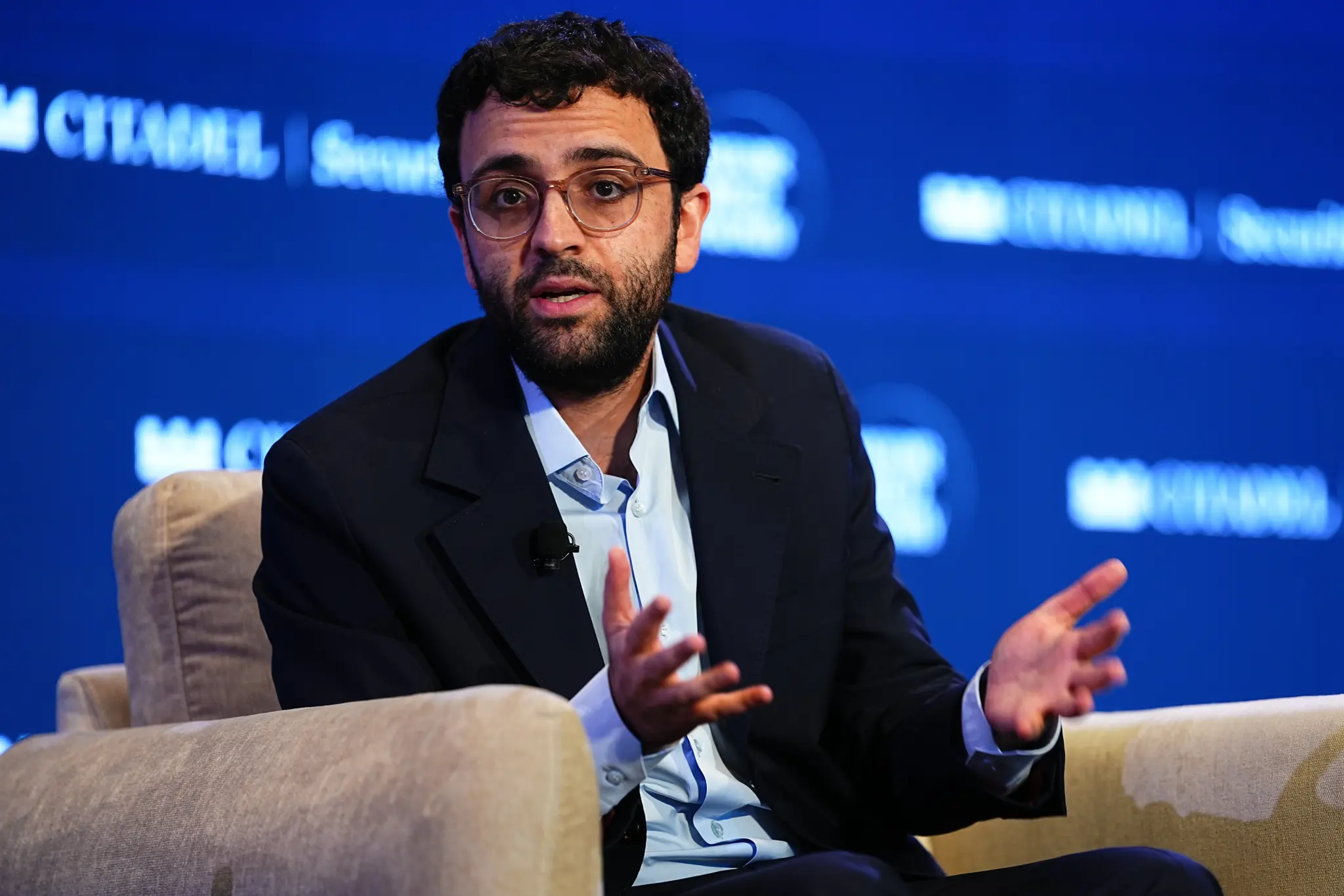

Kalshi co-founder Tarek Mansour speaking at the Semafor World Economy Summit in Washington, D.C., on April 15


Polymarket's investigation focuses on two points: how Kalshi precisely obtained advance knowledge of its new product launches and marketing campaign schedules, and what level of detail they acquired to enable such efficient and comprehensive replication.


Suspicions within the platform have been accumulating over the past year, and an incident at an offline event in February became the catalyst for the current conflict. Polymarket had been preparing a pop-up grocery store event since last November, scheduled to open in Manhattan on February 12: the first 300 in-store customers would receive free groceries. For this, they signed contracts totaling $643,380 for venue, branding, and execution.


Just nine days before Polymarket's opening, Kalshi suddenly launched an identical free grocery marketing campaign at a Westside supermarket in New York, distributing $50 grocery vouchers with the promotional slogan "Free Market," while simultaneously launching prediction markets on topics like monthly egg price increases.


A Polymarket insider claimed the move was clearly intended to divert traffic from their event. Founder Shayne, who grew up in New York, said the event held special significance for the company, and being maliciously hijacked was very disappointing for the team.


Kalshi's head of communications, Elisabeth Diana, denied copying, stating their grocery marketing plan had been in preparation for a long time and they did not obtain the competitor's event timing through an insider. Kalshi spokesperson Such added that both companies' event inspirations came from the New York Mayor's campaign platform promoting grocery subsidies.


Furthermore, since January, Polymarket had been secretly developing a spot perpetual contract trading tool, allowing users to bet on real-time price movements of assets like stocks without holding the underlying asset, originally scheduled for announcement and launch on April 21. However, just one hour before Polymarket's announcement, the tech media outlet *The Information* published an exclusive article citing anonymous sources, revealing Kalshi was about to launch a similar perpetual contract product.


Polymarket's office is located in a fashionable New York neighborhood, directly across the street from Paradigm


According to sources, Polymarket executives were furious about this.


One source said, "It seemed like they knew we would announce that day, which is very suspicious."


Such explained that Kalshi's perpetual product development started in 2024. He believed *The Information* learned about the plan from a social media teaser Kalshi posted on X on April 13. The teaser showed a video of what appeared to be an infinite loop spring toy with the caption "Timeless," which in finance refers to perpetual futures contracts, contracts that never expire.


Polymarket's "copycat file" includes over a dozen sets of screenshots comparing official announcements, social media posts, and product interfaces from both companies. An executive stated these archived cases represent only one-tenth of all similar incidents.


One page of the file records: On June 10, 2025, at 9:01 AM, Polymarket announced on X an hourly crypto price prediction product, garnering nearly 24 million impressions. On the same day at 9:00 AM, the brokerage Webull jointly announced with Kalshi the launch of an identical product. Polymarket's file notes: "Same day?"


But Such countered, stating Kalshi had already launched a similar product before June 10, 2025, and that day was merely its listing on Webull through partnership. He argued it was actually Polymarket that launched later, making it clear who copied whom.


There are also cases of advertising material collisions. On Friday, August 22 last year, Polymarket ran a Meta ad in California for football betting, with the prominent headline "Hey, California"; just one weekend later, Kalshi launched an almost identical targeted ad with the same headline.


Such stated "Hey, California" is generic promotional language, not protected by trademark or copyright. He argued that claiming corporate espionage based solely on an advertising slogan is illogical.


The feud between the two prediction platforms has intensified in 2026. U.S. lawmakers and regulators are tightening oversight of prediction markets, with the industry facing criticism related to insider trading and war gambling. Meanwhile, capital continues to pour heavily into both leading platforms.


According to data from analytics firm PitchBook, Polymarket, founded in 2020, has raised approximately $2 billion to date, with its latest funding round aiming for a valuation of $15 billion. Kalshi, founded in 2018, has raised $2.6 billion, with its latest valuation at $22 billion, double its valuation from December last year.


Related Questions

QWhat are the two main prediction market platforms involved in the alleged corporate espionage case, as described in the article?

AThe two main prediction market platforms are Polymarket and Kalshi.

QWhat specific incident in February did Polymarket cite as a key event leading to heightened suspicions against Kalshi?

APolymarket cited an incident where, just 9 days before their planned Manhattan pop-up grocery event, Kalshi launched a similar free-groceries promotional event in New York, which Polymarket believed was an attempt to divert traffic from their own event.

QWhat two possibilities does Polymarket internally suspect regarding how Kalshi might have obtained its confidential information?

APolymarket internally suspects two possibilities: that there is a mole within Polymarket, or that Kalshi's investor Paradigm has been conducting surveillance from their office across the street.

QHow did Polymarket reportedly respond to the surveillance concerns regarding Paradigm's office location?

AIn response to the surveillance concerns, Polymarket reportedly installed dark, tinted window film on their office windows during the spring.

QAccording to the article, what was Kalshi's explanation for the coincidental timing of their perpetual futures product announcement with Polymarket's?

AKalshi's spokesperson, Such, explained that their perpetual product development started in 2024 and suggested that the media outlet The Information learned of their plans from a social media teaser Kalshi posted on April 13th, not from inside information about Polymarket's schedule.

Related Reads

Single-Day Plunge of 30%, Arthur Hayes Suddenly Liquidates: Why Did ZEC Get Exploded by Security Issues?

On June 5th, Zcash founder Zooko Wilcox disclosed a critical soundness vulnerability in the project's latest Orchard privacy pool. This flaw, found in the elliptic curve multiplication constraints, could allow an attacker to create unlimited counterfeit ZEC within the shielded pool, with transactions appearing valid. The vulnerability was discovered in late May by security researcher Taylor Hornby, who utilized Anthropic's new Opus 4.8 AI model for a targeted audit. The Zcash ecosystem had already performed an emergency network upgrade to patch the issue. However, the detailed disclosure triggered severe market panic, causing ZEC's price to plummet over 30% in a single day. Notably, prominent investor Arthur Hayes announced he had sold his entire ZEC position following the news. The incident starkly challenges the "technological trust" narrative central to privacy coins. Despite years of top-tier cryptographic audits, the bug persisted until uncovered with advanced AI-assisted research. This highlights the growing gap between theoretical perfection and practical implementation in privacy technology. The event serves as a industry-wide warning: in an AI-driven security landscape, the assumption that "undiscovered equals safe" is obsolete. It underscores the urgent need for continuous, proactive security practices combining AI audits, formal verification, and rapid response mechanisms.

foresightnews_api1h ago

Single-Day Plunge of 30%, Arthur Hayes Suddenly Liquidates: Why Did ZEC Get Exploded by Security Issues?

foresightnews_api1h ago

Breaking the Curse of DeFi Cascading Liquidations, Vitalik Proposes a New Solution

**Vitalik Buterin Proposes New DeFi Design to Eliminate Forced Liquidations** Ethereum co-founder Vitalik Buterin has published a proposal for a new decentralized finance (DeFi) architecture aimed at removing the automatic liquidation mechanisms prevalent in current lending protocols. The core idea involves creating synthetic assets using options as building blocks, fundamentally avoiding the抵押借贷结构 that triggers forced sell-offs. The proposal responds to a recurring flaw in DeFi: during sharp market downturns, mass自动清算 of under-collateralized positions can exacerbate price declines, creating systemic selling pressure and market instability, as evidenced by recent crypto market volatility. Buterin's model would split an asset like 1 ETH into two option-like derivatives, P and N, pegged to a price index with a set strike price and expiration. At expiry, an oracle determines the settlement price to allocate the underlying ETH between P and N holders. This design eliminates the "cliff" of instant liquidation. Instead, a position's value would gradually drift from its target peg if not actively rebalanced by the user, transferring the rebalancing decision from the protocol to the user or automated tools. A key advantage is the reduced reliance on high-frequency, real-time oracle price feeds, which are vulnerable to manipulation and errors in current systems. The delayed settlement in the options model allows for more robust, fault-tolerant oracle designs. However, significant challenges remain for practical adoption. High transaction costs (slippage) from frequent rebalancing on automated market makers (AMMs) could erode user funds. The model may not be suitable for stablecoins requiring a strict 1:1 dollar peg, as it inherently allows for value drift. Success would depend on developing new liquidity provisioning models and deep markets for these synthetic assets. The proposal represents a fundamental rethinking of DeFi risk management, challenging the industry to explore alternatives to被动集中平仓 rather than merely optimizing existing liquidation processes. It remains a theoretical framework awaiting implementation and testing by development teams.

foresightnews_api1h ago

Breaking the Curse of DeFi Cascading Liquidations, Vitalik Proposes a New Solution

foresightnews_api1h ago

Bitcoin's Decline Marks the Transformation of Crypto

Title: The Decline of Bitcoin Marks the Transformation of Crypto While Bitcoin's price recently fell below $70,000, down approximately 45% from its peak, the broader crypto industry is not following it into decline. Instead, crypto is maturing and evolving beyond its dependence on Bitcoin's price movements. Two of Bitcoin's core functions are being usurped. First, AI has captured its role as the primary speculative asset. AI, with its tangible revenue, explosive demand, and massive capital inflows ($700-830 billion in 2024), is siphoning off the speculative "hot money" that once drove Bitcoin. It also contributes to a sustained high-interest-rate environment, further tightening liquidity for assets like Bitcoin. Second, dollar-pegged stablecoins like USDC and USDT have replaced Bitcoin as the crypto market's foundational currency and primary on/off-ramp. Most trading pairs and on-chain transactions are now settled in stablecoins, severing the historical link where all capital inflows had to pass through Bitcoin first. This decoupling allows projects to thrive based on their own fundamentals rather than Bitcoin's price. Examples include Hyperliquid, an on-chain derivatives exchange with annual revenues of $8-13 billion, and prediction market platform Polymarket, valued at $200 billion with $3.65 billion in annual fees. These projects are evaluated on traditional metrics like revenue and user growth. New opportunities are emerging, particularly around privacy. Privacy coins like Zcash (ZEC) are seeing surging demand, while infrastructure like NEAR enables private, cross-chain asset transfers without requiring users to hold a specific token—privacy becomes a universal service layer. In this new paradigm, stablecoins are the universal cash, various project tokens represent equity, and privacy-enabled cross-chain coordination layers (like NEAR) act as the critical infrastructure connecting a fragmented, multi-chain ecosystem. Bitcoin is now just one asset among many. The era where the entire crypto market moved in lockstep with Bitcoin is over. The industry's health should now be judged by project fundamentals—real revenue, active users, and tokenomics that capture value—and the development of the underlying infrastructure enabling a mature, dollar-denominated crypto economy.

foresightnews_api1h ago

Bitcoin's Decline Marks the Transformation of Crypto

foresightnews_api1h ago

Lightspark CEO: In Ten Years, Bitcoin Will Be as Invisible as TCP/IP, Yet Power Trillions in Daily Transactions

A decade from now, Bitcoin will function like TCP/IP — invisible yet foundational, supporting trillions in daily transactions globally, according to Lightspark CEO David Marcus. In this future, a coffee shop in Lagos receives instant payment, a manufacturer in São Paulo settles an invoice with a supplier in Ho Chi Minh City, and a freelancer in Bangalore gets paid weekly from an Austin startup — all via Bitcoin's settlement layer, with none of the parties consciously interacting with it. This vision parallels the adoption of open protocols: first driven by necessity where existing systems fail, then scaling rapidly as tools mature and economic benefits become clear. The structural shift begins with wallets. Modern non-custodial wallets, like Spark, allow users to hold dollars, local currency, and Bitcoin in a single address, seamlessly switching between them. This eliminates friction and revolutionizes global custody, moving significant deposits to user-controlled keys not by ideology, but by superior utility. As a result, Bitcoin becomes the default savings layer for billions, as its fixed supply and appreciating value make it a rational choice for savers holding it alongside stablecoins in their everyday wallets. Businesses follow a similar path, from small companies in emerging markets to multinational corporations, holding Bitcoin alongside operational stablecoins. The latest trend is direct Bitcoin transactions for commerce. When both parties hold Bitcoin, transacting in it becomes the simplest option — no conversions, no intermediary currency. This starts in niche areas like high-value B2B settlements but grows as infrastructure makes sending Bitcoin as easy as stablecoins. An accelerating force is AI agents. By 2036, AI agents conducting commerce on behalf of individuals and firms will increasingly choose Bitcoin for settlement. Optimizing for speed, finality, and minimal counterparty risk across jurisdictions, they find Bitcoin's global, neutral, and programmable network ideal for netting and settling obligations. Thus, Bitcoin is becoming the native currency for machine commerce, just as it has become a native savings asset for humans. The global monetary system is being rebuilt from the protocol layer: open infrastructure, default self-custody, Bitcoin settling everything underneath, with stablecoins as the interface. Most users won't think about Bitcoin when they transact — and they won't need to.

foresightnews_api1h ago

Lightspark CEO: In Ten Years, Bitcoin Will Be as Invisible as TCP/IP, Yet Power Trillions in Daily Transactions

foresightnews_api1h ago

Trading

Spot
Futures
活动图片




