Payments giant Stripe acquires team from crypto wallet app Valora

cointelegraphPublished on 2025-12-11Last updated on 2025-12-11

Abstract

Payments giant Stripe has acquired the team behind crypto wallet app Valora, a day after launching the testnet for its stablecoin-focused blockchain project, Tempo. Valora CEO Jackie Bona stated the team will join Stripe to contribute expertise in web3 and user-first experiences. Valora, which spun out of Celo development group cLabs in 2021, offers a mobile wallet supporting stablecoins across multiple blockchains. The Valora app will continue operating under cLabs. This move accelerates Stripe's growing blockchain initiatives, particularly Tempo network, which has a $5 billion pre-launch valuation and emphasizes easy stablecoin creation.

Payments giant Stripe has acquired the team from crypto wallet firm Valora, just a day after launching its testnet for its stablecoin-focused blockchain project Tempo.

According to Valora CEO Jackie Bona, the acquisition will see the Valora team join Stripe and work on the firm’s blockchain initiatives.

Valora was founded in mid-2021 after spinning out of Celo development group cLabs and raising $20 million in Series A funding in the process.

The Valora app is a mobile wallet that supports stablecoins and other assets across Celo, Ethereum, Base, Optimism and Arbitrum. Apart from the wallet, the team also developed an open protocol launchpad for Web3 apps geared toward a mobile-native experience.

“Stripe shares our conviction that stablecoins and crypto can dramatically expand who gets to participate in the global economy,” said Bona, adding that “by bringing Valora’s team to Stripe, we’ll be able to contribute our expertise in web3 and user-first experiences to a platform with unparalleled reach.”

It is not explicitly stated what the Valora team will work on; however, Stripe will be tapping a team that has had a strong focus on global payments, digital wallets and user-friendly smartphone-based Web3 apps.

“Through this work, we’ve seen firsthand how access to stablecoins and crypto rails can expand economic opportunity. In the past few months, it became clear that we could accelerate this mission by joining Stripe, one of the world’s leading financial infrastructure platforms,” Bona said.
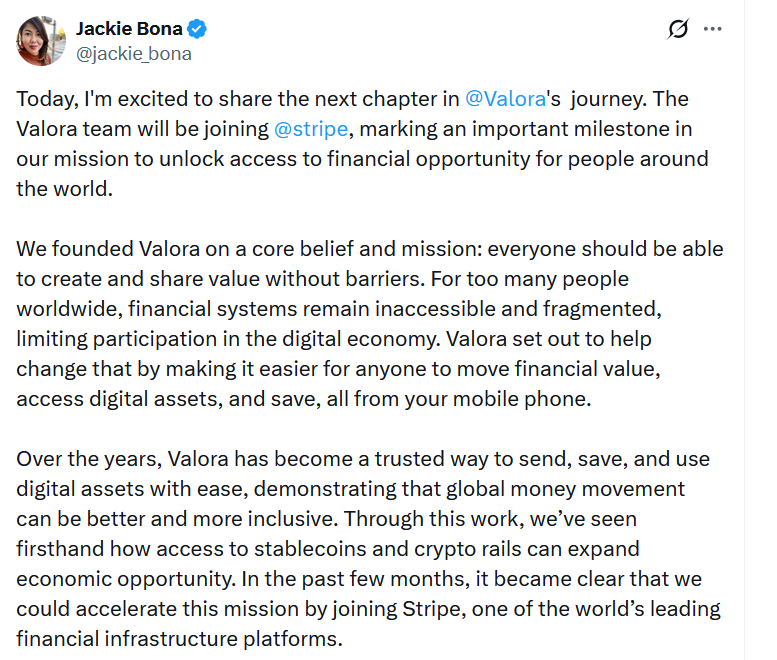
Source: Jackie Bona

Related: The easiest and safest methods for gifting crypto at Christmas in 2025

The Valora app will continue to function, but its operations and future development will be handed over to cLabs.

Momentum building for Stripe and Tempo

After an on-again-off-again relationship with crypto, Stripe has been making strides in the blockchain space over the past couple of years. Momentum has been building particularly since first unveiling Tempo four months ago in partnership with crypto VC firm Paradigm, with the network already having a $5 billion pre-launch.

The latest move from Stripe comes just a day after Stripe and Paradigm’s layer-1 blockchain project Tempo launched its open testnet.

One of the key features highlighted during the testnet launch was the ease and simplicity of creating stablecoins directly in the browser, among other benefits.

Magazine: 11 critical moments in Ethereum’s history that made it the No.2 blockchain

Related Reads

Selling Call Options: On-Chain Protocol Attempts to Achieve 4-14% APY with Gold

Selling Call Options: On-chain Protocol Aims to Generate 4-14% Annual Yield from Gold Gold, a $30+ trillion asset, produces no inherent cash flow. Traditional methods to generate yield involve lending it out or selling its volatility via call options. While the covered call strategy is proven, access has been limited to institutions, burdened by fees, issuer risk, and opaque pricing. On-chain gold leads in custody and liquidity but lags in yield generation. Lending demand is thin, and AMM liquidity provision exposes holders to impermanent loss, eroding gold's price upside. Enhanced is a structured products infrastructure tackling this. Its core is an RFQ auction engine where institutional market-makers competitively bid to purchase call options sold against user-deposited assets, converting asset volatility into premium income. Its first product, the PAXG Volatility Yield Vault, allows users to deposit PAXG (tokenized gold). The vault automatically sells bi-weekly, out-of-the-money call options via the RFQ auction. Premiums are distributed to depositors, targeting 4-14% APY. The strategy dynamically adjusts strike prices based on market conditions to balance yield and retained upside. Unlike first-generation on-chain vaults, Enhanced emphasizes competitive price discovery, alignment with holders via flexible OTM strikes, and a focus on yield-starved real-world assets (RWA) like gold. The protocol acknowledges the trade-offs: capped upside, no principal protection, and dependence on volatility. It suits holders seeking to generate income from otherwise idle assets while maintaining most of their underlying exposure. Enhanced represents a shift towards on-chain wealth management, transforming volatility from a cost into yield. Starting with gold, the infrastructure is designed to expand to tokenized equities, commodities, and broader RWA, marking a new phase for structured products on-chain.

marsbit3m ago

Selling Call Options: On-Chain Protocol Attempts to Achieve 4-14% APY with Gold

marsbit3m ago

In South Korea's AI Battle, Lee Jae-myung Cannot Afford to Lose

South Korean President Yoon Suk-yeol is betting the nation's future on an all-out push into AI and semiconductors, despite slumping approval ratings. In a high-stakes move, he ordered the relocation of a military airport in Gwangju by mid-2028 to make way for a major semiconductor cluster, demanding "lightning war" speed to rival projects like Taiwan's TSMC in Japan. His administration has unveiled trillion-won investment plans to double DRAM capacity and build AI data centers. This aggressive industrial policy collides with a harsh financial reality for ordinary citizens. Fueled by the AI narrative, the KOSPI index skyrocketed 116% in early 2026, led by leveraged ETFs tied to chip giants Samsung and SK Hynix. However, the market subsequently crashed by 40%, entering a technical bear market. The crash triggered a devastating chain reaction: leveraged ETFs were forced into mass sell-offs, amplifying losses. Over 1.2 million margin accounts faced liquidation calls, with an estimated 350,000 to 460,000 completely wiped out. Young investors were hit hardest, suffering collective losses estimated in the tens of trillions of won. The article paints a stark contrast: while the president champions a national "golden era" of AI, a generation of retail investors is experiencing financial ruin, their dreams shattered by a brutal market correction. The nation's strategic gamble on high-tech supremacy unfolds alongside a profound social crisis of household debt and lost savings.

marsbit5m ago

In South Korea's AI Battle, Lee Jae-myung Cannot Afford to Lose

marsbit5m ago

Everyone Thinks Cryptocurrency is Dead, But He Says It's About to Explode

Title: A Bullish Case Amidst Doubt: Bitcoin's Path for Ordinary Investors While many declare crypto dead, Scott Melker argues the opposite. In a wide-ranging interview, he reflects on the industry's evolution into a more institutionalized landscape in 2026. Dismissing the myth of trading success, Melker advocates for "boring" investment as the key to financial freedom for the average person. His core advice is straightforward: buy Bitcoin, consistently dollar-cost average, and hold. He warns against trying to time the volatile market, calling it a dangerous path where most lose out. Melker shares his journey from a DJ and trader to a media entrepreneur, highlighting the importance of building a durable brand based on reputation rather than hype. He acknowledges the structural shifts in the market, noting that many tokens fail to accrue value to holders, while assets with real institutional adoption, like Bitcoin, Ethereum, and Solana, will thrive. The lessons from the 2022 bear market are clear: avoid unrealistic yield traps and focus on hard assets. For investors, he recommends an 80% Bitcoin, 10% Ethereum, 10% Solana portfolio, using strategies to generate cash flow to buy more Bitcoin. Melker's ultimate goal is promoting Bitcoin to the mainstream, viewing it as the most critical financial asset for escaping the inflationary "rat race." His philosophy for 2026 and beyond is simple: "Bitcoin and chill." He urges investors to stay the course, emphasizing that the current market, with its institutional adoption and ETFs, represents the industry's best era yet.

marsbit10m ago

Everyone Thinks Cryptocurrency is Dead, But He Says It's About to Explode

marsbit10m ago

Why Are Crypto VCs Focusing on Stablecoin Infrastructure?

Crypto VC Focuses on Stablecoin Payment Infrastructure Despite an overall cooling crypto VC market in Q1 2026, investment in stablecoin payment infrastructure is gaining momentum. Capital is concentrating on mature projects with existing users, transaction volume, and clearer revenue models over purely speculative token-based ventures. Stablecoins are evolving from trading tools into backend infrastructure for efficient, 24/7 cross-border payments (e.g., B2B, remittances, payroll). Startups are building along the entire payment stack—connecting stablecoins to bank accounts, cards, forex liquidity, and local compliance systems. Recent large funding rounds for companies like Rain (cards), OpenFX (cross-border), and RedotPay highlight this trend. VC interest stems from several factors: solving real inefficiencies in traditional cross-border settlement, established fee-based revenue models (transaction fees, forex spreads), stablecoins becoming an invisible backend tool for end-users, clearer US regulatory frameworks attracting traditional finance, and acquisition exits to companies like Stripe and Mastercard. However, challenges remain. High on-chain stablecoin volume doesn't equal real retail payment volume; funding is concentrated in a few top performers; services risk commoditization; global expansion requires navigating local banking and regulations per market; and large traditional payment firms are both potential clients and future competitors. Future investment may focus on cross-border B2B payments, bank-stablecoin connectivity, stablecoin-linked cards, multi-chain/asset payment orchestration platforms, and infrastructure for AI Agent payments. Ultimately, VCs are betting not on a single stablecoin's dominance, but on the critical infrastructure needed to integrate programmable, global settlement assets into the traditional financial system.

marsbit11m ago

Why Are Crypto VCs Focusing on Stablecoin Infrastructure?

marsbit11m ago

Billions in USDT Flee Korea. Police Powerless in the Fight Against Money Laundering

South Korea is facing a severe and rapidly escalating challenge with crypto-based money laundering. Police data shows cases surged 152-fold in the first half of 2026 compared to all of 2025, with laundering now constituting 79.4% of all detected crypto-related crimes. The primary method is the "Hwanchigi" scheme, which uses cryptocurrency transfers to move illicit funds overseas, bypassing the regulated banking system. Tether (USDT) is the preferred vehicle for converting proceeds from drug trafficking, illegal gambling, and phishing into dollars before moving them to offshore exchanges. Despite enhanced monitoring and enforcement efforts, a stark gap exists between detection and prosecution. While authorities tracked and blocked millions in illegal assets in high-profile cases, arrests have lagged dramatically. In the first half of 2026, only 18 arrests were made despite over 1,200 detected cases. Customs seized approximately $4.92 billion in illegal foreign exchange operations, with over 90% of crypto-related crimes for prosecution flowing through unlicensed channels. The situation highlights a systemic disconnect: blockchain analytics can track transactions nearly in real-time, but the judicial process moves slowly. This asymmetry raises questions about whether detection statistics alone are a meaningful measure of effectiveness in combating money laundering, as the low cost and high speed of these schemes allow criminal networks to scale faster than law enforcement can respond.

cryptonews.ru26m ago

Billions in USDT Flee Korea. Police Powerless in the Fight Against Money Laundering

cryptonews.ru26m ago

Trading

Spot
活动图片