Optical Modules Soar, Why Is NOK the Second Leader After MRVL?

marsbitPublished on 2026-06-03Last updated on 2026-06-03

Abstract

Nokia's stock has surged nearly 170% to around $16.8 since Nvidia's $1 billion investment and AI-RAN partnership in October 2025, reflecting a market re-rating from a cyclical telecom equipment provider to an AI infrastructure player. This rise, adding roughly $60 billion in market cap, is driven by AI capex expansion into telecom edge, RAN, and optical networks. The company's Q1 2026 results showed strong momentum, with AI & Cloud net sales up 49% and 10 billion euros in new orders, prompting Nokia to raise its AI & Cloud market growth forecast to a 27% CAGR (2025-2028). Optical network growth of 20% further strengthens its position in connecting AI data centers. Recent tests with operators like T-Mobile and the opening of an AI Networking Innovation Lab demonstrate progress from concept to early commercial deployment. Nokia's strategy integrates Nvidia GPUs into its network hardware, enabling concurrent AI processing and RAN tasks for real-time optimization and new edge services. However, with a trailing P/E nearing 100x and consensus price targets lagging the current stock price, significant future growth is already priced in. The key constraint now is the pace and scale of large-scale operator deployments. While execution signals remain positive and the company's position in AI edge infrastructure is established, high valuation leaves limited room for error, making tangible commercial contracts the critical factor for further stock performance.

Nokia's share price is currently around $16.8, having accumulated an increase of nearly 170% since Nvidia's subscription to new shares at $6.01 in October 2025. Its market capitalization has increased by approximately $60 billion, reaching a 16-year high. The market no longer views it merely as a cyclical telecom equipment supplier but is rapidly re-rating it as an AI network and edge infrastructure player. Nvidia's equity investment and technical collaboration have been the most direct catalyst.

Behind this is the major trend of AI capital expenditure shifting from core data centers to the telecom edge, wireless access networks, and optical networks. The question is, how far has this re-rating progressed, and how much support can future actual implementation provide for the stock price?

Nokia's Stock Price Has Completed the AI Infrastructure Re-rating

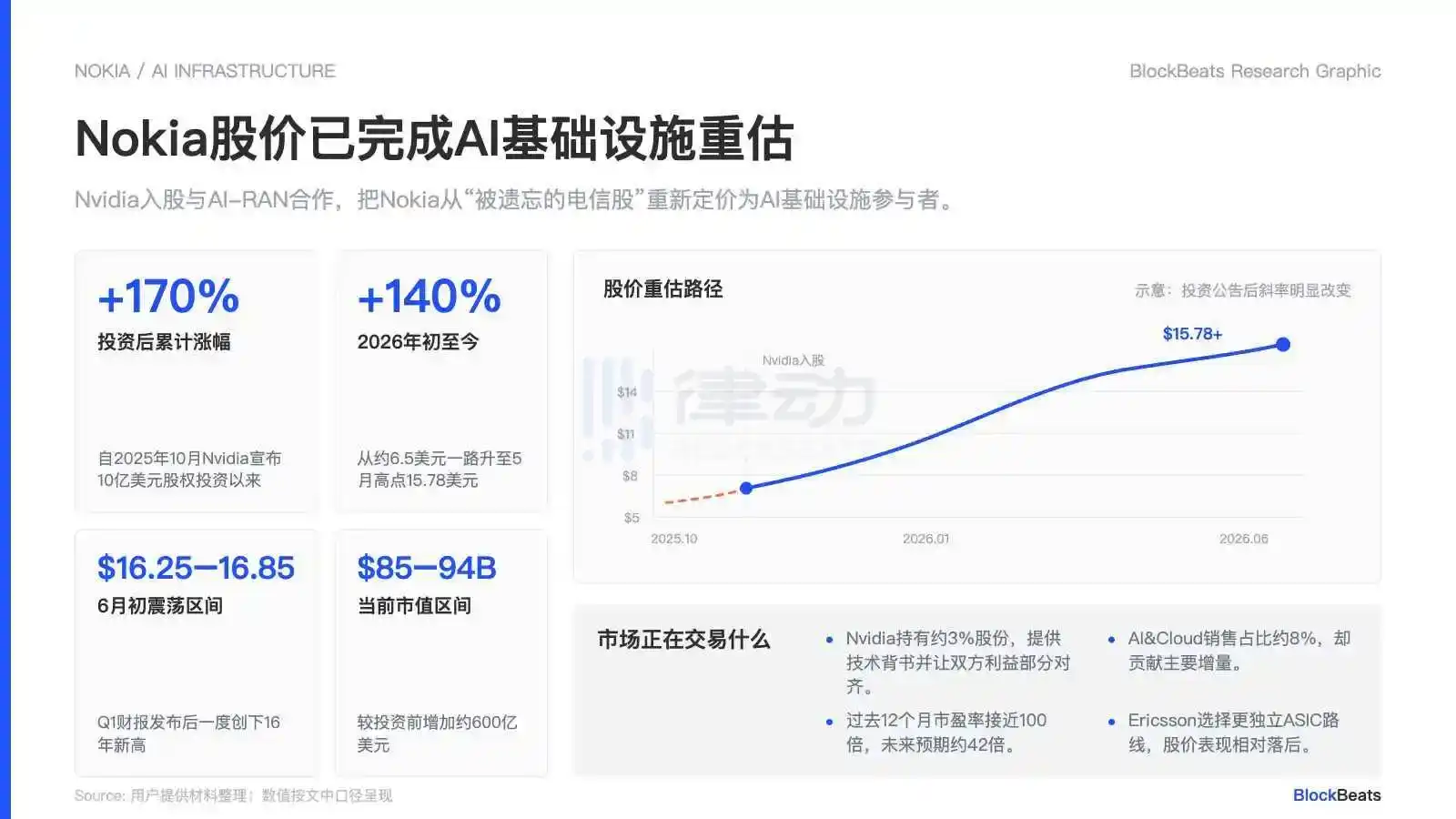
Since Nvidia announced a $1 billion equity investment and reached an AI-RAN strategic cooperation agreement in October 2025, Nokia's share price has accumulated gains of nearly 170%. Year-to-date in 2026, the increase exceeds 140%, rising from around $6.5 to a peak of $15.78 in May, and fluctuating in the $16.25-$16.85 range in early June. Following the Q1 earnings release, it once hit a 16-year high.

The current market capitalization is approximately $85-94 billion, an increase of about $60 billion from pre-investment. The AI&Cloud business accounts for about 8% of group sales but contributes the majority of the incremental value. The trailing twelve-month P/E ratio is close to 100 times, while the forward P/E ratio is about 42 times, significantly higher than traditional telecom peers but still lower than pure-play AI infrastructure companies. In contrast, Ericsson's share price performance lags due to its choice of a more independent ASIC chip strategy.

These changes indicate that the market is already trading on Nokia's transformation from a "forgotten telecom stock" to an AI infrastructure participant. Nvidia holds approximately 3% of the shares, providing both technical endorsement and partially aligning interests. Coupled with the narrative of the U.S. pushing to regain leadership in the telecom field, this has collectively accelerated this round of re-rating.

However, after significantly outperforming, what actual business progress is the market truly trading on?
Q1 Orders and Guidance Raise Validate Accelerated Transformation

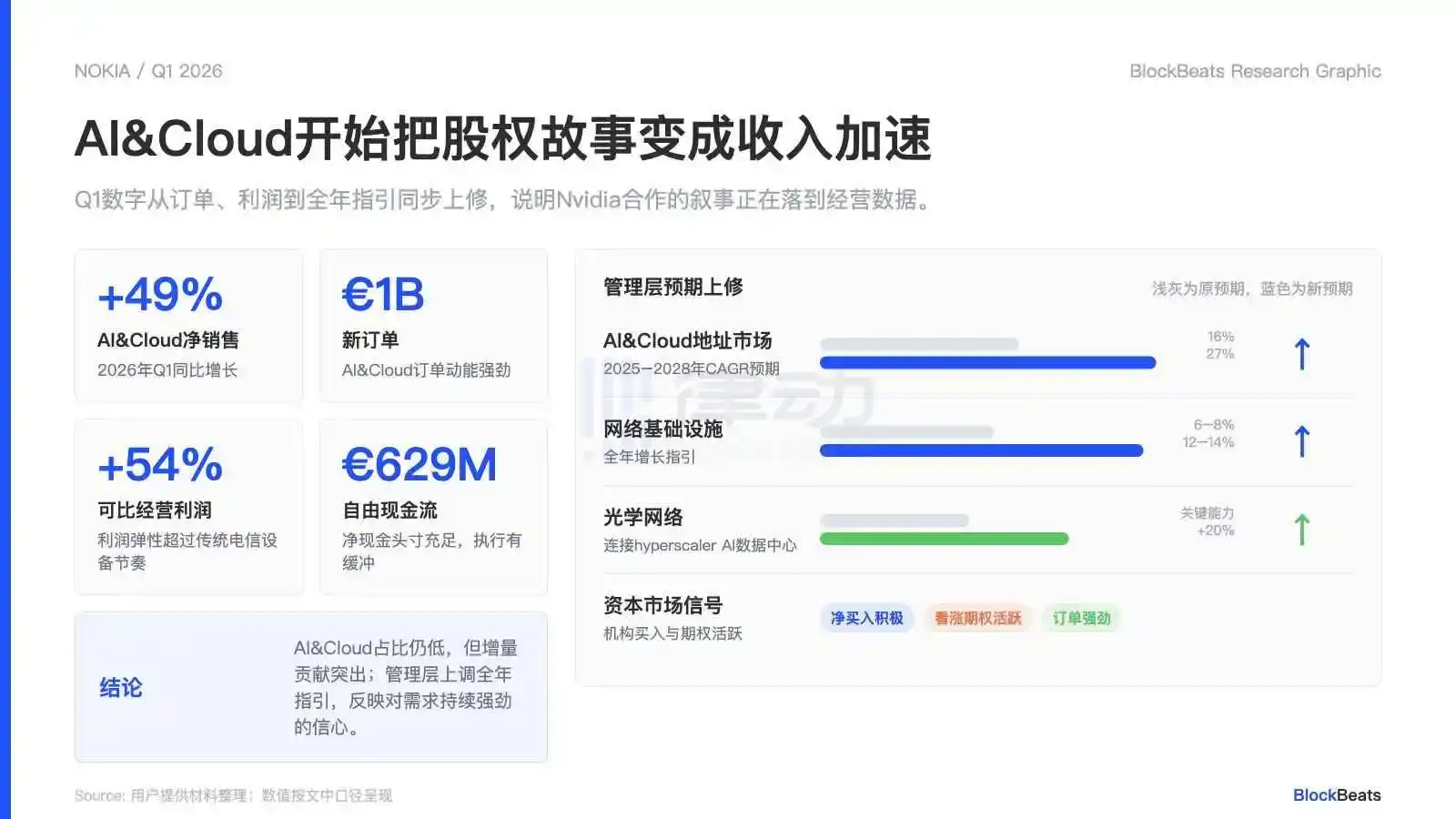
In the Q1 2026 earnings report, Nokia's AI&Cloud net sales increased by 49% year-over-year, securing €1 billion in new orders, with comparable operating profit surging by 54%. Consequently, the company raised its expected annual compound growth rate for the AI&Cloud addressable market from 16% to 27% for 2025-2028, and its full-year growth guidance for network infrastructure from 6-8% to 12-14%.

Optical network business grew by 20% during the same period, becoming a key part of connecting hyperscaler AI data centers. This capability was further strengthened following the acquisition of Infinera. New order intake is strong, free cash flow reached €629 million, and the net cash position is ample, providing a buffer for future execution.

These figures indicate that the cooperation with Nvidia is shifting from an equity story to visible revenue acceleration. Although AI&Cloud still represents a low proportion, its incremental contribution is prominent. The company's raised full-year guidance reflects management's confidence in sustained strong demand. Institutions have been net buyers over the past 12 months, and call option activity is higher than normal levels, further supporting this assessment.
MWC Tests and Innovation Lab Confirm Early Commercial Pathway

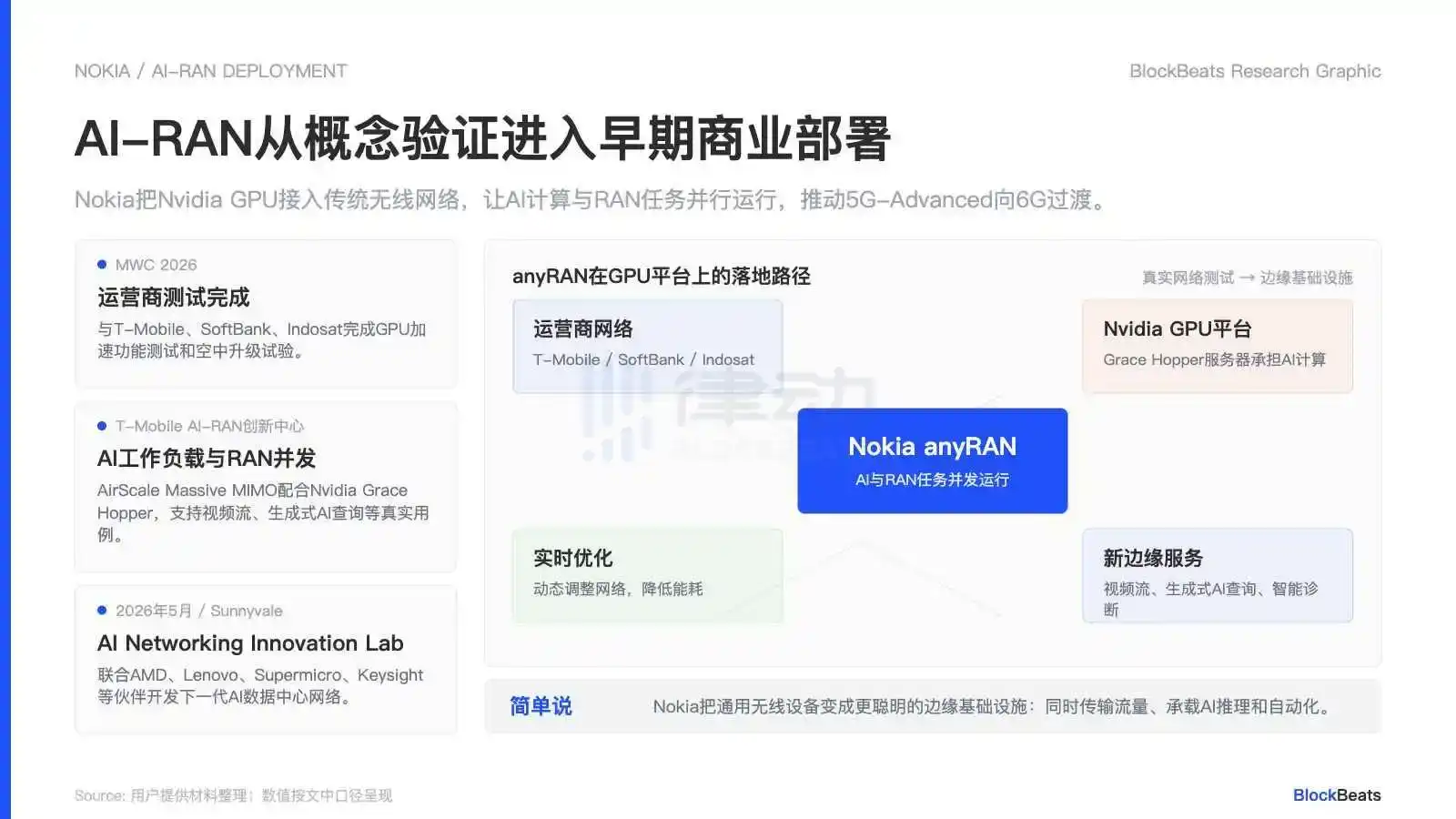
During MWC 2026, Nokia completed functional tests and over-the-air upgrade trials with operators like T-Mobile, SoftBank, and Indosat. At T-Mobile's AI-RAN Innovation Center, they used Nokia's AirScale Massive MIMO radio equipment alongside Nvidia Grace Hopper servers, successfully running AI workloads concurrently with RAN (Radio Access Network) tasks, supporting practical use cases like video streaming and generative AI queries.

In May 2026, Nokia opened the AI Networking Innovation Lab in Sunnyvale, California, collaborating with partners like AMD, Lenovo, Supermicro, and Keysight to develop next-generation AI data center networks. Concurrently, it introduced AI agent features for fixed broadband products, helping operators diagnose problems automatically, reduce costs, and accelerate fiber deployment.

These developments show that the acceleration path for Nokia's anyRAN software on Nvidia GPU platforms is now implementable. AI-RAN (using AI to optimize wireless access networks) is no longer just a concept but can deliver real-time optimization, reduce energy consumption, and generate new edge services within actual operator networks, providing a viable path for the transition from 5G-Advanced to 6G. Nokia CEO Justin Hotard stated that the cooperation is moving from validation to early commercial deployment.

Simply put, Nokia is applying Nvidia GPUs to traditional wireless network hardware, enabling AI computing and network transmission tasks to run in parallel. This allows for real-time network adjustments, saves power, and facilitates the development of new services. This approach turns general-purpose equipment into smarter edge infrastructure.
Deployment Scale Becomes the Biggest Constraint Under High Valuation

Although Q1 data, test results, and ecosystem partner expansion are relatively positive, the current P/E ratio is close to 100 times. Analyst consensus target prices are around €9.4-€12 (some investment banks have raised to around €12-€14), significantly lagging the current stock price. This indicates that the market has already priced in considerable optimism for long-term AI-RAN penetration and the 27% growth expectation, leaving a significantly compressed margin for error.

Over the next 12-24 months, the conversion speed of actual deployment contracts from major operators, the overall pace of AI capital expenditure, and differences in approach compared to Ericsson (which insists on independent ASICs, avoiding deep ties to a single GPU supplier) will become the core variables. If subsequent orders fall short of expectations or AI spending slows, the risk of a pullback will significantly increase.

Institutional net buying and bullish option preferences currently still support share price momentum, but these ultimately need to be validated by execution. Nokia's position as a representative AI edge infrastructure player has gained recognition, and the combination of optical networks with wireless access networks expands the overall market opportunity. However, there is a noticeable distance from current early orders to truly commercial deployment at hyperscaler scale.

It is still in the early acceleration phase, with overall execution signals being positive. However, the high valuation has already tightened the margin for error considerably. Investors should focus next on actual large-scale deployment progress rather than new demonstrations to gauge how much further this trend of AI expanding to the telecom edge can go.


Related Questions

QAccording to the article, why has Nokia's stock price experienced a significant revaluation recently?

ANokia's stock price has been revalued because the market is no longer viewing it just as a cyclical telecom equipment vendor, but as an AI network and edge infrastructure player. This shift was catalyzed by a strategic investment and AI-RAN collaboration with Nvidia, aligning with the trend of AI capital expenditure moving from core data centers into telecom edges and optical networks.

QWhat were the key performance highlights for Nokia's AI & Cloud business in Q1 2026?

AIn Q1 2026, Nokia's AI & Cloud business saw net sales grow by 49% year-over-year, secured 1 billion euros in new orders, and comparable operating profit increased by 54%. Due to this strong performance, the company raised its growth expectations for the AI & Cloud addressable market.

QWhat practical demonstrations at MWC 2026 validated Nokia's AI-RAN path?

AAt MWC 2026, Nokia conducted functional tests and over-the-air upgrade trials with operators like T-Mobile, SoftBank, and Indosat. A key test at T-Mobile's AI-RAN Innovation Center successfully ran AI workloads concurrently with RAN tasks using Nokia's AirScale Massive MIMO hardware and Nvidia Grace Hopper servers, supporting real use cases like video streaming and generative AI queries.

QWhat is a major constraint for Nokia's stock mentioned in the article, given its current valuation?

AA major constraint is the high valuation, with a trailing P/E close to 100x. This high valuation reflects significant market optimism upfront, leaving little room for error. The key variable now is the conversion speed of large-scale operator deployment contracts and the overall pace of AI capital expenditure over the next 12-24 months.

QHow does Nokia's strategic approach differ from its competitor Ericsson's according to the article?

ANokia's strategy involves a deep technical collaboration and equity investment from Nvidia, integrating Nvidia's GPU technology into its telecom hardware. In contrast, Ericsson is pursuing a more independent ASIC chip route, avoiding deep binding to a single GPU vendor like Nvidia.

Related Reads

Fei-Fei Li's Team Clarifies the Concept of 'World Models', Sora Merely a Renderer

"World Models" has become a widely used yet confusing term in AI. To address this, a team led by Fei-Fei Li and World Labs proposed a functional taxonomy based on the Partially Observable Markov Decision Process framework. This taxonomy categorizes systems called "world models" into three distinct projections: Renderers, Simulators, and Planners. Renderers, like OpenAI's Sora and other video generation models, focus on producing photorealistic visual outputs for human perception. They prioritize visual fidelity over physical accuracy. Simulators, such as NVIDIA Omniverse, aim to compute precise future environmental states for computational tasks like engineering analysis or digital twins. Planners, like Vision-Language-Action models, take in observations and goals to output executable actions for robots or agents. The article clarifies that most current "world models," including Sora, are primarily Renderers. They generate convincing visuals but lack the core ability to simulate state transitions based on actions, a key requirement for a true world model in classic reinforcement learning definitions. This conceptual confusion has practical implications, leading to potential misalignment in technology selection, investment, and public understanding of AI capabilities. Clear categorization is crucial. It helps enterprises avoid costly mistakes (e.g., using a renderer for robot training), allows investors to accurately assess markets, and enables researchers to build comparable benchmarks. While future systems may integrate these functions, recognizing current boundaries is essential for honest assessment and progress.

marsbit37m ago

Fei-Fei Li's Team Clarifies the Concept of 'World Models', Sora Merely a Renderer

marsbit37m ago

Bloomberg Uncovered: How Do China's Wealthy Circumvent the Annual $50,000 Limit to Transfer Assets?

**Summary: How Wealthy Chinese Circumvent $50,000 Annual Foreign Exchange Limits** Despite China's strict capital controls, including an annual $50,000 per person foreign exchange quota, an estimated $150 billion in funds still leaves the country annually via various gray and underground channels. This report outlines the evolution of China's "capital wall" and the methods used to bypass it. **The Evolving Capital Controls:** * **Foundation (1994):** The system of "current account convertibility with strict capital account controls" was established. * **Quota Set (2007):** The $50,000 individual annual forex purchase limit was formalized. * **Crackdown Begins (2015-2017):** Following market volatility, enforcement tightened. Banks were required to scrutinize transactions, and channels like using UnionPay cards for Hong Kong insurance premiums or buying overseas property were blocked. * **Digital & Legal Upgrades (2024-2026):** Enhanced algorithms now flag suspicious patterns (e.g., "smurfing"). The Common Reporting Standard (CRS) provides Chinese tax authorities with data on citizens' offshore accounts. Unlicensed cross-border brokers have been targeted. **Five Primary Methods for Moving Capital:** 1. **Underground Banking / "Hawala" (Duiqiao):** The largest-scale method. No money crosses borders. Clients pay RMB to a domestic account; an overseas associate deposits equivalent foreign currency into the client's offshore account. Risks include high fees, account freezes, and legal penalties. 2. **"Smurfing" or "Ant Moving":** Using multiple individuals' $50,000 quotas to pool funds for one offshore recipient. Increasingly detected by anti-money laundering algorithms. 3. **Trade Invoice Manipulation:** Businesses over-invoice imports or under-invoice exports via offshore shell companies, creating a pretext to transfer excess funds abroad under the guise of trade. 4. **Channel Migration:** After a crackdown on internet brokers, funds flow toward more compliant but costly channels like major banks' cross-border wealth management services or Qualified Domestic Institutional Investor (QDII) quotas. 5. **Structural Arrangements:** High-net-worth individuals use complex, high-cost legal structures involving offshore trusts, insurance, and investment migration programs to transfer asset ownership. **Regulatory Response: Focusing on People, Not Just Money** The current strategy extends oversight from enterprises to **individual residents**. Tools like CRS allow retroactive visibility into offshore assets. Cryptocurrencies, once seen as a potential loophole, are now actively monitored and prosecuted as an illegal channel. The underlying driver remains: with significant wealth concentrated among millions of affluent households seeking diversification amid domestic economic shifts, the incentive to move assets offshore persists despite regulatory barriers.

marsbit57m ago

Bloomberg Uncovered: How Do China's Wealthy Circumvent the Annual $50,000 Limit to Transfer Assets?

marsbit57m ago

Trading

Spot
Futures
活动图片




