Opinion: Most Tokenized Assets Are Still Traditional Finance Wrapped On-Chain

marsbitPublished on 2026-05-25Last updated on 2026-05-25

Abstract

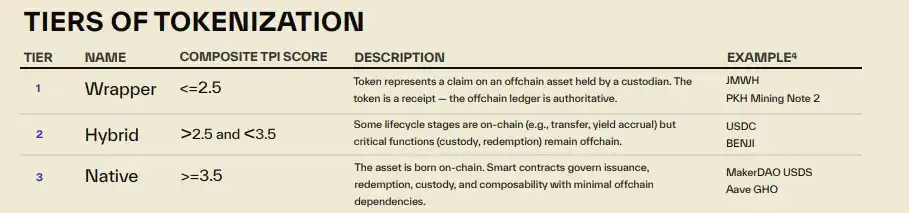
**Summary:** A market analysis reveals that the vast majority of tokenized assets remain mere "wrappers" for traditional finance on-chain. Of 593 surveyed assets, 77.6% are "Wrapped" assets where the token exists on-chain but key lifecycle functions (issuance, redemption, custody, access) remain off-chain. Only 11.1% are "Hybrid" assets, where some operational logic (transfers, settlement, yield accrual) is migrating on-chain, representing the true beginning of transformation. A mere 2.7% are "Native" assets built with a fully on-chain operational model. This explains why stablecoins feel structurally advanced compared to other RWA—they are true on-chain financial primitives, not just digitized traditional processes. The key future distinction won't be between tokenized and non-tokenized assets, but between those that are merely distributed on-chain and those that begin to *operate* on-chain.

Author: Yaroslav Writtle

Compiled by: Deep Tide TechFlow

Deep Tide Guide: The RWA sector has been discussed for so long, yet 77.6% of tokenized assets are still just "on-chain wrapping paper" — the token is on-chain, but issuance, redemption, and custody are entirely off-chain. What's truly worth attention are the 11.1% of "hybrid" assets, which are moving part of their lifecycle on-chain. This explains why stablecoins feel far ahead of other RWAs: they are genuine on-chain financial primitives, not just digital shells for traditional processes.

Market Size Growing Faster Than Market Maturity

An effective way to understand this market is not to look at whether it's tokenized or not.

Instead, look at:

  • Wrapped
  • Hybrid
  • Native

A 2026 market survey covering 593 tokenized assets showed that 460 assets, or 77.6%, were still classified as wrapped. Only 66 assets, or 11.1%, were hybrid, and a mere 16 assets, or 2.7%, had reached a native state.

This is the true shape of the market.

Wrapped Remains the Default Form
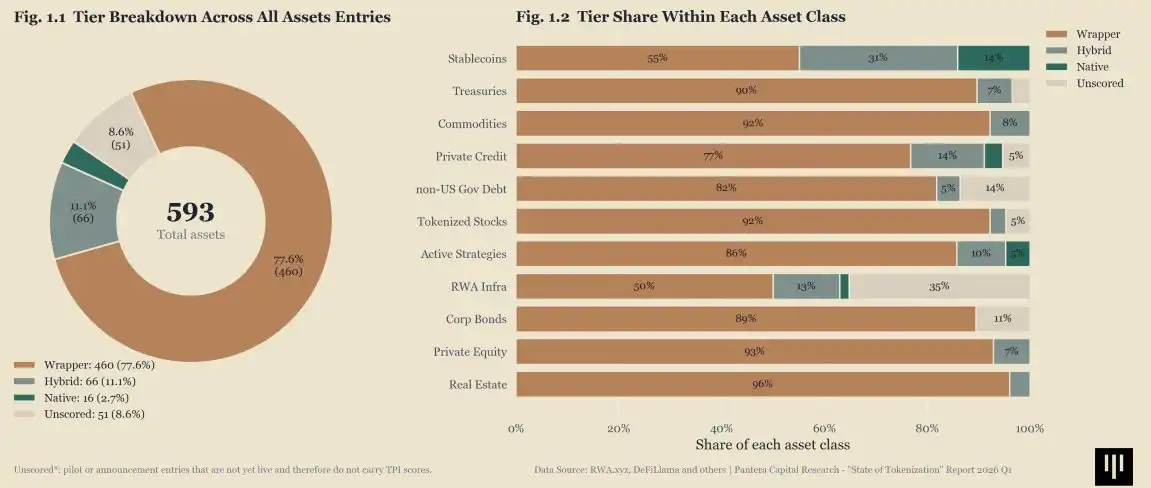
Most tokenized assets improve distribution, not infrastructure.

The token exists on-chain.

Most of its lifecycle does not.

Issuance, redemption, custody, transfer permissions, pricing, and investor access still heavily rely on off-chain systems.

So surface growth may be real, but on-chain autonomy remains low.

Hybrid Is Where Real Transformation Begins

Hybrid is the part of the market worth watching.

This is where certain parts of the lifecycle begin migrating on-chain:

  • Transfer logic
  • Settlement processes
  • Yield accrual
  • Partial compliance or access controls

Not fully native.

But no longer just wrapping paper.

This middle category is still small, which is why the market feels like it's moving faster than it actually is.

Native Is Rare for a Reason

Native assets are rare because the bar is high.

To reach that level, it's not just about the token being on-chain.

The operating model must also be on-chain.

This includes:

  • Issuance and redemption
  • Transfer execution
  • Custody assumptions
  • Composability with other systems

Very few assets truly meet this standard today.

Stablecoins Still Feel Ahead of Other Assets

This also helps explain why stablecoins still feel structurally ahead of most RWAs.
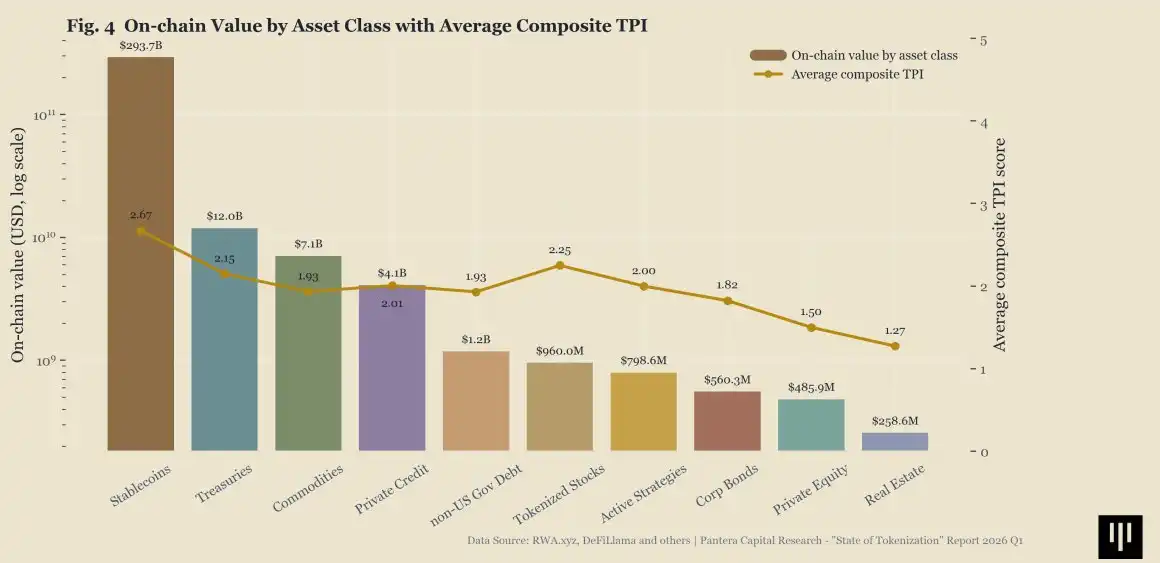
They are closer to being true on-chain financial primitives.

Many other tokenized assets still resemble digital wrapping paper for traditional processes, rather than assets that genuinely operate within an on-chain financial system.

What Matters Next

The market doesn't need more proof that assets can be tokenized.

A more useful question now is: which parts of the lifecycle have truly migrated along with it?

This is where the next round of differentiation will occur.

Not between tokenized and non-tokenized.

But between assets that are still distributed on-chain, and assets that are beginning to operate on-chain.


Related Questions

QAccording to the article, what percentage of tokenized assets are considered 'wrapped' and what does this category mean?

A77.6% of tokenized assets are considered 'wrapped'. This means the token exists on-chain, but key lifecycle functions like issuance, redemption, custody, transfer permissions, pricing, and investor access remain heavily dependent on off-chain systems.

QWhat is the 'hybrid' category of tokenized assets, and why does the article suggest it's the important one to watch?

AThe 'hybrid' category refers to assets where some parts of their lifecycle, like transfer logic, settlement, yield accrual, or compliance controls, are beginning to move on-chain. The article suggests this is the important category because it represents the real start of infrastructure transformation, moving beyond just being a digital wrapper for traditional processes.

QWhy are truly 'native' on-chain assets still so rare according to the analysis?

ATruly 'native' on-chain assets are rare because the bar is very high. It requires not just the token to be on-chain, but the entire operational model—including issuance, redemption, transfer execution, custody assumptions, and composability with other systems—to be fundamentally built on-chain.

QHow does the article explain the perceived structural lead of stablecoins over most other Real World Assets (RWAs)?

AThe article explains that stablecoins feel structurally ahead because they are closer to being genuine on-chain financial primitives. In contrast, many other tokenized RWAs still resemble digital wrappers for traditional financial processes, not assets operating within an on-chain financial system.

QWhat does the article propose as the key question for the next phase of development in tokenized assets?

AThe article proposes that the key question is no longer whether assets can be put on-chain, but which parts of their lifecycle are genuinely migrating on-chain. The next phase of differentiation will occur between assets that are merely distributed on-chain and those that are beginning to operate on-chain.

Related Reads

CPU, Quietly Returning to the Center of the AI Computing Power Stage

Over the past three years, AI computing power narratives have been dominated by GPUs. However, starting in 2026, this story began to shift. While training large models remains GPU-intensive, the rapid growth of inference and AI agent workloads, which require high levels of task orchestration, concurrency, and data flow management, has highlighted a renewed critical role for CPUs. These are tasks GPUs are not designed to handle. Intel's recent launch of the Xeon 6+ processor, built on its Intel 18A process and featuring up to 288 efficiency cores (E-cores), exemplifies this strategic pivot. It is positioned not as a mere companion to GPUs but as the essential "control plane" for AI infrastructure, optimized for high-density, energy-efficient, and high-throughput workloads characteristic of AI agents and inference. This "CPU resurgence" is not about CPUs outperforming GPUs in raw computation. It reflects a systemic bottleneck: as AI scales from training single models to deploying countless intelligent agents, the demand for coordination and data handling surges. Major cloud providers are also developing their own high-density ARM-based server CPUs for similar workloads. However, Intel's success with this strategy faces significant challenges. Competition includes NVIDIA's integrated CPU-GPU solutions, the expanding adoption of cloud vendors' in-house ARM CPUs, and the crucial market test of Intel's 18A manufacturing process against rivals like TSMC's N2. In conclusion, CPUs are indeed reclaiming a central, though redefined, role in AI compute—managing the complex orchestration that enables massive-scale AI deployment. While the trend is clear, which company will ultimately lead this CPU resurgence remains an open question to be decided in the data centers of 2027 and beyond.

marsbit13m ago

CPU, Quietly Returning to the Center of the AI Computing Power Stage

marsbit13m ago

After Collaborating with 35+ DeFi Projects, Pink Brains Discovers the New 2026 KOL Marketing Rules

After collaborating with over 35 leading DeFi projects on marketing over three years, Pink Brains identifies a key shift for effective marketing in 2026: prioritizing the user journey over traditional campaign tactics. The most effective marketing mirrors how users actually behave—starting with discovery on social platforms like X (formerly Twitter), followed by data-driven verification on sites like DefiLlama, and finally, participation with small test funds. Success hinges on genuine, verifiable mechanisms, not just marketing hype. Current user interest centers on several key themes: new DeFi trends (RWA, perps, crypto x AI), meaningful airdrops requiring real contributions, real yield from protocol revenue, and tokens with value capture mechanisms directly tied to product usage. Case studies like Hyperliquid's HYPE (with its aggressive buyback program) and Venice's VVV (linking demand to AI compute) exemplify how strong tokenomics foster user retention. New trading venues like prediction markets, collectibles platforms, and GambleFi are also gaining traction, driven by verifiable activity. The article outlines common mistakes in DeFi KOL marketing, such as using creators unfamiliar with the product, generic messaging, or relying on a few top-tier KOLs. Instead, effective strategies align with different KOL types—educators, content creators, airdrop hunters, and niche experts—for various stages of the user journey. Ultimately, long-term user retention depends on a combination of a genuinely useful product, responsive support, community-aligned tokenomics, and strategic community building. The core takeaway is that sustainable growth stems from products whose value is validated by data and real-world utility, not just promotional efforts.

marsbit31m ago

After Collaborating with 35+ DeFi Projects, Pink Brains Discovers the New 2026 KOL Marketing Rules

marsbit31m ago

Trading

Spot
Futures
活动图片