Opinion Almost Entirely Flipped, Airdrop Value Less Than Platform Fee Revenue?

Odaily星球日报Published on 2026-03-05Last updated on 2026-03-05

Abstract

Opinion, a prediction market platform once hailed as one of the most anticipated airdrops of 2026, has sparked significant community backlash following its Token Generation Event (TGE). Despite raising over $25 million from top VCs and being deeply integrated with the Binance ecosystem, the project repeatedly delayed its TGE, causing its points' OTC value to drop from a peak of $45 to around $6. The controversy intensified when the tokenomics were revealed: only 3.5% of the airdropped tokens (23.5% of total supply) were unlocked at TGE, with the rest vested over 7 months. In contrast, the marketing allocation saw 7.7% unlocked immediately. This, combined with large allocations to investors, team, and advisors (totaling over 54%), angered early users who had paid high transaction fees to earn points. Many users reported losses, with one notable example being an investment of $200,000 yielding only around $1,000 worth of tokens at launch. Ironically, the platform’s cumulative fee revenue exceeded $17 million, surpassing the initial airdrop’s value. As a result, user activity and TVL plummeted, raising questions about the future of prediction markets on BNB Chain.

Original | Odaily Planet Daily (@OdailyChina)

Author | Asher(@Asher_ 0210)

TGE Repeatedly Delayed, Leading to a Continuous Drop in OTC Points Price

Another $20 Million Funding Round in February Made Opinion One of the Most Anticipated Airdrops of 2026

The rising narrative around prediction markets garnered significant attention for Opinion even before its TGE. Combined with top-tier VC backing and deep integration with the Binance ecosystem, the market once regarded it as one of the most anticipated airdrop projects of 2026.

In terms of funding, Opinion completed two rounds, raising over $25 million in total. In March 2024, the project was selected for the 7th season of Yzi Labs' MVB accelerator program, becoming one of 13 early-stage projects. In March 2025, Opinion completed a $5 million seed round led by Yzi Labs, with participation from Echo, Animoca Ventures, Manifold Trading, Amber Group, and others. By February 2026, Opinion announced another $20 million Pre-Series A funding round, co-led by Hack VC and Jump Crypto, with participation from Primitive Ventures, Decasonic, Continue Fund, and others.

Continuous support from several leading institutions led to higher market expectations for the airdrop scale and potential valuation.

TGE Was Originally Scheduled Before Chinese New Year But Repeatedly Postponed Due to Market Conditions

In December 2025, Opinion founder Forrest stated in the official Discord that the project's TGE was expected before the Chinese New Year. This quickly ignited community sentiment, with many users starting to "work overtime" to farm points and frequently participate in various prediction events to boost trading volume. As point farming became more competitive, some users' farming costs even exceeded $20 per point, all to accumulate more points before the TGE, hoping to snag the first "big airdrop" of 2026.
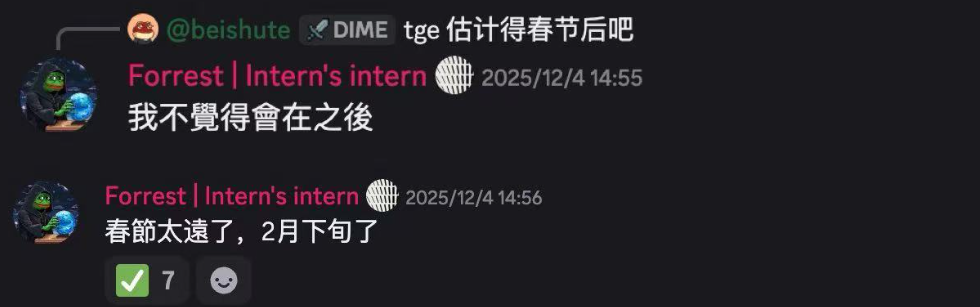
Opinion founder previously stated TGE would occur before Chinese New Year

However, entering February, the overall crypto market experienced a significant correction, and Opinion's TGE timeline became uncertain. The TGE, originally anticipated before the New Year, had no news, causing market expectations for the points to cool. Although Binance launched the Opinion-related Binance Wallet Booster and Alpha airdrop activities on February 4th, the official team still did not announce a clear TGE schedule. As expectations gradually cooled, the OTC price of Opinion points also fell from a high of about $45 per point to around $20 per point.

As the TGE was repeatedly delayed, community sentiment gradually turned negative. Some users began questioning the project's progress in community groups, but in the official Discord, any obvious negative comments often led to the swift removal of the involved members. Some dissatisfied users even went to other prediction market project communities, such as predict.fun, to continue venting their frustrations about Opinion's various issues.
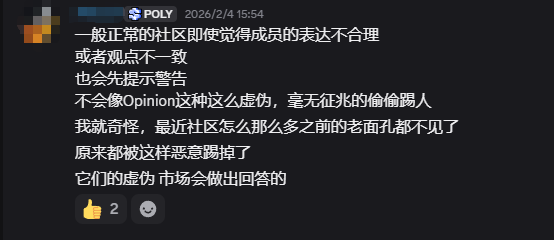
Opinion community members complaining in other prediction market project communities

Repeated TGE delays, continuous point dilution, and arbitrary kicking of members from the official community led to accumulating dissatisfaction within the Opinion community. Points kept increasing, fees kept being paid, but the answers to when the project would TGE and what it would ultimately be worth became increasingly elusive.

Airdrop Allocation Sparks Controversy: Only 3.5% of TGE Airdrop Unlocked, Marketing Allocation Unlocks a High 7.7%

After Tokenomics Revealed, Point Price Plunged to $6

On the evening of March 2nd, the Opinion Foundation officially announced the tokenomics of its native token OPN. The total supply of OPN is 1 billion tokens, with the airdrop accounting for 23.5% (235 million tokens). At first glance, this proportion is not low compared to current crypto projects.

However, the actual unlock ratio at TGE sparked controversy. Of the total airdrop allocation, only 3.5% (35 million tokens) were released on TGE day, with the remaining portion to be linearly released over 7 months. This means that for the vast majority of users who farmed points for the airdrop, the number of tokens actually received on TGE day was far lower than previous market expectations.

What further displeased the community was the unlock ratio of other allocation parts. According to the official token distribution, the Marketing portion accounts for 8.9%, but 7.7% is released at TGE, significantly higher than the airdrop release ratio. In comparison, users who participated in early interactions and contributed trading volume only received 3.5% at TGE.

This comparison quickly sparked controversy within the community—early interactive users contributing trading volume received a minimal share at TGE, while the related marketing share received a higher proportion of unlocks at launch. Simultaneously, Binance Launchpool directly received 2% of the token supply, further intensifying community dissatisfaction.

At the same time, the internal holding比例 further exacerbated community discontent. According to the token distribution, investors account for 23%, the team and advisors account for 19.5%, and the foundation accounts for 12%, totaling over 54%.
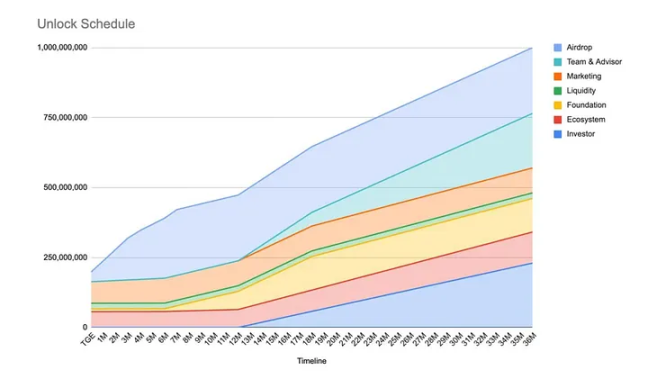
OPN Token Unlock Schedule

After the tokenomics were announced, market expectations quickly changed. Prior to this, OPN points were once quoted at $45 per point on the secondary market. With only 3.5% being airdropped at TGE, the OTC price of Opinion points plummeted, with pre-market quotes quickly falling to $6 per point.

Furthermore, many "airdrop farming whales" spent real money on fees to farm points, only to be flagged as Sybils. According to feedback data from community members, 1 point ultimately corresponded to $6, but many users with high point rankings received an airdrop value even lower than this. KOL Daidaidai Bitcoin posted his loss details on platform X: invested $200,000 to farm points,最终 received 2000 OPN, worth about $1000 at current prices. "200k USD for 2000 tokens. Yes, you read that right." This phrase quickly went viral in the Chinese crypto community.

What the community found even more ironic was that according to Dune data, Opinion's cumulative revenue from trading fees over the past months has exceeded $17 million. Calculated at current market prices, the TGE airdrop value is even lower than this figure.
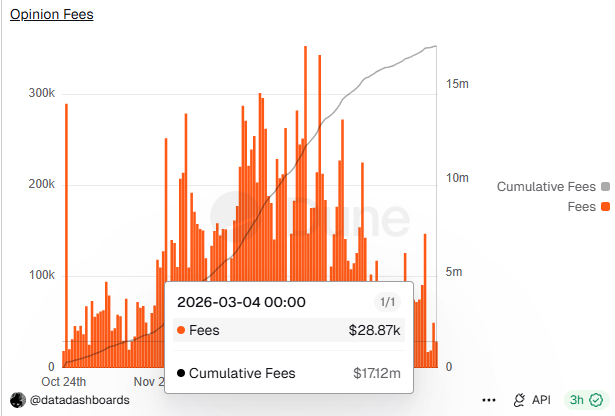
Opinion's cumulative fee revenue exceeds $17 million

Summary

From "the most anticipated airdrop of 2026" to being joked about by the community as "almost entirely flipped," Opinion's plot twist took only a few months. Although Opinion founder Forrest recently stated that more emphasis would be placed on Season 2 rewards, for many early participants, the Season 1 airdrop result has severely透支 trust.
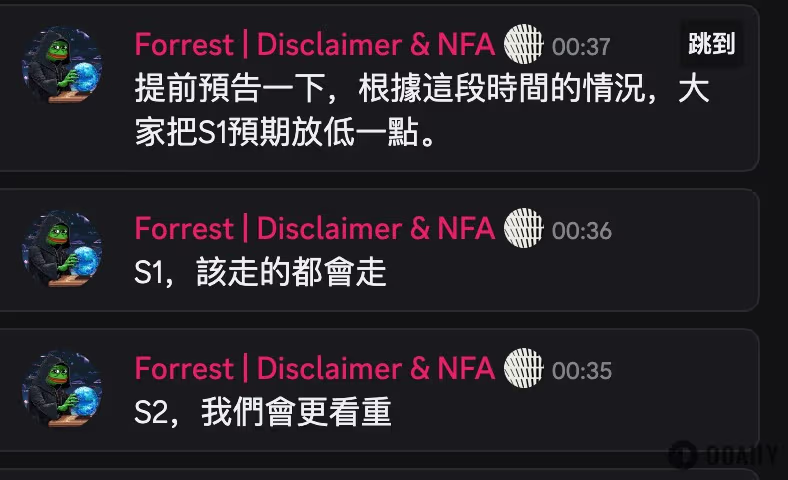
Opinion founder emphasizes greater focus on S2 rewards

This sentiment was quickly reflected in user behavior. More and more participants chose to reduce or even stop trading on the platform, and on-chain data showed a significant subsequent decline. Platform TVL plummeted from about $150 million to $36 million, and trading volume dropped from $150 million to about $15 million, indicating a clear cooling off in user activity.

Against this backdrop, the controversy surrounding Opinion is more than just an airdrop incident. As one of the most watched prediction market projects in the BNB Chain ecosystem, this event has also had a significant impact on the entire sector.

After this storm, can the BNB Chain ecosystem still produce new prediction market platforms?

Related Questions

QWhat was the main reason for the community's disappointment with Opinion's airdrop?

AThe main reason was the extremely low initial unlock of the airdrop allocation. Only 3.5% of the total airdropped tokens (23.5% of total supply) were distributed at TGE, while a much higher percentage (7.7%) of the marketing allocation was unlocked immediately.

QHow did the delay of the TGE (Token Generation Event) impact the perceived value of Opinion's points?

AThe repeated delays of the TGE caused the OTC (Over-The-Counter) price of Opinion points to plummet, falling from a high of approximately $45 per point to around $6 per point after the tokenomics were revealed.

QAccording to the article, what was the total amount of fees that the Opinion platform generated from user transactions?

AAccording to Dune data cited in the article, the Opinion platform accumulated over $17 million in revenue from transaction fees.

QWhat drastic change in user activity did Opinion experience following the airdrop controversy?

AUser activity dropped significantly. The platform's TVL (Total Value Locked) plummeted from about $150 million to $36 million, and its trading volume fell from $150 million to approximately $15 million.

QWhat was the total supply of OPN tokens and what percentage was allocated to the airdrop?

AThe total supply of OPN tokens was 1 billion. The airdrop allocation was 23.5% of the total supply, which equals 235 million tokens.

Related Reads

The AI Agent Era Accelerates Its Arrival: Questflow Defines a New Paradigm of Financial Intelligence with On-Chain AI Brokerage

The AI Agent era is accelerating, with the CB Insights AI 100 list highlighting global investment confidence. The focus has shifted from whether AI works to its speed of deployment and ability to manage complex workflows, with autonomous AI Agents driving this transformation. At the forefront is Questflow, a Singapore-based startup redefining financial intelligence through its on-chain AI brokerage. Unlike tools that merely provide data dashboards, Questflow deploys AI Agents that proactively scan markets, form judgments, and execute trades via a conversational interface—operating 24/7 without requiring manual confirmation for each decision. This embodies the new AI paradigm of agents capable of executing multi-step workflows autonomously. Questflow's mission is to democratize institutional-grade trading intelligence. Historically reserved for the ultra-wealthy, this capability is now accessible starting from just $1 through Questflow's "AI Clone + Copy Trade" model. The platform charges only a 1% execution fee, aligning its incentives directly with users and eliminating traditional management or performance fees. The timing is opportune, aligning with key trends identified by CB Insights: the scalable deployment of AI Agents, accelerated AI adoption in financial services, and the maturation of on-chain infrastructure. With robust liquidity on platforms like Hyperliquid and Polymarket, alongside advancements in AI reasoning and non-custodial wallet security, Questflow is positioned to merge the roles of broker, fund, and exchange into a single, accessible platform for millions.

链捕手14m ago

The AI Agent Era Accelerates Its Arrival: Questflow Defines a New Paradigm of Financial Intelligence with On-Chain AI Brokerage

链捕手14m ago

Why Pricing Social Interactions is Doomed to Fail?

Titled "Why Putting a Price on Social Interaction Is Doomed to Fail," this article critiques attempts to monetize social networks directly through SocialFi models, arguing their inevitable failure stems from a fundamental misunderstanding of media dynamics. Using Marshall McLuhan's theory of "hot" and "cold" media, the author posits that social networks are inherently "cold" media. Their value isn't contained in individual posts but is co-created through user participation, interpretation, and fragmented, ongoing interaction (e.g., replies, shares). This ambiguity and need for user involvement are core to their function. The article asserts that SocialFi projects like Friend.tech failed because introducing real-time, tradable financial pricing (a definitive "hot" signal) into this "cold" environment doesn't add a layer—it replaces the medium's essence. The unambiguous price signal overshadows and nullifies the nuanced, participatory social signal. Users become traders, not participants, and when speculative profits vanish, the underlying social ecosystem—never genuinely cultivated—collapses entirely. This principle extends beyond crypto. The author argues platforms like Twitter have gradually "heated up" through metrics (likes, retweets counts, algorithmically defined value), shifting users from participants to performers and eroding organic engagement. The solution isn't to abandon capital but to manage its entry point. Successful models like Substack, Patreon, or Bandcamp allow capital to "condense" at specific, isolated nodes (e.g., subscriptions, one-time payments) without permeating and "heating" every social interaction. They preserve the core "cold," participatory medium while enabling monetization at designated boundaries. The NFT boom and bust serves as a stark parallel: the ancient "cold" medium of collecting (valued for story, community, gradual accumulation) was rapidly destroyed by platforms that introduced real-time floor prices, rarity scores, and trading dashboards, transforming collectors into speculators and vaporizing cultural value when prices fell. The core lesson: "Liquidity equals heat." Injecting high liquidity and definitive pricing into a "cold" participatory medium doesn't optimize it; it fundamentally alters and destroys its value-creating mechanism. The future lies not in pricing every social gesture but in finding precise, non-invasive points for capital to condense without overheating the entire ecosystem.

marsbit22m ago

Why Pricing Social Interactions is Doomed to Fail?

marsbit22m ago

Jensen Huang's CMU Speech: In the AI Era, Don't Just Watch, Build

Jensen Huang, CEO of NVIDIA and a first-generation immigrant, delivered the commencement address to Carnegie Mellon University's class of 2026. He shared his personal journey from a humble background to founding NVIDIA, emphasizing resilience, learning from failure, and the responsibility that comes with leadership. Huang framed the present moment as the dawn of the AI revolution, a shift he believes is more profound than previous computing waves. He described AI as fundamentally resetting computing—moving from human-written software to machines that understand, reason, and use tools. This will create a new industry for generating intelligence and transform every sector. While acknowledging AI's potential to automate tasks and displace some jobs, Huang distinguished between the *tasks* of a job and its core *purpose*. He argued AI will augment human capability, not replace humans. The real risk, he stated, is not AI itself, but people being left behind by those who effectively use AI. He presented AI as a generational opportunity for massive infrastructure investment—in chip factories, data centers, energy grids, and advanced manufacturing—that could re-industrialize nations like the U.S. and bridge the digital divide by making computing and intelligent tools accessible to all. Huang called for a balanced approach: advancing AI safely and responsibly, establishing prudent policies, ensuring broad access, and encouraging universal participation. He urged the graduates not to fear the future but to engage with optimism and ambition, reminding them of CMU's motto, "My heart is in the work." His core message was clear: this is their moment to actively build and shape the AI-powered future, not merely observe it.

marsbit1h ago

Jensen Huang's CMU Speech: In the AI Era, Don't Just Watch, Build

marsbit1h ago

Trading

Spot
Futures
活动图片





