OpenAI's Partnership with U.S. Department of Defense Sparks 300% Surge in ChatGPT Uninstallations on Announcement Day

marsbitPublished on 2026-03-04Last updated on 2026-03-04

Abstract

On February 28th, the number of ChatGPT app uninstalls by U.S. users surged by 295% compared to the previous day, following the announcement of OpenAI's partnership with the U.S. Department of Defense (referred to as the "Department of War" during the Trump administration). Data from Sensor Tower indicates this was a significant deviation from ChatGPT’s average 30-day uninstall rate of 9%. In contrast, downloads of Claude, the AI app from OpenAI competitor Anthropic, increased by 51% on the same day. This shift in user behavior is attributed to Anthropic’s public refusal to collaborate with the Defense Department due to ethical concerns, including potential use of AI for citizen monitoring and autonomous weapons. ChatGPT’s download numbers fell by 13% on Saturday and a further 5% on Sunday. User sentiment was reflected in app reviews, with 1-star ratings for ChatGPT increasing by 775% on Saturday. Meanwhile, Claude rose to the top of the U.S. App Store’s free apps chart and also led charts in several other countries. Data from Appfigures and Similarweb corroborated these trends, noting Claude’s rapid growth in the U.S. and internationally.

Author: TechCrunch / Sensor Tower

Compiled by: Deep Tide TechFlow

Deep Tide Insight: News of OpenAI's collaboration with the U.S. Department of Defense (renamed the "Department of War" under the Trump administration) has triggered strong backlash among users.

Meanwhile, Anthropic gained user trust by refusing to cooperate, with Claude's daily downloads surging and topping the App Store. This data directly quantify the practical impact of AI ethics stances on user behavior.

Full Text:

On February 28 (Saturday), the number of U.S. users uninstalling the ChatGPT mobile app increased by 295% compared to the previous day. This reaction was directly triggered by the news of OpenAI's partnership with the U.S. Department of Defense (DoD)—a department renamed the "Department of War" during the Trump administration.

This data comes from market research firm Sensor Tower. Compared to ChatGPT's average 9% daily uninstallation rate over the past 30 days, the 295% single-day spike is a significant anomaly.

At the same time, downloads of Claude, developed by OpenAI's competitor Anthropic, saw a reverse trend in the U.S. On February 27 (Friday), downloads increased by 37% compared to the previous day, and on February 28 (Saturday), they rose by another 51%. Earlier, Anthropic announced its refusal to collaborate with the U.S. Department of Defense, citing an inability to agree on terms—Anthropic expressed concerns that AI would be used for surveilling U.S. citizens and deployed in fully autonomous weapon systems lacking safety capabilities.

The data indicates that a significant portion of users support Anthropic's stance on this issue.

ChatGPT's download numbers were also affected. On the Saturday following the announcement of the partnership, its U.S. downloads decreased by 13% compared to the previous day. The decline continued into Sunday, with another 5% drop. In contrast, on the Friday before the announcement, the app had recorded a 14% day-over-day growth in downloads.

These rapid changes were also reflected in Claude's App Store ranking. On Saturday, Claude climbed to the top of the U.S. App Store's free app chart, maintaining this position as of March 2 (Monday). This represents a rise of over 20 spots compared to about a week earlier (February 22, 2026).

Users also expressed their opinions on OpenAI's decision through app ratings. Sensor Tower data shows that on Saturday, the number of 1-star reviews for ChatGPT surged by 775%, with a further 100% increase on Sunday. Meanwhile, 5-star reviews decreased by 50% during the same period.

Other third-party data providers corroborated Sensor Tower's findings.

For example, Appfigures noted that on Saturday, Claude's total daily downloads in the U.S. surpassed ChatGPT's for the first time. The agency also observed an increase in Claude's U.S. downloads, though its estimates were higher: an 88% day-over-day increase on Saturday.
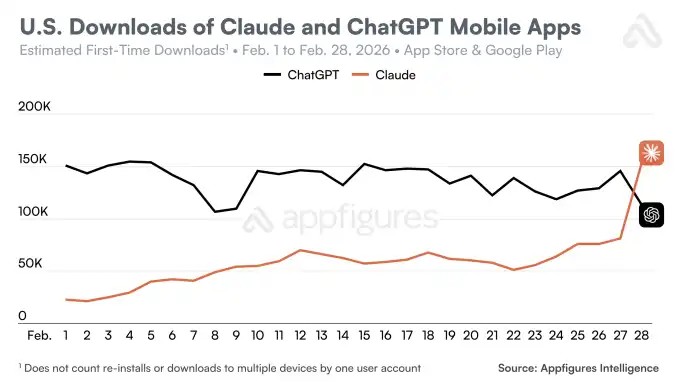
Appfigures also noted that Claude has now topped the free iPhone app charts in six countries outside the U.S., including Belgium, Canada, Germany, Luxembourg, Norway, and Switzerland.

A third market research firm, Similarweb, reported that Claude's U.S. downloads over the past week were approximately 20 times higher than in January. However, the agency cautioned that this may not be entirely due to political factors and could involve other reasons.


Related Questions

QWhat was the 295% surge in ChatGPT mobile uninstallations on February 28th a direct reaction to?

AThe 295% surge in ChatGPT mobile uninstallations on February 28th was a direct reaction to the news of OpenAI signing a cooperation agreement with the U.S. Department of Defense (DoD).

QWhich competitor's app saw a significant increase in downloads and topped the U.S. App Store charts following its refusal to work with the Department of Defense?

AAnthropic's Claude app saw a significant increase in downloads and topped the U.S. App Store charts after it announced its refusal to cooperate with the Department of Defense.

QWhat were Anthropic's stated reasons for refusing to cooperate with the U.S. Department of Defense?

AAnthropic refused to cooperate due to concerns that AI would be used for surveillance of U.S. citizens and for fully autonomous weapon systems that do not yet have safety capabilities.

QHow did the user ratings for ChatGPT change, specifically the number of 1-star and 5-star reviews, after the news of the DoD partnership?

AAfter the news, the number of 1-star reviews for ChatGPT surged by 775% on Saturday and increased by another 100% on Sunday, while 5-star reviews decreased by 50% during the same period.

QAccording to the data, in how many countries outside the U.S. did Claude's app top the free iPhone application chart?

AClaude's app topped the free iPhone application chart in six countries outside the U.S.: Belgium, Canada, Germany, Luxembourg, Norway, and Switzerland.

Related Reads

Can Generative Models Finally Be Trained End-to-End? The Core Is a For Loop

This article introduces a novel training paradigm for generative models called Explorative Modeling (XM), which enables true end-to-end training. Traditionally, powerful generative models like autoregressive and diffusion models are not trained end-to-end. They are trained to predict a single small step but require iterative multi-step sampling for inference. This "exposure bias" leads to error accumulation and limits performance. The core challenge XM addresses is "mode blurring." In generative tasks, a single input (e.g., "generate a dog") corresponds to many valid outputs (multiple modes). Standard training objectives like reconstruction loss force the model to average these modes, producing unrealistic, blurry outputs. To avoid this, existing models break generation into many small, almost deterministic steps, sacrificing end-to-end training. XM tackles this by restructuring the training loop itself. Its key insight is to amplify "generative expressivity." For each training input, instead of generating one sample, the model generates K candidate outputs. Only the candidate closest to the real data is used for computing the loss and updating the model via backpropagation. This simple "best-of-K" mechanism is implemented as a short for-loop. By exploring multiple possibilities, the model learns to distribute its guesses across different modes rather than collapsing to their uninformative average. The paper demonstrates that "exploration" acts as a new, powerful scaling axis. Gains from XM increase with model size, data scale, and compute. Experiments show improvements in FID scores for image generation and significant efficiency gains, sometimes outperforming larger models without exploration. When pushed to the limit, XM enables fully single-step, end-to-end generative models. In robotics tasks, an "Explorative Policy" matched the performance of a 100-step Diffusion Policy with a single forward pass, drastically improving inference speed. While the best-of-K concept is not entirely new, the authors' contribution lies in formally understanding it as a direct method to boost generative expressivity without fragmenting the generation process. This work suggests that as models scale, enhancing exploration during training may become crucial for overcoming fundamental performance bottlenecks.

marsbit50m ago

Can Generative Models Finally Be Trained End-to-End? The Core Is a For Loop

marsbit50m ago

Annual Salary of Millions Competing for Electricians, Meta Rushes to Open Its Own Technical School

The AI boom is facing an unexpected bottleneck: a severe shortage of skilled construction workers and electricians. As tech giants like Meta, OpenAI, and Alphabet race to build massive data centers—such as OpenAI's $16 billion "Stargate" project—they are hitting a critical labor wall. The U.S. needs an estimated 130,000 more electricians, 240,000 construction workers, and 150,000 supervisors by 2030 for AI infrastructure alone, but tens of thousands of electrician jobs go unfilled each year. While AI companies offer high premiums, with electricians earning up to $280,000 annually, worker scarcity still causes massive losses—delays on a single project can cost $14.2 million per month. The complexity of building AI data centers, which require immense power (equivalent to powering hundreds of thousands of homes), sophisticated electrical systems, and advanced liquid cooling solutions, demands highly skilled technicians who are in short supply. To combat this, companies are investing heavily in training. Meta has committed $115 million to a free training school offering tuition, housing, and stipends, targeting 5,000 new workers. OpenAI is partnering with unions to secure skilled labor. These efforts are paying off, with a significant rise in Gen Z interest in trade schools over college. However, the power demands are staggering. AI data centers are driving a rapid surge in electricity consumption, projected to account for up to 12% of U.S. power use by 2028 and raising costs for consumers. Furthermore, the construction boom is project-based, leading to a potential future glut of trained workers once building peaks, which could depress wages industry-wide. The race for AI supremacy now depends as much on skilled hands as on advanced chips.

marsbit2h ago

Annual Salary of Millions Competing for Electricians, Meta Rushes to Open Its Own Technical School

marsbit2h ago

Trading

Spot
活动图片