OpenAI's Partnership with U.S. Department of Defense Sparks 300% Surge in ChatGPT Uninstallations on Announcement Day

marsbitPublished on 2026-03-04Last updated on 2026-03-04

Abstract

On February 28th, the number of ChatGPT app uninstalls by U.S. users surged by 295% compared to the previous day, following the announcement of OpenAI's partnership with the U.S. Department of Defense (referred to as the "Department of War" during the Trump administration). Data from Sensor Tower indicates this was a significant deviation from ChatGPT’s average 30-day uninstall rate of 9%. In contrast, downloads of Claude, the AI app from OpenAI competitor Anthropic, increased by 51% on the same day. This shift in user behavior is attributed to Anthropic’s public refusal to collaborate with the Defense Department due to ethical concerns, including potential use of AI for citizen monitoring and autonomous weapons. ChatGPT’s download numbers fell by 13% on Saturday and a further 5% on Sunday. User sentiment was reflected in app reviews, with 1-star ratings for ChatGPT increasing by 775% on Saturday. Meanwhile, Claude rose to the top of the U.S. App Store’s free apps chart and also led charts in several other countries. Data from Appfigures and Similarweb corroborated these trends, noting Claude’s rapid growth in the U.S. and internationally.

Author: TechCrunch / Sensor Tower

Compiled by: Deep Tide TechFlow

Deep Tide Insight: News of OpenAI's collaboration with the U.S. Department of Defense (renamed the "Department of War" under the Trump administration) has triggered strong backlash among users.

Meanwhile, Anthropic gained user trust by refusing to cooperate, with Claude's daily downloads surging and topping the App Store. This data directly quantify the practical impact of AI ethics stances on user behavior.

Full Text:

On February 28 (Saturday), the number of U.S. users uninstalling the ChatGPT mobile app increased by 295% compared to the previous day. This reaction was directly triggered by the news of OpenAI's partnership with the U.S. Department of Defense (DoD)—a department renamed the "Department of War" during the Trump administration.

This data comes from market research firm Sensor Tower. Compared to ChatGPT's average 9% daily uninstallation rate over the past 30 days, the 295% single-day spike is a significant anomaly.

At the same time, downloads of Claude, developed by OpenAI's competitor Anthropic, saw a reverse trend in the U.S. On February 27 (Friday), downloads increased by 37% compared to the previous day, and on February 28 (Saturday), they rose by another 51%. Earlier, Anthropic announced its refusal to collaborate with the U.S. Department of Defense, citing an inability to agree on terms—Anthropic expressed concerns that AI would be used for surveilling U.S. citizens and deployed in fully autonomous weapon systems lacking safety capabilities.

The data indicates that a significant portion of users support Anthropic's stance on this issue.

ChatGPT's download numbers were also affected. On the Saturday following the announcement of the partnership, its U.S. downloads decreased by 13% compared to the previous day. The decline continued into Sunday, with another 5% drop. In contrast, on the Friday before the announcement, the app had recorded a 14% day-over-day growth in downloads.

These rapid changes were also reflected in Claude's App Store ranking. On Saturday, Claude climbed to the top of the U.S. App Store's free app chart, maintaining this position as of March 2 (Monday). This represents a rise of over 20 spots compared to about a week earlier (February 22, 2026).

Users also expressed their opinions on OpenAI's decision through app ratings. Sensor Tower data shows that on Saturday, the number of 1-star reviews for ChatGPT surged by 775%, with a further 100% increase on Sunday. Meanwhile, 5-star reviews decreased by 50% during the same period.

Other third-party data providers corroborated Sensor Tower's findings.

For example, Appfigures noted that on Saturday, Claude's total daily downloads in the U.S. surpassed ChatGPT's for the first time. The agency also observed an increase in Claude's U.S. downloads, though its estimates were higher: an 88% day-over-day increase on Saturday.
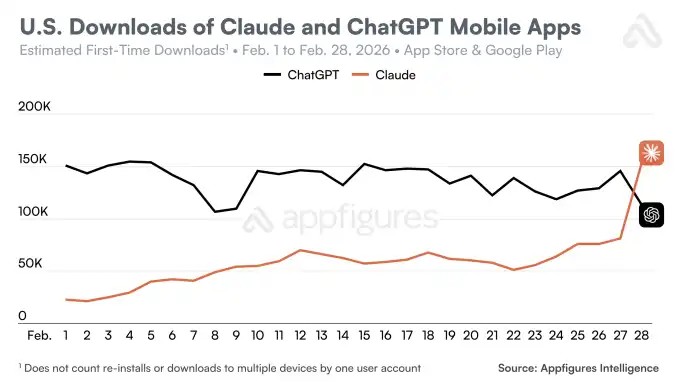
Appfigures also noted that Claude has now topped the free iPhone app charts in six countries outside the U.S., including Belgium, Canada, Germany, Luxembourg, Norway, and Switzerland.

A third market research firm, Similarweb, reported that Claude's U.S. downloads over the past week were approximately 20 times higher than in January. However, the agency cautioned that this may not be entirely due to political factors and could involve other reasons.


Related Questions

QWhat was the 295% surge in ChatGPT mobile uninstallations on February 28th a direct reaction to?

AThe 295% surge in ChatGPT mobile uninstallations on February 28th was a direct reaction to the news of OpenAI signing a cooperation agreement with the U.S. Department of Defense (DoD).

QWhich competitor's app saw a significant increase in downloads and topped the U.S. App Store charts following its refusal to work with the Department of Defense?

AAnthropic's Claude app saw a significant increase in downloads and topped the U.S. App Store charts after it announced its refusal to cooperate with the Department of Defense.

QWhat were Anthropic's stated reasons for refusing to cooperate with the U.S. Department of Defense?

AAnthropic refused to cooperate due to concerns that AI would be used for surveillance of U.S. citizens and for fully autonomous weapon systems that do not yet have safety capabilities.

QHow did the user ratings for ChatGPT change, specifically the number of 1-star and 5-star reviews, after the news of the DoD partnership?

AAfter the news, the number of 1-star reviews for ChatGPT surged by 775% on Saturday and increased by another 100% on Sunday, while 5-star reviews decreased by 50% during the same period.

QAccording to the data, in how many countries outside the U.S. did Claude's app top the free iPhone application chart?

AClaude's app topped the free iPhone application chart in six countries outside the U.S.: Belgium, Canada, Germany, Luxembourg, Norway, and Switzerland.

Related Reads

Casper Network Publishes the Casper Manifest, a Multi-Year Roadmap to Power Regulated Real-World Assets and the Machine Economy

The Casper Association has published "The Casper Manifest," a multi-year technical roadmap for Casper Network. Introduced at the Digital Finance Forum in Bermuda, the roadmap outlines nine coordinated initiatives designed to position the layer-1 blockchain as the infrastructure for regulated real-world asset (RWA) tokenization and the machine-to-machine economy. Key initiatives focus on: 1. **Developer Access:** Adding full Ethereum Virtual Machine (EVM) compatibility alongside its existing WebAssembly (Wasm) execution layer. 2. **User Experience:** Implementing gasless transactions, batch operations, and smart accounts with biometric authentication. 3. **Institutional Compliance & Privacy:** Building compliant security tokens aligned with the ERC-3643 standard and a multi-phase roadmap for confidential transactions with built-in audit tools. 4. **Machine Economy:** Implementing the X402 open payment standard to enable AI agents and machines to make autonomous, programmatic micropayments. 5. **Token Infrastructure:** Creating a Native Token Registry to give all tokens protocol-level status with fixed, predictable costs. 6. **Quantum Safety:** Developing hybrid accounts with both classical and quantum-resistant keys. The first initiative, X402 micropayments, is expected within weeks. Subsequent releases through 2026 and 2027 will include EVM compatibility, compliant security tokens, the Native Token Registry, gasless transactions, and quantum-safe features. The goal is to create a blockchain that is frictionless for users, trusted by institutions, and native for machines.

TheNewsCrypto49m ago

Casper Network Publishes the Casper Manifest, a Multi-Year Roadmap to Power Regulated Real-World Assets and the Machine Economy

TheNewsCrypto49m ago

TechFlow Intelligence: Trump-Linked Companies Transfer $12 Million in Assets Before China Visit, 'The Big Short' Protagonist Warns of Stock Market Bubble Again

The article reports multiple developments across tech, crypto, and finance. In AI, Mozilla used AI for large-scale code review, Google confirmed hackers used AI to find zero-day exploits, and OpenAI deployed GPT-5.5 to find errors in math benchmarks. A court ruled Anthropic's scanning and destroying books for AI training as fair use, while its Claude platform launched on AWS. Google's new video model 'Omni' was leaked. In crypto/Web3, Trump-linked companies transferred $12M in crypto assets before a China visit. BlackRock chose Ethereum for tokenized funds, and a hacker stole $174k via a malicious NFT that tricked an AI. Jack Dorsey's first tweet NFT plummeted from $2.9M to under $5. In chips/hardware, TSMC approved an additional $20B for its Arizona plant. Apple's Tim Cook and Elon Musk will accompany Trump to China, while Nvidia's Jensen Huang is notably absent. For markets, Michael Burry warned of parabolic stock rises and suggested near-total sell-offs, with online discussions comparing current sentiment to the 1999 bubble. Other notes include WTI oil surpassing $100, a 20% price hike for Beijing-Shanghai high-speed rail, and new products like Unitree's $26.9k humanoid robot. The underlying theme suggests AI is becoming infrastructure, creating pressure on old systems while a new order is not yet ready, leaving investors anxious.

marsbit1h ago

TechFlow Intelligence: Trump-Linked Companies Transfer $12 Million in Assets Before China Visit, 'The Big Short' Protagonist Warns of Stock Market Bubble Again

marsbit1h ago

Trading

Spot
Futures
活动图片