OpenAI, Open-Sourced

marsbitPublished on 2026-07-30Last updated on 2026-07-30

Abstract

OpenAI has open-sourced its code security tool, Codex Security CLI. The tool, which originated from the private beta project Aardvark in October 2025, is designed to automatically discover, verify, and fix vulnerabilities in codebases. It functions as an application security agent, first analyzing a repository to build a threat model, then identifying and ranking vulnerabilities based on real-world impact, and finally testing them in a sandbox for validation. According to OpenAI, in its first 30 days, the tool scanned over 1.2 million commits, uncovering 792 critical and 10,561 high-severity vulnerabilities, with a reported reduction of over 50% in false positives upon repeated scans of the same repositories. However, initial user experiences on platforms like Hacker News highlighted significant issues, particularly concerning cost and reliability. Developers reported failed scans that consumed substantial portions of API rate limits and incurred high expenses, with one user noting a cost of approximately $13 for an aborted run. The high cost is attributed to the tool's default configuration, which uses the premium GPT-5.6-sol model with inference intensity set to "extra-high." The release follows public statements by NVIDIA's Jensen Huang advocating for open-source AI. While OpenAI has open-sourced the application-layer CLI and SDK, the core AI models remain proprietary. The move opens the door for community development and potential adaptations of the tool.

OpenAI has finally become "Open" once again!

Recently, OpenAI officially announced: it has quietly released an open-source code security tool—Codex Security CLI.
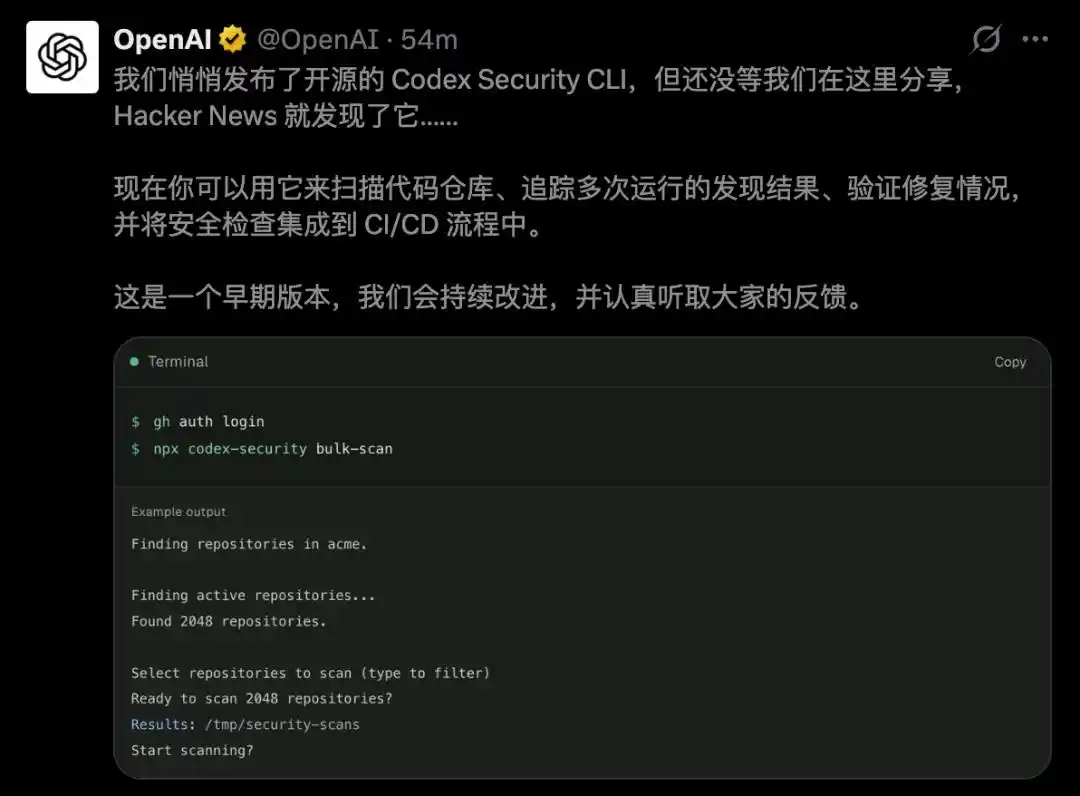
Previously, someone on Hacker News discovered it first, sparking instant discussions, and GitHub stars surged to 1.2k.

Seeing that it could no longer be kept hidden, OpenAI had no choice but to come forward and claim it.

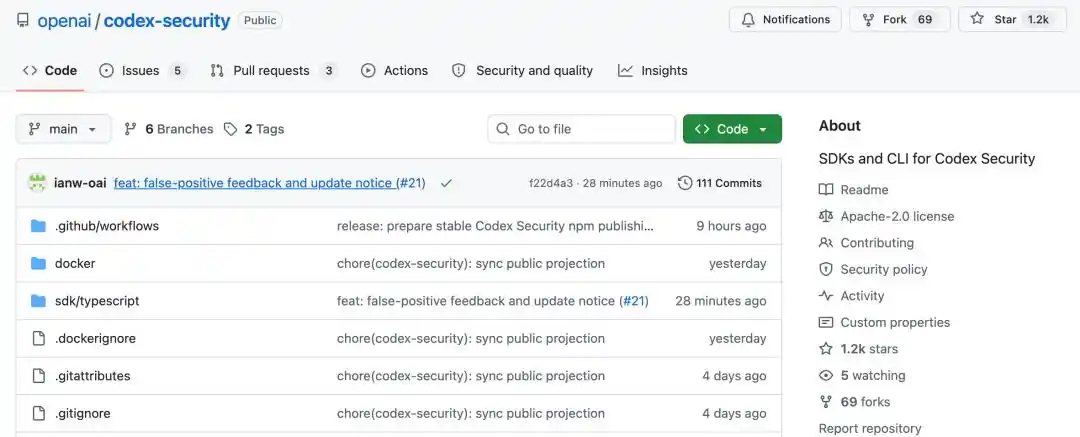
GitHub address: https://github.com/openai/codex-security

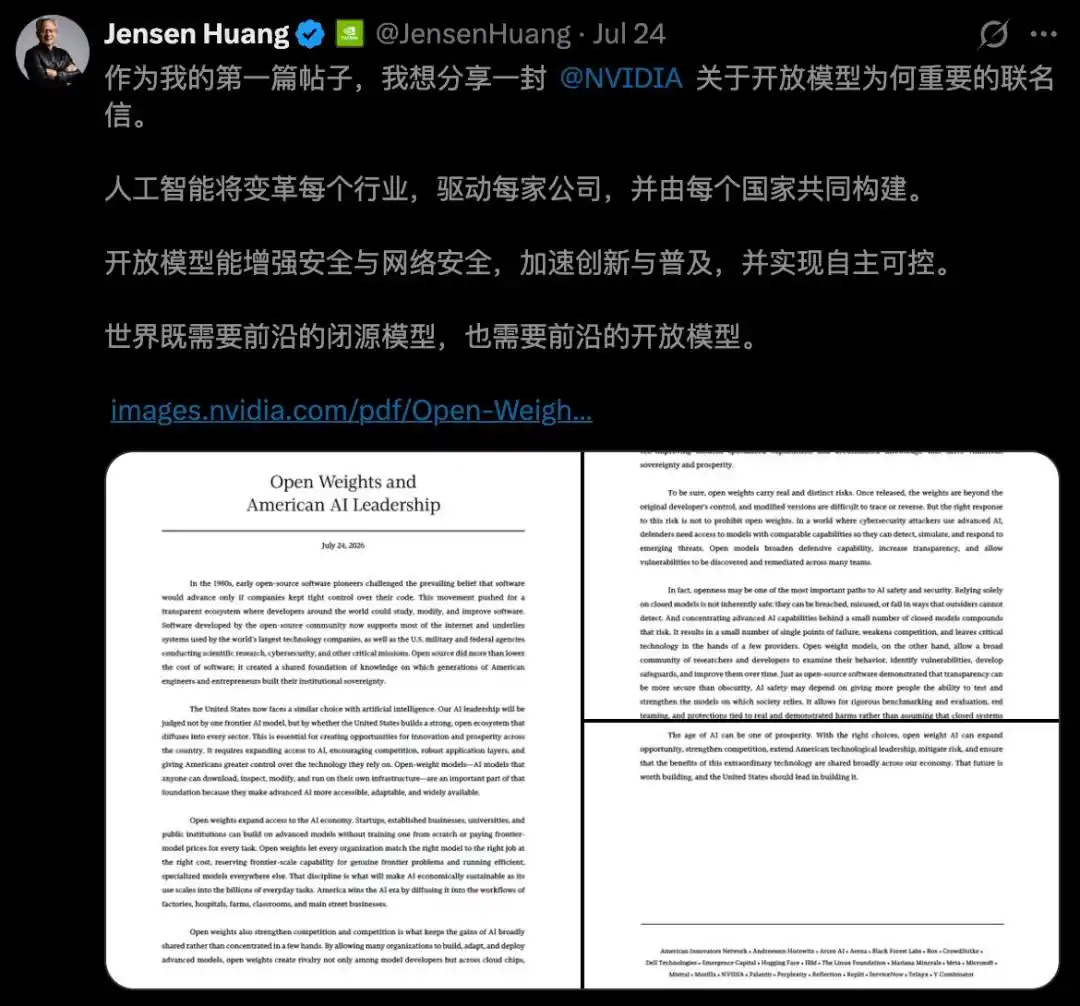
A few days ago, Jensen Huang personally stepped in, publicly expressing strong support for open-source AI, and soon after, OpenAI officially joined the camp.

Little did we expect that the surprise would come so quickly, as the heavyweight open-source masterpiece was unveiled almost instantly.

It has to be said, Huang's words still carry significant weight!

OpenAI's Code Security Tool is Now Open-Source

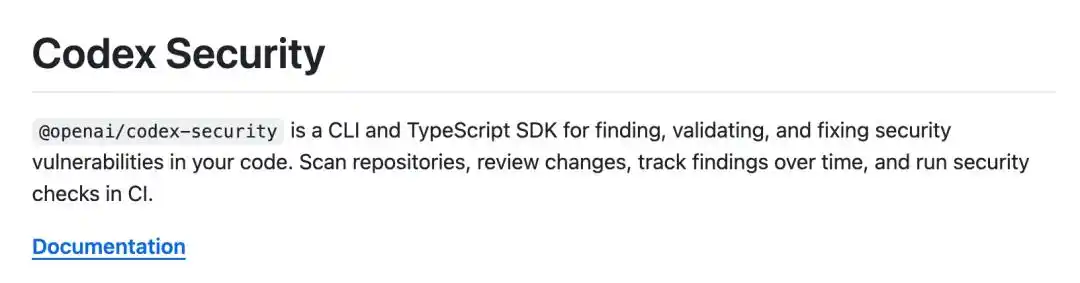
The "star" of this open-source release is codex-security, comprising a CLI and a TypeScript SDK.

Its core functionality is very straightforward, focusing on a "combo punch": automatically discovering vulnerabilities in a codebase, verifying them, and fixing them.
It's designed to be ready-to-use; the entire workflow can be run with just three lines of commands:

  • npm install @openai/codex-security
  • npx codex-security login
  • npx codex-security scan .

For CI runs, logging in isn't required; just configure an OPENAI_API_KEY.

The requirements are Node.js 22 or higher, Python 3.10 or higher, plus access to Codex Security.

1.2 Million Commits, 792 Critical Vulnerabilities

Strictly speaking, Codex Security isn't a completely "new species".

It evolved from the private beta project Aardvark in October 2025 and was renamed and launched as a research preview version on March 6th this year.

The most hardcore aspect of this tool lies in its positioning—an application security agent.
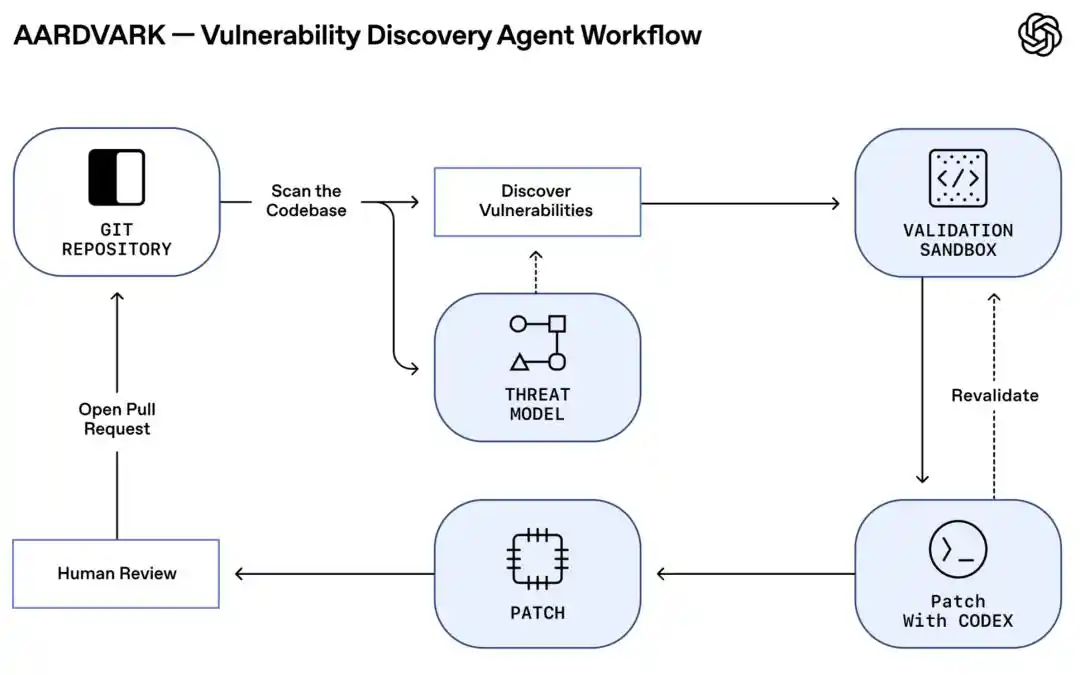
Codex Security truly dives deep into the underlying code to understand what your system is actually doing. Its workflow is divided into three steps:

First, it reads the entire repository to generate an editable threat model, figuring out what the project does and where it's most exposed;

Then, based on this context, it searches for vulnerabilities and ranks them by their real-world impact;

Finally, it throws suspicious issues into a sandbox for real stress testing, only reporting those that can be verified.

Looking at its track record, it's indeed quite formidable.

In its first 30 days online, it scanned over 1.2 million commits, uncovering 792 critical severity findings and 10,561 high severity findings.

OpenAI also mentioned that for the same batch of repositories scanned repeatedly, the false positive rate dropped by over 50%.

The First Batch of Early Adopters, Bills Exploded

No matter how grand the official promises are, they can't compare to the "real-world test disasters" that immediately surfaced among developers.

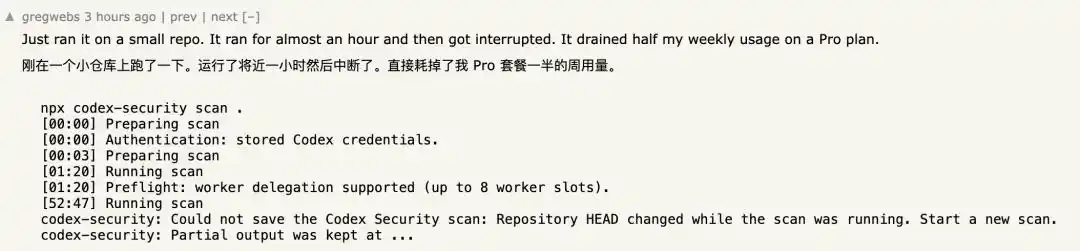
On HN, a developer named gregwebs tested it on a small repository and directly posted the utterly devastating terminal logs.

Preparation started at 0:03, scanning began at 1:20, ran all the way to 52:47, and finally, a line of red text popped up—the repository HEAD changed during scanning, please start over.

Not only did it waste an hour, but this single run also consumed half of his Pro plan's weekly quota.
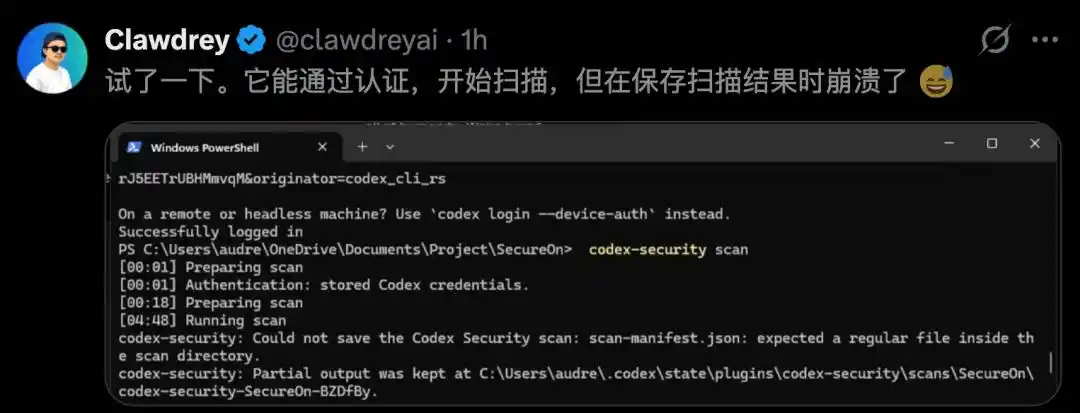
Another user, Quai, had it worse. The scan hit account rate limits right after starting, and the tool retried for a minute before giving up.

The tool did hint that "partial results have been preserved," but he couldn't find an obvious way to use them in the next scan. This failed run cost about $13.

Why is it so expensive? Just look at the default configuration and the answer becomes clear.

Codex Security defaults to calling gpt-5.6-sol and brutally cranks the "reasoning effort" up to extra-high.

It's important to know that Sol is the most "premium" tier in the GPT-5.6 family, with API pricing as high as $5 per 1M input tokens and $30 per 1M output tokens.
Huang Kicked Things Off, OpenAI Took a Step

Just after Jensen Huang publicly voiced strong support for open-source AI, OpenAI brought out Codex Security.

However, don't interpret this "open-source" move as too generous just yet.

OpenAI's step is quite calculated: they've open-sourced the application-layer shell, while the model layer is still tightly held in their own hands.

Regardless, the Pandora's box of agents taking over code security has been opened.

Next, it's up to developers to see how they can hack and modify this open-source artifact, using the magic of the community to counter OpenAI's own magic.

References:

https://x.com/gdb/status/2082235089539526690?s=20

https://x.com/OpenAI/status/2082263717916586117?s=20

This article is from WeChat public account "AI Era", author: ASI Revelations

Related Questions

QWhat did OpenAI recently open-source, and what is its primary function?

AOpenAI recently open-sourced Codex Security CLI, a tool designed to automatically detect, validate, and fix security vulnerabilities in codebases.

QWhat commands are needed to run the basic workflow of the open-sourced tool?

AThe basic workflow requires three commands: `npm install @openai/codex-security`, `npx codex-security login`, and `npx codex-security scan .`.

QWhat were some of the early user complaints regarding the Codex Security tool?

AEarly users complained about high costs, slow scans, account rate-limiting, and the tool's default use of the expensive `gpt-5.6-sol` model with the `extra-high` reasoning setting.

QAccording to the article, what significant results did Codex Security achieve in its first 30 days?

AIn its first 30 days, Codex Security scanned over 1.2 million commits and identified 792 critical and 10,561 high-severity findings.

QHow does the article characterize the nature of OpenAI's 'open-sourcing' of Codex Security?

AThe article characterizes it as a strategic move where OpenAI open-sourced the application layer (the CLI/SDK) but keeps the core model layer proprietary and under its control.

Related Reads

Deep Dive into FWA: An Intriguing Experiment Turning NFTs into "On-Chain Gachapon"

A Deep Dive into FWA: The “On-Chain Gacha” Experiment for NFTs Fake World Assets (FWA), created by TokenWorks, introduces an innovative “NFT gacha machine” fully operating on-chain. Users can deposit eligible NFTs paired with ETH (called Backing) to create a Position, acting as a prize pool. Others can then pay a uniform Acquisition Price for a chance to win a random NFT from the pool. The core mechanism features a reverse probability system: Positions with lower Backing have a higher chance of being selected, serving as common prizes, while high-Backing Positions are rare “jackpots.” The acquisition price is calculated based on the harmonic mean of all Backings, keeping entry costs low. When a Position is won, the purchaser must choose: keep the NFT or accept the Standing Bid (85% of the Backing, claimable in ETH or $FWA tokens), returning the NFT to the original depositor. The protocol involves two main roles. Depositors provide liquidity (NFT + ETH), earning a share of fees from each draw, distributed equally per active Position, plus potential $FWA rewards. Purchasers pay to spin the gacha, receiving $FWA rewards for participation. A special “Crown” reward goes to the Position with the highest Backing. The $FWA token has a fixed supply and is initially obtainable only through protocol participation (depositing or purchasing), with external buying disabled early on to reduce sell pressure. Its value is supported by a built-in buy pressure: when purchasers opt for the $FWA settlement on a Standing Bid, the protocol uses the backing ETH to buy $FWA from the market. Revenue for the protocol comes from a 1% fee on each draw, a 1% settlement fee when an NFT is kept, and the 15% discount from Standing Bid settlements (currently allocated to the protocol). The design cleverly blends Uniswap-style liquidity provision, gacha mechanics, and tokenomics to create a novel, self-regulating marketplace for NFT liquidity and engagement.

marsbit12m ago

Deep Dive into FWA: An Intriguing Experiment Turning NFTs into "On-Chain Gachapon"

marsbit12m ago

10,000 Scientists Get 1 Year of Free Access: OpenAI Brings the Scientific Research Pipeline into ChatGPT

OpenAI has launched the "ChatGPT for Academic Researchers" program, offering free one-year access to its flagship models for 100,000 university researchers globally, with 10,000 spots available this summer. Selected institutions include prestigious centers like ENS Paris and the IAS at Princeton. The initiative provides an integrated research workspace within ChatGPT, bundling tools like ChatGPT, ChatGPT Work, and Codex, along with expanded Deep Research capabilities, higher usage limits, and specialized tools for life sciences. The suite connects to platforms like Zotero and GitHub, aiming to streamline the entire research workflow from literature review and coding to data analysis and manuscript drafting. OpenAI notes that about 1.3 million people already use ChatGPT weekly for advanced science and math. The program targets building long-term user dependency by embedding these tools into daily research habits. However, access comes with limitations: it does not include API credits or model weights, and eligibility is restricted to verified academic researchers from supported countries. This approach contrasts with Anthropic's "AI for Science" program, which offers API credits but not an integrated workspace. Both companies emphasize preventing misuse by withholding model weights, a point of contention for AI researchers seeking transparency. The core strategy remains clear: provide a powerful, integrated environment to foster user reliance ahead of the post-free period.

marsbit17m ago

10,000 Scientists Get 1 Year of Free Access: OpenAI Brings the Scientific Research Pipeline into ChatGPT

marsbit17m ago

What's Going On with Gigadevice? Major Shareholder Cashes Out 44 Billion, Then Announces 20 Billion Buyback

Gigadevice Innovation, a leading Chinese memory chip company, has executed a controversial financial maneuver. The company's controlling shareholder and chairman, Zhu Yiming, sold approximately 44 billion RMB worth of his shares between early May and mid-June 2026, capitalizing on a soaring stock price that peaked at 846.66 RMB on June 29th. Following a subsequent stock crash—plummeting to around 350 RMB in 22 trading days and erasing over 330 billion RMB in market value—Zhu announced a combined "market rescue" plan on July 29th. This plan includes his personal commitment to buy back at least 1 billion RMB in shares and a company proposal to repurchase 1 to 2 billion RMB worth of stock. This sequence of high-selling followed by a low-buying plan has confused and unsettled many of the company's 240,000 retail investors. The stock's dramatic decline was attributed to several factors: the successful IPO of its sister company, Changxin Technologies, which ended Gigadevice's status as a primary investment proxy for the domestic memory sector; a Morgan Stanley report warning of a potential peak in the memory chip cycle; and a severe loss of market confidence triggered by the chairman's massive sell-off. While the sell-off was procedurally compliant, its timing has been criticized. The company's fundamentals appear strong, with preliminary H1 2026 results showing revenue up 177% year-on-year to 11.5 billion RMB and net profit skyrocketing 1099% to 6.9 billion RMB, driven by a boom in memory chips and MCU demand. However, a significant portion (2.05 billion RMB) of this profit came from non-recurring gains like securities investment, and the memory industry is notoriously cyclical. Analysts highlight the company's role in the domestic substitution of niche DRAM and NOR Flash memory, with some maintaining bullish price targets. Yet, the recent events underscore key risks: its fabless model creates dependency on foundries like Changxin, and the chairman's actions have raised serious questions about management's alignment with minority shareholders. The promised buybacks cannot commence until December 13th due to a mandatory six-month cooling-off period following an insider sale, leaving the stock vulnerable in the interim.

marsbit17m ago

What's Going On with Gigadevice? Major Shareholder Cashes Out 44 Billion, Then Announces 20 Billion Buyback

marsbit17m ago

Trading

Spot
活动图片