OpenAI Official Plugin Strongly Integrated into Claude Code

marsbitPublished on 2026-03-31Last updated on 2026-03-31

Abstract

OpenAI has officially released the "codex-plugin-cc" on GitHub, enabling developers to integrate OpenAI’s Codex model capabilities directly into Anthropic’s command-line development tool, Claude Code. This cross-platform integration breaks down ecosystem barriers between major AI tools, allowing developers to leverage the strengths of both models without switching environments. With simple configuration, Claude Code becomes a versatile programming assistant combining the advantages of both companies. Key features include: - Standard code review via the `/codex:review` command, providing expert improvement recommendations and double-checking for logic errors. - Adversarial review using `/codex:adversarial-review`, which challenges design decisions to identify potential performance bottlenecks or security risks. - Task delegation through `/codex:rescue`, allowing complex debugging or repair tasks to be handed off to a Codex sub-agent for collaborative problem-solving. This integration enhances code quality and development efficiency through multi-model collaboration.

Recently, the AI developer community welcomed a major update: OpenAI officially released an open-source project named codex-plugin-cc on GitHub. This plugin allows developers to directly utilize the capabilities of OpenAI's Codex model within the command-line development tool Claude Code, introduced by Anthropic.

This "cross-brand" integration breaks down the ecosystem barriers that previously existed between major AI model tools, enabling developers to leverage the technical strengths of both industry giants without switching environments. With simple command configurations, Claude Code instantly transforms into an all-in-one programming assistant that combines the best of both.
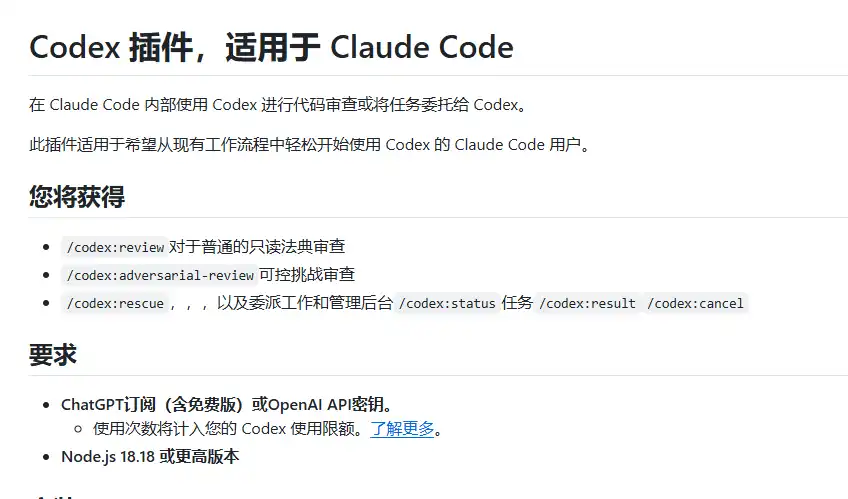
Empowered by this plugin, users can initiate a standard read-only code review using the /codex:review command to receive professional improvement suggestions from Codex. This dual verification mechanism effectively catches logical vulnerabilities that a single model might miss, adding a "double insurance" for code quality.

More uniquely, its "adversarial review" feature allows developers to use /codex:adversarial-review to actively request Codex to challenge existing design decisions. This mode is specifically designed to stress-test the rationality of system architecture, uncovering potential performance bottlenecks or security risks from a "fault-finding" perspective.

Additionally, the plugin introduces a task delegation mechanism, enabling users to transfer complex debugging or repair tasks to a Codex sub-agent via /codex:rescue. This collaborative model achieves automatic task distribution, allowing the primary model and auxiliary models to each focus on their respective areas of expertise.

github:https://github.com/openai/codex-plugin-cc

Related Questions

QWhat is the name of the official OpenAI plugin that integrates with Claude Code?

AThe plugin is called codex-plugin-cc.

QWhat is the primary function of the /codex:review command in the new plugin?

AThe /codex:review command is used to initiate a standard read-only code review to get professional improvement suggestions from the Codex model.

QWhat unique feature does the /codex:adversarial-review command provide?

AThe /codex:adversarial-review command enables an 'adversarial review' function, which actively challenges existing design decisions to stress-test the system architecture and uncover potential performance bottlenecks or security risks.

QHow does the /codex:rescue command facilitate task management?

AThe /codex:rescue command allows users to delegate complex debugging or repair tasks to a Codex sub-agent, enabling a collaborative model where the main and auxiliary models work in their respective areas of expertise.

QWhere was the codex-plugin-cc project officially released?

AThe project was officially released by OpenAI on GitHub.

Related Reads

Qualcomm Chip Price Hike Deals a Blow to Android Phones

Qualcomm has officially announced a new round of price increases for its entire chip portfolio, effective September 1. The hikes, reaching up to 18% for the flagship Snapdragon 8 Elite Gen 6 Pro, follow similar moves by MediaTek, intensifying cost pressures on the already strained smartphone industry. CEO Cristiano Amon confirmed the plan, citing the need to offset rising industry-wide costs and restore declining profit margins. Qualcomm's Q3 FY2026 results showed a 25% drop in net profit, with mobile revenue plunging 20% year-over-year, hitting its lowest level since 2021. The surge in AI computing demand has led memory manufacturers to prioritize HBM production, creating a shortage in general-purpose DRAM and NAND Flash chips. Their prices soared by 93%-98% and 55%-60% respectively in Q1 2026, causing the memory cost share in smartphones to jump from 10%-15% to over 30%. Coupled with the soaring cost of advanced nodes like TSMC's 2nm and packaging, overall chip costs have reached historic highs. These upstream pressures are forcing downstream smartphone brands like Xiaomi, OPPO, and vivo to cut orders for mid-to-low-end models by up to 20% and use cost-saving measures like older chipsets. Reportedly, the Snapdragon 8E5 will be repurposed as a "long-lasting" chip for sub-brand phones in H2 2026. Amid this cost crisis, the Android market remains sluggish. Q2 2026 smartphone shipments in China fell 4.3% year-over-year, marking five consecutive quarters of decline. Major Android brands saw market share drop, while Huawei and Apple, with their in-house chip advantages, gained share. Qualcomm is diversifying into automotive and IoT sectors to reduce reliance on smartphones, but these new segments cannot yet fill the mobile revenue gap. Industry observers warn that the full impact of component cost hikes will hit in the second half of 2026, likely leading to higher-than-expected price increases for Android flagships and a further contraction in the Chinese smartphone market.

marsbit49m ago

Qualcomm Chip Price Hike Deals a Blow to Android Phones

marsbit49m ago

Breaking: GPT-5.6 Prices Slashed Effective Today

OpenAI has announced significant price cuts for its GPT-5.6 model API, effective immediately. The entry-level **GPT-5.6 Luna** sees the most drastic reduction, with input prices dropping 80% to $0.20 per million tokens and output prices falling to $1.20 per million tokens. The mid-tier **GPT-5.6 Terra** is reduced by 20%, now costing $2.00 (input) and $12.00 (output) per million tokens. The flagship **GPT-5.6 Sol** maintains its original price but introduces a new **Fast mode**, offering speeds up to 2.5 times faster for double the cost. The company attributes these price reductions to efficiency gains achieved through **GPT-5.6 Sol's own involvement in optimizing its production systems**. The model assisted in rewriting GPU kernels and improving speculative decoding, leading to a 20% reduction in end-to-end service costs and over 15% improvement in token generation efficiency. OpenAI emphasizes this process remained human-led. A key focus of the降价 is to lower the barrier for running **AI agent workflows**. By making the capable, tool-calling Luna model significantly cheaper, OpenAI aims to enable more frequent use in cost-sensitive, high-volume tasks like code review and monitoring. This creates a potential feedback loop: model-assisted efficiency gains lead to lower costs, which enables broader agent deployment, which in turn drives further optimization. The new pricing and features will also apply to Codex and ChatGPT Work subscriptions. The changes intensify competition in the large language model market, with OpenAI directly challenging rivals like Anthropic to respond.

marsbit1h ago

Breaking: GPT-5.6 Prices Slashed Effective Today

marsbit1h ago

Trading

Spot
活动图片