OpenAI Completely Overhauls Codex, Grows Its Own Mouse, Schedules Itself to Outwork Humans

marsbitPublished on 2026-04-17Last updated on 2026-04-17

Abstract

OpenAI has fundamentally transformed Codex from a coding assistant into a versatile AI agent capable of autonomous computer control. The updated Codex can now operate in the background with its own independent cursor, allowing it to run applications like Xcode, test software, and fix bugs without interrupting the user’s workflow. It features a built-in browser for real-time visual editing of web pages, enabling developers to make changes through direct UI interactions. The release also introduces over 90 plugins for tools like JIRA, CircleCI, and SharePoint, integrating end-to-end development and productivity workflows. A new "heartbeat" feature allows Codex to self-schedule tasks, maintain context across sessions, and work autonomously over extended periods. Additional enhancements include memory capabilities, support for handling GitHub code reviews, multi-tab terminals, and built-in file generation for Excel, PDF, and PowerPoint. Currently, advanced computer control is available on macOS (excluding EU/UK users), with Windows support limited to data retrieval. This expansion positions Codex as a foundational step toward OpenAI’s planned "super-app," combining coding, automation, and multi-tool integration into a single platform.

Just now, OpenAI has turned Codex upside down!

Yesterday you were still using Codex to write code.

Today it can already view your screen, click your mouse, remember your preferences from last week, and schedule its own tasks.

Multiple AI Agents work for you in the background simultaneously, without affecting your mouse and keyboard at all.
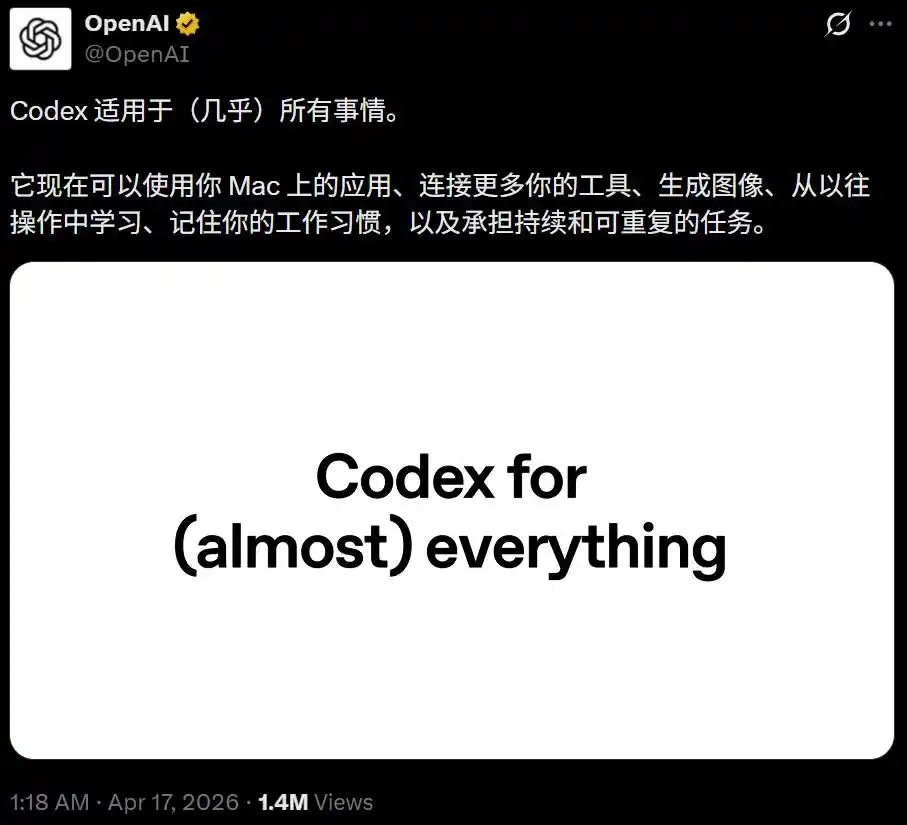
Codex's "Secret Sauce": It can use apps directly in the background without taking over your entire computer.

From today, this tool used weekly by 3 million developers is no longer just a programming Agent.

You Do Your Work, It Runs Xcode in the Background

Now, Codex has its own cursor, which does not interfere with your mouse.

You write documents while it runs Xcode to test an App next to you, both happening at the same time.

This feature has significant origins; its lead, Ari Weinstein, is the co-creator of Apple Shortcuts, whose team was acquired by OpenAI last fall.

To understand what it can do, just watch a demo.

First, the user gives the command: "Run this Tic-Tac-Toe App in Xcode, play a game to test it yourself, and fix any bugs you find."

Then, Codex opens Xcode by itself, starts the iOS simulator, and begins playing with its own cursor.

During testing, it discovers a logic bug—after a human move, the computer draws two O's simultaneously.

After some thought, Codex decisively switches back to the code interface and locates the position of the bug.

After modifying the Swift code, it immediately recompiles and performs a second round of complete testing for verification.

In less than a minute. Run → Test → Find bug → Fix → Regression verification, the entire Debug closed loop, all in one go.

Currently, Computer Use only supports macOS; users in the EU and UK cannot use it for now.

The Windows version can pull information from other apps into Codex but does not yet support background cursor-level control.
In this update, Codex gains support for Intel Macs for the first time.

Click to Modify, No More Code Hunting for Front-End Debugging

The Codex client now has a built-in browser,底层 powered by OpenAI's own Atlas engine.

In practical terms,以前 front-end developers adjusting UI had to jump back and forth between code and the browser. Now you can operate on the rendered webpage.

Click the main title, leave a comment "Reduce font size and shorten the slogan"; click the top left corner, "Add a logo";发现 the chart's X-axis legend is out of bounds, click the error spot, write "Fix the out-of-bounds issue".

Codex understands visual and spatial context,修改 code in the background instantly, and the page refreshes in real-time.
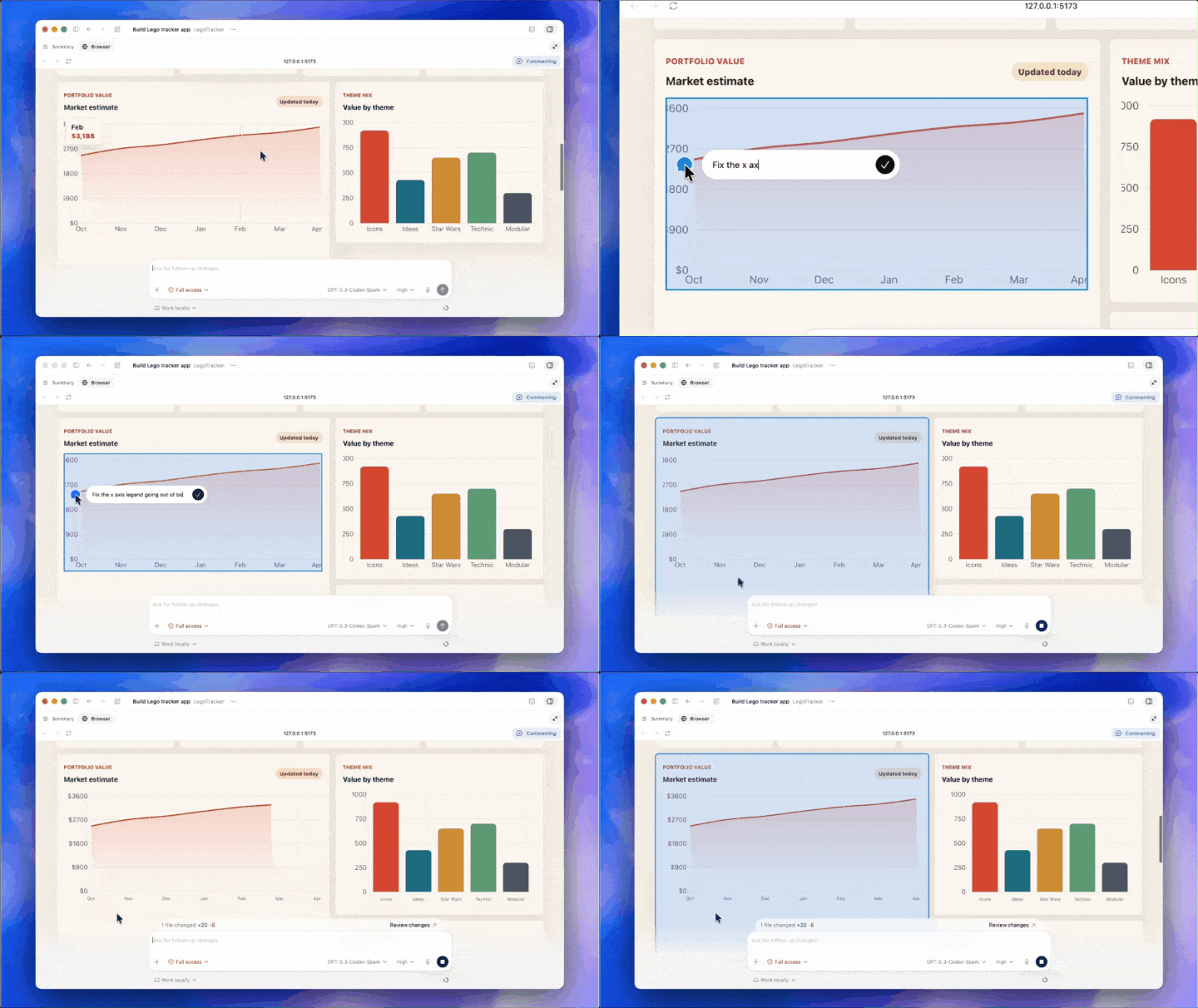
OpenAI used a web application called Brickfolio, a Lego set tracker, for the demo.

Codex wrote the code from scratch, configured the environment, started the local server, and opened the rendered page in the built-in browser. The whole process took just seconds.

Then came the WYSIWYG (What You See Is What You Get) modification experience. It feels like reviewing a design mockup; you just annotate the problems, and all underlying iterations are handled by the AI.

In other words, the user只需 clicks and marks here and there on the page, and Codex changes the code in the background, producing results in real-time on the front end.

The built-in browser is currently limited to localhost preview. OpenAI stated that future expansions will include full browser control capabilities.

Over 90 Plugins Launched, The Entire Toolchain Welded into Codex

On the plugin front, OpenAI launched over 90 in one go.

Atlassian Rovo manages JIRA, CircleCI handles CI/CD, GitLab Issues tracks requirements, Microsoft Suite processes documents, Neon by Databricks operates databases—covering almost all tools a development team uses daily.
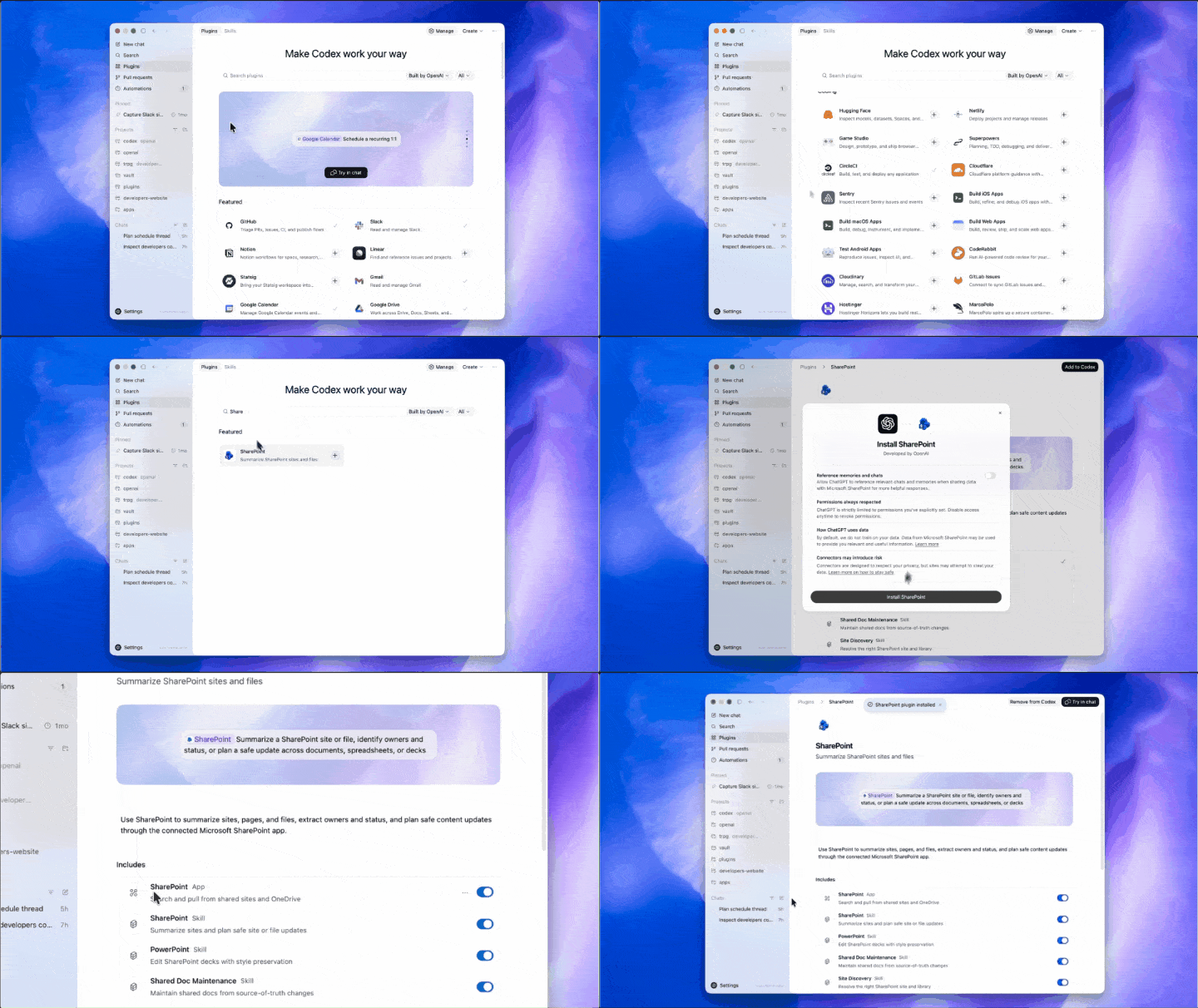
Usage is simple: just @ the plugin name in the input box.

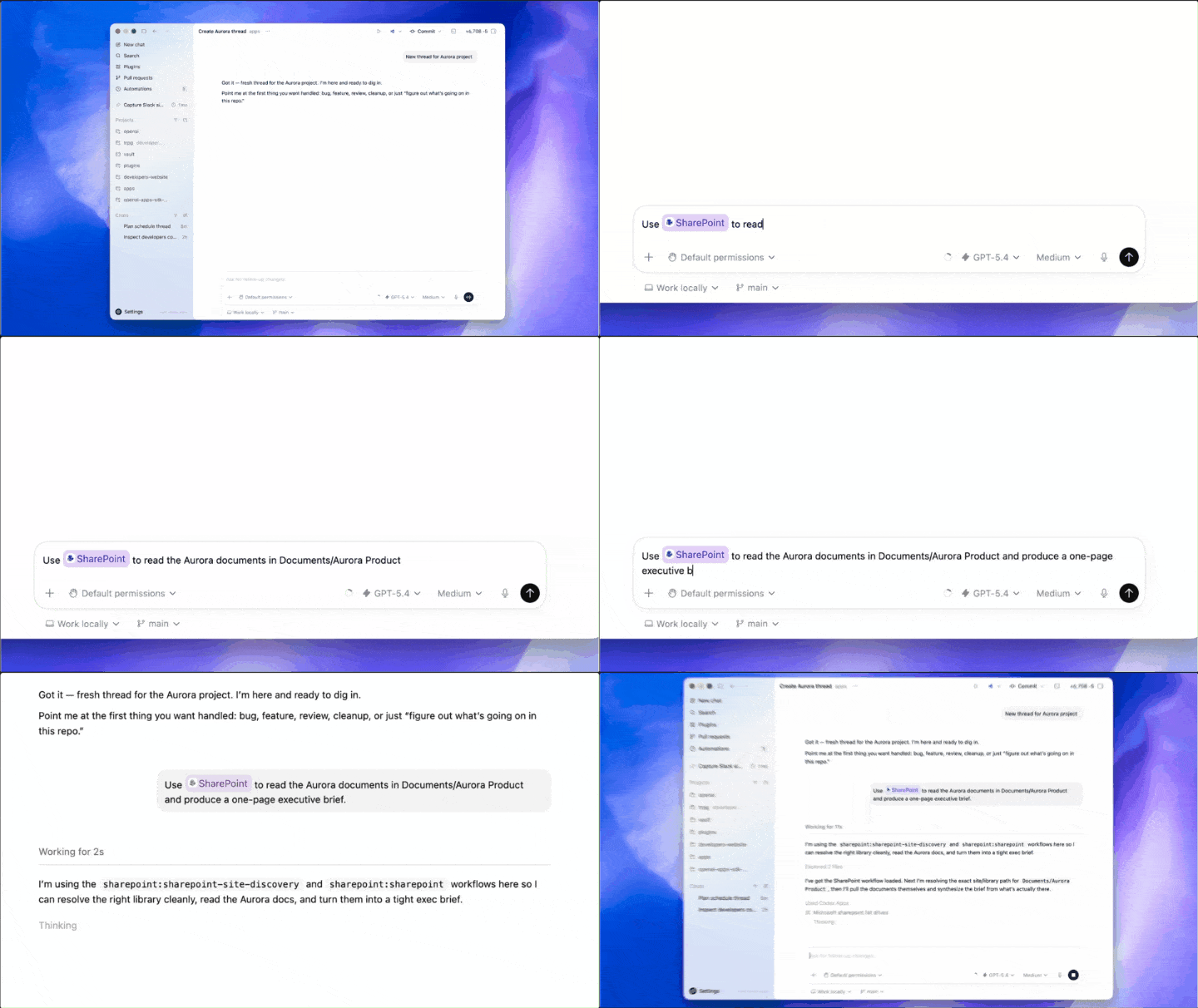
For example, @SharePoint, ask Codex to read documents in the product catalog and generate an executive brief. It automatically searches the file tree, parses documents, and extracts core information, saving you from searching through various cloud drives.
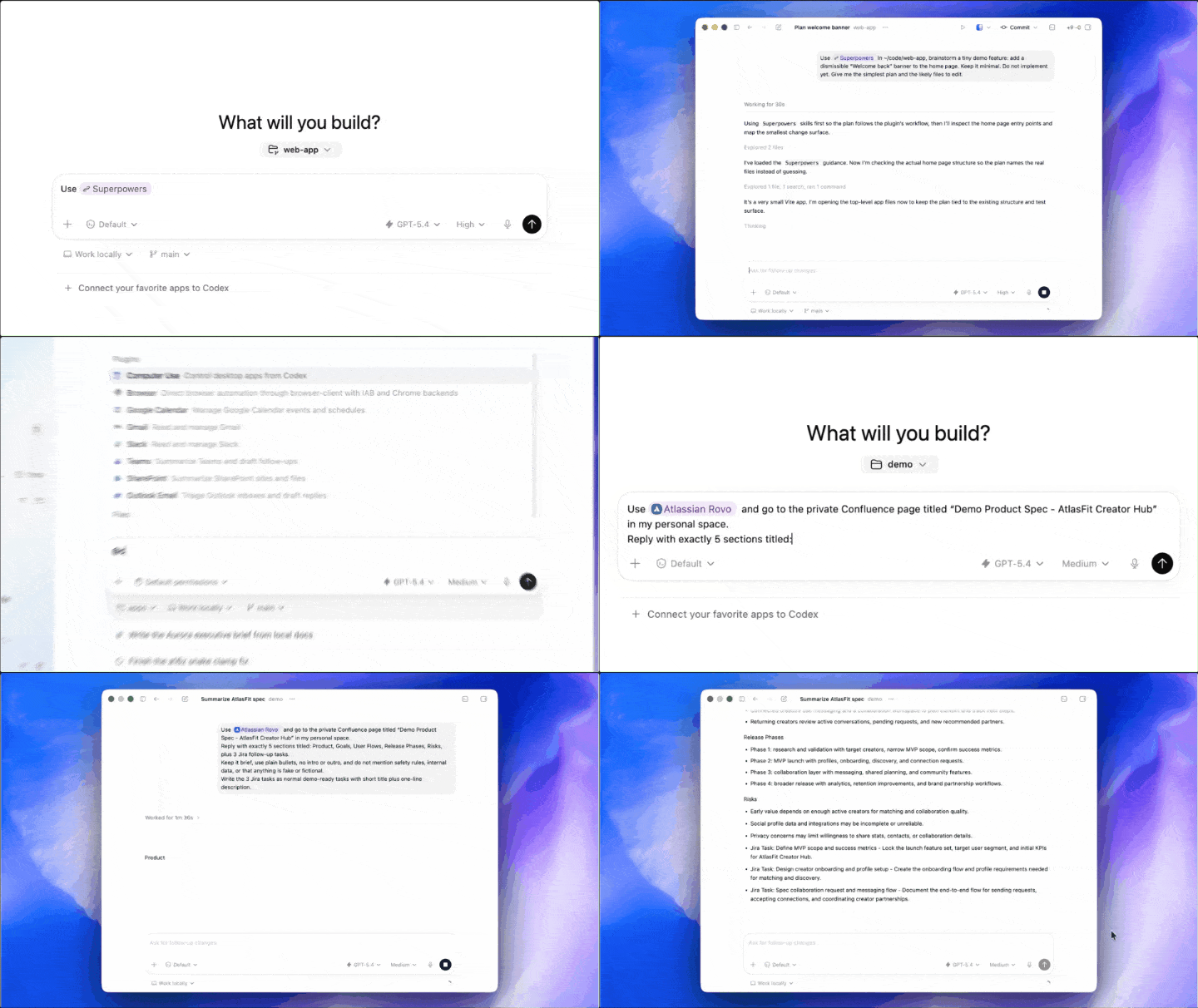
Another example: @Superpowers, ask Codex to conceptualize a feature plan within the local code directory. It will traverse your file structure, read code and CSS, and provide a set of implementation suggestions that fit the current project architecture.

@CircleCI can help diagnose branch build failures; @Atlassian Rovo can read product specifications on Confluence, output summaries in format, and even convert feature points into standard JIRA tasks.
From upstream requirements to local coding, to CI/CD and task management, plugins串起来了 the entire chain.

AI Starts Scheduling Itself

Even more noteworthy is the new "Heartbeat" mechanism.

Now Codex can schedule future work for itself, automatically waking up at the set time to continue working, even across days or weeks. Moreover, it can reuse previous conversation threads, so the context accumulated last time is not lost.

For example, a user can ask Codex to check Slack, Gmail, Google Calendar, and Notion. It pulls relevant information from these four channels and throws out a prioritized to-do list.

The user adds, "Can you keep an eye on this for me?"

Codex immediately sets itself an hourly automatic patrol schedule, proactively reports on key points requiring decisions, and even asks, "Do you need me to draft a reply for you?"

This is no longer just a tool; it's a junior employee who doesn't sleep.

Coupled with the natively built-in image generation capability of gpt-image-1.5, product concept maps, front-end designs, and visual prototypes can all be completed in one go within the same workflow.

Daily Needs Filled in One Go

Besides these major features, there are also a batch of experience-level upgrades.

First, the memory function is available in preview; Codex can remember your preferences and corrected points, so you don't have to explain from scratch the next time you start a chat.

Second, GitHub code review comments can now also be processed in Codex.

Support for opening multiple terminal tabs simultaneously is here, and the ability to connect to remote development machines via SSH is also in internal testing. There's also a new summary panel to help you keep an eye on the Agent's work plans, information sources, and output files at any time.

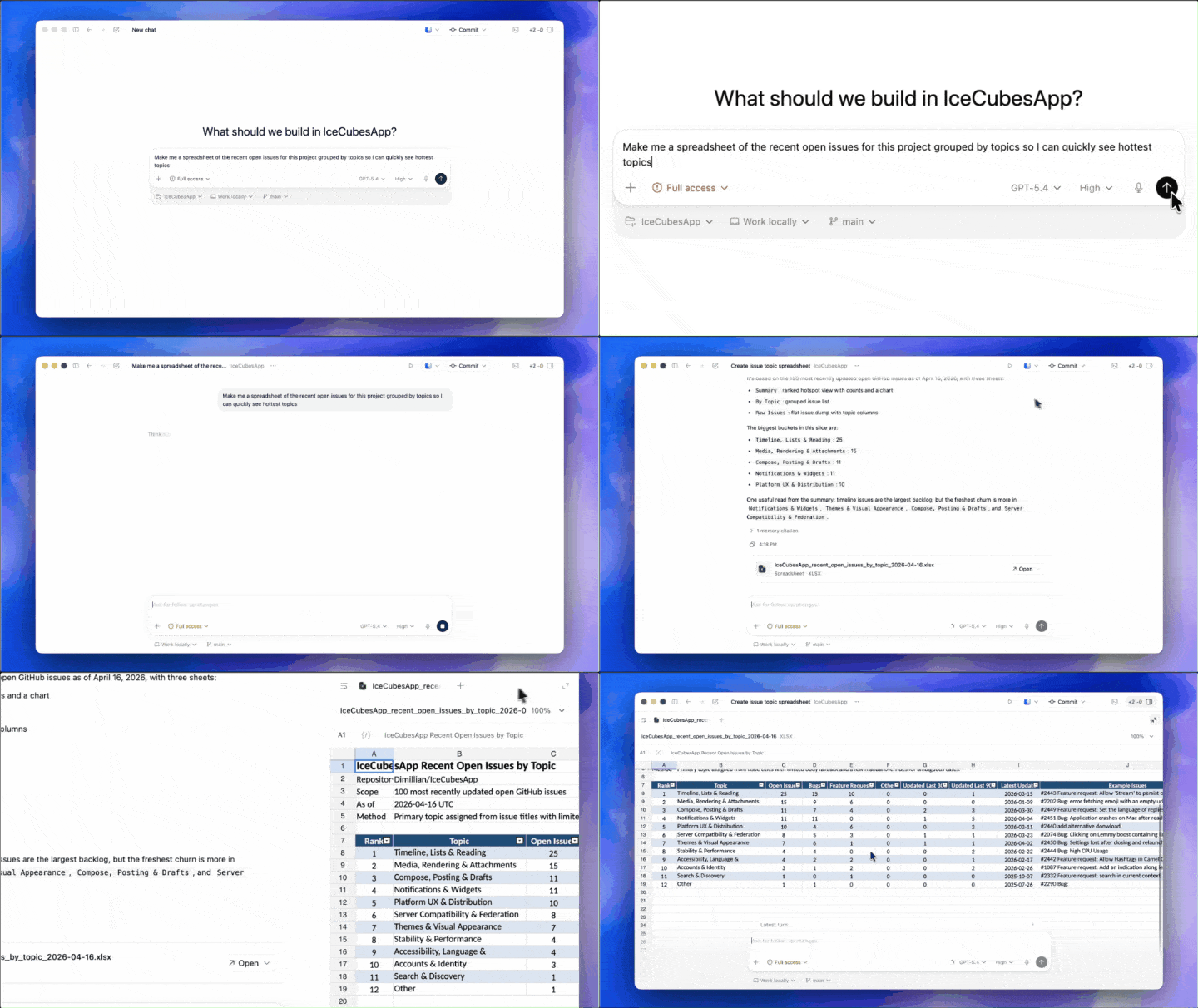
In the demo, the user asked Codex to organize the recent open issues of the current project and generate a table grouped by theme.

Codex then pulled the code repository context in the background and, after a few minutes, threw out a core summary listing the project's current biggest pain points.

Click to generate an Excel file—no need to switch to external software; a complete spreadsheet preview can be opened right in the sidebar.

The same goes for PDFs and PPTs, all handled within the Codex window.
The First Piece of the Super App Puzzle

Looking back at the timeline, you can feel OpenAI's pace.

March 19: Foreign media reported that OpenAI plans to merge ChatGPT, Codex, and the Atlas browser into a desktop "Super App".

March 31: OpenAI secured $122 billion in funding, with a valuation of $852 billion, led by Amazon, NVIDIA, and SoftBank. The funding documents clearly stated that the capital would be used for the development and deployment of the Super App.

April 16: This wave of Codex updates landed.

Another telling data point: over 80% of OpenAI's internal employees are already using Codex, and not just engineers.

Writing weekly reports, organizing feedback, drafting product requirement documents, reviewing contracts, sending security training reminders—they use it for everything.

50% of Codex users are already using it for non-coding tasks.

This isn't a programming tool adding features. This is a Super App using the shell of a programming tool for a cold start.

If You Can't Beat Them, Infiltrate: Made an Official Plugin for Anthropic

Even more interestingly, OpenAI also made an official plugin for Claude Code, actively embedding Codex into the competitor's ecosystem.

It somewhat has the vibe of, rather than waiting for developers to switch camps, better to infiltrate their workflow first.

Currently, Codex emphasizes background execution, multi-Agent parallelism, and unattended operation; Claude Code's advantages lie in long-context reasoning and deep code understanding. More and more teams are choosing to use both.

However, what OpenAI wants is clearly not just a share of the pie.

$122 billion is bet on something far greater than a programming tool.

Reference: https://openai.com/index/codex-for-almost-everything/

This article is from the WeChat public account "新智元" (New Wisdom Yuan), edited: Hao Kun (Very Sleepy)


Related Questions

QWhat is the key new feature of OpenAI's Codex that allows it to operate in the background without taking over the user's entire computer?

AThe key new feature is called 'Computer Use', which gives Codex its own independent cursor, allowing it to operate applications in the background (like running Xcode) while the user continues their work uninterrupted with their own mouse and keyboard.

QWhich operating system currently has the most comprehensive support for Codex's new background control capabilities, and which regions are temporarily excluded?

AmacOS currently has the most comprehensive support for the new background cursor-level control. Users in the European Union and the United Kingdom are temporarily unable to use this feature.

QHow does the new 'heartbeat' mechanism in Codex function?

AThe 'heartbeat' mechanism allows Codex to schedule future work for itself. It can wake up automatically at a set time (even across days or weeks) to continue tasks and can reuse previous conversation threads, maintaining all accumulated context from earlier interactions.

QWhat was the significant business move mentioned in the article that suggests OpenAI is building a 'super app'?

AThe significant business move was OpenAI securing $122 billion in funding at an $852 billion valuation, with investors including Amazon, Nvidia, and SoftBank. The funding documents explicitly stated the capital would be used for the development and deployment of a desktop 'super app' that merges ChatGPT, Codex, and the Atlas browser.

QWhat surprising strategic move did OpenAI make regarding its competitor Anthropic's Claude Code?

AOpenAI created and released an official plugin for Anthropic's Claude Code, effectively embedding its own Codex tool into the ecosystem of its direct competitor. This is a strategic move to integrate into developers' workflows rather than waiting for them to switch platforms entirely.

Related Reads

Welcome to the New Crypto World: Only This Time, The Place Where You Lose Money Is Called the Stock Market

Welcome to the New Crypto World: Only This Time, the Place to Lose Money is Called the Stock Market. The article depicts a future (2026) where global stock markets, particularly tech stocks, are exhibiting behaviors and risks reminiscent of the cryptocurrency world. The narrative centers on a sharp crash in South Korea's KOSPI index and leading stocks like SK Hynix, highlighting widespread retail losses, leverage-induced liquidations, and extreme volatility. It argues that a significant shift in market dynamics is underway: pricing is increasingly driven by narratives (like the AI boom) over fundamental valuation, amplified by high leverage and the rapid, emotion-fueled consensus formed on social media. Former crypto traders, seeking new opportunities, brought their high-risk strategies—chasing narratives, using leverage—into equity markets, focusing on sectors like AI and semiconductors. Ironically, data suggests some major tech stocks have recently shown greater volatility and faster crashes than Bitcoin, which is becoming relatively more stable and "stock-like" through institutional adoption. The piece details how leveraged ETFs in Korea, particularly those tied to single stocks, created a vicious cycle of forced selling that exacerbated the market plunge. It concludes that while stocks retain underlying fundamentals, the *trading* of them has undergone a "de-rationalization": markets now prioritize themes, social media sentiment, and leveraged bets over traditional analysis. In a paradoxical twist, Bitcoin is striving to become more like a traditional asset, while a segment of the stock market is becoming more like crypto—a cycle of grand stories, crowded trades, easy leverage, and the pervasive, often misplaced, belief that one can exit before everyone else. The final, poignant wish from a Korean retail investor—to go back to life before trading and get their money back—underscores that markets offer no refunds.

marsbit17m ago

Welcome to the New Crypto World: Only This Time, The Place Where You Lose Money Is Called the Stock Market

marsbit17m ago

Feishu Has Become Doubao

This may be the most important day in the ten-year history of Feishu. On July 30, ByteDance announced a major restructuring via internal email. Feishu, an independent operation for a decade, will no longer function separately and will lose its independent sales and marketing teams. Its product team is being integrated into Doubao AI, and its Go-to-Market strategy merges into the Volcano Engine's To B system. This move signals a strategic pivot, not a failure of Feishu. The era where Feishu sought to be an all-encompassing super-app for productivity is ending. AI has become the dominant logic. Industry trends show a shift from building platform "entrances" to embedding AI directly into workflows, as seen with Microsoft Copilot and Google's Gemini. Data reveals the driver: over 90% of Feishu's new clients in Q2 2026 purchased its AI products. Enterprises are now buying integrated AI solutions, not standalone software. By integrating Feishu's deep enterprise workflow scenarios, Doubao evolves from a consumer-facing chatbot into a powerful enterprise productivity engine. This gives Doubao a critical asset: real-world business application. Concurrently, ByteDance established the "Creative Services Platform," unifying its previously fragmented sales fronts (Feishu, Doubao, Volcano Engine) into a single customer-facing entity. This represents ByteDance's first genuine shift to thinking like a true To B company, organizing around client needs rather than internal product silos. The restructuring underscores that AI is no longer just a business line but foundational infrastructure. Doubao is becoming the new organizational core, mirroring TikTok's past ascendancy. This demonstrates a profound shift: AI is beginning to reshape corporate structures, determining resource allocation and strategic priorities. ByteDance is likely just the first of many companies to undergo such an AI-driven reorganization.

marsbit27m ago

Feishu Has Become Doubao

marsbit27m ago

The Second Half of the RWA Issuance Race: Amidst the Utilization Dilemma, Trillions Worth of On-Chain Assets Awaken

RWA (Real-World Asset) tokenization has surged to a record $32 billion in on-chain value. However, a structural challenge has emerged: approximately 87% of these tokenized assets are inactive, not participating in DeFi lending or trading activities. This "utilization gap" highlights a key question: what happens after assets are brought on-chain? Data shows a stark contrast among major platforms. While Securitize leads in scale ($4.9B), it has a DeFi utilization rate of only 0.7%. Similarly, Ondo Finance ($3.5B) sees about 2.7% utilization. In contrast, Maple Finance, with a smaller $2.3B in assets, achieves a 62% utilization rate by embedding its assets directly into lending activities from the outset. Three primary factors contribute to low utilization: 1) **Asset Nature**: Tokenized treasuries are often held for yield, not traded. 2) **Regulatory Barriers**: Securities laws and KYC requirements restrict free movement into permissionless DeFi pools. 3) **Infrastructure Gaps**: A lack of deep secondary markets, real-time pricing, and mature clearing mechanisms hinders liquidity. The RWA narrative is now shifting from a "race to issue" to a "battle for application." While native lending protocols like Maple have inherent advantages, distribution channels are becoming critical. The success of products like SyrupUSDG on platforms like Robinhood Crypto demonstrates that access to existing user bases can accelerate adoption far more effectively than protocol-led efforts alone. The $32 billion milestone validates the feasibility of tokenization, but low utilization underscores that bringing assets on-chain is just the first step. The true test for the sector is enabling these assets to circulate, be utilized, and create new economic value within the DeFi ecosystem.

marsbit27m ago

The Second Half of the RWA Issuance Race: Amidst the Utilization Dilemma, Trillions Worth of On-Chain Assets Awaken

marsbit27m ago

Trading

Spot
活动图片