Only Work 2 Hours a Day? This Google Engineer Uses Claude to Automate 80% of His Work

marsbitPublished on 2026-04-15Last updated on 2026-04-15

Abstract

A Google engineer with 11 years of experience automated 80% of his work using Claude Code and a simple .NET application, reducing his daily work from 8 hours to just 2–3 hours while generating $28,000 in monthly passive income. The key to this transformation lies in three core elements: First, using a structured CLAUDE.md file based on Andrej Karpathy’s principles—Think Before Coding, Simplicity First, Surgical Changes, and Goal-Driven Execution—reduces Claude’s rule violations from 40% to just 3%. Second, the "Everything Claude Code" system acts as a full AI engineering team, with 27 pre-built agents for planning, reviewing, and executing tasks across multiple AI platforms. Third, a hidden token consumption issue in Claude Code v2.1.100 was identified, where 20,000 extra tokens were silently added, diluting instructions and reducing output quality. A quick fix using npx downgrades the version to avoid this. The automated system enables code generation, testing, and review to run autonomously in 15-minute cycles. The engineer now only reviews output, saving 5–6 hours daily. The setup takes less than 20 minutes, and the return on time investment is significant—potentially saving $10,000–$12,000 monthly for those valuing their time at $100/hour. The article emphasizes that managing AI systems, not just using them, is the new critical skill, enabling a shift from doing work to overseeing automated processes.

Editor's Note: As "AI writing code" gradually becomes an industry consensus, what truly changes productivity is not the model itself, but how you set rules for the model, organize workflows, and embed it into a sustainable operating system.

Starting from a simple CLAUDE.md file, to multi-agent collaboration, and then to an automated development loop, this method transforms the development process from a "dialogue between humans and AI" into "managing an AI engineering team." In this process, errors are constrained upfront, workflows are structured, and code generation, testing, and review are gradually taken over by the system instead of being manually executed.

More notably, the article also reveals a neglected detail: in long contexts and complex systems, model behavior is not entirely controllable. Whether it's hidden token consumption or diluted instructions, they can invisibly affect output quality. This makes "how to manage AI," rather than just "how to use AI," the new core competency.

At this point, developers no longer focus on coding but instead work around rule design, workflow scheduling, and result validation. Those who have completed this step first have already started shifting from "doing things personally" to "letting the system do things for them."

Below is the original text:

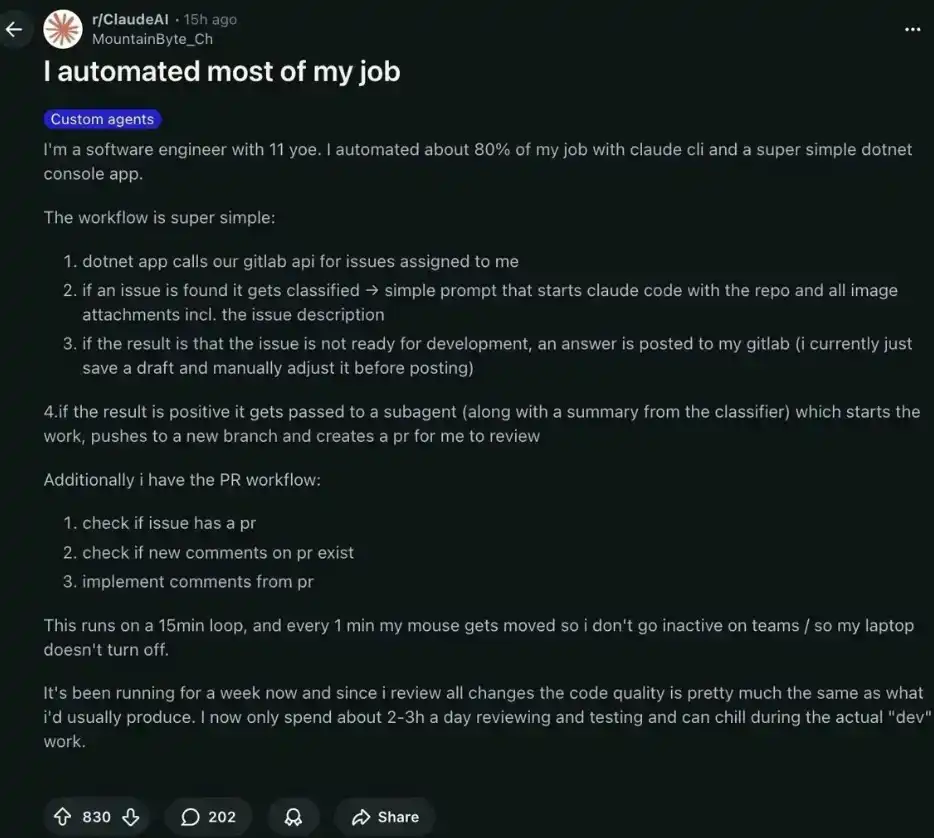
A Google engineer with 11 years of experience automated 80% of his work using Claude Code and a simple .NET application.

Now, he only works 2-3 hours a day instead of the original 8 hours. The rest of the time, he is basically in a "relaxed" state, with the system running on its own, generating $28,000 in passive income for him each month.

What he has mastered is precisely that set of methods you haven't yet learned.

Part 1—Writing CLAUDE.md According to Karpathy's Principles

Andrej Karpathy—one of the world's most influential AI researchers—once systematically summarized the most common mistakes large language models make when writing code: over-engineering, ignoring existing patterns, and introducing unnecessary additional dependencies that no one asked for.
Someone compiled these observations into a unified CLAUDE.md file.

The result: this project gained 15,000 stars on GitHub in a week. In a sense, it can be said that 15,000 people changed their way of working because of it.

The core idea is actually very simple: if errors are predictable, they can be prevented in advance with clear instructions. Just by placing a markdown file in the code repository, you can provide Claude Code with a complete set of structured behavioral rules, thereby unifying decision-making and execution across the entire project.

Inside this file, there are mainly four core principles:

· Think Before Coding → Avoid wrong assumptions and overlooked trade-offs
· Simplicity First → Avoid over-engineering and bloated abstractions
· Surgical Changes → Avoid modifying code that no one asked to change
· Goal-Driven Execution → Test first, then validate against clear success criteria

It doesn't rely on any framework, nor does it require complex tools—just one file can change Claude's behavior at the project level.

The real difference is:

· Without CLAUDE.md: Claude violates specifications about 40% of the time
· Using Karpathy's CLAUDE.md: Violation rate drops to about 3%
· Setup time: Only 5 minutes

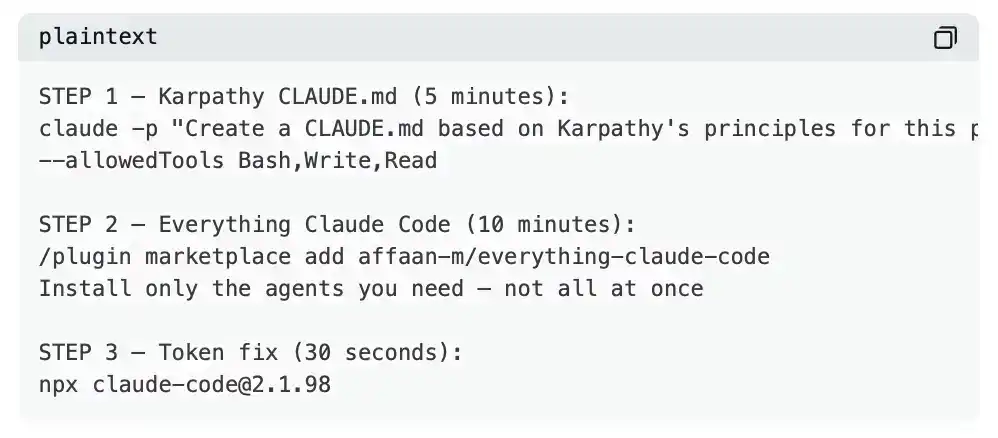
Command to automatically generate your own CLAUDE.md file:

claude -p "Read the entire project and create a CLAUDE.md based on:
Think Before Coding, Simplicity First, Surgical Changes, Goal-Driven Execution.
Adapt to the real architecture you see." --allowedTools Bash,Write,Read

It replaces this kind of Claude: over-engineering simple tasks, introducing unrequested dependencies, and even arbitrarily modifying files that shouldn't be touched.

Part2 Everything Claude Code: A Complete Engineering Team in a Repository

Everything Claude Code (Over 153,000 stars on GitHub)

This is not just a collection of prompts; it's more like a complete AI operating system for building products.
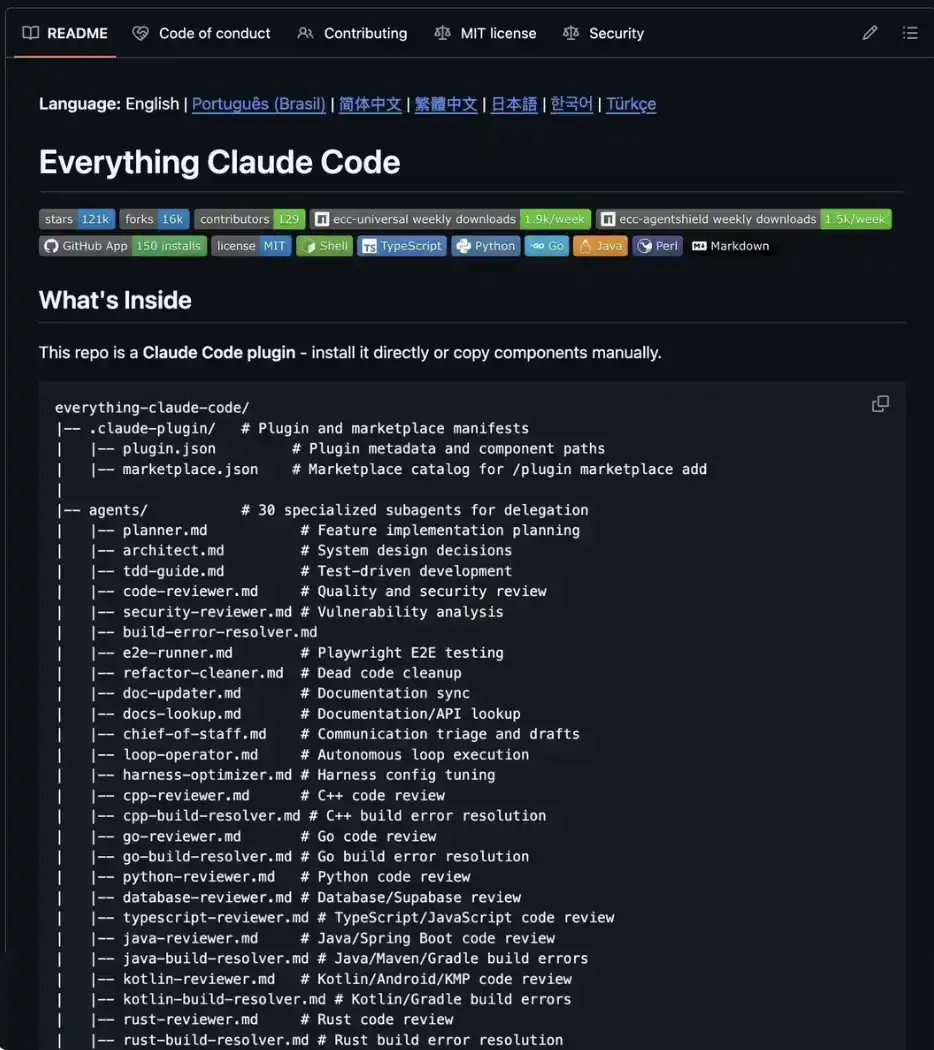
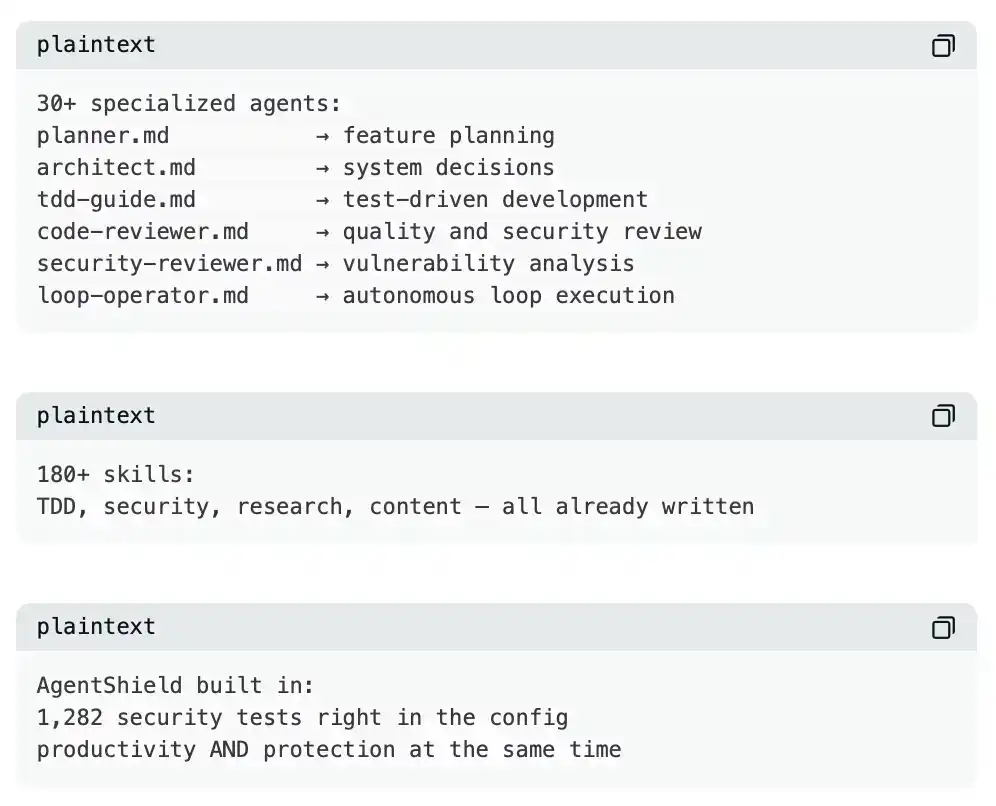
Supports running on Claude, Codex, Cursor, OpenCode, Gemini, and more—one system, usable everywhere.

Installation:

/plugin marketplace add affaan-m/everything-claude-code

Or install manually—just copy the components you need into the project's .claude/ directory. Don't load everything at once—loading 27 agents and 64 skills simultaneously will likely exhaust your context allowance before you even input your first prompt. Only keep what you truly need.

The real difference is:

· Before: You were conversing with an AI
· After: You are managing an automatically running AI engineering team

It replaces: The weeks you would have spent building your own agent system, separately setting up different tools for planning/review/security, and the $200–500 monthly cost for various AI services.

Part3 A Hidden "Scandal": Claude Code v2.1.100 Is Quietly Consuming Your Tokens

Someone set up an HTTP proxy and intercepted and analyzed the complete API requests of 4 different versions of Claude Code.

They found:

v2.1.98: 169,514 bytes request → 49,726 tokens charged
v2.1.100: 168,536 bytes request → 69,922 tokens charged
difference: -978 bytes but +20,196 tokens

v2.1.100 sent fewer data bytes but charged an extra 20,000 tokens. This "inflation" happens entirely on the server side—you can't see it, nor can you verify it through the /context interface.
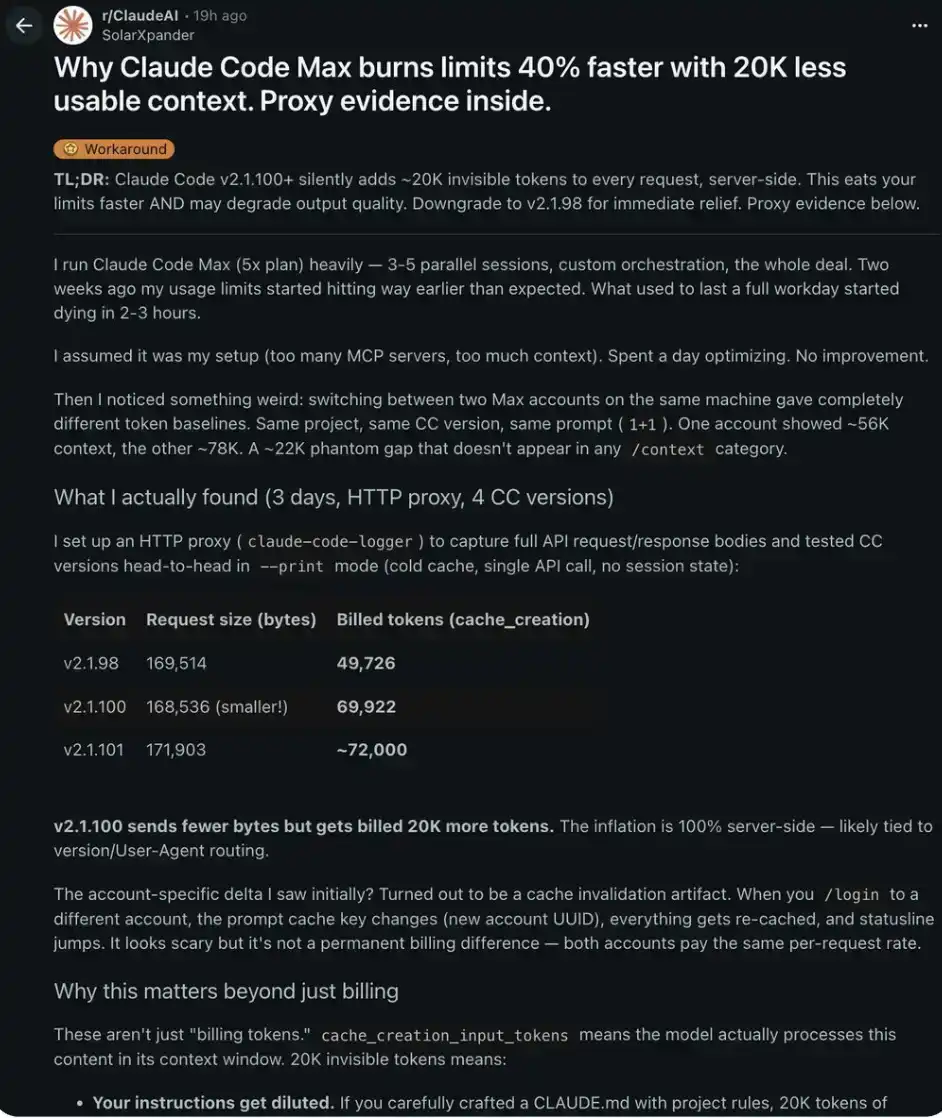
Why this matters beyond billing: these extra 20,000 tokens are stuffed into Claude's actual context window.

This means:

→ Your CLAUDE.md instructions get diluted by these 20,000 "hidden contents"

→ Output quality degrades faster in long conversations

→ When Claude ignores your rules, it's hard to find the cause

→ Claude Max usage allowance is consumed about 40% faster than normal

Fix takes only 30 seconds: npx [email protected]

This is a temporary solution before Anthropic officially fixes the issue, but in practice, you can almost immediately feel the change in session effectiveness.

It replaces: You no longer need to guess why Claude suddenly stops following your instructions.

Case Study: What a Complete Automated System Looks Like

An engineer with 11 years of experience built a system consisting of three parts:
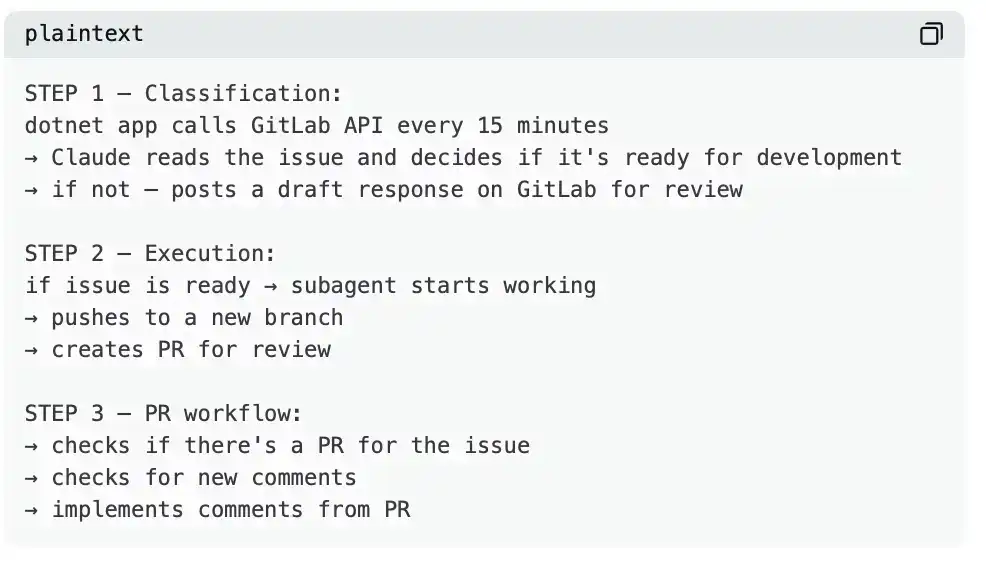
Results after one week:

· Before: 8 hours a day writing code
· After: Only 2–3 hours a day doing code review and testing

· Code quality: Basically unchanged—because he reviews each one
· Teams status: Always online—mouse moves automatically every minute
· Remaining time: Free to use all day

This isn't some "magic"; it's the result of CLAUDE.md + the right agents + a loop mechanism running every 15 minutes.

Complete checklist:
What you gain after reading this:

· Before: Claude violated existing specifications 40% of the time
· After: Using Karpathy's CLAUDE.md, violation rate dropped to 3%

· Before: You needed weeks to build agents
· After: 27 agents ready to use out-of-the-box

· Before: Claude Max exhausted its allowance in 2–3 hours
· After: Downgrading to v2.1.98 recovers about 40% of the usage limit

· Before: Needed 8 hours a day to write code
· After: Only 2–3 hours for review, the rest runs automatically

· Setup time: 15–20 minutes
· Daily savings: 5–6 hours
· Monthly savings: 100–120 hours

If your time is worth $30 per hour—you are "invisibly losing" $3000–3600 every month.

If it's $100 per hour—that's $10,000–12,000 flowing away monthly, just because you're still manually writing code that Claude could have done itself.

Most developers will never reach this level—not because they can't, but because they think it's complicated. In reality, between you and "full automation," there are only three commands and one file.

The engineer I mentioned at the beginning isn't some genius, nor is he a senior engineer from Google. He just spent one evening setting up the system—since then, the system does the work, and he lives his life.

You can do the same thing tonight. While others are still arguing whether AI will replace developers, those who have already set up the system are just collecting money and relaxing.

The choice is clear. You are building your own life—so choose the right path.

Related Questions

QWhat is the core concept behind the CLAUDE.md file mentioned in the article?

AThe core concept of the CLAUDE.md file is to provide a structured set of behavioral rules for Claude Code, based on principles like 'Think Before Coding', 'Simplicity First', 'Surgical Changes', and 'Goal-Driven Execution'. This file helps prevent common AI coding errors by setting clear, project-wide instructions, reducing violation rates from around 40% to just 3%.

QHow does the 'Everything Claude Code' system transform the developer's role?

AThe 'Everything Claude Code' system transforms the developer's role from directly coding and interacting with AI to managing an automated AI engineering team. It includes multiple agents and skills that handle tasks like planning, reviewing, and security, allowing the developer to focus on oversight and results rather than manual execution.

QWhat hidden issue was discovered with Claude Code v2.1.100, and what was its impact?

AClaude Code v2.1.100 was found to silently consume approximately 20,000 extra tokens per request compared to v2.1.98, despite sending fewer bytes. This 'hidden inflation' dilutes instructions from files like CLAUDE.md, reduces output quality in long conversations, and depletes usage limits about 40% faster, without any visible indication to the user.

QWhat were the key components of the automated system built by the Google engineer?

AThe automated system built by the Google engineer consisted of three main parts: a CLAUDE.md file for rule-based AI behavior, a set of tailored AI agents from the 'Everything Claude Code' repository, and an automated loop that ran every 15 minutes to handle coding, testing, and review processes with minimal human intervention.

QWhat time and financial benefits did the engineer achieve by automating 80% of his work?

AThe engineer reduced his daily work from 8 hours to just 2-3 hours, saving 5-6 hours per day and 100-120 hours per month. This automation generated $28,000 in monthly passive income. If valued at $30 per hour, this saves $3,000-$3,600 monthly; at $100 per hour, it saves $10,000-$12,000 monthly.

Related Reads

Must-Watch Events Next Week|CLARITY Act Could Face Senate Vote; SpaceX, Circle to Report Earnings (8.3-8.9)

**Summary: Key Events and Developments to Watch (August 3-9)** The upcoming week is marked by significant financial disclosures, key legislative deadlines, and notable product updates. **Major Financial Events:** Several companies are scheduled to release their Q2 2026 earnings. American Bitcoin (ABTC) will report on August 3, followed by SpaceX and Hut 8 Mining Corp. on August 4, and Circle on August 5. Notably, a significant portion of SpaceX shares (up to 12% of total shares) will be unlocked on August 6 following their earnings release. **Key Legislative Deadline:** The U.S. Senate faces an August 7 deadline to secure 60 votes for the CLARITY Act, a bipartisan bill aiming to establish a federal regulatory framework for cryptocurrencies. The Senate may hold a full vote on the bill during the week. **Economic Data:** The U.S. July Non-Farm Payrolls report will be released on August 7, providing crucial labor market data. **Technology & Product Updates:** * **Shutdowns:** DeFi portfolio tracker Zapper and wallet app Ctrl Wallet will cease operations on August 3. * **Upgrades:** LayerZero will deprecate its v1 relayers on August 3. XRP Ledger's new version 3.3.0, featuring five new functions, is expected next week. * **AI:** Elon Musk announced that the advanced Grok 4.6 AI model is set for release around August 7. * **Bitcoin:** The BIP-110 forced signaling for a potential Bitcoin network change is scheduled to begin around August 8. **Other Notable Events:** Chinese robotics firm Unitree Tech has set its preliminary price inquiry for its IPO for August 5. South Korean exchange Upbit will delist AQT and AERGO tokens on August 3.

marsbit57m ago

Must-Watch Events Next Week|CLARITY Act Could Face Senate Vote; SpaceX, Circle to Report Earnings (8.3-8.9)

marsbit57m ago

Stocks Are Plummeting More Sharply Than Cryptocurrencies. Where Has the Money Gone?

Stock Markets Plunge Deeper Than Cryptocurrencies: Where Did the Money Go? In late July, Seoul's Kospi index triggered circuit breakers for two consecutive days, plummeting over 40% from its June high. The collapse was led by heavyweight stocks like SK Hynix, whose record profits still disappointed investors, and devastating leveraged ETFs, with one major product losing over 83% of its value. This signaled a global, forced deleveraging targeting the most crowded trades. Interestingly, while stocks exhibited extreme volatility akin to crypto markets, Bitcoin rose nearly 15% in July after a prior steep drop. Analysis shows the money fleeing equities did not flow into Bitcoin. Instead, Bitcoin had already absorbed its sell-off in May-June, when U.S. spot Bitcoin ETFs saw historic outflows. The true safe-haven beneficiary was gold, whose price rose over 20% year-on-year, highlighting a decoupling between Bitcoin and gold as "digital gold." The sell-off was a targeted unwinding of leveraged positions in tech and semiconductors, accelerated by broker-dealer risk management and shifts in the AI narrative, including new competition from Chinese memory chipmakers. The retreat path was clear: from high-valuation tech stocks to cash and U.S. Treasuries, then to gold. For Bitcoin to attract sustained institutional inflows, conditions like eased global liquidity pressure, a "soft-landing" Fed rate cut, and U.S. regulatory clarity via legislation like the stalled CLARITY Act are needed. Currently, Bitcoin is not a safe haven but an already-cleared asset. Its low correlation with tech stocks, however, makes it a potential diversification play for institutional portfolios once the storm passes. The money isn't here yet, but the positioning is underway.

marsbit57m ago

Stocks Are Plummeting More Sharply Than Cryptocurrencies. Where Has the Money Gone?

marsbit57m ago

In Conversation with Ray Dalio: We Are Currently in an AI Bubble, with 1% of My Portfolio in Bitcoin

Ray Dalio, founder of Bridgewater Associates, warns in an interview that the current AI boom shows classic bubble characteristics, which could lead to significant economic downturns as seen in past cycles like 1929 or 2000. He explains that speculative enthusiasm, fueled by debt and overvaluation, often precedes a crash when rising rates or taxation force asset sales, causing widespread losses and recession. Dalio also outlines his "Big Cycle" theory, describing an approximate 80-year pattern where widening wealth gaps, massive government deficits, and shifting geopolitical power (like China's rise) create internal conflict and global instability. He emphasizes that we are in a late-cycle, transitional phase where traditional powers like the US and UK face decline. For personal wealth protection, Dalio advises diversification beyond cash into assets like stocks, bonds, real estate, and particularly gold, which he prefers over Bitcoin. While he holds about 1% of his portfolio in Bitcoin as a non-printable hard asset, he views gold as more secure from technological or governmental threats. Regarding AI's impact, Dalio believes it will disproportionately benefit capital owners, worsening inequality by replacing both physical and cognitive labor. He suggests that human intuition and emotional intelligence, combined with AI, will be key for future workers. On taxation, Dalio argues that wealth taxes are impractical and risk triggering asset sell-offs, reducing productive investment. He points to the UK as a cautionary example of debt, low productivity, and political strife. Geopolitically, Dalio foresees a more regionalized world, with the US showing weakness in prolonged conflicts like with Iran, akin to past imperial declines. The ideal outcome, he suggests, is coexisting powerful blocs (e.g., Americas, China-Asia Pacific) without major war.

marsbit4h ago

In Conversation with Ray Dalio: We Are Currently in an AI Bubble, with 1% of My Portfolio in Bitcoin

marsbit4h ago

Daily 7.2 Trillion KRW: Foreign Capital's Record Net Buying on Friday! Wall Street Says Headwinds for Korean Stock Fund Flows Have Subsided

South Korean stock market sees a dramatic shift in fund flows. On July 31, foreign investors made a record net purchase of approximately KRW 7.2 trillion in KOSPI stocks, marking a fundamental reversal from the persistent large-scale net outflows seen in previous months. This contributed to a significant narrowing of foreign net selling in July to KRW 9.8 trillion, down sharply from KRW 48.4 trillion in June and KRW 44.5 trillion in May. Simultaneously, domestic institutional pressure eased. South Korean pension funds and asset managers turned to a net buying position in July, purchasing KRW 1.0 trillion worth of KOSPI shares, contrasting with net sales in May and June. Market volatility is expected to be dampened by new financial regulations. Effective July 31, the Financial Services Commission tightened access for retail investors to single-stock leveraged ETFs by raising the minimum cash deposit requirement. Trading volumes for these products subsequently dropped to about 50% of their monthly average. Citigroup Research maintains its year-end KOSPI target of 10,000 points. The firm cites several supportive factors: the substantial easing of headwinds from capital outflows, a robust fundamental outlook for the semiconductor sector, historically low market valuations, strong economic fundamentals, and the potential for policy support from financial authorities if needed.

marsbit4h ago

Daily 7.2 Trillion KRW: Foreign Capital's Record Net Buying on Friday! Wall Street Says Headwinds for Korean Stock Fund Flows Have Subsided

marsbit4h ago

Trading

Spot
活动图片





