Author: Deep Tide TechFlow
There are less than 10 days left in 2025.
They say a day in the crypto world feels like a year in the human world. But those truly immersed in it might relate more to this:
This year passed too quickly, so fast that events from the beginning of the year now feel like they happened three years ago.
How was your harvest this year? Did you catch a few waves of opportunities, or were you taught a lesson by the market in a certain month? Is that coin you went all-in on at the beginning of the year still around? Which month was it when that narrative had you hooked?
Many answers are probably already blurry.
Memory in the crypto market is too short; a hot topic from three months ago is no longer mentioned today, and the confident judgments made back then are now too embarrassing to look back on.
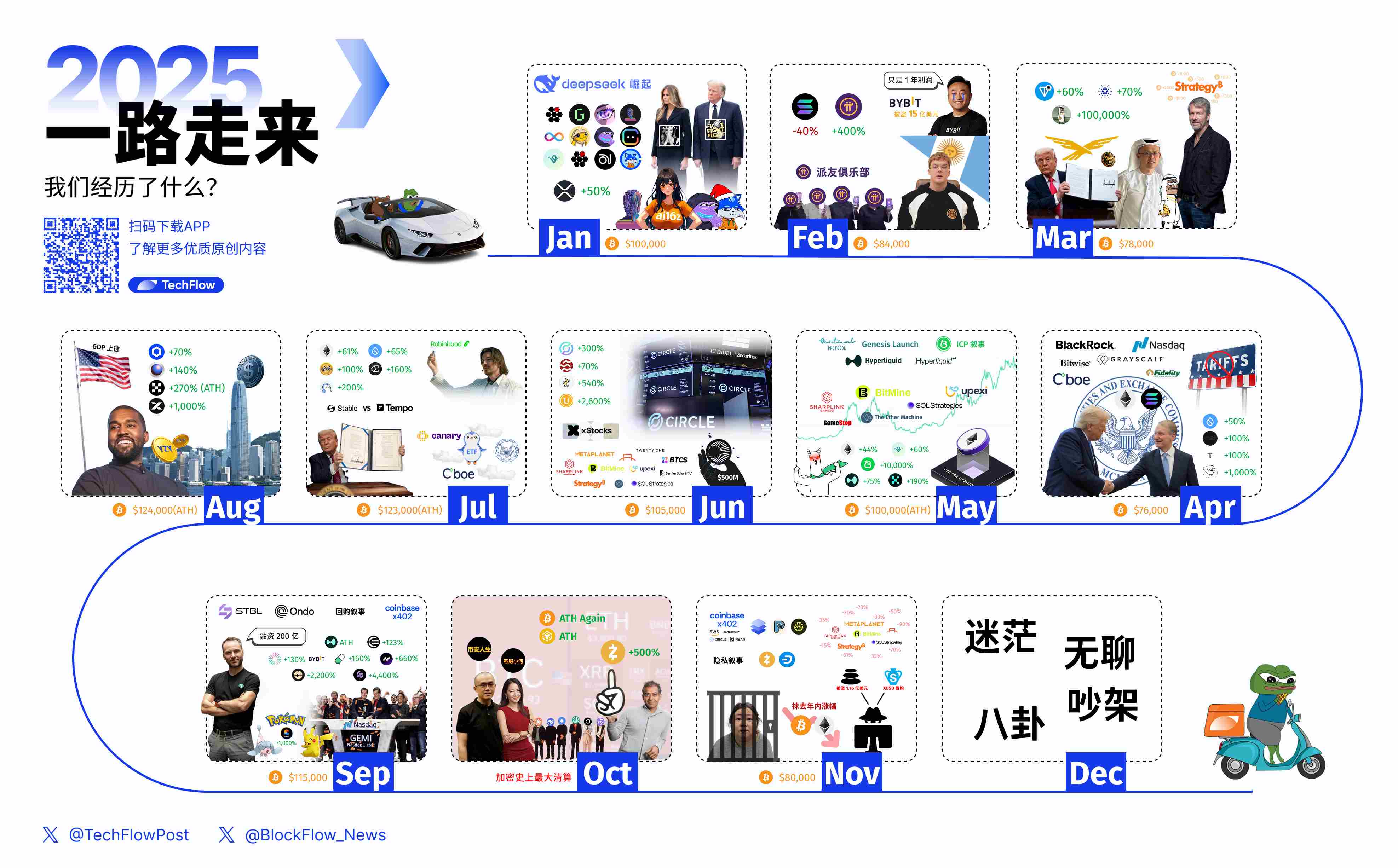
We've compiled a complete market record for 2025, month by month,还原ing: what happened at the time, which coins pumped, what everyone was talking about.
No predictions, no judgments, just helping you recall what we actually went through this year.
January: The Highlight Moments of AI Coins and TRUMP
Keywords: AI Agent, Political Meme, Optimism, and the First Cooldown at Month-End
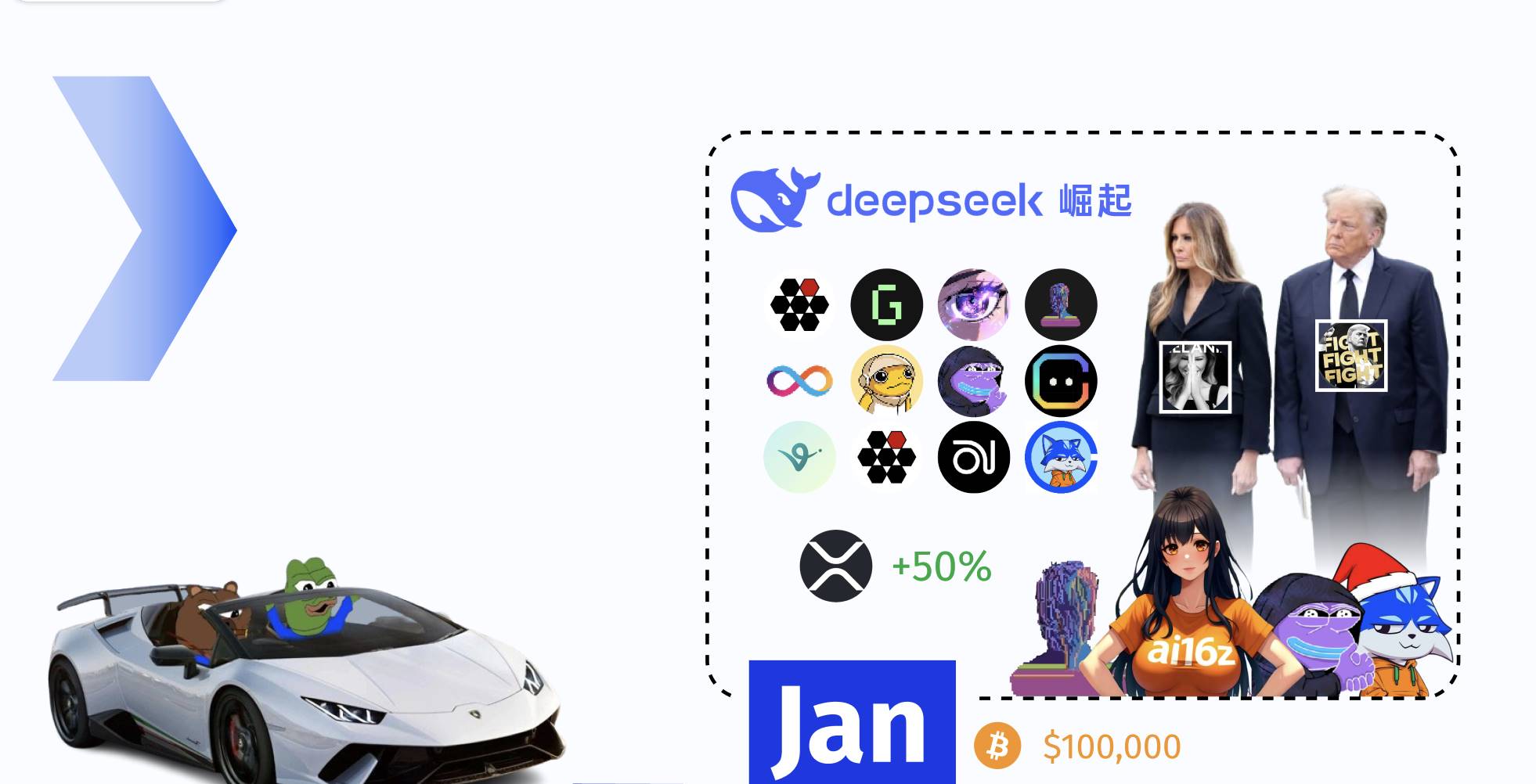
The protagonist of January was AI Agent.
AI16Z reached its all-time high of $2.47 on January 2nd, with its market cap surging to $2.5 billion, becoming the first AI token on Solana to break this milestone. AIXBT, ARC, ZEREBRO, GRIFFAIN...... these names were mentioned almost daily back then.
Political Memes were equally eye-catching. On January 17th, the official $TRUMP token launched, pumping from under $1 to its all-time high of $75 within two days, with its market cap once exceeding $14 billion.
The editor vaguely remembers the shock of waking up to see TRUMP's疯狂拉升 (crazy pump). At the time, everyone was also doubting if it was officially issued. Later, as the information was confirmed, the President issuing a coin became a first in this industry.
Additionally, XRP rose 50% that month due to news of Ripple executives meeting with Trump's team, and the market began betting it would be among the first altcoins to get an ETF approved.
On the macro level, Trump signed an executive order on January 23rd: establishing a digital assets task force, exploring a national crypto reserve, and prohibiting the US from issuing a CBDC. Market sentiment was once very optimistic.
But the wind changed at the end of the month. Around January 20th, DeepSeek released a low-cost AI model, directly impacting the crypto AI Agent narrative; many Agents seemed more like toys for playing house in comparison.
Many of those AI concept coins that had just pumped fell back to their starting points in the following weeks.
February: LIBRA Scam, Bybit Hacked
Keywords: Bybit Hack, $LIBRA Scam, Great Liquidation
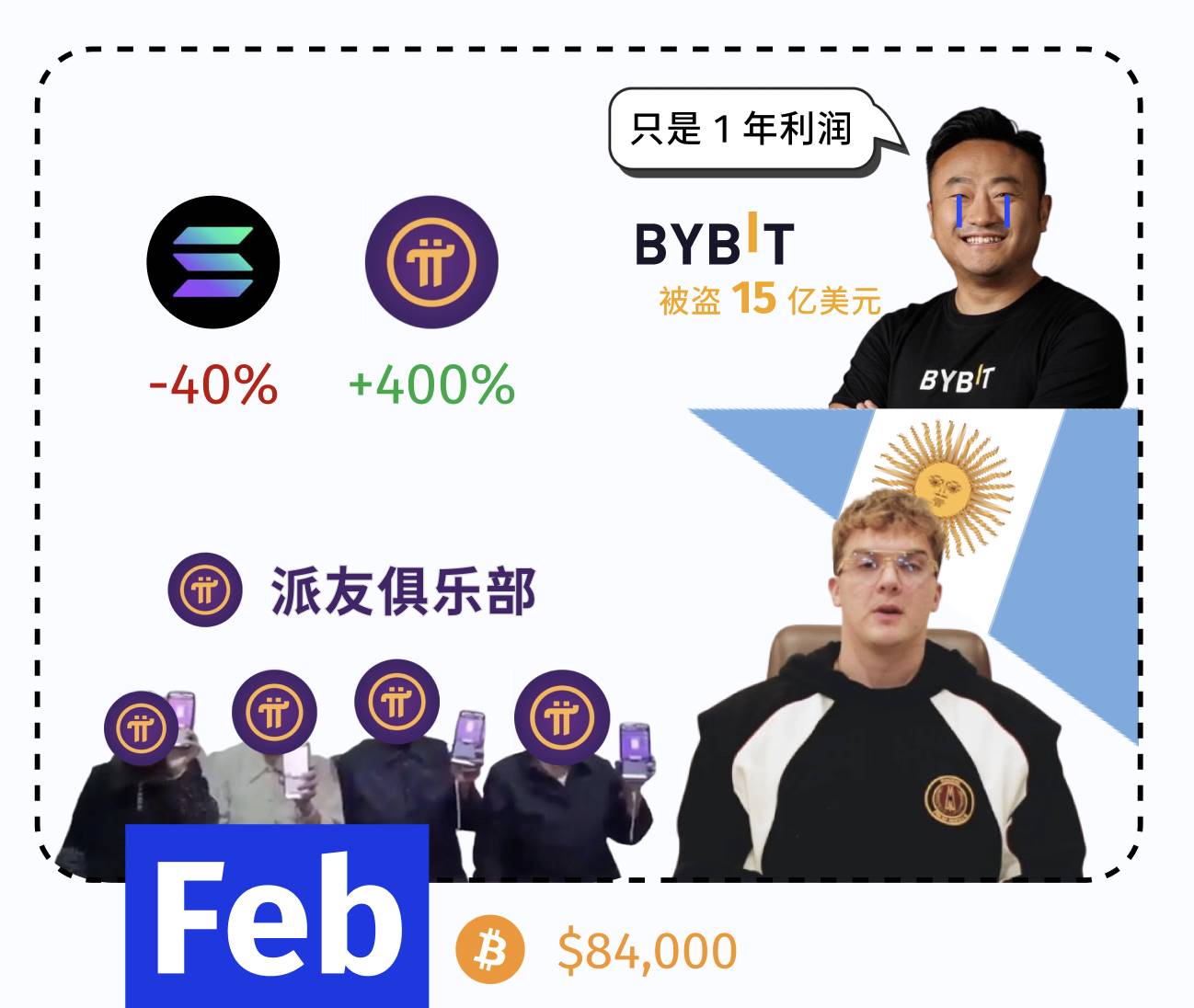
On February 21st, Bybit suffered the largest cryptocurrency theft in history. North Korean Lazarus hackers transferred approximately 400,000 ETH (worth about $1.5 billion) to addresses they controlled.
This was larger than the losses during the FTX collapse and far exceeded any previous exchange hack event.
Simultaneously, trust in political memes彻底崩塌 (completely collapsed) this month. On Valentine's Day, February 14th, Argentine President Milei posted about a coin on social media; the token surged to $5 within 40 minutes, with its market cap hitting $4.5 billion. Hours later, the price crashed 85%, causing over 40,000 investors losses exceeding $250 million.
Subsequently, Milei deleted the post and denied involvement. TRUMP and his wife's同名币 (namesake coins) also gradually declined this month.
From February 24th to 27th, Bitcoin experienced its most brutal three days since the 2022 FTX collapse, dropping 12.6%, with nearly $3 billion in leveraged positions liquidated.
The Meme coin sector was halved overall, Solana's TVL plummeted 30%, falling to its lowest level since last November.
There was an exception, however. Pi Network officially launched its mainnet on February 20th, with the token最高涨到 (reaching a high of) $2.98, sparking discussions about "ground promotion coins finally cashing out".
March: Strategic Reserve to the Left, Tariff Panic to the Right
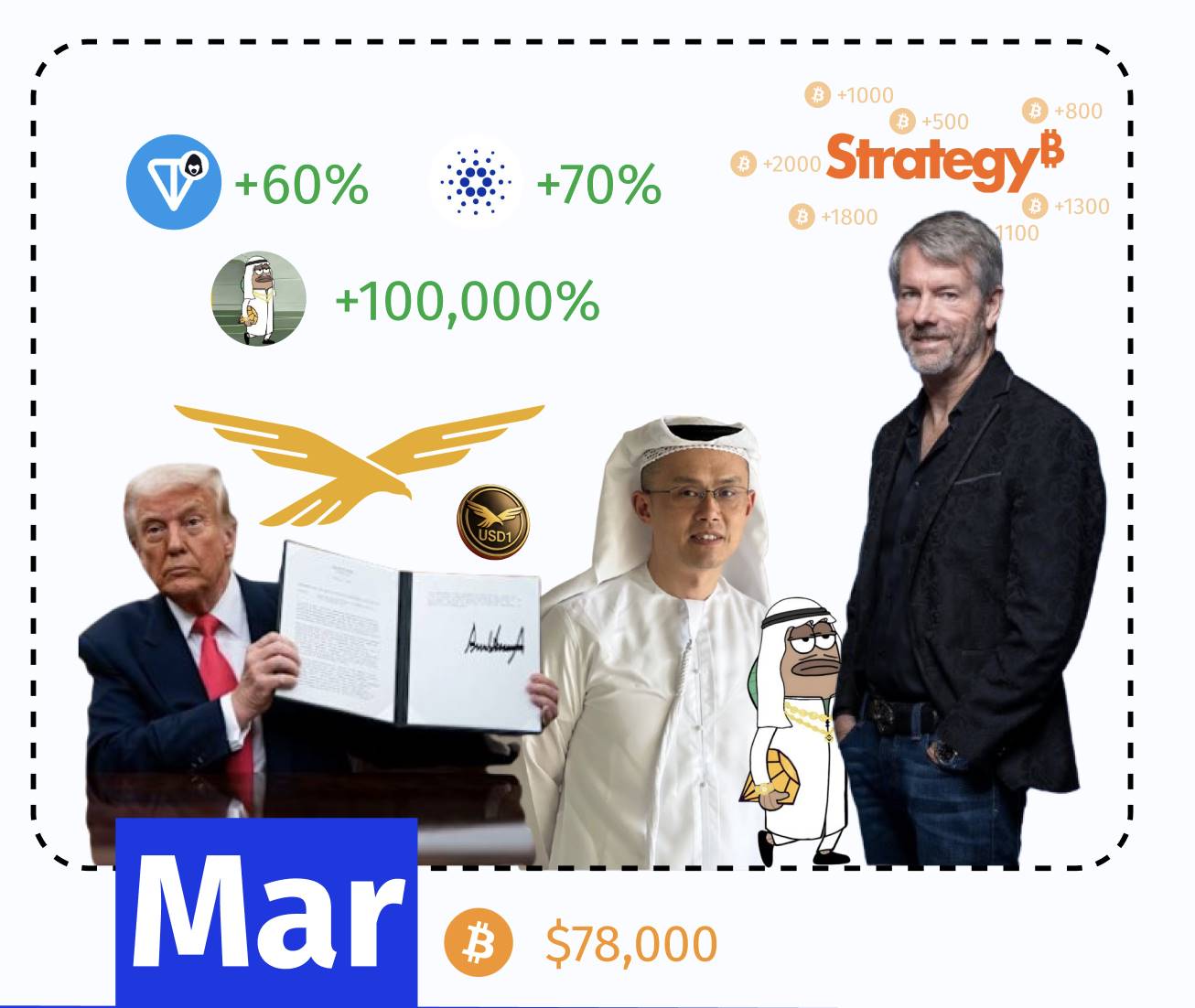
Keywords: Strategic Reserve, Tariff Panic, Meme Crash, MicroStrategy
March was when policy benefits began to show. Trump held the first-ever crypto summit at the White House, signing an executive order on site to establish a "Strategic Bitcoin Reserve".
A few days earlier, he announced on Truth Social that XRP, SOL, and ADA would also be included in the digital asset reserve. ADA surged 70% in a single day, breaking through $1. The market一度认为 (once believed) the regulatory attitude had彻底转向 (completely turned around).
But policy benefits couldn't hold up the market. Trump's tariff threats triggered trade war恐慌 (panic), leading to widespread selling of risk assets. The Meme sector experienced a collective crash: overall down 40-60%,
BSC chain意外成了 (unexpectedly became) a safe haven. The Middle East-themed Meme coin Mubarak pumped thousands of times after CZ shilled it multiple times. BSC chain transaction volume once surpassed Solana's.
Meanwhile, the biggest trust crisis in March happened at Hyperliquid. An attacker shorted the JELLY token, manipulating the price and causing the HLP treasury to face about $12 million in losses. Hyperliquid's response was to vote to delist the token and force settlements, a "decentralized exchange" handling a crisis centrally. This made many people start re-examining the definition of a DEX.
Off-chain, (Micro)Strategy continued buying. On March 18th, it announced issuing $500 million in preferred stock specifically for buying BTC. The faith of Bitcoin accumulators remained firm.
April: Policy Shift, Sentiment Repair
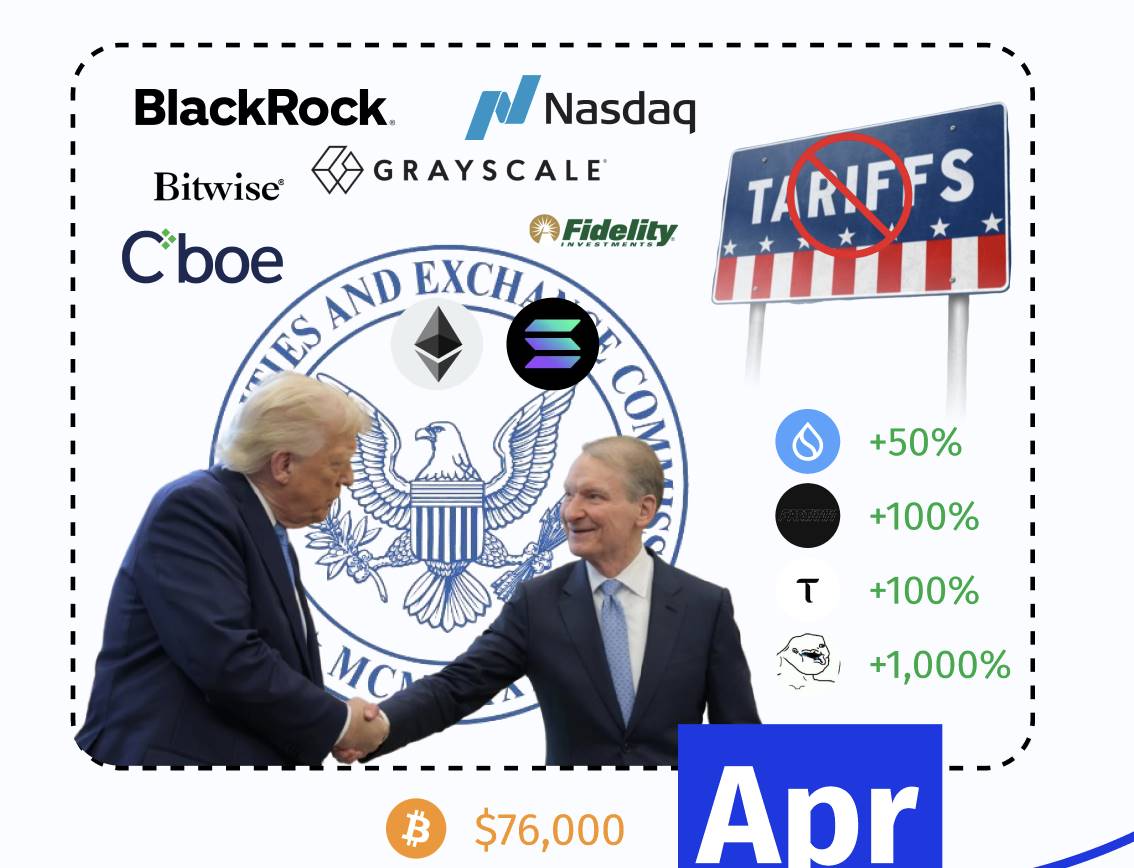
Keywords: Tariff Suspension, Regulatory Shift, SOL ETF, Sentiment Reversal
April was a month of sentiment repair.
On the 9th, Trump announced a 90-day tariff suspension. Upon the news, the S&P 500 surged 9.5% in a single day, its largest daily gain since 2008; the same day, the SEC approved ETH ETF options, further完善 (perfecting) institutional allocation tools.
Simultaneously, the new SEC Chairman Paul Atkins took office, and his pro-crypto attitude gave the market hope.
The total crypto market cap rebounded 10.8% that month. Bitcoin recovered from a low of $76,000 to break through (break through) $90,000 by month-end.
Canada launched the world's first batch of Solana spot ETFs that month. SUI benefited from news of a Grayscale trust and Mastercard partnership, gaining over 50% for the month.
Meme coins also came back to life. Fartcoin rebounded hundreds of times from the bottom to become the rebound leader. RFC (dubbed "Musk's mouthpiece") rose thousands of times.
After the brutal洗礼 (baptism) of February and March, April was the first time many felt "we're back".
May: We're So Back!
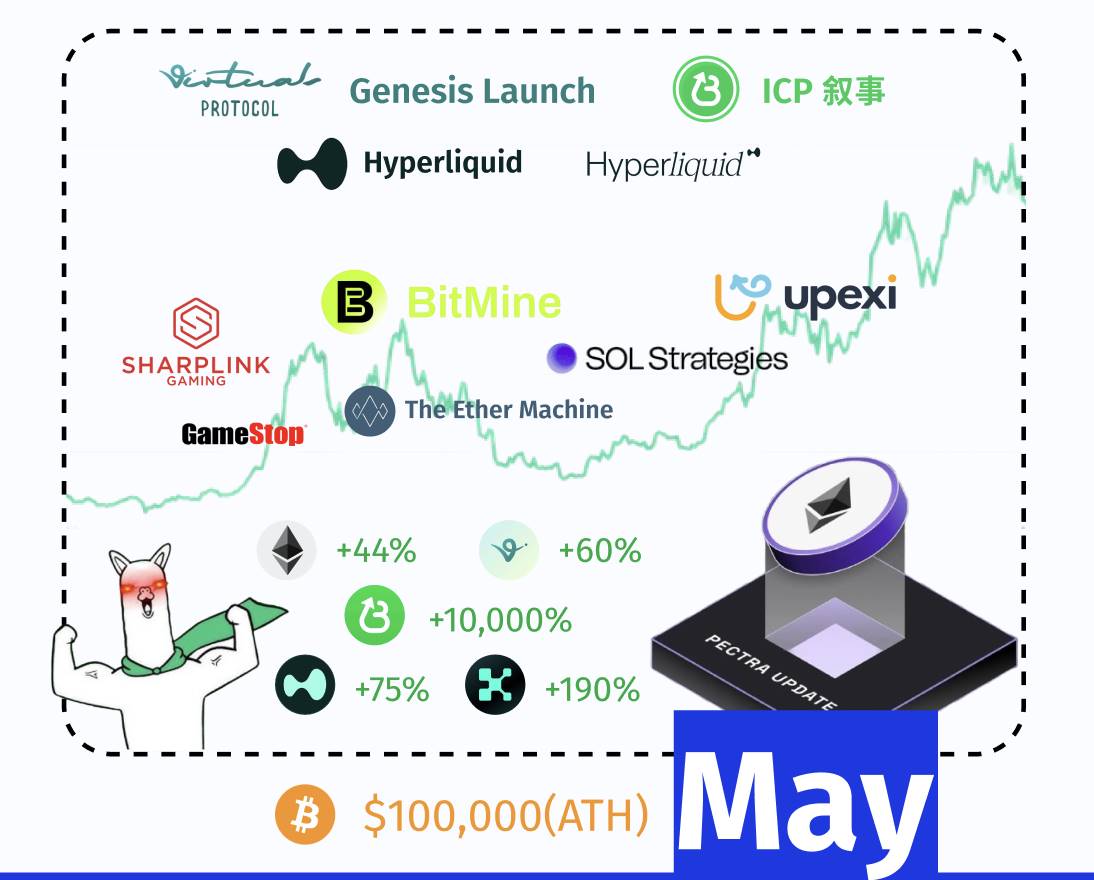
Keywords: All-Time High, Sino-US Détente, DAT Narrative, ICP, Hyperliquid
May was the most euphoric month of 2025 so far.
On the 2nd, China and the US reached a 90-day tariff suspension agreement, temporarily dispersing the clouds of trade war. Risk assets rebounded across the board.
On the 7th, Ethereum completed the Pectra upgrade, its largest hard fork since the Merge in 2022. Although not immediately reflected in the price, ETH rose 44% that month, and market sentiment明显转暖 (clearly warmed).
On the other side, Bitcoin broke through $110,000 to set a new all-time high. Everything was back. The crypto market began blooming on multiple fronts:
The "Digital Asset Treasury" (DAT) narrative for listed companies continued to heat up. GameStop, SharpLink Gaming, etc., began their BTC and ETH buying journeys, replicating (Micro)Strategy's model.
On-chain, new玩法 (play styles) emerged endlessly. The Believe platform blew up. Users只需 (only needed) to @launchcoin on X加上代币名称 (plus the token name) to launch a coin with one click, birthing the so-called ICP narrative (Internet Capital Market); the platform token LAUNCHCOIN surged that month.
Virtuals Protocol launched the Genesis Launch pad, reigniting the AI token launch热潮 (craze). VIRTUAL rose 60%. Kaito's Yap Points reward system brought new heights to on-chain social, its token涨了 (rose) 190%. 嘴撸 (Airdrop farming via social interaction/chat) began to be widely regarded as a mainstream airdrop farming method.
And Hyperliquid's token HYPE rose 75% that month. The Chinese crypto circle, realizing later, began热烈讨论 (heatedly discussing) the new model of DEXs and the so-called "human efficiency ratio" – Hyperliquid creating massive profits with极少的员工 (very few employees).
May was good to everyone. Everything was finally alive again.
June: DAT Heats Up, Stablecoin Carnival
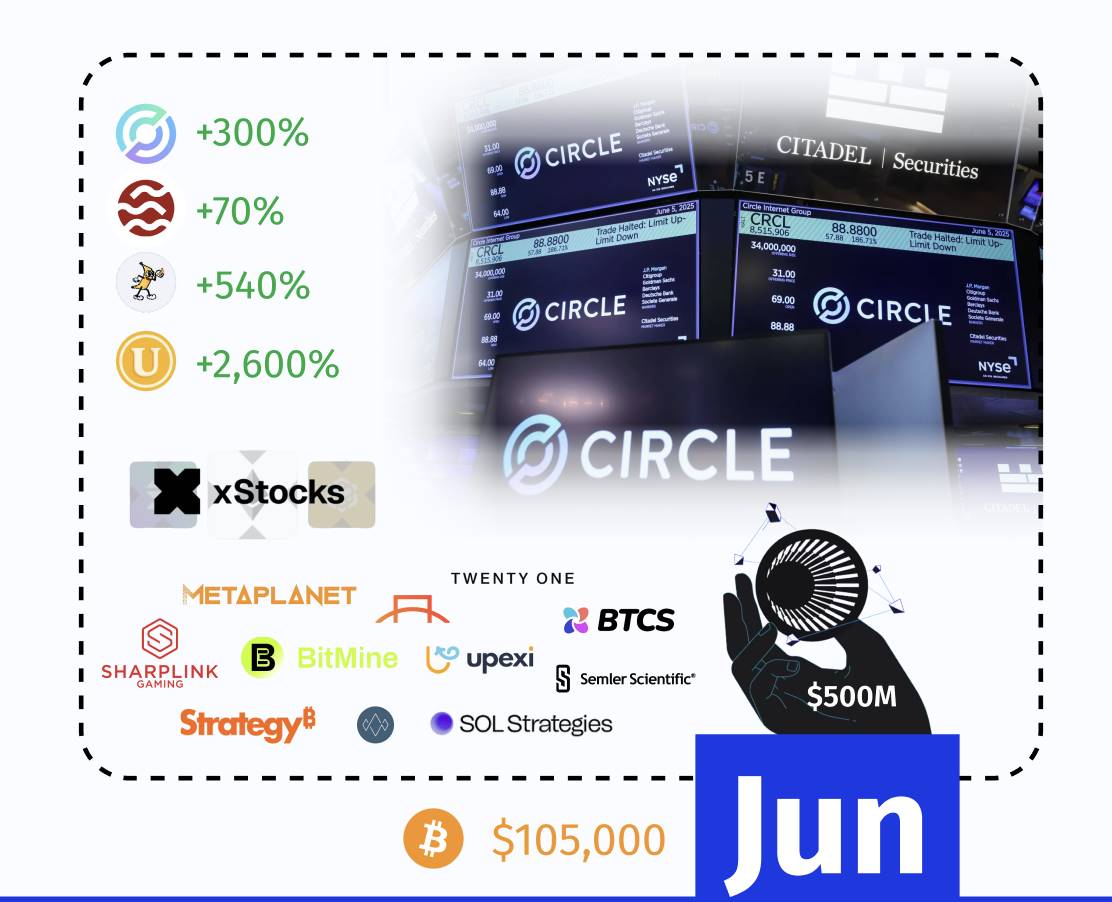
Keywords: Circle Listing, DAT Expansion, Stock Tokenization
In June, the stablecoin narrative彻底爆发 (completely exploded).
On June 5th, Circle rang the bell on the NYSE, ticker CRCL. IPO priced at $31, oversubscribed 25 times. On June 23rd, the stock price hit its historical high of $298.99, rising nearly nine times from the IPO price.
This was a highlight moment for crypto-native companies in US stocks and a landmark event for the stablecoin track gaining traditional capital recognition.
Four days later, another stablecoin project created an even bigger stir. Plasma launched its public sale on Cobie's Sonar platform, raising $500 million within 5 minutes.
The cap was raised to $1 billion that day, filled in 30 minutes. Tether CEO, Peter Thiel, Bybit were all early investors. The market's狂热 (fanaticism) for "stablecoin infrastructure" exceeded all expectations.
The DAT narrative continued发酵 (ferment). (Micro)Strategy kept buying. Metaplanet bought 1,088 BTC in a month. DeFi Development Corp announced obtaining a $5 billion equity financing line specifically for increasing SOL holdings, calling itself the "SOL version of MicroStrategy". SharpLink Gaming continued adding to its ETH position, increasing holdings to 188,000 ETH.
On the 30th, another new narrative quietly started: US stock tokenization.
Kraken and Bybit simultaneously launched xStocks. 60+ US stocks (Tesla, Nvidia, Apple, Microsoft, etc.) traded in tokenized form on Solana.
Meanwhile, Hyperliquid solidified its position as the老大 (boss) of on-chain derivatives trading. Ethereum staking reached an all-time high. The Meme sector also had highlights; BANANAS31 started its暴涨 (surge). USELESS, because its name was absurd and useless enough, also rose over 2000%.
July: GENIUS Act Lands, BTC & ETH Both Hit New Highs
Keywords: GENIUS Act, BTC/ETH ATH, Tokenization Expansion, Stablecoin Chains
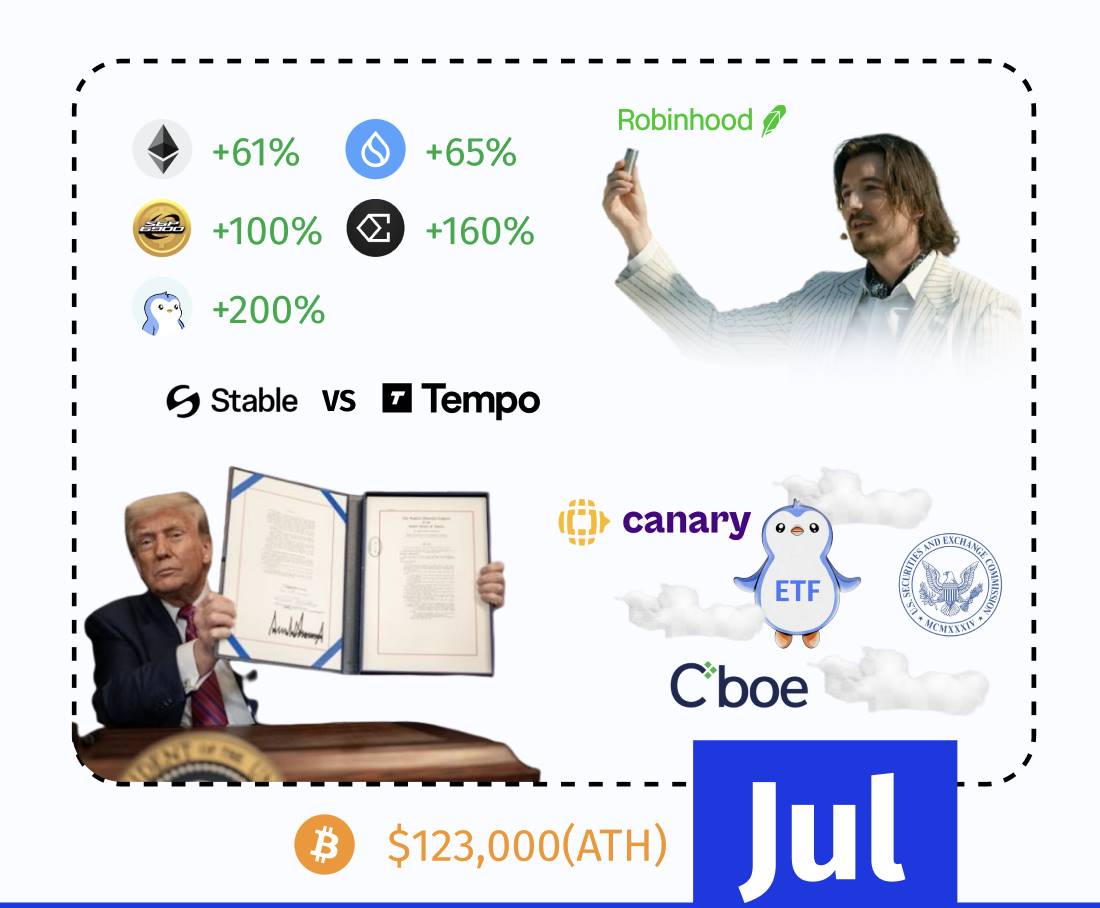
On July 18th, Trump signed the《GENIUS Act》, the first federal regulatory law for stablecoins in US history.
Bitcoin wasn't idle either. It started breaking out on July 10th, surging to a historical high above $120,000 on July 14th. ETF单日流入 (single-day inflows) hit a record of $1.2B.
ETH also went on a rampage, setting a 2025 high of $3,848 on July 21st.
Simultaneously, the tokenization narrative heated up further. Robinhood released 200+ tokenized US stock trades, running on Arbitrum, including private equity tokens for OpenAI and SpaceX.
PENGU also made a big move, submitting a PENGU ETF application; this might be the world's first ETF to include NFTs.
The stablecoin chain war also commenced. "Stable", supported by Tether and Bitfinex, announced its roadmap on July 1st, competing with the later Tempo and Circle's own Arc.
Regarding Meme coins, SPX6900 rose 100%+, the old stablecoin project ENA rose 160%+. Everything was still pretty good.
August: OKB Explodes, BTC Hits New High Again
Keywords: Exchange Token Breakout
The feeling in August was "not bad".
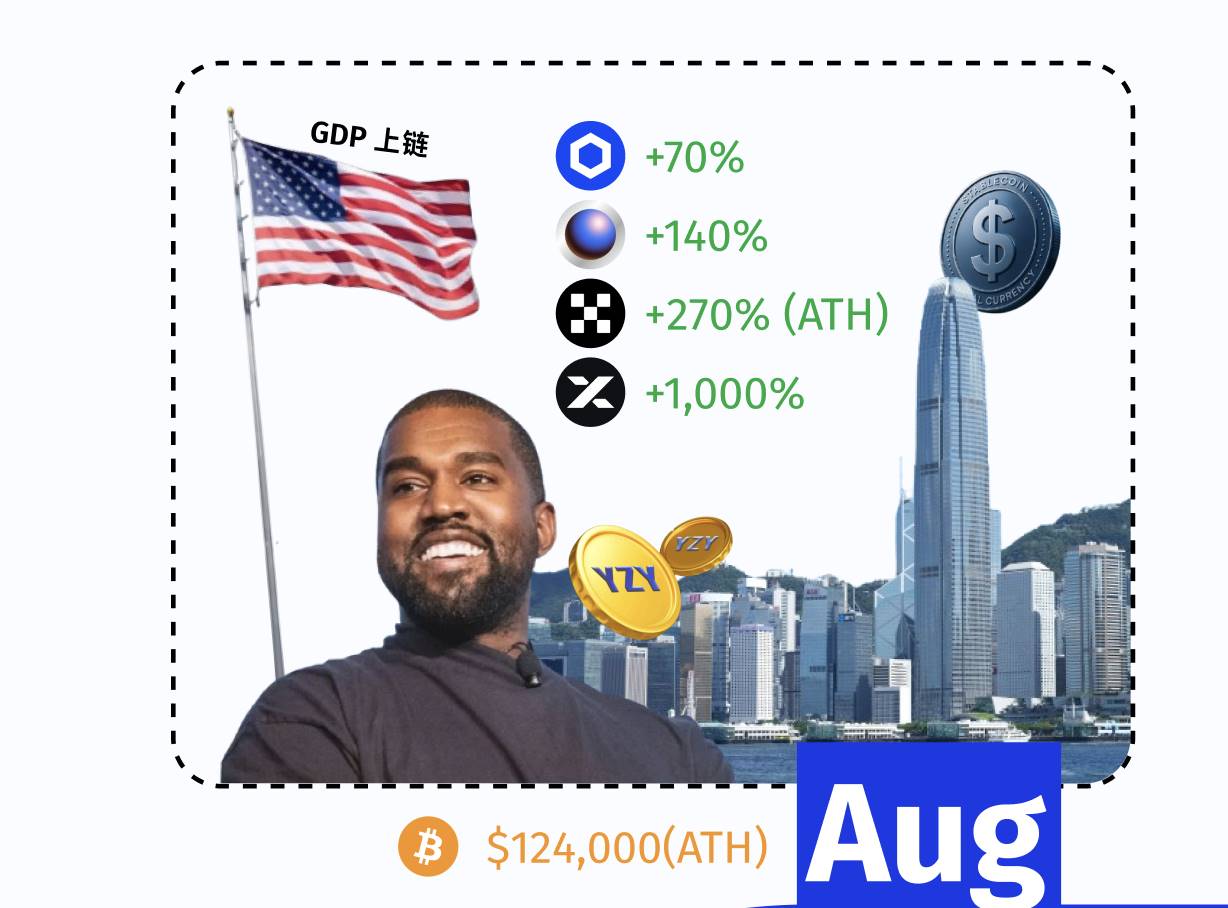
BTC hit a new high of $124,000 mid-month before pulling back, closing around $108,000 at month-end. But the altcoin market was火热 (hot), especially exchange tokens which became the biggest winners.
On August 13th, OKX announced a one-time burn of 65.25 million OKB, locking the total supply at 21 million from 300 million;同时升级 (simultaneously upgrading) the X Layer chain. Upon the news, OKB rose 170% that day to set a new high of $148, later continuing to surge to $255, up nearly 400% from the bottom.
Meanwhile, MNT (Mantle) was integrated into the Bybit exchange, primarily as an RWA chain. In the future, MNT will be used as a transaction fee token on Bybit, similar to a platform token.
On the 28th, the US Department of Commerce announced cooperation with Chainlink and Pyth to put macroeconomic data like GDP, PCE on-chain; the news pushed LINK up about 61% in August, PYTH飙升涨 (soared) 70%+ that day.
Hong Kong's stablecoin regulation also officially landed. The《Stablecoin Ordinance》 took effect on August 1st, with the HKMA opening license applications. Many domestic companies like JD.com were eager to try (though they later gave up for certain reasons).
Of course, there was少不了 (no lack of) drama with celebrity coins. On August 21st, Kanye West (Ye) launched the YZY token on Solana. It rose 1400% to $3 within 1 hour, FDV once hitting $3 billion, and then...... crashed 80%, gradually归零 (going to zero).
Kanye claimed his Instagram was hacked and the promotion was for a fake coin. Regardless of the truth, another celebrity coin became a classic case of "fans footing the bill".
The SocialFi track's ZORA also had a moment, riding the integration with Coinbase's Base App and the Creator Coins热潮 (craze), gaining over 100% in August, once hitting an ATH of $0.15.
Pump.fun also复苏 (recovered), recapturing most of the Solana launchpad market share, with August revenue of $46 million.
September: Fed Rate Cut, ASTER Rises
Keywords: Rate Cut, Crypto IPO, Aster
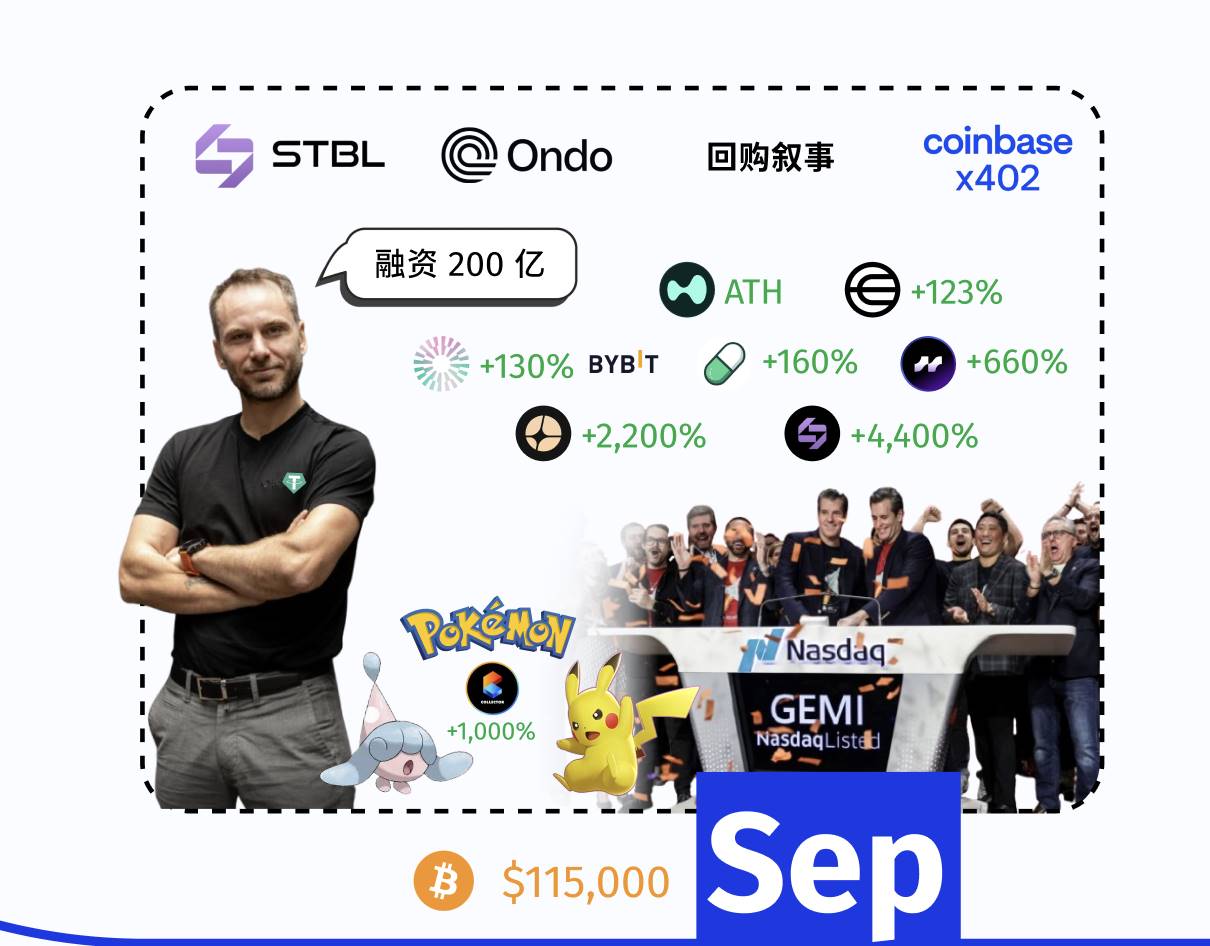
The FOMC announced a 25 basis point rate cut on September 17th, the first cut of 2025.
In the same month, Tether conducted a private融资 (financing) at a $500 billion valuation, again making people marvel at its wealth, but it was无关 (unrelated) to most retail investors.
However, Tether co-founder Reeve Collins started anew with the STBL protocol. It launched on Binance Alpha on September 16th, rising 455% that day, FDV breaking $1 billion. From its lowest to highest point in a month, it rose 44 times.
Crypto company IPOs saw a small高潮 (peak). Figure listed on Nasdaq on September 11th as the "RWA first stock"; Gemini followed suit the next day. Wall Street's attitude towards Crypto was visibly changing.
Among crypto projects, the on-chain perpetuals赛道 (track) saw a "DEX war"爆发 (erupt). Aster emerged out of nowhere, its token暴涨 (surging) 2800% in its first week; its seven-day trading volume once surpassed Hyperliquid's.
Regarding tokens, PUMP,靠着 (relying on) an aggressive buyback strategy (cumulative buybacks over $95M), rose 160% for the month, hitting an ATH on September 14th. AVNT速通 (speedrun) listed on both Upbit and Binance within a week, rising 660%. BNB rose 19.7% after Franklin Templeton expanded the Benji platform. MNT rose 130% due to its integration into the Bybit ecosystem.
And Coinbase's x402 protocol was announced this month, laying the groundwork for the火热 (hotness) of the 402 track in the following two months.
October: Living the 'Binance Life', Welcoming a Bloody Liquidation
Keywords: Epic Big Liquidation, Binance Life
October was supposed to be "Uptober".
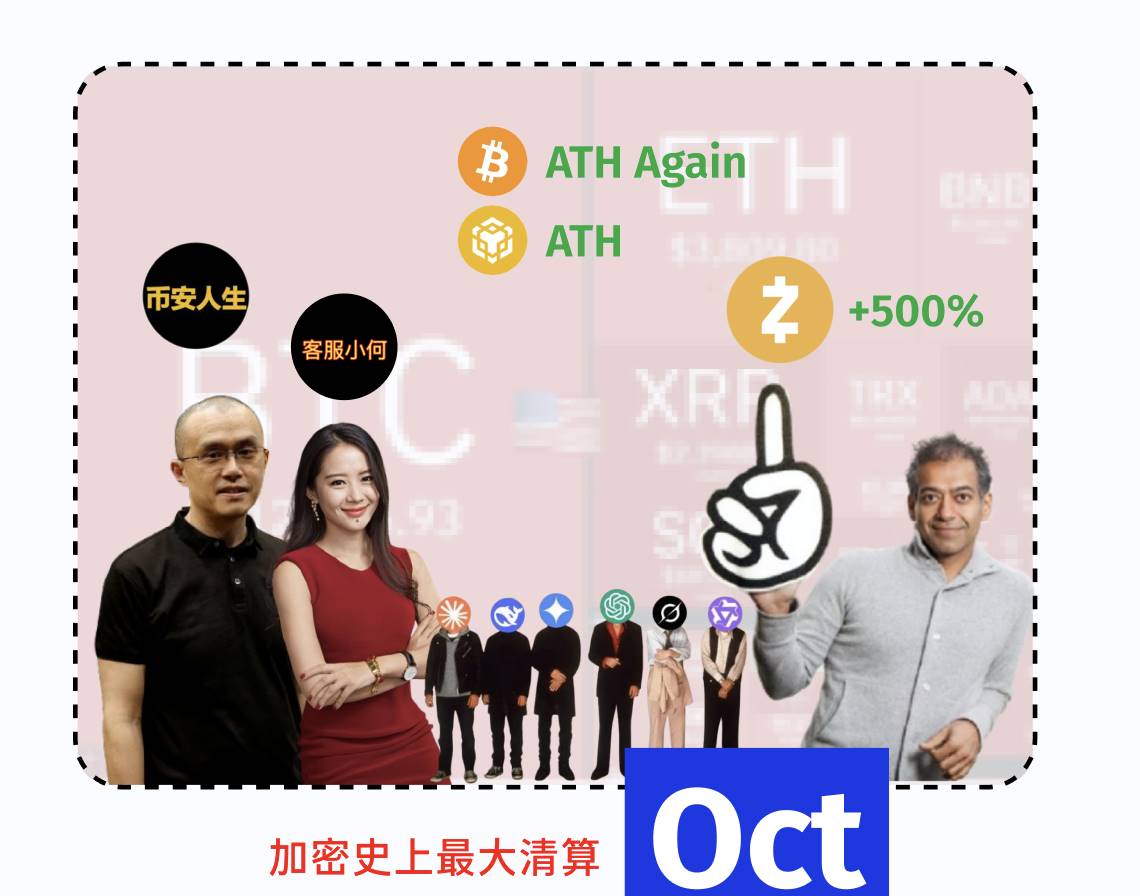
The first Chinese Meme coin "币安人生" (Binance Life) launched on October 4th. "Drive a Binance car, live in a Binance community, enjoy the Binance life". This meme struck a chord with the collective sentiment of the Chinese-speaking circle. It went from zero to a $500 million market cap within five days, rising over 3000%.
In the past seven years, BTC had never fallen in October. But October 2025彻底打破 (completely broke) this tradition.
BTC was still making new highs at the beginning of October, hitting a historical high of $126K on October 3rd. Then, on October 11th, the史诗级大清算 (epic big liquidation) occurred. $19 billion in leveraged positions were liquidated within 24 hours, causing the largest single-day liquidation惨案 (disaster) in crypto history.
Market sentiment and liquidity in crypto began to急转直下 (deteriorate rapidly) from this point.
Although there was局部上涨 (localized上涨 (rise)) this month from Naval shilling Zcash, the market never had any particularly major热点 (hot topics) afterwards. Institutions and retail suffered难以估量的损失 (immeasurable losses) equally in this wave.
November: Crying Without Tears from the Drop, Privacy Rises Against the Trend
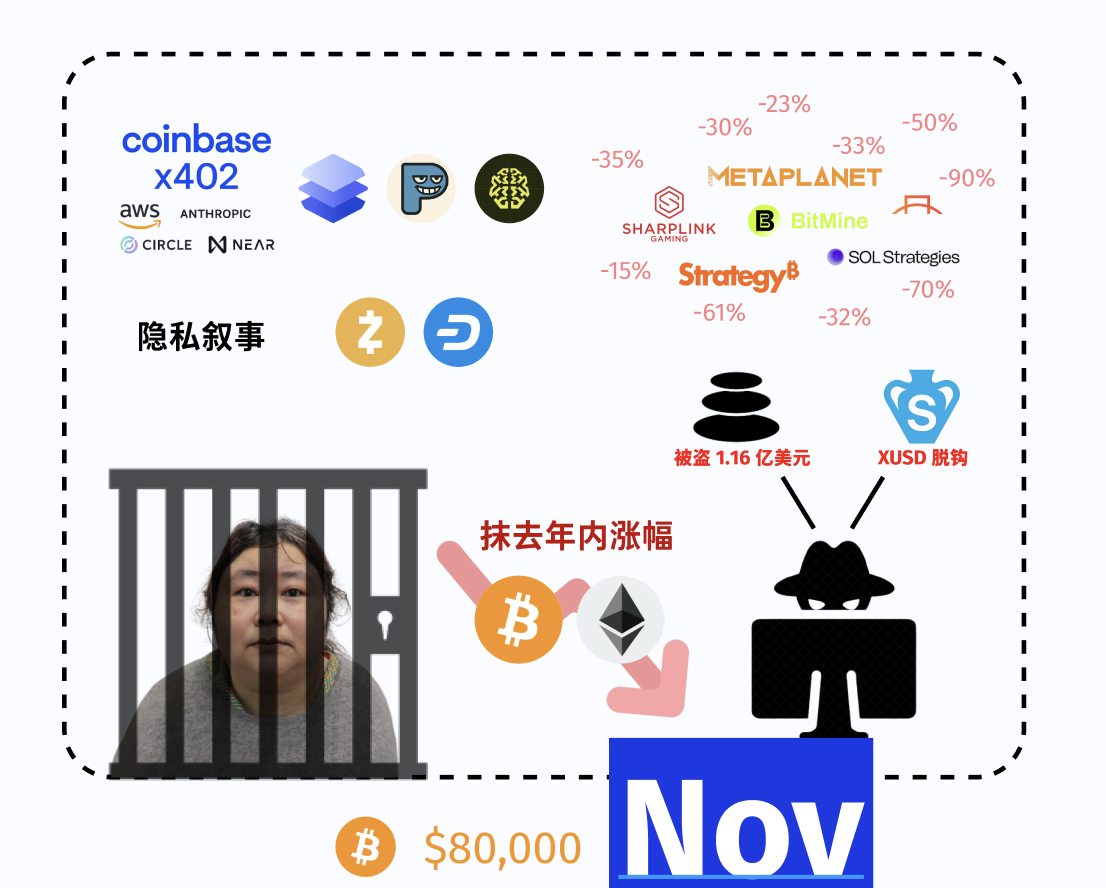
Keywords: BTC $80K, DeFi Blow-up, Privacy Rises, x402, Scammer's BTC Seized
The liquidation wave in October was thought to be the worst, but November proved the market could be even more miserable.
BTC fell from $110K at the beginning of the month all the way to $80K, hitting a seven-month low. The total market cap evaporated nearly $1 trillion, falling from $4.2T to $3.2T. BlackRock's IBIT saw单月流出 (single-month outflows) of $2.34 billion, setting the largest monthly outflow record since the ETF's inception.
But some people made money in the bear market. Privacy coins意外成了 (unexpectedly became) a safe haven. ZEC soared from $40 in September to over $600 in November, a gain of over 1200%. DASH also rose from $20 to $136, up more than 6 times.
The AI payment narrative also briefly caught fire. Coinbase's x402 protocol allowed AI Agents to autonomously pay for services. The ecosystem token PING rose from zero to a $70 million market cap. Concept coins like PayAI, SANTA followed the hype. But the heat came and went quickly, already退潮 (receding) by month-end.
Meanwhile, "Digital Asset Treasury" companies (DAT) collectively陷入困境 (fell into difficulty).
(Micro)Strategy暴跌 (crashed) 36% in November. MSCI was evaluating whether to remove (Micro)Strategy from its index; other ETH and SOL-centric companies also fell incessantly.
Additionally, the seizure of nearly 190,000 BTC involved in the cases of scammers Qian Zhimin and Chen Zhi caused market concerns about potential selling pressure and again amplified the "crypto = money laundering" label.
December: Boredom, Drama, and Gossip
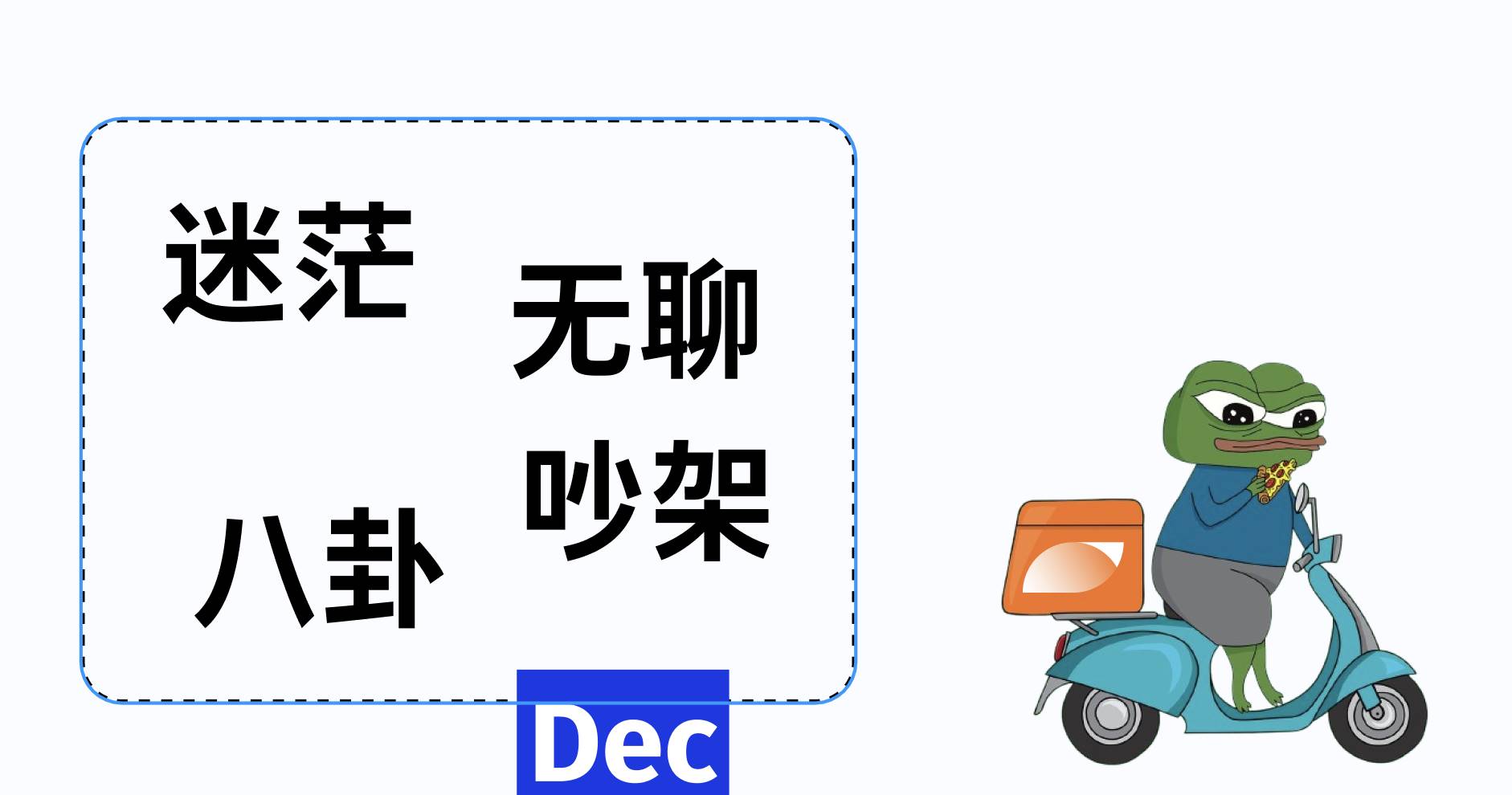
Riding the little e-bike, delivering this last order. No narratives, only emotions.
Groups aren't chatting about positions, but gossip: who ran away again, who faked donations again, who had uneven profit sharing again.
Some call this a "silent bear market". Slowly, silently, grinding down everyone's enthusiasm. The only consensus is to wait. Wait for liquidity to return.
We're about to enter the next year.
Those of us in crypto don't know where we're going, but we're still on the road.
Hope 2026 is better to us.