Oil Prices Are Approaching a Tipping Point, What Will Happen in Mid-April?

marsbitPublished on 2026-04-05Last updated on 2026-04-05

Abstract

Oil prices are approaching a critical inflection point, with mid-April identified as a key threshold. The ongoing disruption in the Strait of Hormuz has halted oil tanker traffic, resulting in a production loss of nearly 11 million barrels per day from key producers including Iraq, Kuwait, the UAE, Saudi Arabia, and Bahrain. The release of 400 million barrels from strategic petroleum reserves (SPR) has provided a temporary buffer, delaying immediate price spikes but not resolving the structural supply deficit. If the conflict ends before mid-April, Brent crude could retreat to the $80–90 range. However, if disruptions persist beyond mid-April, the market faces a cumulative inventory drawdown of 210 million barrels or more, pushing prices toward $110–120 or even demand-destructive levels above $200. The conflict has shifted from a cycle of escalation and de-escalation to a test of market endurance. Iran appears incentivized to prolong the situation until the market reaches a breaking point, strengthening its negotiating position. Even if resolved soon, supply losses have already altered long-term oil balances, suggesting a structurally higher price floor ahead.

Editor's Note: This article argues that what truly drives oil prices is not just whether the conflict ends, but "when the tipping point is crossed".

In the Iran conflict, now in its fourth week, the oil market is experiencing a classic case of "time-based pricing." The release of strategic reserves has delayed the impact but cannot eliminate the supply gap; disruptions in tanker transport and lagging production recovery are causing inventory pressures to accumulate into the future. Once the key node in mid-April is passed, the pricing mechanism will shift from "buffered volatility" to "re-pricing dominated by the gap."

More notably, the structure of the game itself is changing. The conflict no longer follows an "escalate to de-escalate" path but has turned into an endurance test against the market's tipping point. Whoever can hold out until the supply-demand imbalance is priced in by the market gains the initiative in negotiations. This means that even if the conflict ends shortly, oil prices will struggle to return to their previous range. The supply losses occurring now are reshaping the global oil balance for the foreseeable future.

The original text follows:

In this article, I will break down the possible scenarios. With the Iran conflict now in its fourth week, how will this situation affect the oil market?

On March 9, we published a public article titled "My Latest Assessment of the Oil and Gas Market Under the Iran Conflict," which stated:

Below is the impact on oil prices under different scenarios ("barrels lost" already includes the time required for production recovery):

Scenario 1: Tanker transport resumes the next day

→ Brent crude annual average will be in the high $70s to low $80s range (approx. 210 million barrels lost)

Scenario 2: Tanker transport resumes by March 15

→ Brent annual average will be in the mid-to-high $80s (approx. 290 million barrels lost)

Scenario 3: Tanker transport resumes by March 22

→ Brent annual average will be in the low $90s (approx. 370 million barrels lost)

Scenario 4: Tanker transport resumes by March 29

→ Brent annual average will be in the mid-to-high $90s (approx. 450 million barrels lost)

If tanker transport cannot return to normal by March 29, the situation the oil market will face is almost unthinkable. The only way out would be forced demand contraction, pushing prices to extreme levels.

Shortly after the report was published, the International Energy Agency (IEA) announced a coordinated release of a total of 400 million barrels from global strategic petroleum reserves (SPR). This will somewhat mitigate the impact of the supply loss. But as we pointed out in a subsequent article, "IEA's Coordinated SPR Release is the Biggest Gift for the Bulls":

From a trading perspective, traders are in no rush to push oil prices higher until this "cushion" is depleted. The concentrated SPR release does ease short-term supply anxiety, but it is only a temporary solution. The market will remain tense; as long as tanker transport remains disrupted, oil prices will gradually rise.

On the other hand, if the situation eases quickly—for example, with an immediate ceasefire or agreement—oil prices will fall rapidly. For instance, if a peace deal is reached before March 15, global inventories would see an net increase of 110 million barrels (400 million released - 290 million lost).

This could push Brent prices back down to the mid-$70s range.

Conversely, without a peace deal and with the supply disruption lasting until the end of March, global inventories would see a net reduction of 50 million barrels, and the gap would widen by about 80 million barrels for each additional week.

Therefore, the SPR's role is merely to "buy time" and does not solve the core problem. Tanker transport must return to normal. However, it does prevent a catastrophic price spike in the short term, thereby avoiding a large-scale demand collapse.

Fast forward to now, we have entered the "March 29 scenario" set at the beginning of the month. Next, we assess the oil market's direction based on the latest facts.

Facts

Total production shutdowns from Saudi Arabia, UAE, Kuwait, Iraq, and Bahrain have reached 10.98 million barrels per day:

Iraq: -3.6 million bpd

Kuwait: -2.35 million bpd

UAE: -1.8 million bpd

Saudi Arabia: -3.05 million bpd

Bahrain: -0.18 million bpd

Saudi Arabia has maxed out the capacity of its East-West pipeline, currently exporting about 4 million bpd via the Red Sea. The UAE is also using bypass transport via the Abu Dhabi pipeline (Habshan-Fujairah), whose capacity of about 1.8 million bpd is also at its limit. Tanker traffic through the Strait of Hormuz remains completely interrupted. In fact, even if the war ended tomorrow, it would take months to restore production and rebuild normal transport.

Scenario Projections

I will outline three possible paths:

1) The war ends this week, transport resumes by the weekend

2) The war ends in mid-April

3) The war ends at the end of April

It is important to note that the release of 400 million barrels of SPR, compared to our initial assessment on March 9, has bought the market more time. The oil price scenarios below already reflect this change.

Scenario 1: Ends this week

Impact on global inventory: -50 million barrels (SPR already factored in)

Impact on Brent: Short-term pullback to low $80s, annual average in the mid-to-high $80s

Scenario 2: Ends in mid-April

Impact on global inventory: -210 million barrels

Impact on Brent: Short-term pullback to low $90s, annual average in the mid-to-high $90s

Scenario 3: Ends at the end of April

Impact on global inventory: -370 million barrels

Impact on Brent: Short-term spike to the $110 range, annual average at $110–$120

Key Inflection Point: Mid-April

For the oil market, there is a clear "tipping point." The current market consensus expects the conflict to end before mid-April, and this expectation is crucial for oil price pricing.

Oil prices are a product of "marginal pricing." As long as the market believes supply is "just about sufficient," panic will not ensue. This is precisely the current state of the oil market—a lack of panic.

Policy statements from the Trump administration, the relaxation of sanctions on Iranian and Russian crude, and the SPR release have collectively suppressed oil prices.

But once this tipping point is crossed, these factors will become ineffective.
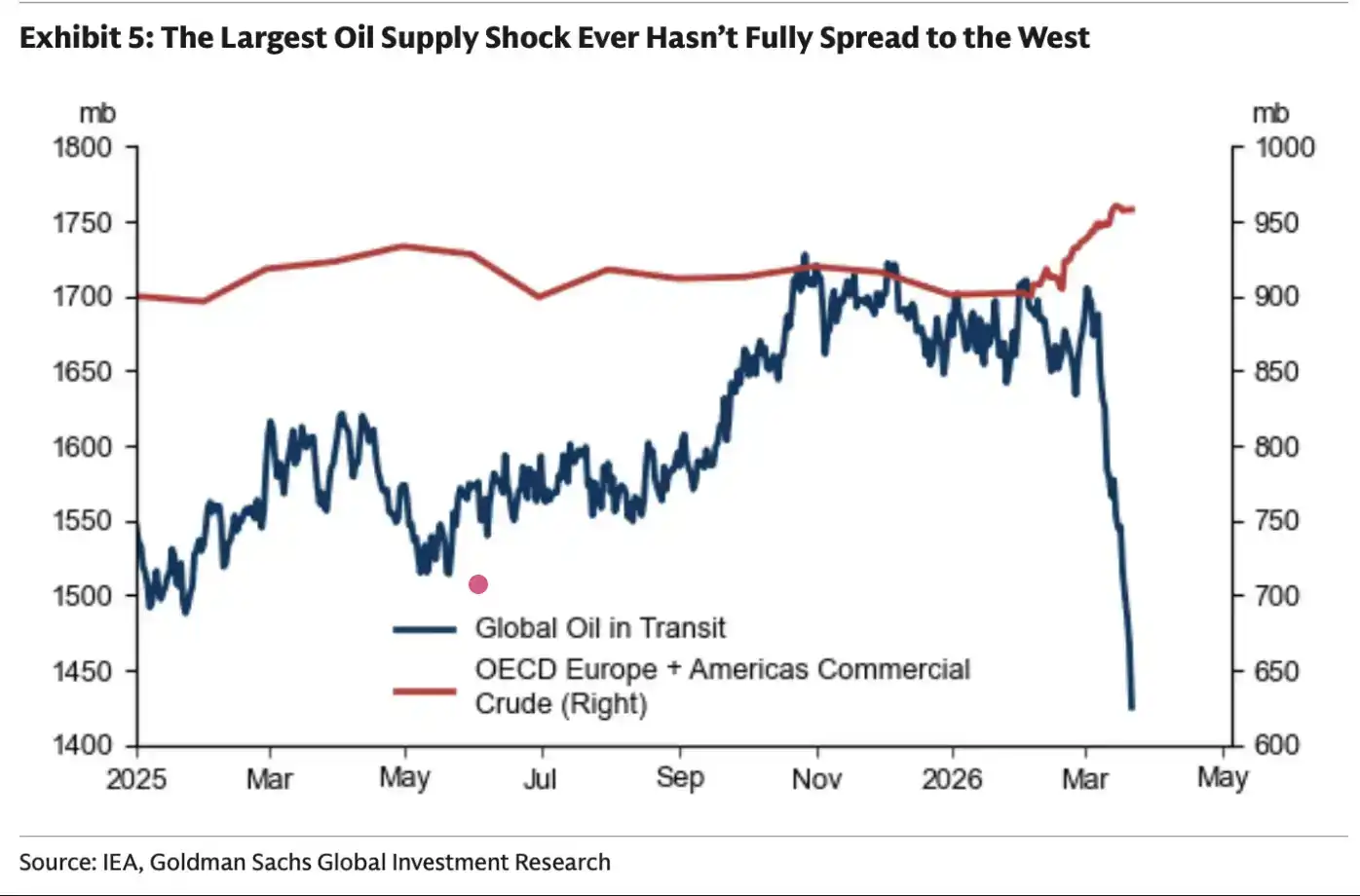
Currently, the evaporation effect of global "oil in transit" has not yet fully transmitted to onshore inventories. But our judgment is that by mid-April, this impact will become fully evident.

If the conflict remains unresolved by mid-April, the International Energy Agency (IEA) will have to coordinate another release of approximately 400 million barrels of strategic petroleum reserves (SPR). Otherwise, oil prices will surge into the "demand destruction" range ($200+).

Long-Term Impact

In Energy Aspect's latest weekly report, their estimate of the market's cumulative supply loss is about 930 million barrels. Among this, the cumulative production loss from May to December is about 340 million barrels.

This assessment is significantly more aggressive than ours. In our inventory sensitivity analysis, we did not fully account for the reality that countries like Iraq and Kuwait might need 3 to 4 months to restore production capacity. This means our previous estimates might have been too conservative.

For Goldman Sachs, the conclusion is straightforward: the longer the conflict lasts, the longer high oil prices will persist.
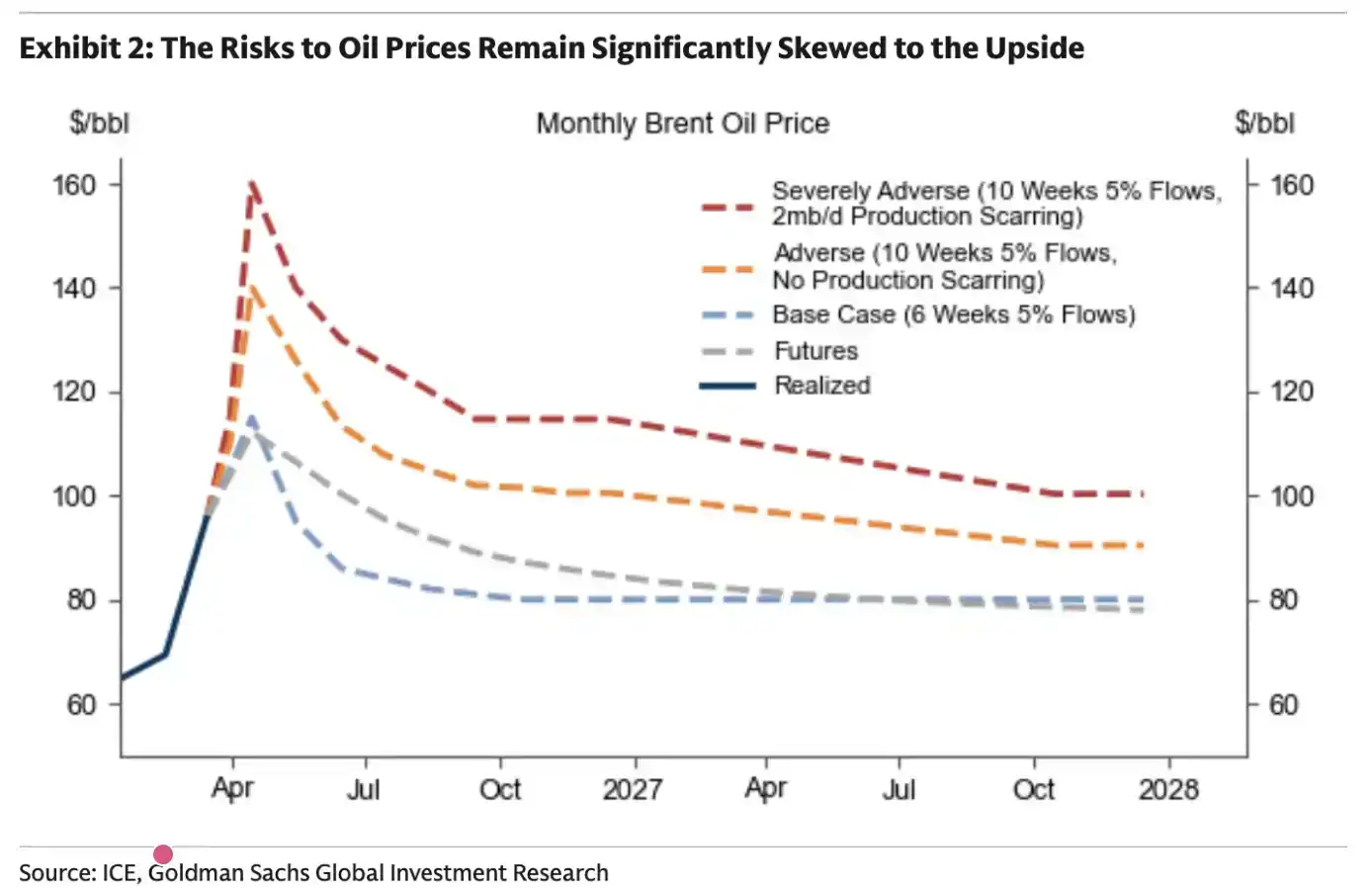
Under the above scenarios, Goldman Sachs also provided a hypothesis: what the market would look like if the conflict lasted another 10 weeks. Their judgment is largely consistent with our earlier projections.

In essence, the oil market has a "tipping point." Once this line is crossed, there is no turning back.

Readers should be prepared for expectations: future oil prices will be structurally higher. Even if the war ends this week, the supply losses that have already occurred will have a substantive impact on the future global oil supply-demand balance.

How long will it last?

Until now, I have avoided making judgments on "when this conflict will end." On one hand, I don't want to "tempt fate," and on the other hand, it is truly unpredictable.

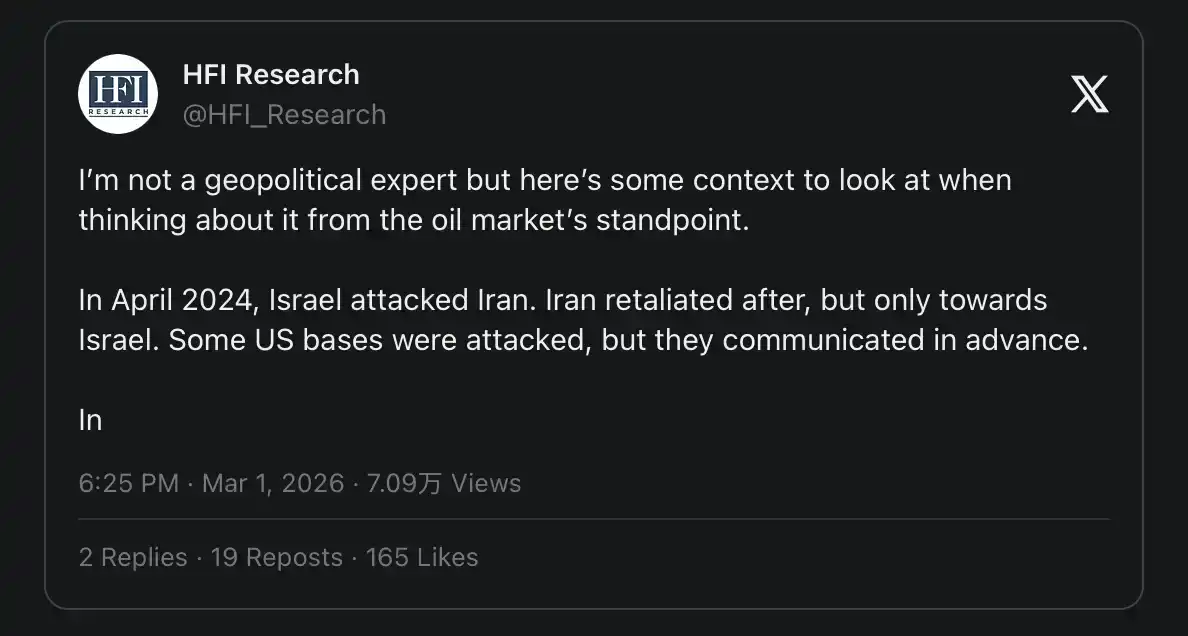
But one thing is clear: this time is different from past conflicts. The common strategy of "escalate to de-escalate" is not evident this time.

Retaliatory strikes occurred without warning; Iran's strike range also seems to have expanded beyond Israel to include Gulf countries. It was this pattern of response that made me realize from the beginning—this time, it's different.
As the conflict has lasted nearly four weeks, I am increasingly concerned: with an agreement迟迟无法达成, each day of delay significantly reduces the probability of reaching a deal. As we analyzed in "Time is Running Out," Iran understands the operating logic of the oil market very well. It only needs to wait for the market to hit that "tipping point" to secure the maximum concessions from the US in negotiations. From a tactical perspective, reaching an agreement now offers no advantage. The Strait of Hormuz card has been played and cannot be easily reused in the future.

For the Gulf countries, if the current Iranian regime is not overthrown, this situation of being "strangled" will recur in the future. Even if some kind of "toll" mechanism is established, this uncertainty would still be hard to accept.

Therefore, logically, the initiative does not lie with the US but with Iran. In this case, Iran has more incentive to push the situation towards the oil market's "tipping point" to test US endurance. All it needs to do is "hold on" for another three weeks, until the market begins to crack.

However, it must be emphasized that I am not a geopolitical expert and have no absolute certainty about such judgments. What I can provide is an assessment of the current situation based on fundamental analysis.


Related Questions

QWhat is the critical point in the oil market mentioned in the article, and why is mid-April significant?

AThe critical point refers to the threshold where the oil market shifts from 'buffered volatility' to a 'gap-driven repricing.' Mid-April is significant because, by that time, the evaporation effect of global 'crude oil in transit' will fully manifest in onshore inventories. If the conflict is not resolved by then, the market could face severe supply shortages, potentially driving prices to extreme levels unless another strategic petroleum reserve (SPR) release is coordinated.

QHow does the release of strategic petroleum reserves (SPR) affect the oil market according to the article?

AThe release of SPRs, such as the 4 billion barrels coordinated by the IEA, acts as a temporary buffer that delays the impact of supply disruptions. It prevents immediate catastrophic price spikes and demand destruction but does not solve the core issue of supply gaps. Once the SPR buffer is depleted, the market must confront the underlying supply deficit, leading to potential price surges if normal tanker transport is not restored.

QWhat are the three scenarios for the conflict's resolution and their respective impacts on Brent crude prices?

A1) If the conflict ends this week with transport restored by the weekend: Brent crude would fall to the low $80s short-term, with an annual average in the mid-to-high $80s. 2) If it ends in mid-April: Short-term prices would drop to the low $90s, with an annual average in the mid-to-high $90s. 3) If it ends in late April: Short-term prices could spike to around $110, with an annual average of $110-$120.

QWhy does the article suggest that Iran has an incentive to push the conflict towards the oil market's critical point?

AIran understands the oil market's mechanics and recognizes that reaching the critical point (where supply gaps become acute) would strengthen its negotiating position. By prolonging the conflict until mid-April, Iran could force the U.S. into making greater concessions, as the U.S. and its allies would face severe economic pressure from soaring oil prices and supply shortages.

QWhat long-term impact does the article predict for global oil supply and demand, even if the conflict ends soon?

AEven if the conflict ends immediately, the supply losses already sustained (e.g., prolonged production recovery times in countries like Iraq and Kuwait) will structurally elevate oil prices and reshape global oil balance. The cumulative supply loss, estimated at up to 9.3 billion barrels by some analysts, implies that high oil prices will persist longer, affecting future供需平衡.

Related Reads

KOL's Perspective: Why Is SOL Set to Rise from This Point?

**Summary: Why SOL is Positioned for Growth at This Level** The article argues that SOL is poised for an upward move from its current price point, citing several key factors. Primarily, SOL has just broken out of a 4-month consolidation phase. This breakout signals a return of risk appetite to the broader crypto market, as SOL is seen as a key indicator of overall crypto health. The token's ownership has reportedly shifted from short-term traders and tourists to long-term accumulators, leading to low volume. Any meaningful increase in trading activity could thus trigger significant upward momentum. Fundamental strengths include strong institutional adoption, integration with DeFi and RWAs (Real-World Assets), and the potential benefits from the Clarity Act. Despite its high volatility—having dropped 70% from its all-time high but still up 12x from its bear market low—SOL is highlighted as one of the few tokens from the last cycle to reach new highs. It boasts a robust ecosystem of applications, users, and protocols. Future catalysts include the expected influx of AI developers following the Miami Accelerate conference, which focused on AI on Solana. Furthermore, Solana is positioned as the premier chain for memecoin activity, a trend expected to continue and drive network usage and fees. The article concludes that recent price action reflects a healthy transfer to long-term holders, setting the stage for growth.

marsbit33m ago

KOL's Perspective: Why Is SOL Set to Rise from This Point?

marsbit33m ago

Those Pre-Bitcoin PoW Protocols Have Recently Been Reimplemented

This article details a recent surge in replicating pre-Bitcoin Proof-of-Work (PoW) protocols, specifically focusing on Hal Finney's 2004 RPOW (Reusable Proofs of Work). Within five days in May 2026, multiple independent builders in the Bitcoin/cypherpunk community launched projects inspired by this early electronic cash proposal. The initiative began with Fred Krueger's `rpow2.com`, a centralized but auditable system that replaced RPOW's original IBM 4758 hardware with Ed25519 signatures. Initially a faithful replica, it later adopted Bitcoin-like features (21M supply cap, difficulty adjustment) and a controversial 5.24% founder allocation. This sparked rapid forks, including `rpow4.com` which incorporated full Bitcoin parameters, a prediction market (`rpowmarket.com`), and a DEX (`rpow2swap.com`). Concurrently, Mike In Space created a prototype of Wei Dai's 1998 b-money proposal (`b-money.replit.app`), pushing the historical exploration even further back. The article contrasts these centralized, server-dependent experiments with Bitcoin's core innovation of decentralized, trustless consensus. It also highlights a parallel development: the `HASH` project on Ethereum, which uses smart contract hooks to enable a purely fair-launch, browser-mineable PoW token with 0% allocations to team or VCs. The collective activity is framed as a meme-driven, educational exploration of cypherpunk history rather than a serious financial movement, with all projects heavily disclaiming any investment value.

marsbit37m ago

Those Pre-Bitcoin PoW Protocols Have Recently Been Reimplemented

marsbit37m ago

South Korean Exchanges 'Battle' Regulators, Challenging the Boundaries of Enforcement and Legislation

South Korea's cryptocurrency industry is engaged in a rare, direct confrontation with regulators. The Financial Intelligence Unit (FIU), the primary anti-money laundering (AML) watchdog, has recently imposed heavy penalties on major exchanges like Upbit and Bithumb for alleged violations involving unregistered overseas VASPs and AML procedures. However, exchanges are now actively challenging these actions in court and through industry associations. In a significant shift, the Seoul Administrative Court ruled in favor of Upbit's operator, Dunamu, overturning part of an FIU-ordered business suspension. The court found the FIU's penalty criteria and justification insufficiently clear. Similarly, the court suspended the enforcement of a six-month business suspension against Bithumb pending a final ruling, citing potential irreversible harm to the exchange. Beyond legal battles, the industry is contesting proposed legislative amendments. The Digital Asset eXchange Alliance (DAXA) strongly opposes a draft rule that would mandate Suspicious Transaction Reports (STRs) for all crypto transfers over 10 million KRW (~$6,800). DAXA argues this "poison pill" clause violates legal principles and would overwhelm the STR system, increasing reports from 63,000 to an estimated 5.45 million annually for major exchanges, thereby crippling effective AML monitoring. This conflict highlights a structural tension in South Korea's crypto governance: comprehensive digital asset laws are still developing, while regulators rely heavily on AML enforcement. The industry's move from passive compliance to active legal and legislative challenges signifies a new phase, pressing for clearer rules and more proportionate enforcement. While short-term disputes may intensify, this clash could ultimately lead to a more mature and sustainable regulatory framework for South Korea's vibrant crypto market.

marsbit1h ago

South Korean Exchanges 'Battle' Regulators, Challenging the Boundaries of Enforcement and Legislation

marsbit1h ago

After 50x Storage Surge, Justin Sun Always Looks to the Next Decade

Sun Yuchen, known for his controversial stunts like a $30 million lunch with Warren Buffett (canceled due to a kidney stone) and eating a $6.2 million duct-taped banana, is often overshadowed by a significant fact: his decade-long track record of spotting major investment trends. In 2016, he famously advised young people to invest in Bitcoin, Nvidia, Tesla, and Tencent instead of buying property. A hypothetical $20,000 investment in Nvidia and Tesla from that list would now be worth over 50 million RMB. His latest major call was on November 6, 2025, predicting a "50x storage opportunity" tied to the AI boom, which materialized with Sandisk's stock surging nearly 50-fold by 2026. Looking ahead, Sun now focuses on the next frontier: Physical AI. He identifies four key areas: 1. **Embodied AI/Robotics**: He sees this reaching its "iPhone moment," with companies like UBTech and Galaxy General leading in commercialization. 2. **Drones**: Viewed as the first commercially viable form of Physical AI, revolutionizing sectors from warfare (e.g., AeroVironment's Switchblade) to logistics. 3. **Spatial Computing**: Beyond VR, it's about AI understanding physical space, a foundational technology for robotics and autonomous systems, exemplified by Apple's Vision Pro. 4. **Space Exploration**: After a 2025 suborbital flight with Blue Origin, Sun advocates for space as the ultimate frontier, discussing blockchain's potential role in space asset management and data transactions. His investment philosophy involves betting on entire, inevitable trends rather than single companies. For robotics, he sees Tesla (the body/manufacturer) and Nvidia (the brain/AI platform) as complementary plays. In defense drones, he highlights companies making tanks obsolete (AeroVironment) and those augmenting fighter jets (Kratos). For space, he participated in Blue Origin's flight and anticipates SpaceX's potential IPO to redefine the sector's valuation. Sun Yuchen's vision frames the next two decades not as a revolution in information flow (like the internet), but in the fundamental operation of the physical world through AI-powered robots, autonomous systems, and spatial intelligence, ultimately extending human and AI activity into space. While many still focus on conventional assets, he continues to look toward the next technological horizon.

marsbit2h ago

After 50x Storage Surge, Justin Sun Always Looks to the Next Decade

marsbit2h ago

Trading

Spot
Futures
活动图片




