Off to a Strong Start! USDD TVL Surpasses $1 Billion Mark, Embarking on a Powerful Journey in 2026

marsbitPublished on 2026-01-16Last updated on 2026-01-16

Abstract

USDD, a decentralized stablecoin, has achieved a significant milestone at the beginning of 2026 by surpassing $1 billion in Total Value Locked (TVL). This growth reflects strong market confidence in its decentralized mechanism, value stability, and sustainable model. Key drivers include its innovative yield-generating mechanism, multi-chain ecosystem, and robust risk management. USDD functions as an "interest-bearing USDT" through its Smart Allocator system, which dynamically allocates reserve funds to vetted on-chain projects, generating over $8.34 million in actual returns. The introduction of sUSDD allows users to easily earn passive yield with auto-compounding features. USDD has expanded across major blockchains like TRON, Ethereum, and BNB Chain. A collaboration with Binance Wallet’s Yield+ campaign attracted over 3,000 users in its first week, boosting sUSDD TVL by 867% to $295 million. The stablecoin uses an over-collateralized debt model with strict minimum collateral ratios, ensuring transparency and 1:1 redeemability with major stablecoins. In 2026, USDD aims to shift from incentive-driven growth to real-use-case adoption, focusing on deeper integration with DeFi protocols, exchanges, and payment tools. Its decentralized, non-freezable, and yield-bearing features position it as a compelling alternative to centralized stablecoins. Breaking the $1 billion TVL mark is just the beginning of its upward trajectory.

At the beginning of 2026, the decentralized stablecoin USDD has achieved a significant milestone—its Total Value Locked (TVL) has officially surpassed the $1 billion mark! This accomplishment not only marks a new phase in the development of the USDD ecosystem but also demonstrates the market's high recognition of its decentralized mechanism, stable value support, and sustainable development model.
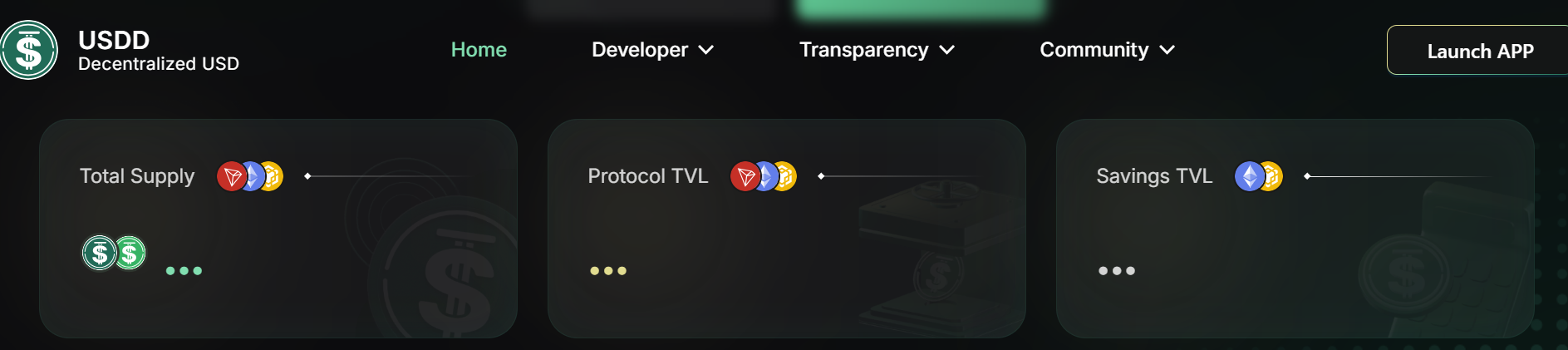
At a time when the DeFi industry is still undergoing structural differentiation and continuous reshuffling, USDD's "strong start" carries significant symbolic meaning. It not only validates USDD's long-term value logic but also injects new growth confidence into the decentralized stablecoin sector, setting a positive tone for the industry's development in 2026.

The Underlying Logic of Counter-Trend Growth: Synergistic Efforts in Mechanism, Ecosystem, and Risk Management

USDD's achievement of this milestone growth is primarily attributed to its three core advantages: an innovative sustainable yield mechanism, a robust multi-chain ecosystem layout, and an exceptional risk management system.

In terms of the yield mechanism, USDD has been positioned as an "interest-bearing version of USDT" since its inception. Through the Smart Allocator yield distribution mechanism, the protocol dynamically allocates a portion of reserve funds to rigorously vetted high-quality on-chain projects, generating diversified returns such as interest, protocol incentives, and platform rewards. According to disclosures, this mechanism has already generated over $8.34 million in actual returns.

Building on this, USDD introduced the interest-bearing token sUSDD, allowing users to seamlessly convert USDD to sUSDD with one click, enabling passive yield generation and automatic compounding without complex operations. This design significantly lowers the barrier to entry for users and extends USDD's utility from a mere value-pegging tool to a capital efficiency tool with yield attributes, enhancing its appeal within the DeFi ecosystem.

In terms of ecosystem layout, USDD has completed the critical transition from a single chain to a multi-chain framework, demonstrating strong user adoption and capital retention during its expansion. For example, during the recent Yield+ campaign launched in collaboration with Binance Wallet, the first week attracted over 3,000 participants, with sUSDD's TVL surging by over 867% in a short period, exceeding $295 million and becoming the fastest-growing stablecoin product during the same period.

Currently, USDD is natively deployed on mainstream public chains such as TRON, Ethereum, and BNB Chain, gradually building a cross-chain synergistic stablecoin infrastructure.

In terms of risk management, USDD adopts an over-collateralized debt position model with strict minimum collateral ratio requirements, ensuring that every USDD is backed by sufficient and transparent assets. Additionally, its stable peg module allows users to exchange USDD for mainstream stablecoins at a 1:1 ratio with zero slippage, providing dual guarantees for liquidity and price stability. It is this series of mechanism designs that enable USDD to maintain its price peg even during market volatility, continuously earning user trust.

Growth Driven by Real-World Adoption: Multi-Chain Ecosystem and Real-World Use Case Deployment in 2026

Looking ahead to 2026, USDD's development roadmap is becoming clearer and more long-term oriented. The team has explicitly stated its intention to gradually shift the ecosystem from "incentive-driven" to "real-use-driven." This means that USDD will increasingly focus on building application scenarios based on genuine demand, gradually reducing reliance on short-term subsidies and external incentives, and instead creating distributable value through endogenous mechanisms like the Smart Allocator.

Simultaneously, USDD plans to further deepen cooperation with on-chain exchanges and core DeFi protocols, exploring a dual-drive model that synergizes on-chain and off-chain activities. On one hand, it aims to expand the native use of USDD in scenarios such as trading, lending, and yield strategies; on the other hand, it seeks to enhance user reach and capital retention through wallets, payment systems, and aggregation tools, forming a positive feedback loop between the protocol, partners, and users.

Facing increasingly fierce competition in the stablecoin market, USDD has also established a clear differentiated positioning. Compared to centralized stablecoins, which offer ample liquidity but pose risks such as freezing and opaque yields, USDD provides a more attractive alternative through its decentralized architecture, anti-freezing characteristics, and mechanisms that reward holders. As the industry demands higher levels of transparency and sustainability, USDD's advantages are expected to become even more pronounced.

Surpassing $1 billion in TVL is just the beginning. In the opening phase of 2026, USDD has already charted a clear and steady upward trajectory, making its future growth potential and industry influence increasingly promising.


Related Questions

QWhat major milestone did USDD achieve at the beginning of 2026?

AUSDD's Total Value Locked (TVL) surpassed the $1 billion mark.

QWhat are the three core advantages that contributed to USDD's growth?

AThe three core advantages are its innovative sustainable yield mechanism, robust multi-chain ecosystem layout, and excellent risk management system.

QWhat is the purpose of the sUSDD token introduced by USDD?

AThe sUSDD token allows users to convert USDD to sUSDD to participate in passive yield generation and automatic compounding with low entry barriers.

QWhich major blockchains has USDD been natively deployed on?

AUSDD has been natively deployed on TRON, Ethereum, and BNB Chain.

QHow does USDD ensure price stability and liquidity for its users?

AUSDD uses an over-collateralized debt model with strict minimum collateral requirements and a stable peg module that allows 1:1, no-slippage swaps between USDD and major stablecoins.

Related Reads

a16z: AI's 'Amnesia', Can Continuous Learning Cure It?

The article "a16z: AI's 'Amnesia' – Can Continual Learning Cure It?" explores the limitations of current large language models (LLMs), which, like the protagonist in the film *Memento*, are trapped in a perpetual present—unable to form new memories after training. While methods like in-context learning (ICL), retrieval-augmented generation (RAG), and external scaffolding (e.g., chat history, prompts) provide temporary solutions, they fail to enable true internalization of new knowledge. The authors argue that compression—the core of learning during training—is halted at deployment, preventing models from generalizing, discovering novel solutions (e.g., mathematical proofs), or handling adversarial scenarios. The piece introduces *continual learning* as a critical research direction to address this, categorizing approaches into three paths: 1. **Context**: Scaling external memory via longer context windows, multi-agent systems, and smarter retrieval. 2. **Modules**: Using pluggable adapters or external memory layers for specialization without full retraining. 3. **Weights**: Enabling parameter updates through sparse training, test-time training, meta-learning, distillation, and reinforcement learning from feedback. Challenges include catastrophic forgetting, safety risks, and auditability, but overcoming these could unlock models that learn iteratively from experience. The conclusion emphasizes that while context-based methods are effective, true breakthroughs require models to compress new information into weights post-deployment, moving from mere retrieval to genuine learning.

marsbit2h ago

a16z: AI's 'Amnesia', Can Continuous Learning Cure It?

marsbit2h ago

Can a Hair Dryer Earn $34,000? Deciphering the Reflexivity Paradox in Prediction Markets

An individual manipulated a weather sensor at Paris Charles de Gaulle Airport with a portable heat source, causing a Polymarket weather market to settle at 22°C and earning $34,000. This incident highlights a fundamental issue in prediction markets: when a market aims to reflect reality, it also incentivizes participants to influence that reality. Prediction markets operate on two layers: platform rules (what outcome counts as a win) and data sources (what actually happened). While most focus on rules, the real vulnerability lies in the data source. If reality is recorded through a specific source, influencing that source directly affects market settlement. The article categorizes markets by their vulnerability: 1. **Single-point physical data sources** (e.g., weather stations): Easily manipulated through physical interference. 2. **Insider information markets** (e.g., MrBeast video details): Insiders like team members use non-public information to trade. Kalshi fined a剪辑师 $20,000 for insider trading. 3. **Actor-manipulated markets** (e.g., Andrew Tate’s tweet counts): The subject of the market can control the outcome. Evidence suggests Tate’sociated accounts coordinated to profit. 4. **Individual-action markets** (e.g., WNBA disruptions): A single person can execute an event to profit from their pre-placed bets. Kalshi and Polymarket handle these issues differently. Kalshi enforces strict KYC, publicly penalizes insider trading, and reports to regulators. Polymarket, with its anonymous wallet-based system, has historically been more permissive, arguing that insider information improves market accuracy. However, it cooperated with authorities in the "Van Dyke case," where a user traded on classified government information. The core paradox is reflexivity: prediction markets are designed to discover truth, but their financial incentives can distort reality. The more valuable a prediction becomes, the more likely participants are to influence the event itself. The market ceases to be a mirror of reality and instead shapes it.

marsbit3h ago

Can a Hair Dryer Earn $34,000? Deciphering the Reflexivity Paradox in Prediction Markets

marsbit3h ago

Trading

Spot
Futures

Hot Articles

How to Buy USDD

Welcome to HTX.com! We've made purchasing USDD (USDD) simple and convenient. Follow our step-by-step guide to embark on your crypto journey.Step 1: Create Your HTX AccountUse your email or phone number to sign up for a free account on HTX. Experience a hassle-free registration journey and unlock all features.Get My AccountStep 2: Go to Buy Crypto and Choose Your Payment MethodCredit/Debit Card: Use your Visa or Mastercard to buy USDD (USDD) instantly.Balance: Use funds from your HTX account balance to trade seamlessly.Third Parties: We've added popular payment methods such as Google Pay and Apple Pay to enhance convenience.P2P: Trade directly with other users on HTX.Over-the-Counter (OTC): We offer tailor-made services and competitive exchange rates for traders.Step 3: Store Your USDD (USDD)After purchasing your USDD (USDD), store it in your HTX account. Alternatively, you can send it elsewhere via blockchain transfer or use it to trade other cryptocurrencies.Step 4: Trade USDD (USDD)Easily trade USDD (USDD) on HTX's spot market. Simply access your account, select your trading pair, execute your trades, and monitor in real-time. We offer a user-friendly experience for both beginners and seasoned traders.

5.2k Total ViewsPublished 2024.03.29Updated 2025.03.21

How to Buy USDD

Discussions

Welcome to the HTX Community. Here, you can stay informed about the latest platform developments and gain access to professional market insights. Users' opinions on the price of USDD (USDD) are presented below.

活动图片