Odaily Interview with Bitwise: BTC Could Reach $95,000 Range by Year-End

Odaily星球日报Published on 2026-03-27Last updated on 2026-03-27

Abstract

Odaily interviewed Ryan Rasmussen, research lead at Bitwise Asset Management, which manages around $15 billion in assets and is a major issuer of Bitcoin, Ethereum, and Solana ETFs. Rasmussen discussed Bitcoin's price outlook, predicting it could reach around $95,000 by year-end—a roughly 40% increase from current levels—driven by accelerating institutional adoption. He emphasized that institutional allocation is the primary long-term driver of Bitcoin’s price, noting that many global institutional investors are still in early stages of exposure, with new allocations typically starting at 2-3% and growing to around 5% over time. Rasmussen believes the market is near a bottom and may trade sideways in the near term due to macro uncertainty, but expects significant institutional inflows via ETFs in the second half of the year. The interview highlighted a major shift in market dynamics: early retail investors are taking profits, while long-term focused institutions are accumulating positions. This transition, he argued, is structurally positive for crypto markets. Rasmussen also addressed Bitcoin’s role in portfolios as a diversifier with low correlation to traditional assets and discussed Bitwise’s expanding presence in Asia, where interest from family offices and private banks is growing rapidly. He noted that Asian markets are more forward-looking in crypto adoption compared to the U.S. and Europe.

Original | Odaily Planet Daily (@OdailyChina)

Author | jk
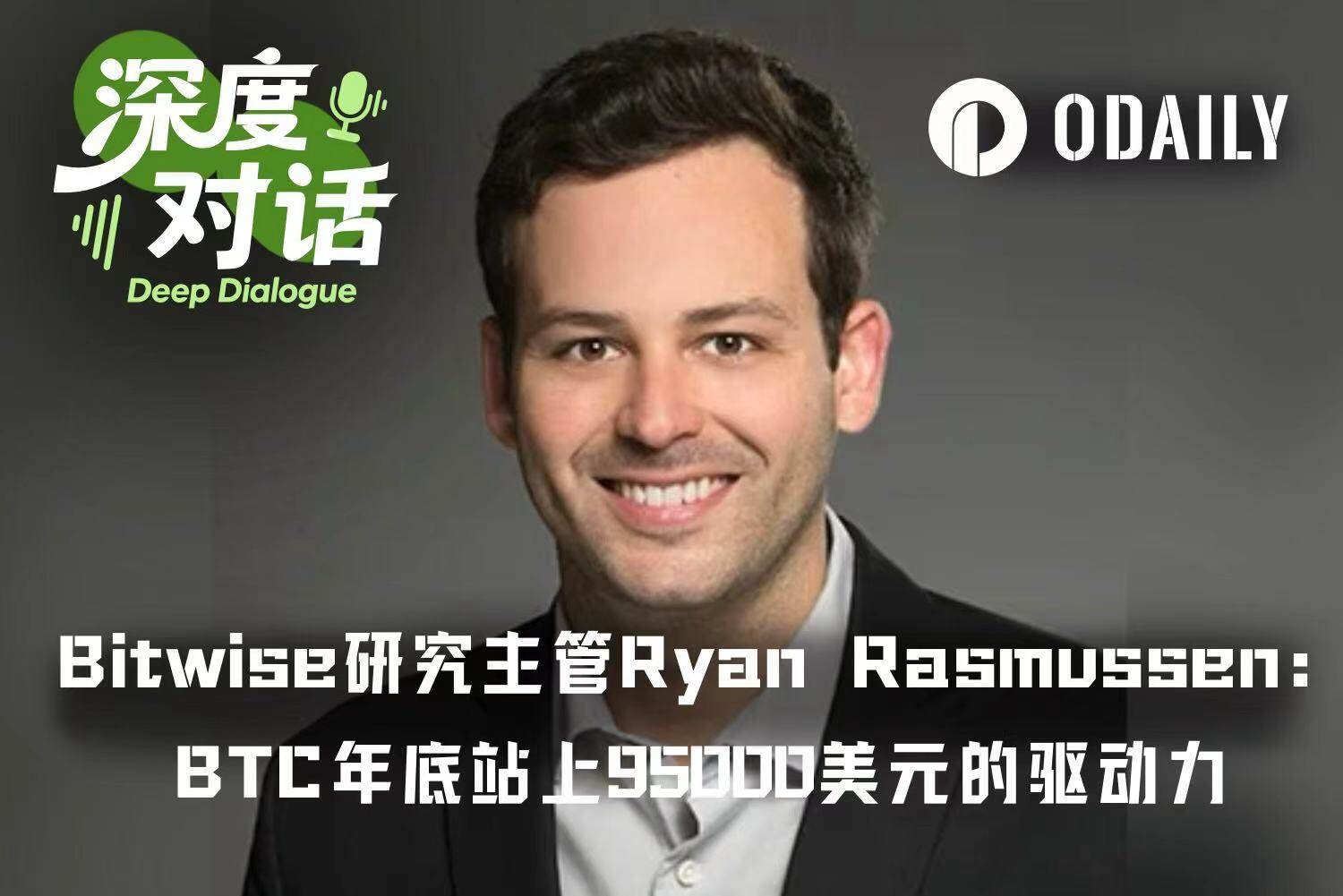
Amid Bitcoin's price halving from its all-time high and geopolitical clouds looming over global markets, is institutional capital retreating or quietly accumulating? On March 24, Odaily Planet Daily interviewed Ryan Rasmussen, Head of Research at Bitwise Asset Management, in New York.

Bitwise currently manages approximately $15 billion in assets, making it the world's largest provider of crypto index funds and one of the major issuers of Bitcoin, Ethereum, and Solana ETFs. In this interview, he shared the core drivers for Bitcoin's price in 2026, specific predictions for the year-end price, discussed the ongoing "great migration of holdings" between retail and institutional investors, and the role of Asian markets in the global crypto landscape.

Below is the full interview:

Odaily: Today we are at the DAS summit in New York, and we are honored to have Ryan from Bitwise with us. Before we begin, could you briefly introduce yourself to our Asian audience?

Ryan: Certainly. I'm Ryan Rasmussen, Head of Research at Bitwise Asset Management. We are a global crypto asset management company primarily serving institutional investors with public and private funds, as well as staking solutions. We currently manage around $15 billion in assets, with operations in the U.S., Europe, and Asia. We are one of the largest issuers in the Solana ETF, Bitcoin ETF, and Ethereum ETF space, and we also manage various index funds. We operate the world's largest cryptocurrency index fund.

Odaily: What are the biggest factors influencing Bitcoin's price in 2026, and could you rank them and assign approximate weight percentages? For example, inflows and outflows of structured products from U.S. traditional financial institutions, statements and policies from Trump and his family, awakening and selling by long-term large holders, survival pressure on miners, and the aftermath of past hacking incidents.

Ryan: The biggest long-term driver of Bitcoin's price is institutional adoption. The reason is that for the past fifteen years, most global institutional investors have been unable to access Bitcoin or other crypto assets. With the launch of U.S. Bitcoin ETFs in January 2024, and now Ethereum, Solana, and other ETF products, we see institutional investors starting to catch up with Bitcoin investment. But this doesn't mean those allocations have truly begun: in fact, many investors we've spoken with, whether in the U.S., Europe, or Asia, have not yet started investing in Bitcoin. So I believe the biggest driver is the pace at which institutional investors begin large-scale allocations to Bitcoin. I think this has started happening in 2026, and more progress will be made in the second half of 2026, which will be a short-term and long-term driver, driven by demand from those institutional investors who haven't yet entered.

Odaily: Can you talk about the weights specifically?

Ryan: This is indeed an interesting topic. Investors who started allocating with us a few years ago began with about 1%, and today most clients have around 5% allocated to crypto assets. The most interesting thing is that those starting initial allocations now are not beginning at 1% but at 2% to 3%, while many long-term clients we've worked with are already at around 5%. So I'd say typical allocations for new investors are around 2%, and for existing investors with crypto exposure, it's about 5%. But when you consider the wealth controlled by global institutional investors, this number is substantial—1% to 2% to 5% of $100 trillion in wealth already exceeds Bitcoin's total market cap. That's why institutional allocation will ultimately dominate Bitcoin's price in the long run, and why it's such an important factor.

Odaily: Could Bitcoin experience significant further drops? Could the current level be the bottom of this cycle?

Ryan: Our view is that we are closer to Bitcoin's bottom, and the downside is not as significant anymore. I wouldn't be surprised if Bitcoin trades sideways for a few more months, as macro factors are really dominating now—conflicts in the Middle East, many things happening in South America, no one can say for sure what will happen in Cuba in the short term, and we saw the situation in Venezuela earlier this year. So there's a lot of macro and geopolitical uncertainty, which I think is putting all risk assets, all financial assets, under pressure.

Once macro uncertainty stabilizes and geopolitical uncertainty stabilizes, I think we'll see Bitcoin and other crypto assets truly start to accelerate upward. But I do believe Bitcoin and the crypto market will largely trade sideways in the coming months. In the second half of the year, we believe we'll see significant institutional inflows through ETFs, pushing prices higher and ending the year above the starting price, meaning Bitcoin will be around the $95,000 range by year-end, which is about a 40% increase from today's price. We believe we are in a crypto bear market that has lasted about a year, and our judgment is that the year will end with gains, and 2027 will be a very positive year.

Odaily: From last year's ATH to this year's price halving, who do you think is accumulating, and who is reducing their positions?

Ryan: What we're observing is a shift from retail to institutional investors, a one-time shift that is having a profound impact on Bitcoin and the broader crypto market, as institutional investors enter through ETFs and other funds, and because we see increasingly clear regulatory environments in the U.S. and abroad, giving institutional investors more confidence in making allocation decisions.

At the same time, retail investors have been through many cycles of crypto booms and busts. Those early investors who entered when Bitcoin was $1, $10, $100, watched it rise to $125,000, and then fall back to $70,000, are now ready to take some chips off the table. This is actually very similar to what happens when a private company finally goes public: early investors finally get their IPO and are ready to cash out, and then new shareholders come in to participate in the company's equity. I think this is exactly what's happening in the crypto market now: early investors, predominantly retail, are transferring their holdings to long-term oriented, systematically operating institutional investors. They are not looking at one to two to three years; they are looking at five, ten, twenty years.

To summarize: currently, retail is selling, and institutions are buying, and this shift is net positive for the crypto market's dynamics because institutional investors are less behaviorally biased, more systematic, and more long-term focused.

Odaily: In the current context of sudden global changes, BTC has disappointed some investors' safe-haven expectations. Compared to traditional assets like gold, silver, and oil, why should people still believe in Bitcoin?

Ryan: I think Bitcoin's long-term prospects have never been stronger. The world's largest financial institutions are all moving towards Bitcoin. We talk to investors every day, from financial advisors to family offices, to hedge funds, endowments, pensions, and even sovereign wealth funds, all researching crypto assets and Bitcoin. I think these are journeys that take many years to complete, and it would be too short-sighted to expect Bitcoin to complete the transition from a niche asset to a mature global asset in just fifteen years.

What Bitcoin brings to an investment portfolio is the same as what gold, oil, and other commodities bring: significant diversification benefits, with low correlation to other asset classes. If you look at Bitcoin's role in a portfolio (assuming you add 5% Bitcoin to a traditional stock, bond, and commodity portfolio) it improves risk-adjusted returns because it has almost no correlation with other assets and has very strong risk-return characteristics over the long term. But investing in crypto assets must be long-term, removing emotional biases, only then can you truly start to see the value of crypto assets in a portfolio.

Odaily: Is Bitwise currently operating in Asia? What are the main activities?

Ryan: Yes, we have operations in Asia. I personally have been to Singapore several times over the past few years. Our institutional partnership team has also been to Hong Kong, Singapore, and other Asian markets. We have people stationed locally, always available to meet with banks, clients, family offices, and various institutions to help them gain exposure to crypto assets through private funds, SMAs, public funds, staking products, and more.

Speaking of staking, we recently expanded significantly into Asia through the acquisition of Chorus One. Chorus One is one of the world's largest staking service providers. We see a lot of interest and demand in Asia, especially from many family offices proactively contacting us for exposure; many banks also contact us, wanting to understand how their wealth management and private banking clients can access crypto assets. We are very excited about the growth prospects and have a team stationed locally. Friends interested are welcome to contact us anytime.

Odaily: Are there any notable differences between Asia and other regions that you can share?

Ryan: The differences are significant. The U.S., Europe, and Asia are three very different markets in terms of how they view crypto assets.

U.S. institutional investors have been lagging in crypto assets because the U.S. has been very adversarial from a regulatory perspective towards crypto assets. The previous administration from 2020 to 2024, from the White House to various regulatory agencies, actively suppressed the crypto industry at every turn. We now see that has changed. This means institutional investors were delayed for many, many years because they were worried about touching assets that the government might be trying to eliminate through regulatory means.

Europe is slightly different, although European institutional investors have been slower to adopt crypto assets than Asia.

In Asia, we see a lot of enthusiasm for participation, and I think Asia is actually more forward-looking in adopting and investing in this technology than is recognized. This is also part of the reason why we find expanding into this market so exciting and attractive.


Related Questions

QWhat is the main driver for Bitcoin's price in 2026 according to Bitwise's Ryan Rasmussen?

AThe main driver is the pace at which institutional investors begin large-scale allocation to Bitcoin, facilitated by the availability of ETFs and other investment vehicles.

QWhat is the typical initial allocation percentage for new institutional investors entering the crypto market, as mentioned by Ryan?

ANew institutional investors typically start with an initial allocation of around 2% to 3% to crypto assets.

QWhat is Bitwise's specific price prediction for Bitcoin by the end of the year?

ABitwise predicts Bitcoin will end the year in the $95,000 range, representing an approximately 40% increase from the price at the time of the interview.

QAccording to the interview, who is currently selling and who is buying Bitcoin in the market?

ARetail investors, particularly early adopters, are currently selling to take profits, while long-term, systematically-minded institutional investors are buying.

QHow does Ryan Rasmussen characterize the difference in crypto adoption between Asian markets and the US/Europe?

AHe states that Asian markets show much more proactive enthusiasm and are more forward-looking in adopting and investing in crypto technology compared to the US, where regulatory hostility previously hindered adoption, and Europe, which has been slower than Asia.

Related Reads

Kicked Out of PayPal, Musk Aims for a Comeback in the Crypto Market

Elon Musk's X (formerly Twitter) has launched its "Smart Cashtags" feature, generating approximately $1 billion in trading volume within days of its April 2026 pilot launch. The feature allows users to click on stock or crypto tickers (or even full Solana token contract addresses) in posts to view real-time price charts and discussions without leaving the app. Initially available to iPhone users in the US and Canada, with a partnership in Canada enabling direct trading via the Wealthsimple app. This move is part of Musk's broader "Everything App" vision, spearheaded by the upcoming X Money platform. Analysts, such as Mizuho's Dan Dolev, see this as a potential disruptor to the US payments market, even prompting a downgrade of PayPal's stock. X Money's beta offers services like 6% APY on deposits, cashback, and P2P transfers, with speculation it may later incorporate crypto trading and stablecoin settlements for faster transactions. However, the ambitious plan faces significant regulatory scrutiny. Senator Elizabeth Warren has questioned the sustainability of the high 6% yield and raised concerns over X's banking partner, Cross River Bank, which has a history of regulatory violations. Additional risks involve the "GENIUS Act," which may create loopholes for stablecoin issuance without full FDIC insurance coverage, potentially leaving users unprotected. The integration of social trading on a platform with over 500 million users could inject new liquidity and retail interest into the crypto market. Yet, it also amplifies risks like herd mentality and the blurring of lines between entertainment and financial speculation. Musk's return to finance, after his ouster from PayPal, hinges on balancing innovation with regulatory compliance.

marsbit2h ago

Kicked Out of PayPal, Musk Aims for a Comeback in the Crypto Market

marsbit2h ago

Trading

Spot
Futures

Hot Articles

What is $BITCOIN

DIGITAL GOLD ($BITCOIN): A Comprehensive Analysis Introduction to DIGITAL GOLD ($BITCOIN) DIGITAL GOLD ($BITCOIN) is a blockchain-based project operating on the Solana network, which aims to combine the characteristics of traditional precious metals with the innovation of decentralized technologies. While it shares a name with Bitcoin, often referred to as “digital gold” due to its perception as a store of value, DIGITAL GOLD is a separate token designed to create a unique ecosystem within the Web3 landscape. Its goal is to position itself as a viable alternative digital asset, although specifics regarding its applications and functionalities are still developing. What is DIGITAL GOLD ($BITCOIN)? DIGITAL GOLD ($BITCOIN) is a cryptocurrency token explicitly designed for use on the Solana blockchain. In contrast to Bitcoin, which provides a widely recognized value storage role, this token appears to focus on broader applications and characteristics. Notable aspects include: Blockchain Infrastructure: The token is built on the Solana blockchain, known for its capacity to handle high-speed and low-cost transactions. Supply Dynamics: DIGITAL GOLD has a maximum supply capped at 100 quadrillion tokens (100P $BITCOIN), although details regarding its circulating supply are currently undisclosed. Utility: While precise functionalities are not explicitly outlined, there are indications that the token could be utilized for various applications, potentially involving decentralized applications (dApps) or asset tokenization strategies. Who is the Creator of DIGITAL GOLD ($BITCOIN)? At present, the identity of the creators and development team behind DIGITAL GOLD ($BITCOIN) remains unknown. This situation is typical among many innovative projects within the blockchain space, particularly those aligning with decentralized finance and meme coin phenomena. While such anonymity may foster a community-driven culture, it intensifies concerns about governance and accountability. Who are the Investors of DIGITAL GOLD ($BITCOIN)? The available information indicates that DIGITAL GOLD ($BITCOIN) does not have any known institutional backers or prominent venture capital investments. The project seems to operate on a peer-to-peer model focused on community support and adoption rather than traditional funding routes. Its activity and liquidity are primarily situated on decentralized exchanges (DEXs), such as PumpSwap, rather than established centralized trading platforms, further highlighting its grassroots approach. How DIGITAL GOLD ($BITCOIN) Works The operational mechanics of DIGITAL GOLD ($BITCOIN) can be elaborated on based on its blockchain design and network attributes: Consensus Mechanism: By leveraging Solana’s unique proof-of-history (PoH) combined with a proof-of-stake (PoS) model, the project ensures efficient transaction validation contributing to the network's high performance. Tokenomics: While specific deflationary mechanisms have not been extensively detailed, the vast maximum token supply implies that it may cater to microtransactions or niche use cases that are still to be defined. Interoperability: There exists the potential for integration with Solana’s broader ecosystem, including various decentralized finance (DeFi) platforms. However, the details regarding specific integrations remain unspecified. Timeline of Key Events Here is a timeline that highlights significant milestones concerning DIGITAL GOLD ($BITCOIN): 2023: The initial deployment of the token occurs on the Solana blockchain, marked by its contract address. 2024: DIGITAL GOLD gains visibility as it becomes available for trading on decentralized exchanges like PumpSwap, allowing users to trade it against SOL. 2025: The project witnesses sporadic trading activity and potential interest in community-led engagements, although no noteworthy partnerships or technical advancements have been documented as of yet. Critical Analysis Strengths Scalability: The underlying Solana infrastructure supports high transaction volumes, which could enhance the utility of $BITCOIN in various transaction scenarios. Accessibility: The potential low trading price per token could attract retail investors, facilitating wider participation due to fractional ownership opportunities. Risks Lack of Transparency: The absence of publicly known backers, developers, or an audit process may yield skepticism regarding the project's sustainability and trustworthiness. Market Volatility: The trading activity is heavily reliant on speculative behavior, which can result in significant price volatility and uncertainty for investors. Conclusion DIGITAL GOLD ($BITCOIN) emerges as an intriguing yet ambiguous project within the rapidly evolving Solana ecosystem. While it attempts to leverage the “digital gold” narrative, its departure from Bitcoin's established role as a store of value underscores the need for a clearer differentiation of its intended utility and governance structure. Future acceptance and adoption will likely depend on addressing the current opacity and defining its operational and economic strategies more explicitly. Note: This report encompasses synthesised information available as of October 2023, and developments may have transpired beyond the research period.

363 Total ViewsPublished 2025.05.13Updated 2025.05.13

What is $BITCOIN

Discussions

Welcome to the HTX Community. Here, you can stay informed about the latest platform developments and gain access to professional market insights. Users' opinions on the price of BTC (BTC) are presented below.

活动图片














