Original|Odaily Planet Daily (@OdailyChina)
Author|Wenser(@wenser 2010)
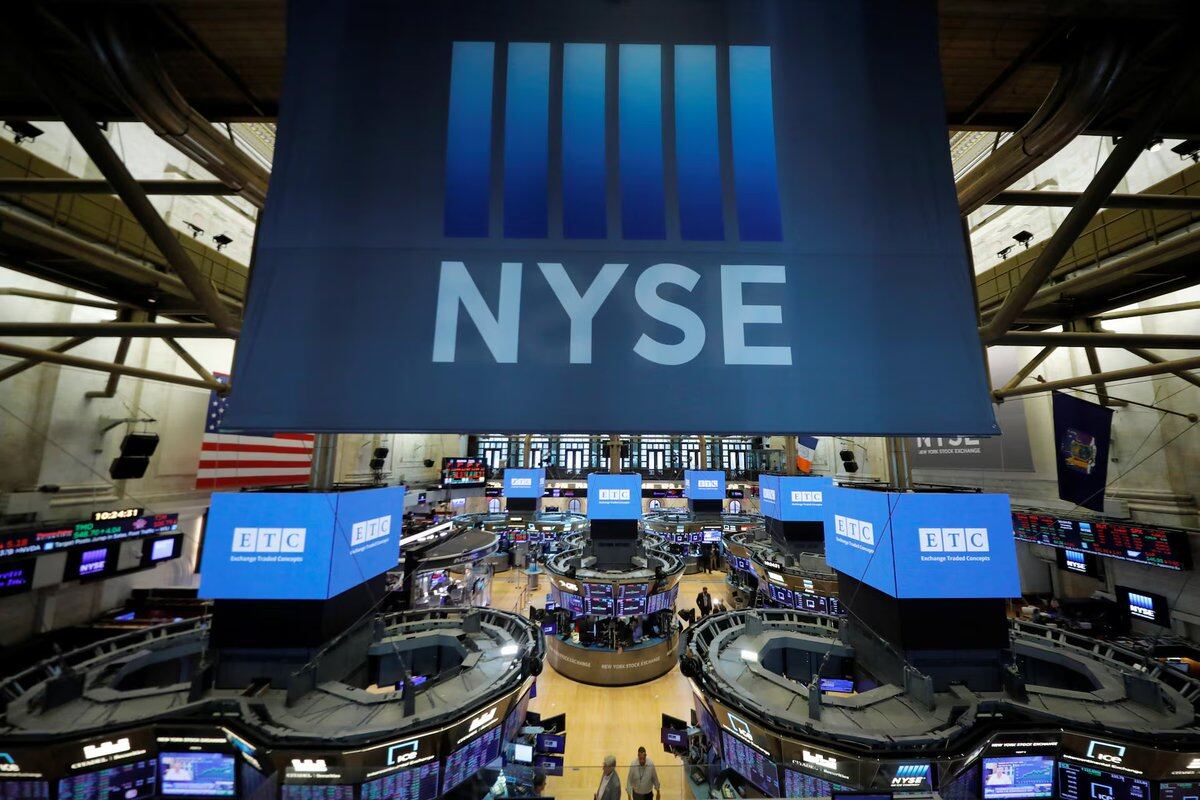
"Flash Crash Monday" is not over yet. Just now, the crypto market was hit with another bombshell—according to multiple media sources, the NYSE plans to launch a tokenized securities trading and on-chain settlement platform supporting 24/7 trading. After investing $2 billion in Polymarket last year, the ICE Group is once again joining the wave of cryptocurrency transformation, this time using its stock exchange as the vehicle. It is worth mentioning that as early as last September, the "competitor" Nasdaq had already submitted an application to the SEC for tokenized stock trading. The NYSE's move is also interpreted by the outside world as a response to competition among stock exchanges.
Odaily Planet Daily will briefly summarize the market views related to this event and explore its potential impact.
NYSE Can't Sit Still: A More Radical "On-Chain Tokenized Stock Solution" Than Nasdaq
After Trump took office, the U.S. cryptocurrency regulatory environment changed dramatically. As a result, crypto IPOs, stablecoins, PayFi, and DeFi have swept away the policy gloom of the Biden era and are developing rapidly. According to statistics, last year's stablecoin trading volume reached $33 trillion, a sharp increase of 72% year-on-year. Behind this is the substantial revenue and profits earned by stablecoin issuers Tether and Circle, as well as the massive liquidity that can be directed to the stock securities market.
Moreover, unlike Nasdaq's application to the SEC for tokenized stock trading last September, nearly six months later, the NYSE's moves related to "tokenized stock trading" are not just an application to regulators but a complete set of on-chain solutions. Recommended reading: "The Self-Revolution of U.S. Stock Exchanges: Nasdaq Applies for Tokenized Stock Trading, Targeting a Trillion-Dollar Market."
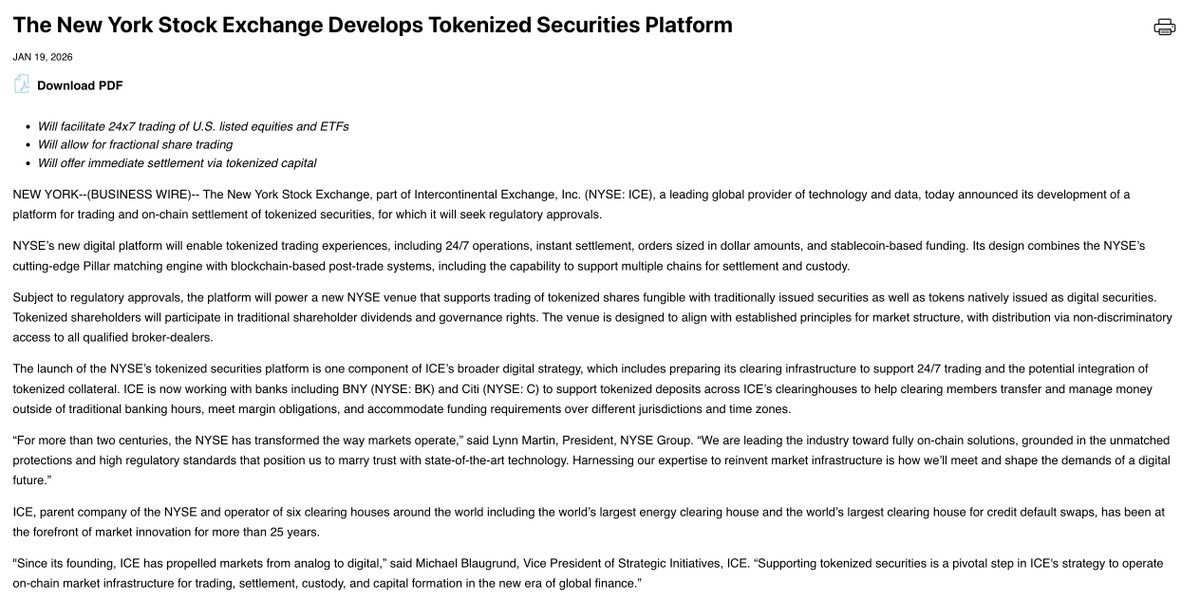
Specifically, the NYSE's "on-chain tokenized stock solution" includes the following three aspects:
- This is a tokenized securities trading and on-chain settlement platform, planning to support 24/7 trading of U.S. stocks and ETF funds, fractional share trading, stablecoin-based fund settlement, and instant delivery, and will combine NYSE's existing matching engine with a blockchain settlement system.
- According to the NYSE's plan, tokenized stocks will have the same dividends and governance rights as traditional securities.
- NYSE's parent company ICE is also collaborating with banking giants such as BNY Mellon and Citigroup to explore tokenized deposits and clearing infrastructure to support cross-time zone, round-the-clock fund and margin management.
In comparison, if Nasdaq's tokenized stock application seems like a "new bottle for old wine" move in response to policy, then the NYSE's plan seems like a "new retail trading platform" that integrates all links from "brewing-packaging-distribution-recycling."
Most importantly, the NYSE's "tokenized stock" trading platform supports 24/7 trading, which was originally one of the advantages of various cryptocurrencies over securities stocks. Now, this advantage becomes a joke in the face of the massive asset targets and liquidity of the world's largest stock exchange, the NYSE.
As a result, there are some pessimistic views in the crypto market: "The RWA sector of the cryptocurrency market and its increasingly tight liquidity will face the strictest 'father.' Compared to the NYSE, which has an annual trading volume of over a hundred trillion dollars, crypto RWA projects can almost be said to be non-existent."
What Do Industry Practitioners Think: Mixed Impacts, The Past Is the Past, The Present Is Now
In 1792, 24 securities brokers signed the Buttonwood Agreement under a buttonwood tree outside 68 Wall Street in New York, marking the birth of the predecessor of the NYSE. At that time, limited by the small number of investment targets and limited market activity, stock trading hours were more flexible, without strict continuous trading sessions. Brokers mainly conducted transactions through auctions or informal methods.
On March 8, 1817, the organization drafted a charter and officially changed its name to the New York Stock Exchange Board.
In May 1887, the NYSE standardized stock trading hours to "Monday to Friday: 10:00 a.m. to 3:00 p.m.; Saturday: 10:00 a.m. to 12:00 p.m."
In 1952, Saturday trading was officially canceled.
In 1985, stock trading opening time was moved forward to 9:30 a.m., and closing was extended to 4:00 p.m., forming the current 9:30–16:00 session, which has lasted for about 41 years.
If the NYSE's application for 24/7 tokenized stock trading is approved, it means that this decades-long or even centuries-old "limited-time model" will become history. From this perspective, the crypto market has gained high recognition from the mainstream financial world.
Pro View: The Era's Train Is Roaring Forward
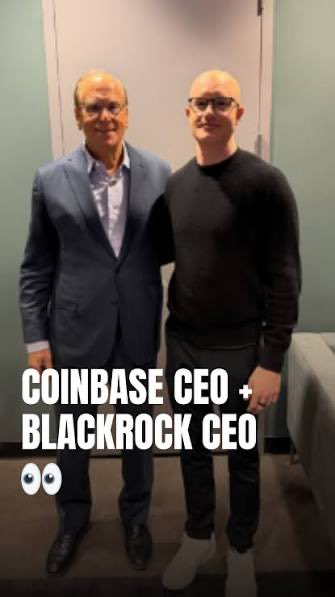
BTC OG and BankToTheFuture founder Simon Dixon posted, "Nothing can stop this (era's) train. Tokens are IOUs for actual assets held by custodians, supplementing DTCC claims. All-day trading can be achieved without tokens. This is an upgraded version of the monitoring state. You will own nothing, and you will be happy." The accompanying picture shows BlackRock CEO Larry Fink and Coinbase CEO Brain Armstrong embracing.
Indian crypto KOL Open4profit posted, "(This will) allow the market to react immediately to global news; AI and algorithms will play a greater role in pricing and risk management; this is a major change for the stock market, pay close attention to liquidity changes."
Redstone DeFi co-founder Marcin saw a "startup opportunity," saying, "This is a good start and fits exactly with what we are going to do next."
Wintermute OTC business head Jake O also highly affirmed this: "Traditional infrastructure can extend trading hours but cannot solve T+1/2 friction or eliminate rent-seeking behaviors that increase costs and delays. Ironically, cryptocurrency solved this years ago: 24/7 trading, instant settlement, global access, no gatekeepers or (traditional bank) 'data fees.' Integration is inevitable: equity trading on-chain, atomic settlement, the line between 'crypto' assets and 'traditional' assets will completely disappear. Welcome to the 21st century..."
Of course, some see it as an opportunity, while others see it as a threat.
Con View: Exchanges Reap the Benefits, the Suffering Falls on the New Generation of Young People
Unlike the industry view that the NYSE's move will stimulate the crypto market and promote cryptocurrency popularization, some industry insiders also see potential problems.
L1D partner LouisT posted: "The entire global financial system is moving on-chain, but somehow, they don't seem to be bidding for our 'bear drug-like' tokens." In other words, traditional financial markets are not buying into the so-called RWA assets of cryptocurrencies.
MoonRock Capital founder expressed concern about the living conditions of the younger generation: "This is not good news for the baby boomer generation, your life has become more difficult." He probably means that compared to previous generations with more increments, the baby boomer generation faces a more complex investment environment and a round-the-clock "liquidity game stage."
BingX advisor Nebraskangooner also raised his doubts: "Why make the stock market trade 24 hours a day? No one wants this except the exchanges. The only benefit is that without the interference of after-hours trading, stop-loss and take-profit points can truly function. Not sure what impact this will have on stock price movements after earnings reports?" This view focuses more on information impact and exchange profits.
Summary: There Is Still a Gap Between Traditional Finance and Crypto-Native Groups, Opportunities for Users and Entrepreneurs Remain
Finally, I would like to briefly share my personal views based on the above information:
First, based on current information, the NYSE's relevant application may be approved as early as the end of 2026, and the main approval agency is still the U.S. SEC. For crypto platforms, this is an important time gap.
Second, the main service targets of the NYSE's tokenized stock trading and on-chain settlement platform are likely still conventional investment institutions and compliant investors. For crypto-native groups and even global investors, what they need is not only the satisfaction of functional needs but also the realization of "KYC-free registration trading, global asset liquidity allocation, and riskier high-leverage" through tokenized stocks and RWA platforms. This may be the advantage of crypto RWA projects.
Finally, the core purpose of the NYSE, Nasdaq, etc., in promoting stock tokenization is still trading volume and fees. Like CEXs constantly listing new token projects, in the short term, they may still need to learn from CEXs, DEXs, and even on-chain Perp DEXs. This is also the basis for existing mature platforms to counterattack. By then, it is not impossible for U.S. stock exchanges like the NYSE and Nasdaq to fall from grace. The key still lies in where the liquidity is, where the attention is, and where the user base is.