NYSE-listed NovaBay pivots to crypto, rebrands as Stablecoin Development Corporation

ambcryptoPublished on 2026-04-03Last updated on 2026-04-03

Abstract

NovaBay Pharmaceuticals, listed on the NYSE, is fully pivoting to cryptocurrency and rebranding as Stablecoin Development Corporation (ticker: SDEV). The company will shift its focus to on-chain treasury and staking activities, moving away from its legacy pharmaceutical business. As of March 16, NovaBay disclosed holdings of approximately 2.06 billion SKY tokens and is actively staking them to generate yield, adopting a DeFi-aligned strategy rather than passive crypto investment. SKY has traded in a stable range between $0.055 and $0.08, reflecting its role as a governance and yield-generating asset. This transition highlights a broader trend of public companies moving beyond Bitcoin holdings to actively participate in on-chain ecosystems.

NovaBay Pharmaceuticals is moving deeper into crypto, announcing a full strategic pivot that includes a rebrand to Stablecoin Development Corporation and a shift toward on-chain treasury and staking activities.

In a Form 8-K filing, the company said it will adopt the new name and begin trading under the ticker SDEV on the NYSE American on 3 April. The move marks a significant transition from its legacy pharmaceutical business toward a crypto-focused operating model.

From pharma to on-chain strategy

The filing shows that the company is no longer experimenting with digital assets but actively restructuring around them. NovaBay disclosed holdings of approximately 2.06 billion SKY tokens as of 16 March, alongside accumulated staking rewards.

Rather than holding crypto passively, the firm said it is engaging in “SKY-related on-chain activities,” including staking. This model allows token holders to earn yield by participating in network operations.

The shift effectively positions the company as an on-chain holding entity, aligning its treasury strategy with the mechanics of decentralized finance [DeFi].

A yield-focused crypto treasury

Unlike corporate Bitcoin strategies that focus on long-term price appreciation, NovaBay’s approach centers on yield generation. By staking its SKY holdings, the company is tapping into a recurring reward mechanism native to blockchain networks.

This structure suggests a different risk and return profile—one tied not only to token price movements but also to network activity and participation incentives.

The company did not provide detailed disclosures on how its SKY position was accumulated. Still, the scale of the holdings signals a high-conviction allocation.

SKY price reflects steady, range-bound behavior

Recent market data shows that SKY has traded within a relatively stable range compared to more volatile crypto assets.

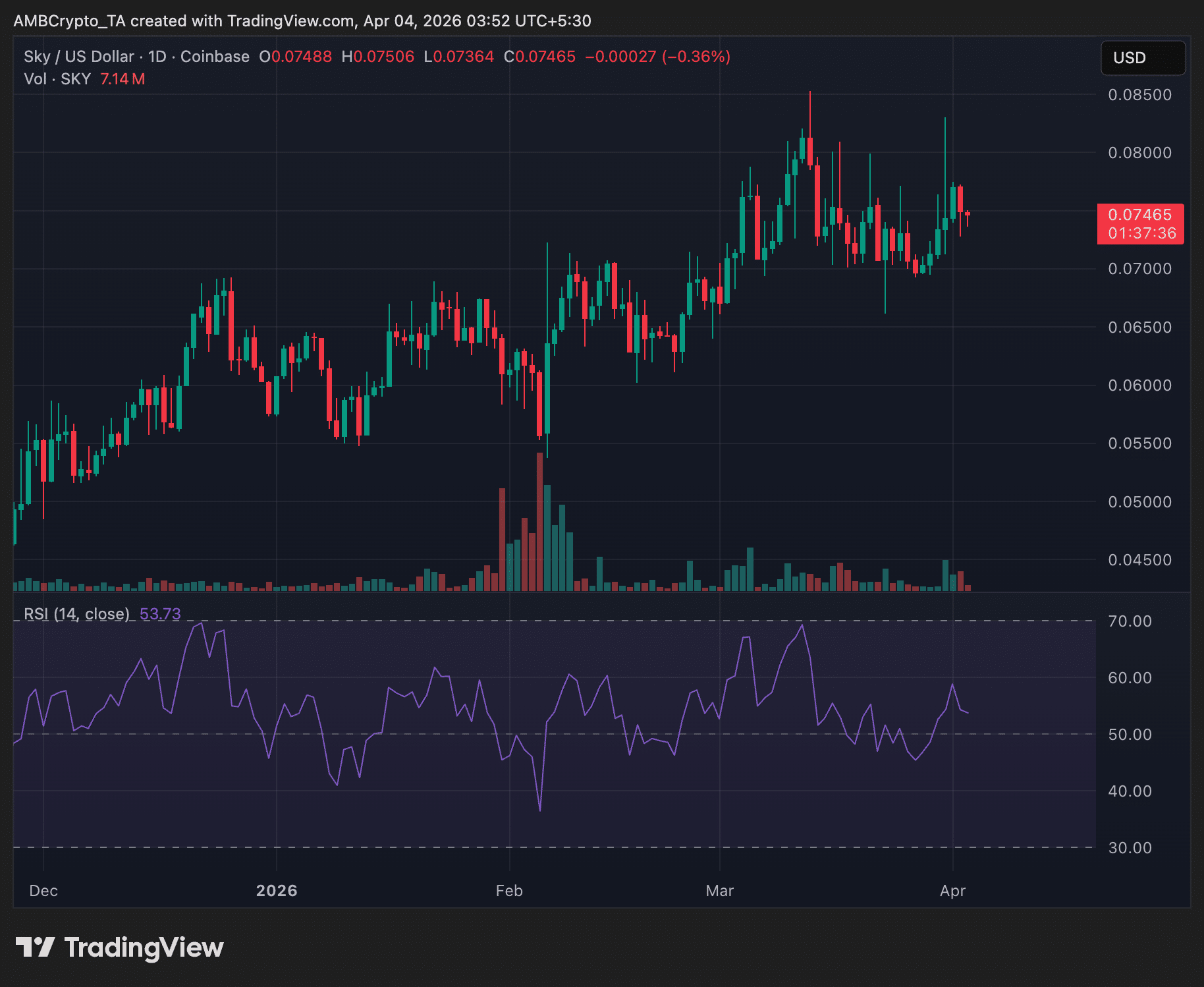
The token has largely fluctuated between $0.055 and $0.08 in recent months, with its Relative Strength Index [RSI] hovering near neutral levels around 50–55. This suggests balanced momentum rather than speculative overheating.
Source: TradingView

The relatively stable price action aligns with SKY’s role as a governance and yield-generating asset, rather than a purely narrative-driven token.

This may also underpin the company’s strategy, which appears focused on long-term participation and reward generation rather than short-term trading gains.

A broader shift in corporate crypto adoption

NovaBay’s transformation reflects a growing trend of publicly listed firms integrating crypto more directly into their core business models.

While earlier corporate adoption focused on holding Bitcoin as a treasury reserve, newer strategies are emerging that involve active participation in on-chain ecosystems — including staking, liquidity provision, and governance.

By rebranding and aligning its identity with stablecoin and DeFi infrastructure, the company is signaling a deeper commitment to this evolving model.

The transition also highlights how traditional corporate structures are increasingly intersecting with decentralized financial systems.


Final Summary

  • NovaBay is rebranding as Stablecoin Development Corporation and shifting to an on-chain treasury model built around staking and token holdings.
  • The move signals a broader evolution in corporate crypto adoption, with firms increasingly engaging in yield-generating DeFi strategies rather than passive exposure.


Related Questions

QWhat is the new name and ticker symbol for NovaBay Pharmaceuticals after its rebranding?

AThe new name is Stablecoin Development Corporation and it will trade under the ticker SDEV on the NYSE American.

QWhat significant change is NovaBay making to its core business model?

ANovaBay is making a full strategic pivot from its legacy pharmaceutical business to a crypto-focused operating model, centering on on-chain treasury and staking activities.

QWhat specific crypto asset does the company hold a large amount of, and how many?

AThe company disclosed holdings of approximately 2.06 billion SKY tokens as of 16 March.

QHow does NovaBay's crypto strategy differ from a typical corporate Bitcoin strategy?

AUnlike corporate Bitcoin strategies that focus on long-term price appreciation, NovaBay’s approach centers on yield generation through staking its SKY holdings to earn recurring rewards.

QWhat does the recent price action and RSI of the SKY token suggest about its market behavior?

ASKY has traded in a relatively range-bound manner between $0.055 and $0.08, with its RSI near neutral levels around 50–55, suggesting balanced momentum rather than speculative overheating.

Related Reads

Bitcoin Withdrawals Continue: 8 Years of Storage in a Coldcard Cold Wallet Ended in Zero

Coldcard Hardware Wallet Hacked: Losses Mount Due to Vulnerable Seed Generation A critical vulnerability in Coldcard hardware wallets has led to a continued wave of fund thefts. According to Galaxy Research, the total stolen has reached 1,367.05 BTC (approx. $88.6 million) from 4,585 addresses, a significant increase from the initial 594.5 BTC reported on July 30, 2026. Most of the stolen funds remain on the attackers' addresses. The issue is not with the current firmware, which Coinkite has updated, but with seed phrases generated on vulnerable devices between March 2021 and the release of fixed firmware versions. Due to a programmer error, devices switched from using a hardware random number generator to the software-based Yasmarang generator, which was initialized with publicly accessible data like the chip's serial number. This made the seed phrases predictable through offline brute-force attacks, meaning wallets remain at risk until funds are moved to a new wallet generated with the patched firmware. Affected devices include Mk2/Mk3 with firmware 4.0.1–4.1.9 (and up to 5.0.3), Mk4/Mk5 up to version 5.6.0, and Q models up to 1.5.0Q. The only exceptions are seeds created with a high-entropy method like at least 50 independent dice rolls or a strong unique BIP-39 passphrase. All other owners must generate a new seed on the fixed firmware and transfer their assets. A case highlighting the human impact involves a 39-year-old long-term investor who lost 2 BTC (approx. $130,000) in minutes. He had accumulated the Bitcoin over eight years through physical labor, viewing it as a financial lifeline and a retirement plan in a country suffering from hyperinflation. His story underscores that even conservative "buy and hold in cold storage" strategies can be compromised by such underlying technical flaws. From a technical perspective, this incident echoes historical failures where weak random number generators undermined cryptographic security, challenging the assumption that offline storage is automatically foolproof.

cryptonews.ru4h ago

Bitcoin Withdrawals Continue: 8 Years of Storage in a Coldcard Cold Wallet Ended in Zero

cryptonews.ru4h ago

Trading

Spot
活动图片




