NYSE Can't Sit Still, Plans to Launch 24/7 Tokenized Trading

比推Published on 2026-01-19Last updated on 2026-01-19

Abstract

The New York Stock Exchange (NYSE) is reportedly planning to launch a tokenized securities trading and on-chain settlement platform that would enable 7x24 hour trading of stocks and ETFs. This move, seen as a response to competitor Nasdaq's own application for tokenized stock trading submitted last year, represents a significant step by traditional finance into the digital asset space. The proposed "on-chain stock tokenization solution" includes features such as fractional share trading, stablecoin-based fund settlement, instant settlement, and plans to grant tokenized stocks equal dividend and governance rights as traditional securities. NYSE's parent company, ICE, is also collaborating with major banks to explore supporting infrastructure. Market reactions are mixed. Proponents view it as an inevitable fusion of traditional and crypto finance, bringing enhanced liquidity and modernized infrastructure like atomic settlement. Critics, however, express concerns that it primarily benefits exchanges and could negatively impact younger investors by creating a relentless trading environment. The approval process by the SEC is expected to take time, potentially not until late 2026, leaving a window of opportunity for existing crypto platforms that offer features like non-KYC trading and high leverage, which the NYSE platform is unlikely to provide. The core driver for traditional exchanges remains trading volume and fees, and their success is not guaranteed in this new competitiv...

Source: Odaily Planet Daily

Author: Wenser

Original Title: NYSE Plans to Launch 24/7 Tokenized Stock Trading, Leaving "Competitors" Stunned


As "Flash Crash Monday" continues, the crypto market has just been hit with another bombshell—according to multiple media sources, the New York Stock Exchange plans to launch a tokenized securities trading and on-chain settlement platform supporting 24/7 trading. After investing $2 billion in Polymarket last year, the ICE Group is once again leveraging its stock exchange to join the century-defining wave of cryptocurrency transformation.

It is worth noting that as early as last September, the "competitor" Nasdaq had already submitted an application to the SEC for tokenized stock trading. NYSE's move is also interpreted by the outside world as a response to competition among stock exchanges.

This article will briefly summarize market views related to this event and explore its potential impact.

NYSE Can't Sit Still: A More Aggressive "On-Chain Tokenization Solution for Stocks" Compared to Nasdaq

After Trump took office, the U.S. cryptocurrency regulatory environment underwent a significant shift. As a result, crypto IPOs, stablecoins, PayFi, and DeFi have developed rapidly, sweeping away the policy gloom of the Biden era. According to statistics, stablecoin trading volume reached $33 trillion last year, a sharp increase of 72% year-on-year. Behind this lies the substantial profits earned by stablecoin issuers Tether and Circle, as well as the massive liquidity that can be directed to the stock securities market.

Moreover, unlike Nasdaq's application to the SEC for tokenized stock trading last September, nearly half a year later, NYSE's moves related to "tokenized stock trading" are not just an application to regulators but a comprehensive "on-chain solution."

Specifically, NYSE's "on-chain tokenization solution for stocks" includes the following three aspects:

  • This is a tokenized securities trading and on-chain settlement platform, planning to support 24/7 trading of U.S. stocks and ETF funds, fractional share trading, stablecoin-based fund settlement, and instant delivery, while integrating NYSE's existing matching engine with a blockchain settlement system.

  • According to NYSE's plan, tokenized stocks will have the same dividends and governance rights as traditional securities.

  • NYSE's parent company, ICE, is also collaborating with banking giants such as BNY Mellon and Citigroup to explore tokenized deposits and clearing infrastructure to support cross-time zone, round-the-clock fund and margin management.
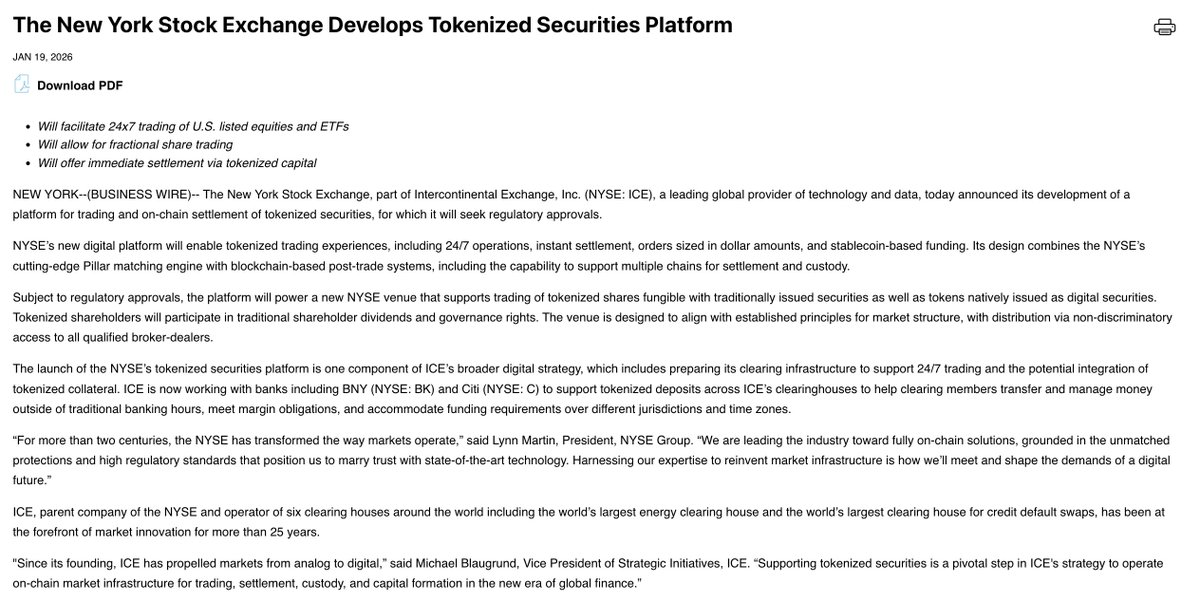
In comparison, if Nasdaq's tokenized stock application seems like a "new bottle for old wine" move in response to policy, NYSE's plan appears to be a "new retail trading platform" that integrates all aspects of "production-packaging-distribution-recycling."

Most importantly, NYSE's "tokenized stock" trading platform supports 24/7 trading, which was originally one of the advantages of various cryptocurrencies over securities and stocks. Now, this advantage becomes a joke in the face of the massive asset targets and liquidity of the world's largest stock exchange, NYSE.

As a result, there are some pessimistic views in the crypto market: "The RWA sector of the crypto market and its increasingly tight liquidity will face the strictest 'father.' Compared to NYSE's annual trading volume of over a hundred trillion dollars, crypto RWA projects can almost be said to not exist."

What Crypto Practitioners Think: Mixed Impacts, the Past Is the Past, the Present Is the Present

In 1792, 24 securities brokers signed the Buttonwood Agreement under a buttonwood tree outside 68 Wall Street in New York, marking the birth of the predecessor of the New York Stock Exchange. At that time, due to limited investment targets and market activity, stock trading hours were relatively flexible, with no strict continuous trading sessions. Brokers primarily conducted transactions through auctions or informal methods.

On March 8, 1817, the organization drafted a charter and officially changed its name to the New York Stock and Exchange Board.

In May 1887, NYSE standardized stock trading hours to "Monday to Friday: 10:00 AM to 3:00 PM; Saturday: 10:00 AM to 12:00 PM."

In 1952, Saturday trading was officially canceled.

In 1985, stock trading opening time was moved forward to 9:30 AM, and closing time extended to 4:00 PM, forming the current 9:30–16:00 session, which has lasted for about 41 years.

If NYSE's application for 24/7 tokenized stock trading is approved, it would mean that this decades- or even centuries-old "limited-time trading model" will become history. From this perspective, the crypto market has gained high recognition from mainstream finance.

Pro Views: The Era's Momentum Is Unstoppable

BTC OG and BankToTheFuture founder Simon Dixon posted, "Nothing can stop this (era's) train. Tokens are IOUs for actual assets held by custodians, supplementing DTCC claims. All-day trading is achievable without tokens. This is an upgraded version of the surveillance state. You will own nothing and be happy." The accompanying image showed BlackRock CEO Larry Fink and Coinbase CEO Brain Armstrong embracing.

Indian crypto KOL Open4profit posted, "(This will) allow the market to react immediately to global news; AI and algorithms will play a greater role in pricing and risk management; this is a significant change for the stock market—keep a close eye on liquidity changes."

Redstone DeFi co-founder Marcin saw a "startup opportunity," saying, "This is a good start and aligns with what we are going to do next."

Wintermute OTC head Jake O also highly affirmed the move: "Traditional infrastructure can extend trading hours but cannot solve T+1/2 friction or eliminate rent-seeking behaviors that increase costs and delays. Ironically, crypto solved this years ago: 24/7 trading, instant settlement, global access, no gatekeepers or (traditional banks') 'data fees.' Convergence is inevitable: equity trading on-chain, atomic settlement, the line between 'crypto' assets and 'traditional' assets will completely disappear. Welcome to the 21st century..."

Of course, some see it as an opportunity, while others see it as a threat.

Con Views: Exchanges Reap the Benefits, the Younger Generation Suffers

Unlike those in the industry who believe NYSE's move will stimulate the crypto market and promote cryptocurrency adoption, some insiders also see potential problems.

L1D partner LouisT posted: "The entire global financial system is moving on-chain, but somehow, they don’t seem to be bidding for our 'bear-drug-like' tokens." In other words, traditional financial market does not buy into the so-called RWA assets of cryptocurrencies.

MoonRock Capital founder expressed concern about the living conditions of the younger generation: "This is not good news for the baby boomers; your lives have become more difficult." He likely meant that compared to previous generations with more increments, baby boomers face a more complex investment environment and a round-the-clock "liquidity gaming stage."

BingX advisor Nebraskangooner also raised doubts: "Why make the stock market trade 24 hours? No one wants this except the exchanges. The only benefit is that without after-hours trading interference, stop-loss and take-profit points can truly function. Not sure what impact this will have on stock price movements after earnings reports?" This view focuses more on information impact and exchange profits.

Summary: A Gap Still Exists Between Traditional Finance and Crypto Natives, Opportunities for Users and Entrepreneurs Remain

Finally, I would like to share some personal views based on the above information:

First, based on current information, NYSE's related application may be approved as early as the end of 2026, with the main approval authority still being the U.S. SEC. For crypto platforms, this is an important time gap.

Second, NYSE's tokenized stock trading and on-chain settlement platform will likely primarily serve conventional investment institutions and compliant investors. For crypto-native groups and global investors, what they need is not just functional satisfaction but also the ability to achieve "KYC-free registered trading, global asset liquidity allocation, and riskier high-leverage" through tokenized stocks and RWA platforms. This may be the advantage of crypto RWA projects.

Finally, the core purpose of NYSE, Nasdaq, and others in promoting stock tokenization remains trading volume and fees. Like CEXs continuously listing new token projects, in the short term, they may still need to learn from CEXs, DEXs, and even on-chain Perp DEXs. This is also the basis for existing mature platforms to potentially counterattack. By then, it is not impossible for U.S. stock exchanges like NYSE and Nasdaq to fall from grace. The focus is still on where the liquidity is, where the attention is, and where the user base is.


Twitter:https://twitter.com/BitpushNewsCN

Bitpush TG Discussion Group:https://t.me/BitPushCommunity

Bitpush TG Subscription: https://t.me/bitpush

Original link:https://www.bitpush.news/articles/7603876

Related Questions

QWhat is the New York Stock Exchange (NYSE) planning to launch according to the article?

AThe NYSE is planning to launch a tokenized securities trading and on-chain settlement platform that supports 7x24 hour trading, fractional share trading, stablecoin-based fund settlement, and instant settlement for U.S. stocks and ETF funds.

QHow does the NYSE's tokenized stock trading plan differ from Nasdaq's application submitted last year?

AUnlike Nasdaq's application, which was seen as a superficial response to policy changes, the NYSE's plan is a comprehensive 'on-chain solution' that integrates trading, settlement, and banking infrastructure, offering full-chain functionality rather than just a tokenized representation of existing stocks.

QWhat are some potential positive impacts of the NYSE's 7x24 hour tokenized trading platform as viewed by crypto industry insiders?

APositive impacts include immediate market reaction to global news, greater role of AI and algorithms in pricing and risk management, elimination of traditional settlement delays and friction, and the blurring of boundaries between crypto and traditional assets, marking a significant step into modern financial infrastructure.

QWhat concerns do critics have about the NYSE's proposed 24/7 trading platform?

ACritics worry that it primarily benefits exchanges by increasing trading fees, complicates risk management for retail investors (especially younger generations), and may negatively impact post-earnings price movements due to constant trading availability, with little actual demand for such extended hours from most market participants.

QWhat advantages might crypto-native RWA projects still hold over traditional exchanges like the NYSE entering tokenized trading?

ACrypto RWA projects can offer advantages like non-KYC registration, global liquidity allocation, higher leverage options, and riskier trading environments, which may appeal to crypto-native users and global investors seeking more flexible and permissionless access compared to the NYSE's likely focus on institutional and compliant investors.

Related Reads

North Korean Hackers Loot $500 Million in a Single Month, Becoming the Top Threat to Crypto Security

North Korean hackers, particularly the notorious Lazarus Group and its subgroup TraderTraitor, have stolen over $500 million from cryptocurrency DeFi platforms in less than three weeks, bringing their total theft for the year to over $700 million. Recent major attacks on Drift Protocol and KelpDAO, resulting in losses of approximately $286 million and $290 million respectively, highlight a strategic shift: instead of targeting core smart contracts, attackers are now exploiting vulnerabilities in peripheral infrastructure. For instance, the KelpDAO attack involved compromising downstream RPC infrastructure used by LayerZero's decentralized validation network (DVN), allowing manipulation without breaching core cryptography. This sophisticated approach mirrors advanced corporate cyber-espionage. Additionally, North Korea has systematically infiltrated the global crypto workforce, with an estimated 100 operatives using fake identities to gain employment at blockchain companies, enabling long-term access to sensitive systems and facilitating large-scale thefts. According to Chainalysis, North Korean-linked hackers stole a record $2 billion in 2025, accounting for 60% of all global crypto theft that year. Their total historical crypto theft has reached $6.75 billion. Post-theft, they employ specialized money laundering methods, heavily relying on Chinese OTC brokers and cross-chain mixing services rather than standard decentralized exchanges. Security experts, while acknowledging the increased sophistication, emphasize that many attacks still exploit fundamental weaknesses like poor access controls and centralized operational risks. Strengthening private key management, limiting privileged access, and enhancing coordination among exchanges, analysts, and law enforcement immediately after an attack are critical to improving defense and fund recovery chances. The industry's challenge now extends beyond secure smart contracts to safeguarding operational security at the infrastructure level.

marsbit35m ago

North Korean Hackers Loot $500 Million in a Single Month, Becoming the Top Threat to Crypto Security

marsbit35m ago

Circle CEO's Seoul Visit: No Korean Won Stablecoin Issuance, But Met All Major Korean Banks

Circle CEO Jeremy Allaire's recent activities in Seoul indicate a strategic shift for the company, moving away from issuing a Korean won-backed stablecoin and instead focusing on embedding itself as a key infrastructure provider within Korea’s financial and crypto ecosystem. Despite Korea accounting for nearly 30% of global crypto trading volume—with a market characterized by high retail participation and altcoin dominance—Circle has chosen not to compete for the role of stablecoin issuer. Instead, Allaire met with major Korean banks (including Shinhan, KB, and Woori), financial groups, leading exchanges (Upbit, Bithumb, Coinone), and tech firms like Kakao. This approach reflects a broader industry transition: the core of stablecoin competition is shifting from issuance rights to systemic positioning. With Korean regulators still debating whether banks or tech companies should issue stablecoins, Circle is avoiding regulatory uncertainty by strengthening its role as a service and technology partner. The company is deepening integration with trading platforms, building connections, and promoting stablecoin infrastructure. This positions Circle to benefit regardless of which entity eventually issues a won stablecoin. Allaire also noted the potential for a Chinese yuan stablecoin in the next 3–5 years, underscoring a regional trend of stablecoins becoming more regulated and integrated with traditional finance. Ultimately, Circle’s strategy highlights that future influence in the stablecoin market will belong not necessarily to the issuers, but to the foundational infrastructure layers that enable cross-system transactions.

marsbit1h ago

Circle CEO's Seoul Visit: No Korean Won Stablecoin Issuance, But Met All Major Korean Banks

marsbit1h ago

SpaceX Ties Up with Cursor: A High-Stakes AI Gambit of 'Lock First, Acquire Later'

SpaceX has secured an option to acquire AI programming company Cursor for $60 billion, with an alternative clause requiring a $10 billion collaboration fee if the acquisition does not proceed. This structure is not merely a potential acquisition but a strategic move to control core access points in the AI era. The deal is designed as a flexible, dual-path arrangement, allowing SpaceX to either fully acquire Cursor or maintain a binding partnership through high-cost collaboration. This "option-style" approach minimizes immediate regulatory and integration risks while ensuring long-term alignment between the two companies. At its core, the transaction exchanges critical AI-era resources: SpaceX provides its Colossus supercomputing cluster—one of the world’s most powerful AI training infrastructures—while Cursor contributes its AI-native developer environment and strong product adoption. This synergy connects compute power, models, and application layers, forming a closed-loop AI capability stack. Cursor, founded in 2022, has achieved rapid growth with over $1 billion in annual revenue and widespread enterprise adoption. Its value lies in transforming software development through AI agents capable of coding, debugging, and system design—positioning it as a gateway to future software production. For SpaceX, this move is part of a broader strategy to evolve from a aerospace company into an AI infrastructure empire, integrating xAI, supercomputing, and chip manufacturing. Controlling Cursor fills a gap in its developer tooling layer, strengthening its AI narrative ahead of a potential IPO. The deal reflects a shift in AI competition from model superiority to ecosystem and entry-point control. With programming tools as a key battleground, securing developer loyalty becomes crucial for dominating the software production landscape. Risks include questions around Cursor’s valuation, technical integration challenges, and potential regulatory scrutiny. Nevertheless, the deal underscores a strategic bet: controlling both compute and software development access may redefine power dynamics in the AI-driven future.

marsbit1h ago

SpaceX Ties Up with Cursor: A High-Stakes AI Gambit of 'Lock First, Acquire Later'

marsbit1h ago

Trading

Spot
Futures
活动图片