‘No Token Issuance’ Statement Fails to Curb Frenzy, ClawdBot Trapped in Crypto Kidnapping Dilemma

比推Published on 2026-01-27Last updated on 2026-01-27

Abstract

ClawdBot, an open-source AI assistant, gained massive traction with over 40,000 GitHub stars and a rapidly growing Discord community. Despite its technical success, it became the center of an unsolicited meme coin frenzy when a token named CLAWD was launched without authorization, reaching a market cap of $16 million. The founder, Peter Steinberger, explicitly stated he would never issue a token and condemned the harassment and scams targeting the project. His account was even hijacked by crypto scammers attempting to force a token launch. Steinberger, a retired entrepreneur whose previous company received a €100 million investment, has no financial incentive to engage in crypto speculation. The incident highlights a shift in meme coin culture from seeking legitimacy through technical projects to aggressively “adopting” viral trends through coercion and scams, potentially harming genuine open-source development.

Author: Curry, Deep Tide TechFlow

Original Title: ClawdBot Founder Says Never Issuing Tokens, Meme Trenches Go Crazy


On January 25th, an open-source AI assistant called ClawdBot went viral.

You might have seen it extensively on Twitter and various media platforms at home and abroad over the past couple of days. The project's GitHub stars surpassed 40,000, and foreigners joked that Mac minis would sell out because of it, as it needs to run 24/7, and a brand new Mac, free of other tasks, versatile and capable, is a good choice.
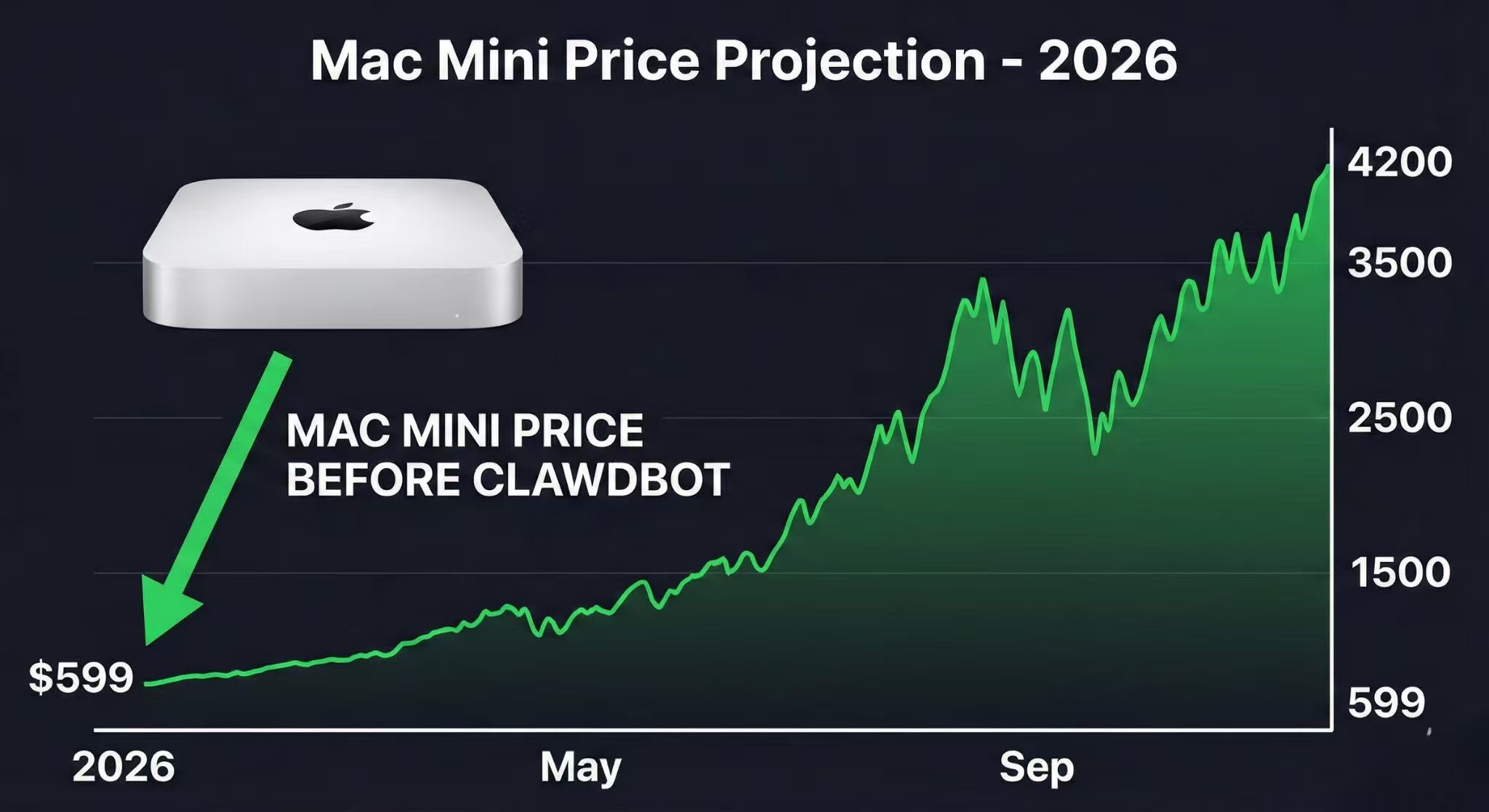
Simultaneously, nearly ten thousand people flooded into the project's Discord community.

ClawdBot founder Peter Steinberger also tweeted, saying he hardly looks at code anymore, letting AI write it all;

This sparked another phenomenon-level technical topic on Twitter after Dan Koe's viral inspirational piece "How to Fix Your Life in a Day" – "How to Quickly Deploy ClawdBot".

Naturally, attention brings liquidity, and the crypto friends smelled it and came.

The同名 Meme token CLAWD was actually launched on the 25th, with its market cap once soaring to $16 million. Everything looked familiar: a trending AI project, a同名 token, early players getting rich. The only problem was:

The founder said he wouldn't issue a token.

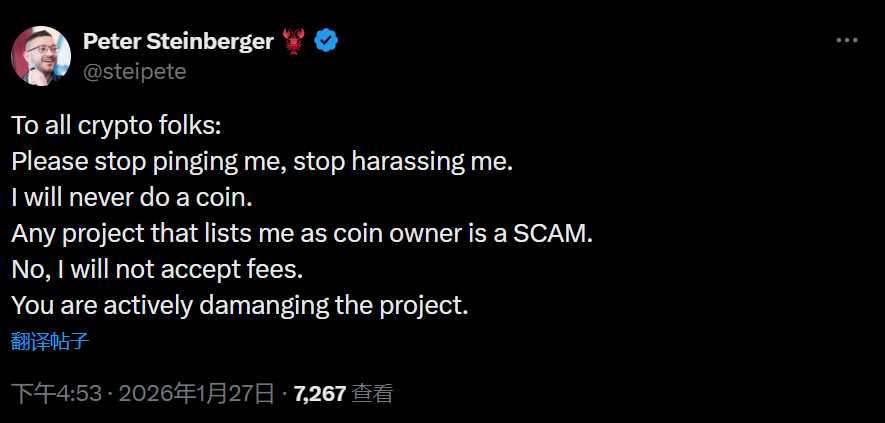
On January 27th, Peter Steinberger posted a statement on Twitter:

"Stop DMing me. Stop harassing me. I will never issue a token. Any project listing me as a token owner is a scam. No, I don't accept any fees. You are damaging the project".
On the same day, he posted another tweet:

Any GitHub folks who can help me get my account back? It's been hijacked by crypto scammers.

You won't issue a token, I'll DM you to issue it. You still won't, then I'll hijack your account and issue it for you.

Unlike the poor devs in the Meme trenches desperately waiting for an official move, this developer who created ClawdBot doesn't seem to be short of money.

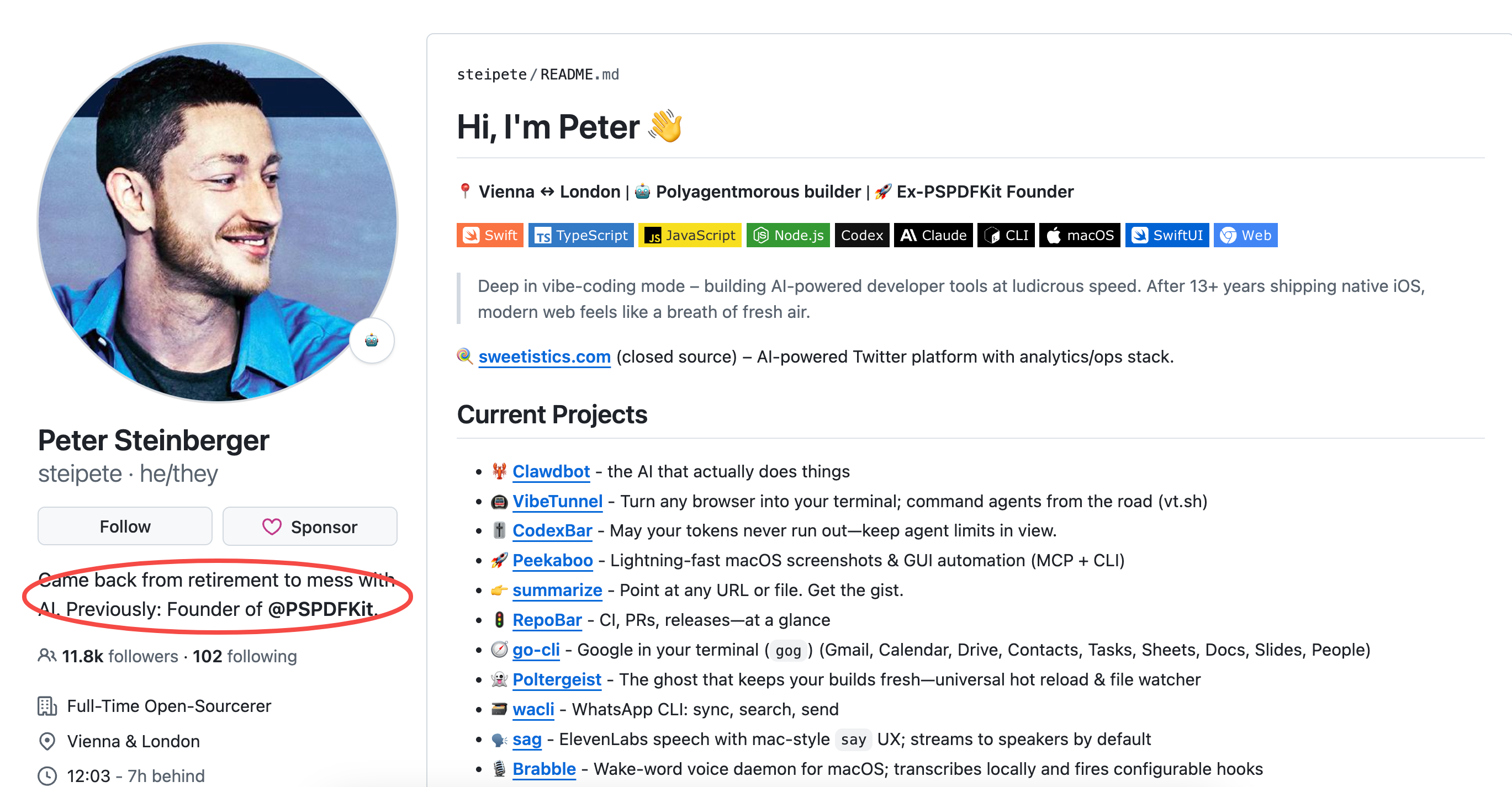
I looked into his background. Peter previously founded a company called PSPDFKit, developing PDF tools.

In 2021, Insight Partners invested €100 million in this company, which at the exchange rate then was roughly:

$116 million.

After the investment was completed, Peter and his co-founder retired. In his own words, he "came back from retirement to mess with AI", now returning from retirement to fiddle with AI.
A person who retired by making products really doesn't need your token profits.

But the brothers in the Meme trenches need it.

This is the most interesting part of the story. In the crypto world's perception, "who wouldn't want to make money" is the first principle. A project goes viral, issuing a token is a matter of course.

If you don't issue, you're either pretending or waiting for a better time, even if the project has little to do with crypto.

So people will DM, harass, even hijack accounts to issue tokens through scams.

Remember when AI Meme first got hot the year before last and last year, the routine was like this:

First, have a technical project or product prototype, then the team announces they will issue a token, the community follows up, the narrative is self-consistent. This is called "technical legitimacy": you have something, so you qualify to issue.

Now it's changed.

Now, upon seeing the hype, first抢注 a同名 token, then wait for "official adoption". If adopted, everyone is happy; if not, keep speculating. Anyway, retail investors can't tell which is real.

In the Meme trenches, this "forced adoption" model is becoming the norm.

Whether it's Chinese Meme or overseas Meme, seeking mention,暗示, or endorsement from an official role in a hot topic is an action that will never stop.

It's just that this initiative is a bit too wolf-like.

Before, Meme was about "creating gods", finding a founder with a technical background, packaging them as the next Vitalik; later it was "蹭神" (rubbing against gods), naming projects after Elon, Trump.

Now it's "绑神" (kidnapping gods), if you don't cooperate, I'll hijack your account.

From active god-making to passive kidnapping, the narrative cycle of AI Meme might really be at its end.

Peter Steinberger said something in the tweet statement above that is truly worth pondering: you are damaging the project.

An open-source, free AI assistant that anyone can use is being forced to spend energy dealing with this nonsense because of harassment from the crypto circle.

I wonder if he will shut down the project because of this, or simply make the code private. Only know that if it really comes to that, the ones who lose the most certainly won't be those speculating on tokens.

The ones who lose the most are the ordinary developers who actually want to use this tool.

But does that matter?

In the crypto world, making money is what matters.


Twitter:https://twitter.com/BitpushNewsCN

BitPush TG Discussion Group:https://t.me/BitPushCommunity

BitPush TG Subscription: https://t.me/bitpush

Original link:https://www.bitpush.news/articles/7606372

Related Questions

QWhat is the founder of ClawdBot and what is his background?

AThe founder of ClawdBot is Peter Steinberger. He previously co-founded a company called PSPDFKit, which developed PDF tools. In 2021, the company received a €100 million (approximately $116 million at the time) investment from Insight Partners, after which Peter retired. He has since returned from retirement to work on AI projects like ClawdBot.

QWhy did the ClawdBot project gain significant attention on January 25th?

AClawdBot, an open-source AI assistant, gained significant attention because its GitHub repository surpassed 40,000 stars, and its Discord community grew to nearly 10,000 members. It became a trending topic on Twitter, with discussions on how to quickly deploy it, and it was humorously suggested that Mac minis might sell out due to the project's requirement to run 24/7.

QHow did the cryptocurrency community react to the popularity of ClawdBot?

AThe cryptocurrency community quickly capitalized on ClawdBot's popularity by launching a meme token named CLAWD on the same day it went viral. The token's market capitalization briefly reached $16 million. Despite the founder's clear statement that he would never issue a token, some individuals resorted to harassing him and even hijacking his social media accounts in an attempt to force or fake an official endorsement.

QWhat was Peter Steinberger's response to the token and the harassment from the crypto community?

APeter Steinberger explicitly stated on Twitter that he would never issue a token and denounced any projects listing him as a token owner as scams. He expressed frustration over the harassment, stating that such actions were damaging the project. He also reported that his GitHub account was hijacked by crypto scammers.

QWhat does the article suggest about the current state of AI-related meme tokens?

AThe article suggests that the narrative cycle for AI-related meme tokens may be ending. It describes a shift from projects building legitimacy through technology and official token launches ('造神' or 'making a god') to simply蹭神' or 'rubbing against a god' by using famous names, and now to '绑神' or 'kidnapping a god,' where communities harass or hijack accounts of legitimate projects to force association. This behavior risks harming genuine open-source projects and their communities.

Related Reads

Within Strategy's Framework, STRC's Dividend Yield Remains at 12% as Share Price Stays Below Par Value

Michael Saylor, Executive Chairman of Strategy (MSTR), confirmed that the dividend rate for its STRC perpetual preferred shares will remain at 12.00% through August 2026. The rate has increased from 9% at its July 2025 launch to the current high via a "ratchet" mechanism, which permanently raises the rate by 0.5% whenever the share price falls below $95. This mechanism is intended to push the price back toward its $100 par value and support Strategy's "at-the-market" (ATM) program for issuing new shares to fund Bitcoin purchases. However, the mechanism has not worked as intended. STRC shares closed at $89.46 on July 31, remaining about 10-11% below par value despite the record-high dividend. Competition from rival Strive's higher-yielding SATA securities has pressured demand. The persistent discount has forced Strategy to suspend new STRC issuances via its ATM program, limiting this funding channel for Bitcoin acquisitions. STRC's struggles reflect Bitcoin's own volatility, as the preferred shares historically move in tandem. Analysts have warned the ratchet structure carries long-term, one-way risk. A law firm is investigating Strategy's ability to maintain dividend payments if Bitcoin's price stays low. Retail investors own roughly 83% of outstanding STRC shares, a group seen as prone to panic selling during downturns. In response, Strategy has established financial reserves, including a liquidity cushion covering about 26 months of dividend/interest obligations, and a $2 billion share buyback program alongside a Bitcoin monetization framework, though the company emphasized it is not obligated to sell any Bitcoin.

cryptonews.ru24m ago

Within Strategy's Framework, STRC's Dividend Yield Remains at 12% as Share Price Stays Below Par Value

cryptonews.ru24m ago

Analyst: Bitcoin's Price Will Drop to $60k in August, Then Rebound to $70k

Financial analyst Andrey Poroshin has provided a new forecast for Bitcoin's price dynamics in August. Poroshin, an analyst at the Bitbanker exchange, expects the cryptocurrency market to experience a downturn this month, with prices retesting the $60,000 level due to a lack of supportive macroeconomic catalysts. He noted that the recent US Federal Reserve decision to hold interest rates did not significantly impact the market, while inflation remains above the 2% target. Poroshin stated that Bitcoin is ending July under pressure from moderate volatility and a lack of new macroeconomic stimuli, leading to continued market caution. According to his base scenario, Bitcoin will drop to a range of $60,000 to $62,000 before recovering to $70,000. He pointed out that even $70,000 remains below the cost of mining in the US, which has prompted some miners to shift towards AI data center operations. Poroshin cited the winding down of BitMEX's operations as a potential catalyst for a price rebound, suggesting the exit of weaker players often coincides with market reversals and reduced short-term selling pressure. He believes Bitcoin is currently less susceptible to geopolitical shocks, such as the Iran-US conflict, and does not expect significant market changes in August related to the pending CLARITY Act. Looking ahead, Poroshin forecasts that September will bring more active price fluctuations driven by potential Fed rate decisions and possible discussions or approval of the CLARITY Act.

cryptonews.ru25m ago

Analyst: Bitcoin's Price Will Drop to $60k in August, Then Rebound to $70k

cryptonews.ru25m ago

Trading

Spot
活动图片