No One’s Leaving: Ethereum Exit Queue Empties As Staking Heats Up

bitcoinistPublished on 2026-01-19Last updated on 2026-01-19

Abstract

Ethereum's validator exit queue has emptied, eliminating a significant source of potential selling pressure as validators can now exit immediately without a backlog. This shift reduces the visible supply overhang and decreases the risk of large, sudden ETH dumps from emergency exits. Concurrently, staking demand is surging, with the entry queue for new validators reaching high levels and wait times extending for weeks. This influx, driven by institutions and staking services, locks up more circulating supply, enhancing network security and providing yield opportunities. While this removes one major downside risk, traders continue to monitor derivatives, ETF flows, and macro conditions for price direction, noting that concentrated risks in large staking pools remain.

Ethereum’s validator exit queue has dropped to zero, a shift that on-chain watchers say could change how the market views sell pressure. According to on-chain metrics and recent reports, validators who once waited weeks to withdraw are no longer lining up. That alone removes a large, visible source of potential ETH flowing back into markets.

Ethereum Exit Queue Clears

The queue once held millions of ETH. Now it is empty, data from Ethereum Validator Queue shows. This means validators who choose to exit can be processed almost immediately, rather than being forced to wait. The backlog that worried traders in late 2025 has gone.

A change this clear removes an obvious supply overhang and it shifts the balance between how much ETH stays locked versus how much can be spent.

Supply Tightening And Market Noise

Based on reports, staking inflows have been strong enough to pull a big share of circulating ETH out of active markets. With fewer validators lined up to leave, sudden large dumps tied to emergency exits become less likely.
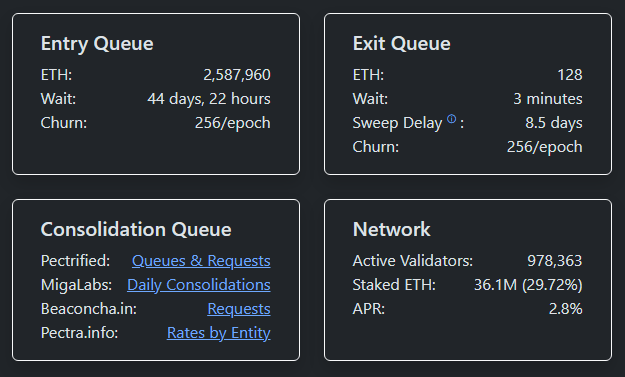
Ethereum staking registry and exit queue numbers. Source: Ethereum Validator Queue

That does not make prices certain, but it lowers one kind of downside risk. Traders tracking on-chain flows now weigh staking behavior alongside spot and derivatives activity when forming short-term views.

Staking Demand Grows

Entry requests to stake ETH are rising fast. Reports note that the entry queue — ETH waiting to become active validators — has climbed to high levels once seen only in big onboarding periods.

Wait times for new activations have stretched into many weeks in places. Institutions and staking services are part of this push, according to market observers, and their moves tend to lock up larger sums for longer.

BTCUSD trading at $3,317 on the 24-hour chart: TradingView

Security, Yield, And Real Effects

More ETH locked for staking helps the network’s security because more validators are actively participating. It also creates yield opportunities for holders who prefer steady returns over trading.

That said, the presence of large staking pools and services means some risks are concentrated. If one big provider faces trouble, the effects will be felt widely. Reports say regulators and product issuers are watching closely as staking becomes easier to access through mainstream channels.

What Traders Are Watching

Price action will depend on many things beyond exit queues. Derivatives positions, ETF flows, and macro headlines still matter. Still, analysts point out that when a visible outlet for mass withdrawals disappears, the narrative around “forced selling” weakens.

Liquidity conditions can shift quietly — and then rapidly — if any of those other levers move. Market participants are therefore watching withdrawal metrics alongside exchange balances and futures open interest.

Featured image from Gemini, chart from TradingView

Related Questions

QWhat does the emptying of Ethereum's validator exit queue indicate about potential market sell pressure?

AThe emptying of Ethereum's validator exit queue indicates that a large, visible source of potential ETH sell pressure has been removed, as validators can now exit immediately without waiting, reducing the risk of sudden large dumps from emergency exits.

QAccording to the article, what is the current status of the entry queue for new Ethereum validators?

AThe entry queue for new Ethereum validators is rising fast and has climbed to high levels, with wait times for new activations stretching into many weeks, indicating strong staking demand.

QHow does increased ETH staking contribute to the Ethereum network's security?

AIncreased ETH staking contributes to the network's security by having more validators actively participating in the consensus process, which helps to decentralize and secure the network.

QBeyond the exit queue, what other factors do traders monitor to form short-term views on Ethereum's price?

ATraders monitor staking behavior, spot and derivatives activity, ETF flows, macro headlines, exchange balances, and futures open interest to form short-term views on Ethereum's price.

QWhat potential risk is associated with the concentration of staking in large pools and services?

AThe risk is that if one large staking provider faces operational or financial trouble, the negative effects could be widely felt across the network due to the concentration of staked assets.

Related Reads

Yao Shunyu's 88 Days

Yao Shunyu, a 27-year-old AI expert with a background from Princeton and OpenAI, joined Tencent in September 2025. Within 88 days, he led a major overhaul of Tencent’s AI strategy and organization, resulting in the release of Hunyuan Hy3 preview—a MoE model with 295B total parameters and 21B active parameters, supporting up to 256K context length. The launch came after Tencent leadership, including CEO Ma Huateng and President Martin Lau, openly criticized Hunyuan's earlier underperformance—citing slow development, over-reliance on superficial benchmark optimization, and poor generalization in real-world applications. Internal adoption was low, with key business units like WeChat and gaming seeking external AI solutions. Yao reshaped Tencent’s AI approach by integrating previously siloed teams, dissolving the ten-year-old Tencent AI Lab, and establishing new units focused on AI infrastructure and data. Hy3 preview was developed using co-design principles, closely aligned with product teams to ensure practical usability from the start. It has already been integrated into core products like Yuanbao, QQ, and enterprise tools. The release signals a shift from chasing rankings to building usable, scalable AI grounded in Tencent’s ecosystem. While external partnerships (like with DeepSeek and OpenClaw) helped retain users temporarily, the focus is now on making Hunyuan a reliable internal foundation. The real test lies in sustaining this new organizational momentum amid fierce competition from Alibaba, DeepSeek, and others.

marsbit1h ago

Yao Shunyu's 88 Days

marsbit1h ago

Trading

Spot
Futures

Hot Articles

Discussions

Welcome to the HTX Community. Here, you can stay informed about the latest platform developments and gain access to professional market insights. Users' opinions on the price of ETH (ETH) are presented below.

活动图片