New Virginia Bill Allows the State to Invest in Bitcoin, Signaling Institutional Shift for Bitcoin Hyper

bitcoinistPublished on 2026-02-06Last updated on 2026-02-06

Abstract

Virginia's legislative move to allow state investment in Bitcoin signals a major institutional shift, normalizing Bitcoin as a treasury reserve asset. This creates sustained demand pressure, exposing Bitcoin's scalability limitations. The article highlights Bitcoin Hyper ($HYPER) as a key Layer 2 solution integrating Solana Virtual Machine (SVM) to enable sub-second transactions and smart contracts, addressing Bitcoin's high fees and lack of programmability. The project has raised over $31.2M in its presale, attracting significant whale investments, indicating strong market confidence in infrastructure built to support institutional Bitcoin adoption.

Trusted Editorial content, reviewed by leading industry experts and seasoned editors. Ad Disclosure

Quick Facts:

  • ➡️ Virginia’s legislative push to allow state investment in Bitcoin validates the asset class for institutional portfolios, likely triggering a supply shock.
  • ➡️ Institutional adoption highlights the need for faster execution layers, as Bitcoin’s L1 cannot handle high-frequency financial applications alone.
  • ➡️ Bitcoin Hyper integrates the Solana Virtual Machine (SVM) to bring sub-second transaction speeds and smart contracts to the Bitcoin network.
  • ➡️ Smart money is accumulating infrastructure plays, with Hyper raising over $31.2M in its ongoing presale.

Legislation advancing in Virginia represents more than just another headline about crypto adoption, it signals a fundamental shift in how sovereign entities view digital scarcity.

By moving to allow state funds to allocate directly to Bitcoin, Virginia is effectively normalizing the asset class for conservative institutional portfolios across the United States. This isn’t just about price appreciation; it’s about legitimizing Bitcoin as a standard treasury reserve asset. Think gold, bonds, and now, Bitcoin.

But the real story goes deeper than the headline numbers. When sovereign entities and pension funds enter the market, they don’t just nibble at the order book; they create a sustained, high-pressure demand shock. This transition from retail speculation to state-sponsored accumulation exposes the network’s glaring bottleneck: scalability.

The base layer is built for security, not the high-frequency throughput a modernized financial system demands.

This disconnect creates a vacuum. As states like Virginia prepare to lock up supply, the market is aggressively pivoting toward Layer 2 solutions that can make that capital productive.

That is where the narrative shifts from simple holding to active utility, driving capital toward projects like Bitcoin Hyper ($HYPER), which are engineered to handle the volume legacy infrastructure simply can’t.

$HYPER is available here.

Sovereign Demand Requires High-Speed Infrastructure

Consider the Virginia bill a precursor to a broader trend where Bitcoin becomes the settlement layer for state economies. The problem? The base chain remains too slow for the applications that will be built on top of it.

A state investment fund doesn’t just want to hold an asset; eventually, it needs to utilize it for yield, collateralization, or payment rails. The current Bitcoin network, with its 10-minute block times and limited scripting, can’t support this financial complexity natively.

Bitcoin Hyper addresses this by integrating the Solana Virtual Machine (SVM) directly as a Bitcoin Layer 2. Frankly, this is a critical technical divergence from previous scaling attempts. Instead of relying on sluggish sidechains, Hyper utilizes a modular architecture where Bitcoin L1 handles settlement while the SVM L2 executes transactions with sub-second finality.
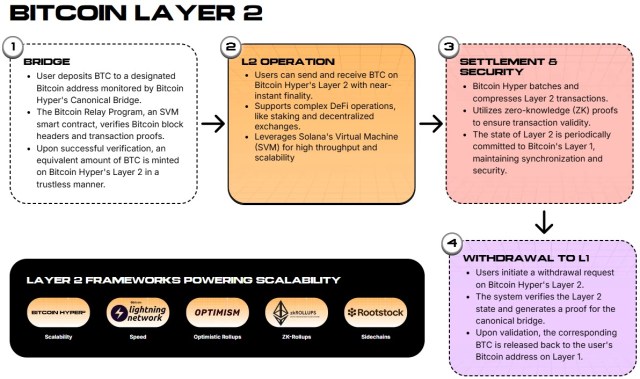
It brings the speed of Solana to the security of Bitcoin, a combination essential for the institutional-grade DeFi applications that inevitably follow state adoption.

Traders are noticing this technical leap. The project focuses on ‘breaking through Bitcoin’s core limitations,’ specifically high fees and a lack of programmability. By enabling fast, scalable smart contracts via Rust, while preserving Bitcoin’s trust model, Bitcoin Hyper positions itself as the execution layer for the liquidity that bills like Virginia’s will eventually bring on-chain.

Learn more about Bitcoin Hyper here.

Smart Money Targets the $31M Presale

While legislators debate policy in Richmond, on-chain data suggests that forward-looking capital is already positioning itself in the infrastructure that will support this new era.

The discrepancy between Bitcoin’s growing store-of-value status and its lack of utility is driving significant flows into development protocols.

According to the official presale page, Bitcoin Hyper has successfully raised over $31.2M, a figure that underscores high conviction in the Layer 2 thesis. With tokens currently priced at $0.0136752, the project has attracted a mix of retail and high-net-worth participants looking for beta exposure to the Bitcoin ecosystem.
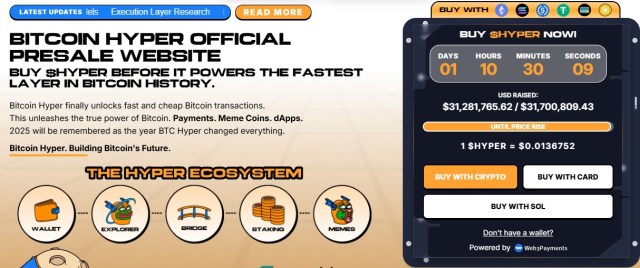
The capital raise suggests the market is pricing in a future where Bitcoin requires a robust, high-speed application layer to function as a global currency.

Deep-pocketed investors seem to be taking notice. On-chain data from Etherscan shows 3 whale wallets accumulated over $1M in recent transactions, signaling accumulation behavior typical before major roadmap milestones.

The largest single transaction of $500K indicates that larger players are securing positions early. Plus, the protocol’s staking model offers high APY with a 7-day vesting period for presale stakers, incentivizing long-term alignment rather than quick flips.

You can buy $HYPER here.

Disclaimer: The content provided in this article is for informational purposes only and does not constitute financial advice. Cryptocurrency investments are highly volatile and carry a high risk of loss. Always conduct your own research before making investment decisions.

Editorial Process for bitcoinist is centered on delivering thoroughly researched, accurate, and unbiased content. We uphold strict sourcing standards, and each page undergoes diligent review by our team of top technology experts and seasoned editors. This process ensures the integrity, relevance, and value of our content for our readers.

patrubogdan

Follow

Full Profile

Related Posts

Winklevoss‑Backed Gemini Cuts Up To 25% Of Staff, Exits UK, EU, And Australia

Tether Pours $150M in Gold.com as $LIQUID’s Presale Turns Heads

XRP Retests $1.29 Support: Is $2 Still in Play or Will LiquidChain Capture the Momentum?

Bitcoin Teeters on Edge: Will $60K Hold or Is a V-Shape Recovery Imminent? $HYPER Keeps Pumping

Senator Lummis Urges Banks to Adopt Stablecoins Amidst CLARITY Act Delay, as Maxi Doge Turns Heads

$BTC Needs to Drop to $8K for Holdings Not to Cover Debt, Says Strategy, as $HYPER’s Presale Soars

Related Questions

QWhat does the new Virginia bill allow the state to do regarding Bitcoin?

AThe new Virginia bill allows the state to invest its funds directly into Bitcoin, normalizing it as a standard treasury reserve asset for institutional portfolios.

QWhat is the main technical solution Bitcoin Hyper provides to Bitcoin's scalability problem?

ABitcoin Hyper integrates the Solana Virtual Machine (SVM) as a Bitcoin Layer 2 to provide sub-second transaction speeds and enable smart contracts, addressing Bitcoin's slow throughput and lack of programmability.

QHow much funding has Bitcoin Hyper's presale raised according to the article?

ABitcoin Hyper's presale has raised over $31.2 million, indicating significant investor interest in its Layer 2 scaling solution for Bitcoin.

QWhy does institutional adoption, like Virginia's, create a problem for the Bitcoin network?

AInstitutional adoption creates a sustained demand shock that exposes Bitcoin's scalability bottleneck, as its base layer is too slow and lacks the throughput for high-frequency financial applications that institutions require.

QWhat combination does Bitcoin Hyper's architecture provide, according to the article?

ABitcoin Hyper's architecture combines the security of Bitcoin's base layer for settlement with the high speed of the Solana Virtual Machine (SVM) for execution, bringing sub-second finality to the network.

Related Reads

Trading

Spot
Futures

Hot Articles

What is $BITCOIN

DIGITAL GOLD ($BITCOIN): A Comprehensive Analysis Introduction to DIGITAL GOLD ($BITCOIN) DIGITAL GOLD ($BITCOIN) is a blockchain-based project operating on the Solana network, which aims to combine the characteristics of traditional precious metals with the innovation of decentralized technologies. While it shares a name with Bitcoin, often referred to as “digital gold” due to its perception as a store of value, DIGITAL GOLD is a separate token designed to create a unique ecosystem within the Web3 landscape. Its goal is to position itself as a viable alternative digital asset, although specifics regarding its applications and functionalities are still developing. What is DIGITAL GOLD ($BITCOIN)? DIGITAL GOLD ($BITCOIN) is a cryptocurrency token explicitly designed for use on the Solana blockchain. In contrast to Bitcoin, which provides a widely recognized value storage role, this token appears to focus on broader applications and characteristics. Notable aspects include: Blockchain Infrastructure: The token is built on the Solana blockchain, known for its capacity to handle high-speed and low-cost transactions. Supply Dynamics: DIGITAL GOLD has a maximum supply capped at 100 quadrillion tokens (100P $BITCOIN), although details regarding its circulating supply are currently undisclosed. Utility: While precise functionalities are not explicitly outlined, there are indications that the token could be utilized for various applications, potentially involving decentralized applications (dApps) or asset tokenization strategies. Who is the Creator of DIGITAL GOLD ($BITCOIN)? At present, the identity of the creators and development team behind DIGITAL GOLD ($BITCOIN) remains unknown. This situation is typical among many innovative projects within the blockchain space, particularly those aligning with decentralized finance and meme coin phenomena. While such anonymity may foster a community-driven culture, it intensifies concerns about governance and accountability. Who are the Investors of DIGITAL GOLD ($BITCOIN)? The available information indicates that DIGITAL GOLD ($BITCOIN) does not have any known institutional backers or prominent venture capital investments. The project seems to operate on a peer-to-peer model focused on community support and adoption rather than traditional funding routes. Its activity and liquidity are primarily situated on decentralized exchanges (DEXs), such as PumpSwap, rather than established centralized trading platforms, further highlighting its grassroots approach. How DIGITAL GOLD ($BITCOIN) Works The operational mechanics of DIGITAL GOLD ($BITCOIN) can be elaborated on based on its blockchain design and network attributes: Consensus Mechanism: By leveraging Solana’s unique proof-of-history (PoH) combined with a proof-of-stake (PoS) model, the project ensures efficient transaction validation contributing to the network's high performance. Tokenomics: While specific deflationary mechanisms have not been extensively detailed, the vast maximum token supply implies that it may cater to microtransactions or niche use cases that are still to be defined. Interoperability: There exists the potential for integration with Solana’s broader ecosystem, including various decentralized finance (DeFi) platforms. However, the details regarding specific integrations remain unspecified. Timeline of Key Events Here is a timeline that highlights significant milestones concerning DIGITAL GOLD ($BITCOIN): 2023: The initial deployment of the token occurs on the Solana blockchain, marked by its contract address. 2024: DIGITAL GOLD gains visibility as it becomes available for trading on decentralized exchanges like PumpSwap, allowing users to trade it against SOL. 2025: The project witnesses sporadic trading activity and potential interest in community-led engagements, although no noteworthy partnerships or technical advancements have been documented as of yet. Critical Analysis Strengths Scalability: The underlying Solana infrastructure supports high transaction volumes, which could enhance the utility of $BITCOIN in various transaction scenarios. Accessibility: The potential low trading price per token could attract retail investors, facilitating wider participation due to fractional ownership opportunities. Risks Lack of Transparency: The absence of publicly known backers, developers, or an audit process may yield skepticism regarding the project's sustainability and trustworthiness. Market Volatility: The trading activity is heavily reliant on speculative behavior, which can result in significant price volatility and uncertainty for investors. Conclusion DIGITAL GOLD ($BITCOIN) emerges as an intriguing yet ambiguous project within the rapidly evolving Solana ecosystem. While it attempts to leverage the “digital gold” narrative, its departure from Bitcoin's established role as a store of value underscores the need for a clearer differentiation of its intended utility and governance structure. Future acceptance and adoption will likely depend on addressing the current opacity and defining its operational and economic strategies more explicitly. Note: This report encompasses synthesised information available as of October 2023, and developments may have transpired beyond the research period.

363 Total ViewsPublished 2025.05.13Updated 2025.05.13

What is $BITCOIN

Discussions

Welcome to the HTX Community. Here, you can stay informed about the latest platform developments and gain access to professional market insights. Users' opinions on the price of BTC (BTC) are presented below.

活动图片















