New Protocol Tacit: The ZEC of the Bitcoin Ecosystem

marsbitPublished on 2026-05-14Last updated on 2026-05-14

Abstract

The article discusses Tacit, a new privacy-focused Bitcoin asset protocol emerging after a period of relative quiet in the Bitcoin ecosystem. Unlike BRC-20 or Runes, Tacit is a "meta-protocol" where the indexer runs directly in the user's browser, removing the need for centralized servers. Its key innovation is enabling privacy for token amounts on the Bitcoin mainnet. Tacit employs cryptographic techniques like Pedersen Commitments and Bulletproofs to conceal transaction amounts while proving conservation of funds. It uses Mimblewimble-style signatures to prevent inflation and ECDH encryption to ensure only senders and receivers can decrypt real amounts. This makes it a native "privacy coin" for Bitcoin, albeit one that hides amounts but not the direction of fund flows between addresses. The protocol, developed by ross.wei (known for Ethereum's ZAMM), has rapidly evolved since its May 7 launch. It now supports fair launches, a marketplace, token swaps, and a novel mixer similar to Tornado Cash but without relying on smart contracts. However, this privacy comes at a cost, with transaction fees estimated to be about 10 times higher than Runes. Future plans include privacy-wrapping native Bitcoin (cBTC), implementing silent receipts, and hiding the token type in transfers. The main token, $TAC, has gained traction with a market cap around $4 million. Positioned between simpler token standards and complex solutions like RGB, Tacit represents a significant and innovative step ...

The Bitcoin ecosystem had been forgotten for a long time. Especially after Magic Eden, once the largest Bitcoin ecosystem marketplace, stopped supporting the Bitcoin ecosystem and discontinued its Magic Eden Wallet service, it gave players who hadn't paid attention to the Bitcoin ecosystem for a while a feeling that "the Bitcoin ecosystem is over."

However, not only are veteran Bitcoin infrastructure projects like UniSat and Xverse still working hard, but after Magic Eden, marketplaces like SatFlow and ord.net have also filled the gap. Recently, the emergence of a new Bitcoin asset protocol has brought the Bitcoin ecosystem back into the spotlight.

This new protocol is called Tacit.

What is Tacit?

First, we need to classify Tacit into the "meta-protocol" category like BRC-20 and Runes, which rely on indexers to handle asset confirmation. If there's any difference, it's that Tacit's indexer runs directly in the user's browser, eliminating the need to trust any centralized server (indexer). As long as two computers run the same code and view the same Bitcoin blockchain data, they will arrive at the same balance results.

Tacit's unique aspect is that it is a new Bitcoin asset protocol focused on "privacy." Many players promoting this new protocol directly use analogies like "ZEC on Bitcoin." This has some merit but isn't entirely accurate, because Tacit's hiding capability only applies to the *amount* of tokens (including the total supply amount specified during new token deployment and the specific amount of each transfer), not to the on-chain address graph.

In other words, Tacit hides the *amount* of fund flow, but not the *direction* of fund flow.

Nevertheless, it is still a native privacy asset protocol on the Bitcoin mainnet. Let's use a simple analogy to explain how it achieves this on the Bitcoin mainnet.

An ordinary Bitcoin transaction is like a transparent ledger; everyone can see a transaction and how much money is involved. Tacit, on the other hand, is like putting the transaction into a "black box" (a Pedersen commitment).

People can still see that this transaction occurred. Although they cannot see the amount, you can prove to everyone that "the money I put in plus the money I take out balances the books."

Pedersen commitments and Bulletproofs are used to hide the transaction amount while proving to the entire network that you haven't fabricated tokens out of thin air (e.g., proving the transferred amount is not negative and the total is conserved).

Mimblewimble-style signatures prove that the outgoing amount equals the incoming amount, ensuring tokens cannot be maliciously inflated.

When the sender transfers tokens to the receiver, the amount information is encrypted using ECDH and written onto the blockchain. Only the sender and receiver can decrypt and see the real amount using their private keys; to others, this data is just gibberish.

Finally, the indexer built into the dApp (the user's browser) reads the data on the Bitcoin chain, independently verifies the aforementioned cryptographic proofs, and thereby calculates your real balance.

Since its launch on May 7th, developer ross.wei (@z0r0zzz) has been updating quickly. Currently, Tacit already supports fair launches, has a marketplace, supports token swaps, and even has a mixer.
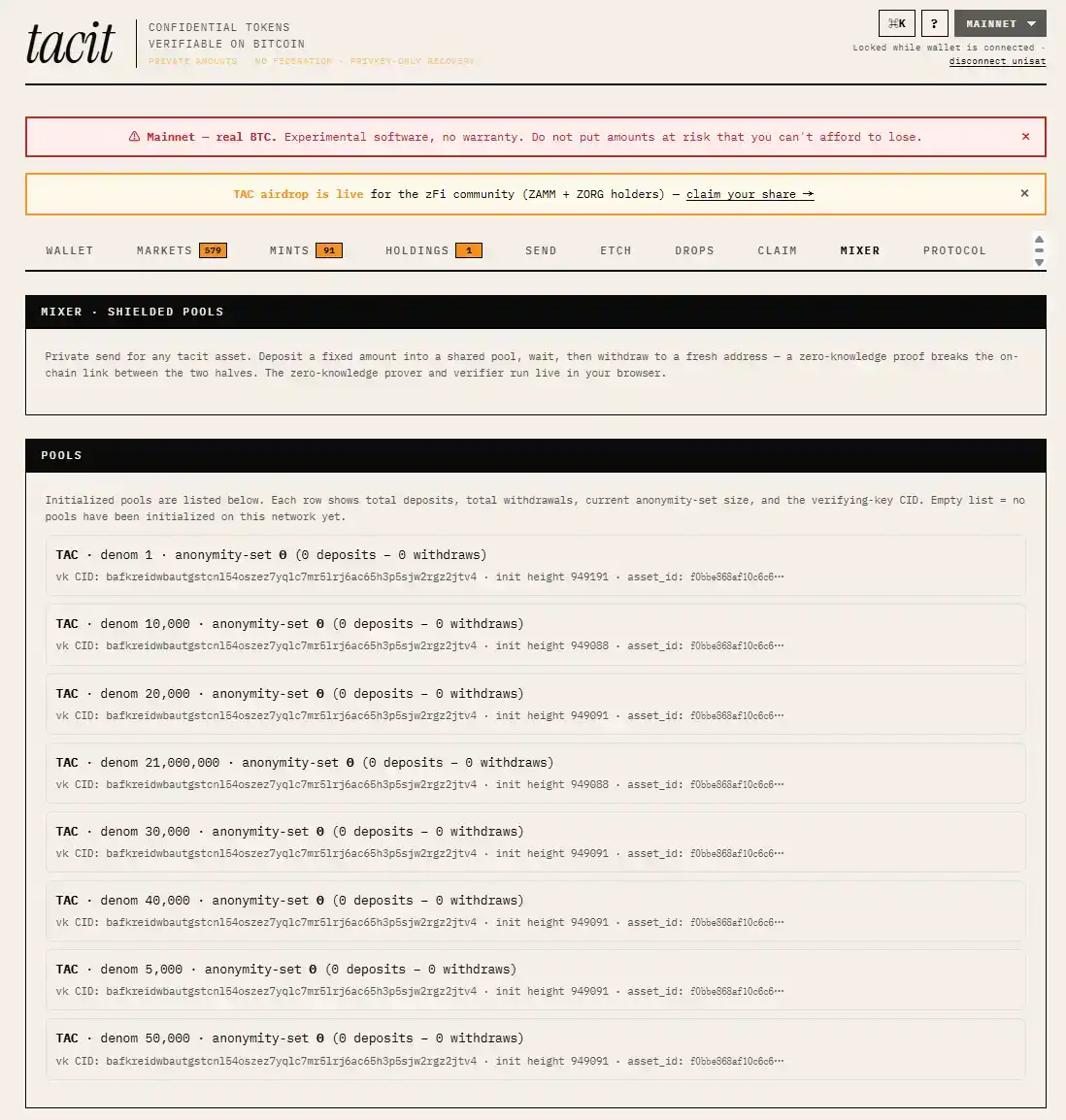
This mixer is somewhat similar to Tornado Cash—the more people deposit, the higher the privacy (harder to identify which addresses in the pool correspond). However, Tacit's mixer does not rely on smart contracts. It embeds the deposit proof in the Taproot transaction note, and the zero-knowledge proof for withdrawals is handled by the indexer in the browser.

It's even slightly stronger than Tornado Cash in some aspects because Tornado Cash cannot hide the amount being mixed. However, Tacit's mixer cannot mix native Bitcoin because hiding the mixing amount itself requires first wrapping the Bitcoin.

Of course, privacy comes at a cost. According to the GitHub documentation, due to the larger witness data required for hiding, the transfer cost corresponds to a mainnet fee rate of approximately 10 sat/vB, meaning each transfer costs about 25,000-30,000 sat, roughly 10 times the cost of a Runes transfer.

Who Built Tacit?

Developer ross.wei (@z0r0zzz) is a relatively well-known developer in the Ethereum ecosystem. He previously developed ZAMM, which uses a single contract for creating new tokens, managing LPs, farming, and swaps, significantly improving gas efficiency and user experience.

$ZAMM was also a notable project on Ethereum in the past, reaching a market cap in the tens of millions of dollars and receiving a retweet from crypto KOL Ansem.

Tacit isn't something he suddenly created on a whim; he has been interested in Bitcoin technology for a while. This new protocol has also garnered attention from Messari Enterprise Research Manager @AvgJoesCrypto.
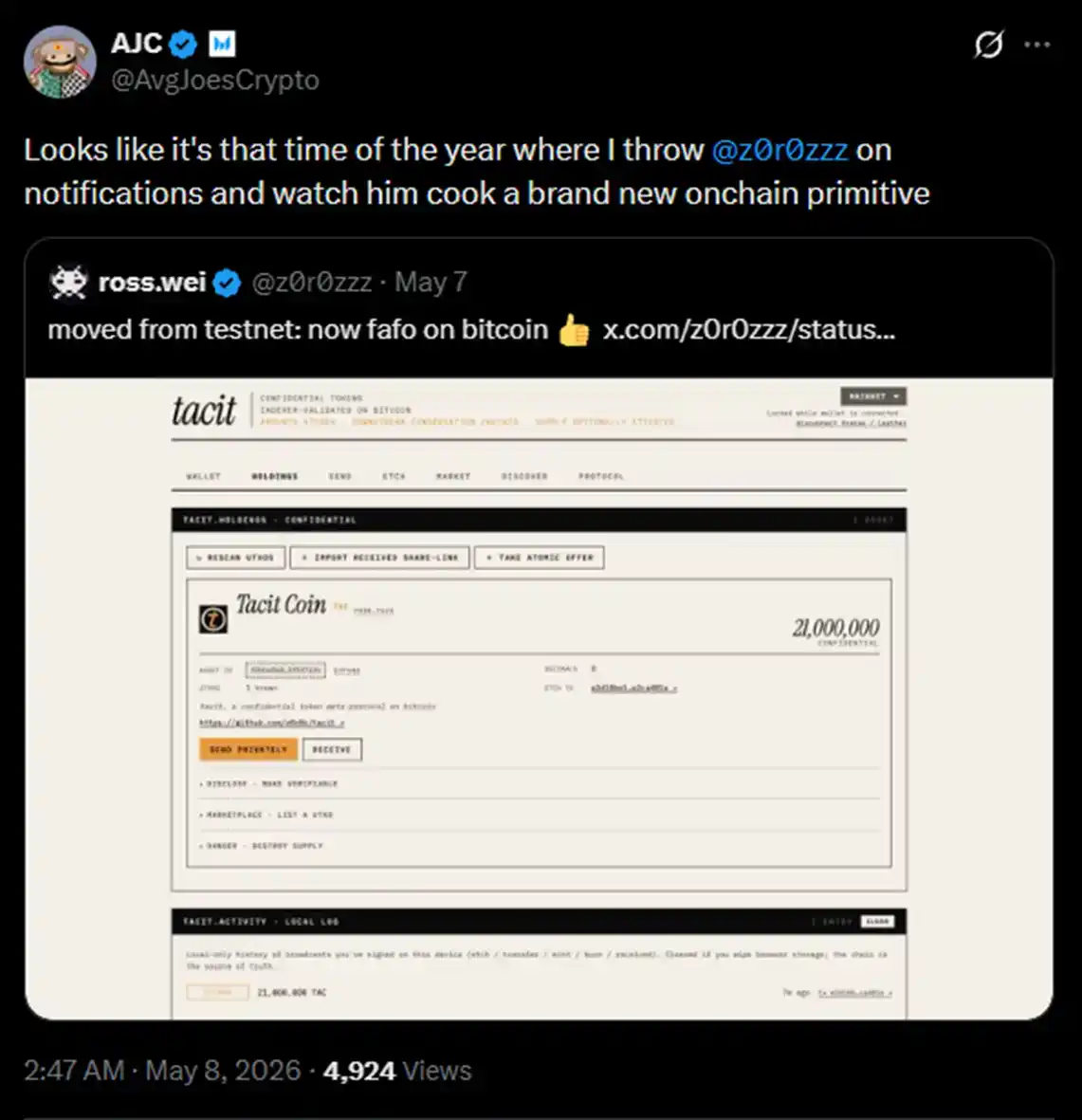
In the future, the author also plans to implement privacy-wrapped native Bitcoin (cBTC), silent receiving (generating a new one-time address for each receiving transaction), and hiding the type of currency being transferred.

Relevant Assets

Currently, the token with the highest trading volume is $TAC. This token was deployed by the protocol author himself and was airdropped not long ago based on holdings of the $ZORG staking token from the Ethereum-based $ZAMM. Its current market cap is approximately $4 million, making it the undisputed leader.

The first token launched via fair launch is $FAIR, though trading for this token is not yet available on the marketplace.

Conclusion

This is indeed an innovative Bitcoin asset protocol. Compared to BRC-20 and Runes, it has already implemented amount privacy and plans to achieve more. Compared to RGB, Taproot Assets, and Liquid CT, it doesn't rely on off-chain client-side proofs or exist as a sidechain; it operates entirely using on-chain data.

After repurposing its own protocol components to create a mixer, it has also addressed the hiding of the on-chain address graph.

Although the usage cost is relatively high, this is truly a refreshing and eye-catching innovation not seen in the Bitcoin ecosystem for a long time.


Related Questions

QWhat is the main characteristic that differentiates the new Bitcoin asset protocol Tacit from protocols like BRC-20 and Runes?

ATacit is a privacy-focused Bitcoin asset protocol. Its primary differentiating characteristic is that it can hide the amount of tokens in transactions (including the total supply defined at deployment and the specific amount in each transfer), while protocols like BRC-20 and Runes have transparent ledgers. However, Tacit does not hide the direction of fund flows (i.e., the address graph).

QHow does Tacit achieve transaction amount privacy on the Bitcoin mainnet according to the article?

ATacit uses a combination of cryptographic techniques: Pedersen commitments and Bulletproofs to hide the transaction amount while proving to the network that no tokens are fraudulently created (e.g., proving amounts are non-negative and conserved). Mimblewimble-style signatures prove that the output amount equals the input amount, preventing malicious inflation. The actual amount information is encrypted using ECDH and written on-chain, decryptable only by the sender and receiver with their private keys.

QWho is the developer behind the Tacit protocol, and what is their background mentioned in the article?

AThe developer behind Tacit is ross.wei (@z0r0zzz). He is a well-known Ethereum developer who previously created ZAMM, a project that reached a multi-million dollar market cap and gained attention from crypto KOLs like Ansem. His interest in Bitcoin technology led to the development of Tacit.

QWhat is the current primary token associated with the Tacit protocol, and how was it distributed?

AThe primary token is $TAC. It was deployed by the protocol author and recently airdropped to holders of $ZORG, the staking token of the Ethereum-based $ZAMM project. Its current market capitalization is approximately $4 million.

QWhat are some of the planned future features for the Tacit protocol as mentioned in the article?

APlanned future features for Tacit include: privacy encapsulation for native Bitcoin (cBTC), silent receiving (generating a new one-time address for each incoming transaction), and hiding the type of token being transferred.

Related Reads

Breaking: OpenAI Undergoes Major Reorganization, President Brockman Assumes Command

OpenAI has announced a major internal reorganization just months before its anticipated IPO. The company is merging its three flagship product lines—ChatGPT, Codex, and the API platform—into a single, unified product organization. The most significant leadership change involves co-founder and President Greg Brockman moving from a background technical role to take full, permanent control over all product strategy. This follows the indefinite medical leave of AGI Deployment CEO Fidji Simo. Additionally, ChatGPT's longtime lead, Nick Turley, has been reassigned to enterprise products, with former Instagram executive Ashley Alexander taking over consumer offerings. The consolidation, internally framed as a strategic move towards an "Agentic Future," aims to break down internal silos and create a cohesive "Super App." This planned desktop application would integrate ChatGPT's conversational abilities, Codex's coding power, and a rumored internal web browser named "Atlas" to autonomously perform complex user tasks. The reorganization occurs amid significant internal and external pressures. OpenAI has recently seen a wave of high-profile departures, including Sora co-lead Bill Peebles and other senior technical leaders, leading to concerns about a thinning executive bench. Externally, rival Anthropic recently secured funding at a staggering $900 billion valuation, surpassing OpenAI's own. Google's upcoming I/O developer conference also poses a competitive threat. Analysts suggest the dramatic restructure is a pre-IPO move to present a clearer, more focused narrative to Wall Street—streamlining operations and demonstrating decisive leadership under Brockman to counter internal turbulence and intense market competition.

marsbit2h ago

Breaking: OpenAI Undergoes Major Reorganization, President Brockman Assumes Command

marsbit2h ago

Two Survival Structures of Market Makers and Arbitrageurs

Market makers and arbitrageurs represent two distinct survival structures in high-frequency trading. Market makers primarily use limit orders (makers) to profit from the bid-ask spread, enjoying high capital efficiency (nominally 100%) but bearing inventory risk. This "inventory risk" arises from passive, fragmented, and discontinuous order fills in the limit order book (LOB). This risk, while a potential cost, can also contribute to excess profit if managed within control boundaries, allowing for mean reversion. Market makers essentially sell "time" (uncertainty over execution timing) to the market for price control and low fees. In contrast, cross-exchange arbitrageurs typically use market orders (takers) to exploit price differences or funding rates, resulting in lower nominal capital efficiency (requiring capital on both exchanges) and higher transaction costs. Their risk exposure stems from asymmetries in exchange rules (e.g., minimum order sizes), execution latency, and infrastructure risks (e.g., ADL, oracle drift). These exposures are active, exogenous gaps that primarily erode profits rather than contribute to them. Arbitrageurs essentially sell "space" (capital sunk across venues) for localized, immediate certainty. Both strategies engage in a trade-off between execution friction and residual risk. Optimal systems allow for temporary, controlled risk exposure rather than enforcing zero exposure at all costs. Their evolution converges towards hybrid models: arbitrageurs may use maker orders to reduce costs, while market makers may use taker orders or hedges for risk management. Ultimately, both use different forms of risk exposure—market makers exposing inventory, arbitrageurs immobilizing capital—to extract marginal, hard-won certainty from the market.

链捕手2h ago

Two Survival Structures of Market Makers and Arbitrageurs

链捕手2h ago

Who Will Define the Rules of the AI Era? Anthropic Discusses the 2028 US-China AI Landscape

This article, based on Anthropic's analysis, outlines the intensifying systemic competition between the U.S./allies and China for AI leadership by 2028. It argues that access to advanced computing power ("compute") is the critical bottleneck, where the U.S. currently holds a significant advantage through chip export controls and allied innovation. However, China's AI labs remain competitive by exploiting policy loopholes—via chip smuggling, overseas data center access, and "model distillation" attacks to copy U.S. model capabilities—keeping them close to the frontier. The piece presents two contrasting scenarios for 2028. In the first, decisive U.S. action to tighten compute controls and curb distillation locks in a 12-24 month AI capability lead, cementing democratic influence over global AI norms, security, and economic infrastructure. In the second, policy inaction allows China to achieve near-parity through continued access to U.S. technology, enabling Beijing to promote its AI stack globally and integrate advanced AI into its military and governance systems, altering the strategic balance. Anthropic contends that maintaining a decisive U.S. lead is essential for shaping safe AI development and governance. The core recommendation is for U.S. policymakers to urgently close compute and model access loopholes while promoting global adoption of the U.S. AI technology stack to secure a lasting strategic advantage.

marsbit4h ago

Who Will Define the Rules of the AI Era? Anthropic Discusses the 2028 US-China AI Landscape

marsbit4h ago

Trading

Spot
Futures

Hot Articles

How to Buy ZEC

Welcome to HTX.com! We've made purchasing Zcash (ZEC) simple and convenient. Follow our step-by-step guide to embark on your crypto journey.Step 1: Create Your HTX AccountUse your email or phone number to sign up for a free account on HTX. Experience a hassle-free registration journey and unlock all features.Get My AccountStep 2: Go to Buy Crypto and Choose Your Payment MethodCredit/Debit Card: Use your Visa or Mastercard to buy Zcash (ZEC) instantly.Balance: Use funds from your HTX account balance to trade seamlessly.Third Parties: We've added popular payment methods such as Google Pay and Apple Pay to enhance convenience.P2P: Trade directly with other users on HTX.Over-the-Counter (OTC): We offer tailor-made services and competitive exchange rates for traders.Step 3: Store Your Zcash (ZEC)After purchasing your Zcash (ZEC), store it in your HTX account. Alternatively, you can send it elsewhere via blockchain transfer or use it to trade other cryptocurrencies.Step 4: Trade Zcash (ZEC)Easily trade Zcash (ZEC) on HTX's spot market. Simply access your account, select your trading pair, execute your trades, and monitor in real-time. We offer a user-friendly experience for both beginners and seasoned traders.

3.1k Total ViewsPublished 2024.03.29Updated 2025.03.21

How to Buy ZEC

Discussions

Welcome to the HTX Community. Here, you can stay informed about the latest platform developments and gain access to professional market insights. Users' opinions on the price of ZEC (ZEC) are presented below.

活动图片