New AMD Paper Overturns Conventional Wisdom: FP4 Training Instability's Cause Is Not Insufficient Randomness

marsbitPublished on 2026-05-27Last updated on 2026-05-27

Abstract

AMD's new research challenges the conventional understanding of FP4 training instability. While reducing precision from FP8 to FP4 promises doubled computational throughput and is supported by new hardware like NVIDIA Blackwell and AMD MI350 series, training large language models natively with FP4 has been notoriously unstable, often attributed to insufficient stochasticity. The paper "Pretraining large language models with MXFP4 on Native FP4 Hardware" demonstrates successful end-to-end FP4 pre-training of Llama 3.1-8B on AMD MI355X GPUs using the MXFP4 format, achieving a 9-10% overall speedup over FP8. Crucially, it identifies the root cause of instability: not randomness, but the accumulation of *structural micro-scaling errors* along the sensitive weight gradient (Wgrad) path. Through controlled experiments, researchers found that quantizing the Wgrad operation to FP4 caused significant convergence degradation. Counterintuitively, common stochasticity-based mitigation techniques like stochastic rounding and randomized Hadamard transforms worsened performance. In contrast, applying a *deterministic* Hadamard transform successfully stabilized training by ensuring consistent error patterns, reducing the extra token cost from 26-27% to just 8-9%. This work has significant implications: 1) It provides a clear diagnostic for low-precision training instability, steering focus towards structural errors. 2) It pushes FP4 from a primarily inference-focused format into the realm...

As is well known, training large models is extremely costly.

However, it's also widely understood that reducing training precision can significantly lower training costs. DeepSeek-V3's use of FP8 training brought the cost down to $5.6 million, already capturing the attention of the entire industry.

Following the success of FP8, the industry continues to explore the boundaries of lower precision: from FP8 down to FP4, how much more can training costs be reduced?

Theoretically, FP4 computational throughput could be twice that of FP8. Both NVIDIA's Blackwell and AMD's MI350 series have already natively supported FP4 operations at the hardware level, with the former claiming FP4 performance up to 4500 TOPS (sparse) on the B200. The hardware is ready, but the software and algorithm side has been stuck on one problem:

Training large models from scratch with FP4 is highly unstable.

Over the past two years, works like LLM-FP4 and NVFP4 pre-training have attempted this path, but few solutions have cleanly and efficiently executed full pipeline pre-training at 4-bit precision while maintaining convergence quality close to FP8.

More troublesome is that the cause of the collapse has been unclear. Analysis suggested the instability in FP4 training was likely due to insufficient randomness.

But recently, AMD, in collaboration with Pennsylvania State University, published a paper that overturns this traditional understanding, offering a new and clear diagnosis for native FP4 training.
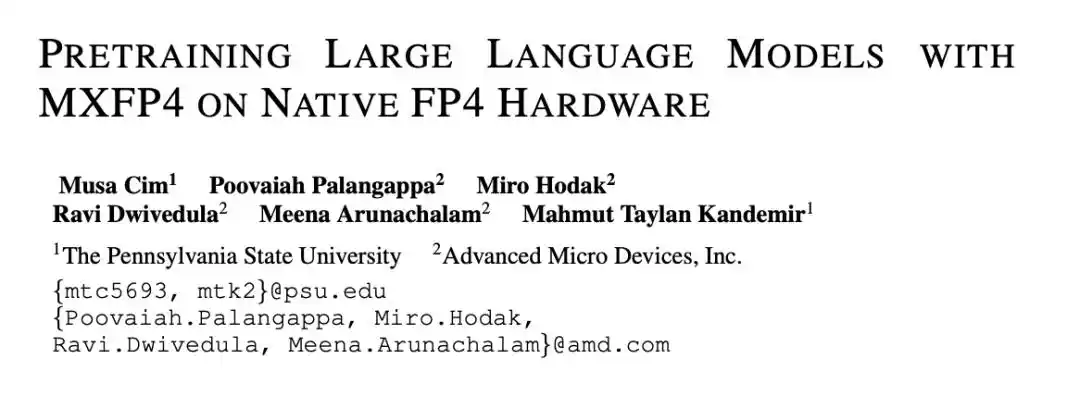
  • Paper Title: Pretraining large language models with MXFP4 on Native FP4 Hardware
  • Paper Link: https://arxiv.org/abs/2605.09825

This paper successfully completed the full-pipeline pre-training of Llama 3.1-8B using the MXFP4 format on AMD Instinct MI355X GPUs, achieving 9-10% faster end-to-end training speed compared to the FP8 baseline, with only an 8-9% additional token cost. This is the first complete experiment to finish large model pre-training on native FP4 hardware (not software simulation).

More importantly, the paper reveals the core issue: The source of FP4 training instability is not insufficient randomness, but the cumulative amplification of structural microscaling errors along sensitive gradient paths.

What is MXFP4

Before dissecting the paper, it's necessary to understand the MXFP4 data format.

Traditional integer quantization typically uses a single scaling factor for an entire tensor. The core design of MXFP4 is called "Micro-scaling": splitting a tensor into small blocks (e.g., groups of 32 elements), assigning a shared exponent (E8M0 format) to each block, where each element within the block is represented by a 4-bit floating-point number. The reconstruction formula can be written as:

Where E_shared is the maximum exponent within the block, and Q_FP4 is the value rounded to the nearest representable 4-bit floating-point value.

The benefit of micro-scaling is that each small block has its own dynamic range and won't be "held hostage" by global outliers. This significantly improves the representational quality of 4-bit floating-point numbers compared to naive global quantization.

However, even with micro-scaling, FP4 training remains unstable.

Troubleshooting Experiments: The Root of Instability

The research team first designed a step-by-step controlled troubleshooting experiment.

A complete Transformer linear layer computation involves three general matrix multiplication operations:

Fprop (Forward Propagation): Computes Y = XW^T, producing activation values.

Dgrad (Activation Gradient): Computes ∇X = ∇Y · W, propagating gradients back to the input.

Wgrad (Weight Gradient): Computes ∇W = (∇Y)^T · X, producing the gradient used to update the weights.

Keeping all other factors constant, the research team gradually replaced these three operations from FP8 to MXFP4, observing the impact of each step on convergence. All experiments were executed using native FP4 tensor cores on AMD Instinct MI355X, without relying on software simulation.

The training task followed the MLPerf standard setup, pre-training Llama 3.1-8B on the C4 dataset, with a convergence target of achieving a validation perplexity of 3.3.

The first two steps only incurred a modest additional token cost. However, once Wgrad was also switched to MXFP4, the cost directly jumped to 26-27%.

Wgrad is the bottleneck for FP4 training. Forward propagation and activation gradient have considerable tolerance for FP4 quantization, but once the weight gradient is quantized to 4 bits, convergence quality degrades significantly.

The industry's prevailing intuition was that FP4 quantization error is essentially a noise problem, which could be "smoothed" by injecting randomness. Two common strategies are:

Stochastic Rounding: Introduces randomness during quantization to make the expected value of rounding error zero.

Randomized Hadamard Rotation: Uses a Hadamard transform with random sign flips to scatter the data distribution before quantization.
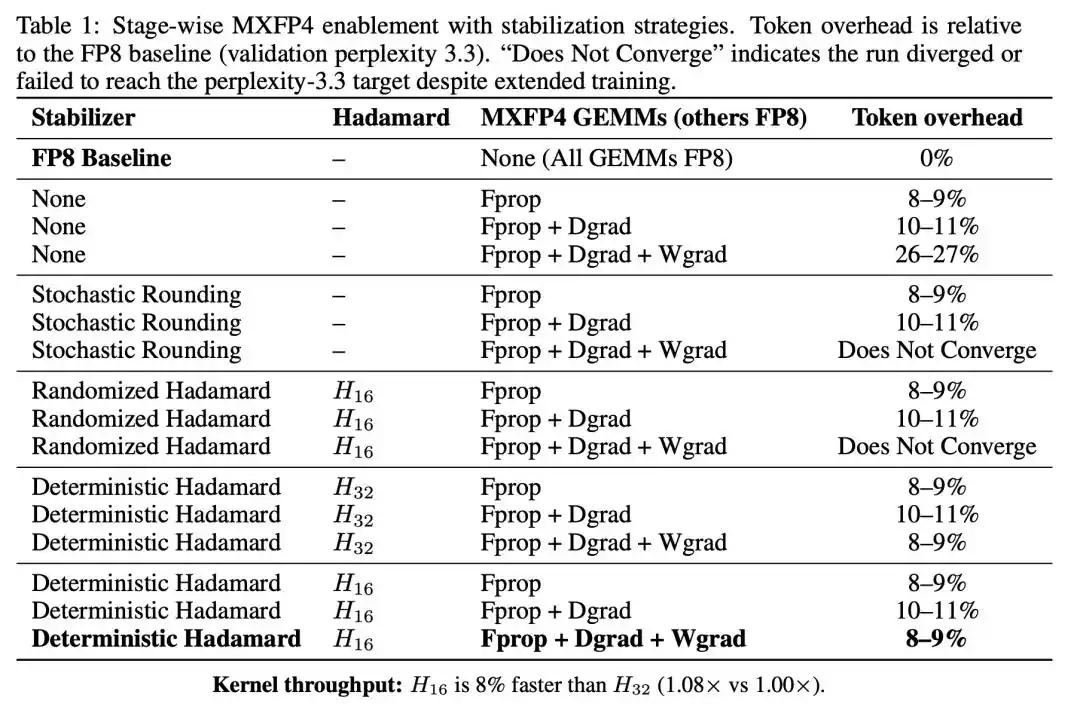
When Wgrad is quantized, both randomness strategies not only failed to stabilize training but directly caused non-convergence. Randomness didn't help; instead, it introduced more effective quantization error on the critical gradient path.

In contrast, deterministic Hadamard rotation dramatically reduced the full-pipeline token cost from 26-27% back to 8-9%, with the training trajectory closely tracking the FP8 baseline.

This is a highly diagnostic result. Both random and deterministic Hadamard rotations are orthogonal transformations that can scatter outlier energy distribution; theoretically, their effects on mitigating quantization error should be similar. Yet, their performance in the Wgrad scenario is completely opposite, revealing the nature of the problem:

FP4 training instability is driven by structural errors generated by MXFP4 micro-scaling on sensitive gradient paths. Randomness strategies failed because they introduced varying error patterns at each step, and these changing patterns accumulated along the gradient path, amplifying instability. Deterministic rotation was effective precisely because it applied the same transformation at every step, keeping the error pattern consistent and preventing error accumulation.

End-to-End Efficiency: Training Step Throughput +20%, Comprehensive Speedup 9-10%

After applying deterministic Hadamard rotation to the full-pipeline MXFP4, the efficiency data is as follows:
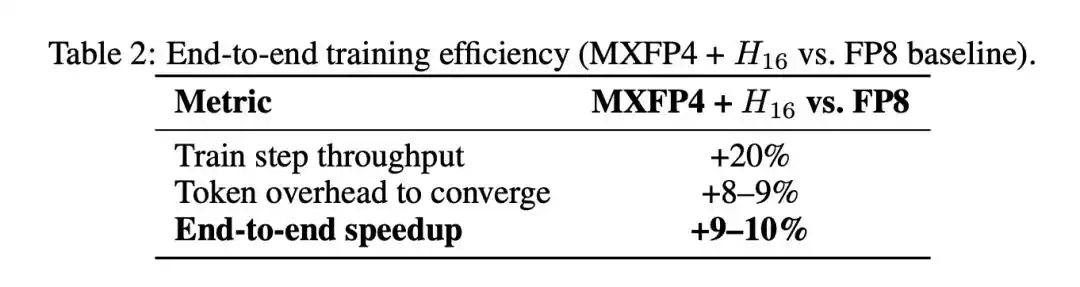
Training step throughput increased by 20%. After accounting for the additional 8-9% token cost, the end-to-end comprehensive speedup remains 9-10%.

Considering this directly halves precision from 8 bits to 4 bits, this convergence quality and speedup magnitude are quite significant.
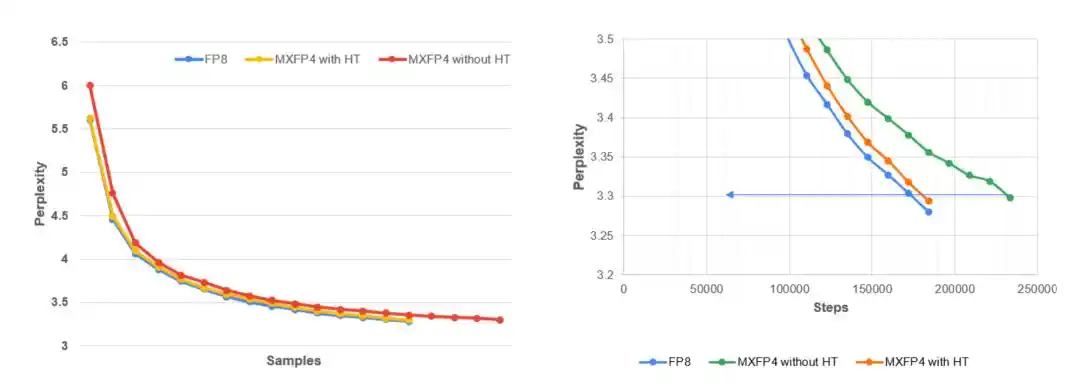
Left: Curve showing the validation perplexity of Llama 3.1–8B versus training token count during MLPerf pre-training on the C4 dataset. Results show MXFP4 + deterministic Hadamard performs very close to FP8, while unstabilized full-pipeline MXFP4 converges slower and is less stable. Right: Zoomed-in view of the later training stage. The MLPerf target perplexity is 3.3. Compared to the unstabilized MXFP4 run, deterministic Hadamard (H16) maintains much tighter alignment with the FP8 baseline.

Notably, the authors explicitly emphasize an important limitation in the paper: The effectiveness of this FP4 training scheme (MLPerf C4 dataset + Llama 3.1-8B) has been verified, but it cannot be assumed to seamlessly transfer to all models, all datasets, and all training methods. FP4 training behavior might be highly setting-dependent, and specific stabilization strategies need re-validation per scenario.

Conclusion

Placing this paper within the broader industry context reveals at least three layers of significance.

First layer: It answers a fundamental "why". Previous FP4 training work mostly focused on "how to make it not crash." This paper provides the first clear causal diagnosis: collapse stems from structural microscaling errors on the Wgrad path, not insufficient randomness. This diagnosis itself holds methodological value, telling subsequent researchers that when encountering instability in low-precision training, they should prioritize investigating structural error sources rather than blindly adding randomness.

Second layer: It pushes FP4 from "inference-only" towards "usable for training". Previously, the industry consensus was that FP4 was only suitable for inference quantization, with FP8 being the minimum for training. NVIDIA's emphasis on FP4 inference rather than training on Blackwell also reflects this judgment. This paper successfully ran full-pipeline pre-training on native FP4 hardware, meaning that the FP4 compute power prepared for inference on MI355X and Blackwell could theoretically also be used for training. If FP4 training proves viable on larger models and more scenarios, it effectively doubles the usable training compute of existing hardware.

Third layer: It utilizes the OCP open standard. MXFP4 is part of the OCP Microscaling format standard, jointly supported by seven companies: AMD, NVIDIA, Intel, Meta, Microsoft, Arm, and Qualcomm. Basing on an open standard means this method has portability across different vendors' hardware and won't be locked into a single ecosystem.

From FP16 to FP8, DeepSeek-V3 has already proven that halving precision can dramatically reduce training costs. From FP8 to FP4, this paper takes the critical first step. With each slash in precision, the entire economics of large model training are shifting.

This article is from the WeChat public account "Machine Heart" (ID: almosthuman2014), edited by Leng Mao.


Related Questions

QAccording to AMD's new research, what is the root cause of training instability when using FP4 precision for large language models, and why do common randomization strategies fail to address it?

AAccording to the AMD and Penn State University paper, the root cause of instability in native FP4 training is not insufficient randomness, but rather the amplification of structural microscaling error accumulation along the sensitive gradient path, specifically the weight gradient (Wgrad) path. Common randomization strategies like stochastic rounding and randomized Hadamard transforms fail because they introduce varying error patterns at each step. When these inconsistent patterns accumulate along the gradient path, they amplify instability instead of mitigating it. In contrast, a deterministic Hadamard transform is effective because it applies the same consistent transformation at every step, preventing the accumulation of divergent error patterns.

QWhat is MXFP4, and how does its 'micro-scaling' design differ from traditional quantization methods?

AMXFP4 is a 4-bit floating-point data format part of the OCP Microscaling (MSFP) standard. Its core design feature is 'micro-scaling', which differs from traditional tensor-level quantization that uses a single scaling factor for an entire tensor. In MXFP4, a tensor is divided into small blocks (e.g., groups of 32 elements). Each block is assigned a shared exponent (E8M0 format), and each element within the block is represented by a 4-bit mantissa. This approach allows each block to have its own dynamic range, preventing the representation quality of the entire block from being 'held hostage' by a few global outliers, thereby improving representation quality compared to naive global quantization.

QIn the diagnostic experiment, which specific operation (Fprop, Dgrad, or Wgrad) was identified as the bottleneck when quantized to MXFP4, and what was the observed impact on training efficiency?

AIn the step-by-step diagnostic experiment, quantizing the Weight Gradient (Wgrad) operation to MXFP4 was identified as the bottleneck. While replacing the Forward Propagation (Fprop) and Activation Gradient (Dgrad) operations with MXFP4 incurred only a modest additional token overhead, replacing Wgrad with MXFP4 caused the token overhead to jump significantly to 26-27%, indicating a substantial degradation in convergence quality and training stability.

QWhat were the key performance results of the end-to-end MXFP4 training with the deterministic Hadamard stabilization on the Llama 3.1-8B model?

AThe end-to-end MXFP4 training with deterministic Hadamard stabilization on the Llama 3.1-8B model achieved a 20% improvement in training step throughput. After accounting for the additional 8-9% token overhead required for convergence compared to the FP8 baseline, the net end-to-end training speedup was 9-10%. The validation perplexity curve closely tracked that of the FP8 baseline, successfully meeting the MLPerf target perplexity of 3.3 on the C4 dataset.

QWhat are the broader implications of this research for the AI hardware and training ecosystem, according to the article's conclusion?

AThe research has three key broader implications for the ecosystem. First, it provides a fundamental diagnostic methodology, shifting the focus from adding randomness to identifying and addressing structural error sources in low-precision training. Second, it potentially moves FP4 from a 'inference-only' to a 'training-viable' precision, effectively doubling the usable training compute on native FP4 hardware like AMD MI355X and NVIDIA Blackwell if validated at scale. Third, by building on the OCP Microscaling (MXFP) open standard supported by multiple major companies, the approach promotes hardware portability and avoids vendor lock-in, benefiting the wider industry.

Related Reads

Why More AI Agents Does Not Equal Higher Productivity?

Editor's Note: As AI Agents become cheaper and easier to use, a new constraint emerges: the cost isn't in launching more Agents, but in the human attention required to manage, judge, and integrate their outputs. This hidden cost is called the "orchestration tax." The article argues that a developer's cognitive bandwidth is the key bottleneck—a serial, non-parallelizable resource akin to a Global Interpreter Lock (GIL). While many Agents can run concurrently, their results ultimately require human judgment for review, conflict resolution, and final integration. Therefore, more Agents don't automatically mean higher productivity; they can simply create longer queues, lead to cognitive fatigue, and create the illusion of busyness without real output. The core solution is to design workflows around this scarce human attention. Key strategies include: scaling the number of Agents to match review capacity (not UI capacity), categorizing tasks (delegating independent ones, keeping complex judgment-heavy ones serial), batch reviewing results to minimize context-switching costs, automating verifiable checks to reserve human judgment for critical decisions, and protecting focused, uninterrupted thinking time. Ultimately, the critical skill is not launching many Agents, but architecting systems that respect the fundamental limit of human attention. Unpaid "orchestration tax" accumulates as both technical and cognitive debt, undermining system understanding and quality. True productivity comes from thoughtfully managing the single-threaded resource—your focus.

marsbit1h ago

Why More AI Agents Does Not Equal Higher Productivity?

marsbit1h ago

Three Years Later: Looking Back at My Predictions About ChatGPT in 2023

Three Years Later: Revisiting My 2023 Predictions on ChatGPT In March 2023, shortly after ChatGPT's launch, I made 20 predictions about its future. Now, in mid-2026, I've used AI agents to fact-check each one against the latest data. Overall, most major directional forecasts were correct, with only one outright error (incorrectly stating GPT-4 had 100 trillion parameters). Key successes included predicting that RAG and retrieval architectures would become the standard for handling knowledge and hallucinations, that natural language interfaces (LUI) would create a massive new industry layer beyond the models themselves, and that China would develop viable large language models, significantly closing the performance gap with Western counterparts within about three years. Predictions about the absence of mass unemployment, the rise of a new "robot network" for agent communication, and ChatGPT not possessing consciousness also held true in their core arguments. However, the "devil was in the details." Errors frequently involved specific numbers, timelines, or overlooking distributional effects. I tended to overestimate the speed of adoption (e.g., for agent networks) while underestimating the ultimate scale of capabilities or costs (e.g., AI winning IMO gold without tools, or the extreme capital required for frontier models). Other misjudgments included: underestimating how AI would reinforce, not dissolve, information filter bubbles; incorrectly assuming AI-generated content would easily circumvent copyright (it has instead triggered record-breaking settlements); and misidentifying where value would be captured (it accrued overwhelmingly to the compute layer, like Nvidia, not just the application or model layers). Key lessons from reviewing these predictions are: 1) Directional and mechanistic insights are far more reliable than precise numbers or absolute statements. 2) There's a consistent bias to overestimate short-term speed but underestimate long-term magnitude. 3) Errors often lie in missing distributional impacts within a generally correct aggregate trend. 4) Predictions phrased with nuance and caveats aged the best. 5) Some fundamental debates (e.g., on machine consciousness or the ultimate value chain) remain unresolved even after three years. This exercise is less about scoring the past and more about establishing rules for clearer thinking about the next three years of AI.

marsbit7h ago

Three Years Later: Looking Back at My Predictions About ChatGPT in 2023

marsbit7h ago

Three Years Later: Looking Back on My 2023 Predictions for ChatGPT

Looking Back After Three Years: Revisiting My 2023 Predictions on ChatGPT In March 2023, shortly after ChatGPT's debut and before GPT-4's release, I made over twenty predictions about AI's future based on limited information and intuition. Now, in May 2026, I revisited those forecasts using an AI-driven analysis with 41 Opus 4.8 agents to cross-reference them with the latest data. The assessment used symbols: ✅ Correct, 🟢 Mostly Correct, 🟡 Partially Correct, ❌ Incorrect. Overall, the directional judgments held up well, with only one major factual error regarding GPT-4's rumored parameter size (incorrectly cited as 100T). However, nuances and degrees of accuracy revealed more. **What Was Largely Correct:** Predictions about mechanisms and directions proved accurate. The rise of RAG (Retrieval-Augmented Generation) as the standard architecture for combating AI hallucination was confirmed, as was the transformative potential of LUI (Language User Interface) in creating a new industry layer atop GUIs. The emergence of "robot networks" (agent-to-agent communication protocols) and China's rapid catch-up in developing capable large models (closing the performance gap with top models to ~2.7%) were also on point. The analysis affirmed that LLMs lack consciousness and that the Turing Test merely measures perceived intelligence. **What Was Off Target:** Errors often involved specific numbers, over-optimistic timelines, or misjudged distributions. The prediction that value would primarily accrue to the application layer was half-right but missed NVIDIA's dominance as the profitable infrastructure layer. Forecasts about AI circumventing copyright issues and fostering a "global common ground" by averaging human viewpoints were incorrect; instead, major copyright settlements occurred and AI personalization is increasing. Estimates for model training costs ("$5-10 billion cap") were significantly off, underestimating frontier costs and overestimating replication costs. The notion that LLMs could never do complex math without tools was disproven by later models winning IMO gold. **Key Patterns from the Review:** 1. **Direction over precision:** Judgments about mechanisms and trends were more reliable than specific numbers or definitive statements. 2. **Timing bias:** There was a tendency to overestimate short-term speed but underestimate long-term magnitude and transformation. 3. **The distribution blind spot:** Aggregate-level correctness often masked uneven impacts (e.g., on young professionals' employment). 4. **The value of qualifiers:** Predictions framed with caution (e.g., "reportedly," "for now," "prototype in 2-3 years") aged better. 5. **Some debates continue:** Issues like the nature of "emergent abilities" or machine consciousness remain unresolved. This three-year review highlights that while seeing the big picture is crucial, humility regarding specifics, timelines, and disparate impacts is essential for future forecasting.

链捕手10h ago

Three Years Later: Looking Back on My 2023 Predictions for ChatGPT

链捕手10h ago

AI Bubble Warning: AI Investments Are Negative Returns for Most Tech Giants

The article issues a stark warning about a potential AI investment bubble. It notes that while the AI boom shares similarities with the TMT bubble of the late 1990s, its scale is vastly larger, currently driving 93% of U.S. GDP growth. Major hyperscale cloud providers like Microsoft, Alphabet, Amazon, Meta, and Oracle are planning to invest trillions in AI data centers over the coming years. However, calculations based on analyst projections for 2025-2030 reveal a concerning math problem: expected capital expenditure growth far outpaces projected revenue growth. Even under an extremely optimistic scenario of zero costs, the implied return on investment for most of these tech giants (except Amazon) is deeply negative. This suggests that the current trajectory could lead to one of history's largest shareholder value destruction events. The piece outlines two potential escapes: AI generating vastly more revenue than currently anticipated—a near-impossible task—or a significant cutback in the planned investment splurge. The latter scenario could trigger a domino effect, severely impacting the entire tech supply chain (from Nvidia to TSMC), potentially pushing the U.S. economy into recession, and causing a major stock market downturn. The author suggests upcoming high-profile IPOs by companies like OpenAI and Anthropic might represent a transfer of risk from early investors to public market participants. While the peak of the hype cycle might sustain investment through 2026, the fundamental financial dilemma remains unresolved, setting the stage for a potential market correction in 2027 or 2028, similar to the years following Alan Greenspan's "irrational exuberance" warning.

marsbit11h ago

AI Bubble Warning: AI Investments Are Negative Returns for Most Tech Giants

marsbit11h ago

Trading

Spot
Futures

Hot Articles

What is SONIC

Sonic: Pioneering the Future of Gaming in Web3 Introduction to Sonic In the ever-evolving landscape of Web3, the gaming industry stands out as one of the most dynamic and promising sectors. At the forefront of this revolution is Sonic, a project designed to amplify the gaming ecosystem on the Solana blockchain. Leveraging cutting-edge technology, Sonic aims to deliver an unparalleled gaming experience by efficiently processing millions of requests per second, ensuring that players enjoy seamless gameplay while maintaining low transaction costs. This article delves into the intricate details of Sonic, exploring its creators, funding sources, operational mechanics, and the timeline of significant events that have shaped its journey. What is Sonic? Sonic is an innovative layer-2 network that operates atop the Solana blockchain, specifically tailored to enhance the existing Solana gaming ecosystem. It accomplishes this through a customised, VM-agnostic game engine paired with a HyperGrid interpreter, facilitating sovereign game economies that roll up back to the Solana platform. The primary goals of Sonic include: Enhanced Gaming Experiences: Sonic is committed to offering lightning-fast on-chain gameplay, allowing players and developers to engage with games at previously unattainable speeds. Atomic Interoperability: This feature enables transactions to be executed within Sonic without the need to redeploy Solana programmes and accounts. This makes the process more efficient and directly benefits from Solana Layer1 services and liquidity. Seamless Deployment: Sonic allows developers to write for Ethereum Virtual Machine (EVM) based systems and execute them on Solana’s SVM infrastructure. This interoperability is crucial for attracting a broader range of dApps and decentralised applications to the platform. Support for Developers: By offering native composable gaming primitives and extensible data types - dining within the Entity-Component-System (ECS) framework - game creators can craft intricate business logic with ease. Overall, Sonic's unique approach not only caters to players but also provides an accessible and low-cost environment for developers to innovate and thrive. Creator of Sonic The information regarding the creator of Sonic is somewhat ambiguous. However, it is known that Sonic's SVM is owned by the company Mirror World. The absence of detailed information about the individuals behind Sonic reflects a common trend in several Web3 projects, where collective efforts and partnerships often overshadow individual contributions. Investors of Sonic Sonic has garnered considerable attention and support from various investors within the crypto and gaming sectors. Notably, the project raised an impressive $12 million during its Series A funding round. The round was led by BITKRAFT Ventures, with other notable investors including Galaxy, Okx Ventures, Interactive, Big Brain Holdings, and Mirana. This financial backing signifies the confidence that investment foundations have in Sonic’s potential to revolutionise the Web3 gaming landscape, further validating its innovative approaches and technologies. How Does Sonic Work? Sonic utilises the HyperGrid framework, a sophisticated parallel processing mechanism that enhances its scalability and customisability. Here are the core features that set Sonic apart: Lightning Speed at Low Costs: Sonic offers one of the fastest on-chain gaming experiences compared to other Layer-1 solutions, powered by the scalability of Solana’s virtual machine (SVM). Atomic Interoperability: Sonic enables transaction execution without redeployment of Solana programmes and accounts, effectively streamlining the interaction between users and the blockchain. EVM Compatibility: Developers can effortlessly migrate decentralised applications from EVM chains to the Solana environment using Sonic’s HyperGrid interpreter, increasing the accessibility and integration of various dApps. Ecosystem Support for Developers: By exposing native composable gaming primitives, Sonic facilitates a sandbox-like environment where developers can experiment and implement business logic, greatly enhancing the overall development experience. Monetisation Infrastructure: Sonic natively supports growth and monetisation efforts, providing frameworks for traffic generation, payments, and settlements, thereby ensuring that gaming projects are not only viable but also sustainable financially. Timeline of Sonic The evolution of Sonic has been marked by several key milestones. Below is a brief timeline highlighting critical events in the project's history: 2022: The Sonic cryptocurrency was officially launched, marking the beginning of its journey in the Web3 gaming arena. 2024: June: Sonic SVM successfully raised $12 million in a Series A funding round. This investment allowed Sonic to further develop its platform and expand its offerings. August: The launch of the Sonic Odyssey testnet provided users with the first opportunity to engage with the platform, offering interactive activities such as collecting rings—a nod to gaming nostalgia. October: SonicX, an innovative crypto game integrated with Solana, made its debut on TikTok, capturing the attention of over 120,000 users within a short span. This integration illustrated Sonic’s commitment to reaching a broader, global audience and showcased the potential of blockchain gaming. Key Points Sonic SVM is a revolutionary layer-2 network on Solana explicitly designed to enhance the GameFi landscape, demonstrating great potential for future development. HyperGrid Framework empowers Sonic by introducing horizontal scaling capabilities, ensuring that the network can handle the demands of Web3 gaming. Integration with Social Platforms: The successful launch of SonicX on TikTok displays Sonic’s strategy to leverage social media platforms to engage users, exponentially increasing the exposure and reach of its projects. Investment Confidence: The substantial funding from BITKRAFT Ventures, among others, emphasizes the robust backing Sonic has, paving the way for its ambitious future. In conclusion, Sonic encapsulates the essence of Web3 gaming innovation, striking a balance between cutting-edge technology, developer-centric tools, and community engagement. As the project continues to evolve, it is poised to redefine the gaming landscape, making it a notable entity for gamers and developers alike. As Sonic moves forward, it will undoubtedly attract greater interest and participation, solidifying its place within the broader narrative of blockchain gaming.

1.6k Total ViewsPublished 2024.04.04Updated 2024.12.03

What is SONIC

What is $S$

Understanding SPERO: A Comprehensive Overview Introduction to SPERO As the landscape of innovation continues to evolve, the emergence of web3 technologies and cryptocurrency projects plays a pivotal role in shaping the digital future. One project that has garnered attention in this dynamic field is SPERO, denoted as SPERO,$$s$. This article aims to gather and present detailed information about SPERO, to help enthusiasts and investors understand its foundations, objectives, and innovations within the web3 and crypto domains. What is SPERO,$$s$? SPERO,$$s$ is a unique project within the crypto space that seeks to leverage the principles of decentralisation and blockchain technology to create an ecosystem that promotes engagement, utility, and financial inclusion. The project is tailored to facilitate peer-to-peer interactions in new ways, providing users with innovative financial solutions and services. At its core, SPERO,$$s$ aims to empower individuals by providing tools and platforms that enhance user experience in the cryptocurrency space. This includes enabling more flexible transaction methods, fostering community-driven initiatives, and creating pathways for financial opportunities through decentralised applications (dApps). The underlying vision of SPERO,$$s$ revolves around inclusiveness, aiming to bridge gaps within traditional finance while harnessing the benefits of blockchain technology. Who is the Creator of SPERO,$$s$? The identity of the creator of SPERO,$$s$ remains somewhat obscure, as there are limited publicly available resources providing detailed background information on its founder(s). This lack of transparency can stem from the project's commitment to decentralisation—an ethos that many web3 projects share, prioritising collective contributions over individual recognition. By centring discussions around the community and its collective goals, SPERO,$$s$ embodies the essence of empowerment without singling out specific individuals. As such, understanding the ethos and mission of SPERO remains more important than identifying a singular creator. Who are the Investors of SPERO,$$s$? SPERO,$$s$ is supported by a diverse array of investors ranging from venture capitalists to angel investors dedicated to fostering innovation in the crypto sector. The focus of these investors generally aligns with SPERO's mission—prioritising projects that promise societal technological advancement, financial inclusivity, and decentralised governance. These investor foundations are typically interested in projects that not only offer innovative products but also contribute positively to the blockchain community and its ecosystems. The backing from these investors reinforces SPERO,$$s$ as a noteworthy contender in the rapidly evolving domain of crypto projects. How Does SPERO,$$s$ Work? SPERO,$$s$ employs a multi-faceted framework that distinguishes it from conventional cryptocurrency projects. Here are some of the key features that underline its uniqueness and innovation: Decentralised Governance: SPERO,$$s$ integrates decentralised governance models, empowering users to participate actively in decision-making processes regarding the project’s future. This approach fosters a sense of ownership and accountability among community members. Token Utility: SPERO,$$s$ utilises its own cryptocurrency token, designed to serve various functions within the ecosystem. These tokens enable transactions, rewards, and the facilitation of services offered on the platform, enhancing overall engagement and utility. Layered Architecture: The technical architecture of SPERO,$$s$ supports modularity and scalability, allowing for seamless integration of additional features and applications as the project evolves. This adaptability is paramount for sustaining relevance in the ever-changing crypto landscape. Community Engagement: The project emphasises community-driven initiatives, employing mechanisms that incentivise collaboration and feedback. By nurturing a strong community, SPERO,$$s$ can better address user needs and adapt to market trends. Focus on Inclusion: By offering low transaction fees and user-friendly interfaces, SPERO,$$s$ aims to attract a diverse user base, including individuals who may not previously have engaged in the crypto space. This commitment to inclusion aligns with its overarching mission of empowerment through accessibility. Timeline of SPERO,$$s$ Understanding a project's history provides crucial insights into its development trajectory and milestones. Below is a suggested timeline mapping significant events in the evolution of SPERO,$$s$: Conceptualisation and Ideation Phase: The initial ideas forming the basis of SPERO,$$s$ were conceived, aligning closely with the principles of decentralisation and community focus within the blockchain industry. Launch of Project Whitepaper: Following the conceptual phase, a comprehensive whitepaper detailing the vision, goals, and technological infrastructure of SPERO,$$s$ was released to garner community interest and feedback. Community Building and Early Engagements: Active outreach efforts were made to build a community of early adopters and potential investors, facilitating discussions around the project’s goals and garnering support. Token Generation Event: SPERO,$$s$ conducted a token generation event (TGE) to distribute its native tokens to early supporters and establish initial liquidity within the ecosystem. Launch of Initial dApp: The first decentralised application (dApp) associated with SPERO,$$s$ went live, allowing users to engage with the platform's core functionalities. Ongoing Development and Partnerships: Continuous updates and enhancements to the project's offerings, including strategic partnerships with other players in the blockchain space, have shaped SPERO,$$s$ into a competitive and evolving player in the crypto market. Conclusion SPERO,$$s$ stands as a testament to the potential of web3 and cryptocurrency to revolutionise financial systems and empower individuals. With a commitment to decentralised governance, community engagement, and innovatively designed functionalities, it paves the way toward a more inclusive financial landscape. As with any investment in the rapidly evolving crypto space, potential investors and users are encouraged to research thoroughly and engage thoughtfully with the ongoing developments within SPERO,$$s$. The project showcases the innovative spirit of the crypto industry, inviting further exploration into its myriad possibilities. While the journey of SPERO,$$s$ is still unfolding, its foundational principles may indeed influence the future of how we interact with technology, finance, and each other in interconnected digital ecosystems.

54 Total ViewsPublished 2024.12.17Updated 2024.12.17

What is $S$

What is AGENT S

Agent S: The Future of Autonomous Interaction in Web3 Introduction In the ever-evolving landscape of Web3 and cryptocurrency, innovations are constantly redefining how individuals interact with digital platforms. One such pioneering project, Agent S, promises to revolutionise human-computer interaction through its open agentic framework. By paving the way for autonomous interactions, Agent S aims to simplify complex tasks, offering transformative applications in artificial intelligence (AI). This detailed exploration will delve into the project's intricacies, its unique features, and the implications for the cryptocurrency domain. What is Agent S? Agent S stands as a groundbreaking open agentic framework, specifically designed to tackle three fundamental challenges in the automation of computer tasks: Acquiring Domain-Specific Knowledge: The framework intelligently learns from various external knowledge sources and internal experiences. This dual approach empowers it to build a rich repository of domain-specific knowledge, enhancing its performance in task execution. Planning Over Long Task Horizons: Agent S employs experience-augmented hierarchical planning, a strategic approach that facilitates efficient breakdown and execution of intricate tasks. This feature significantly enhances its ability to manage multiple subtasks efficiently and effectively. Handling Dynamic, Non-Uniform Interfaces: The project introduces the Agent-Computer Interface (ACI), an innovative solution that enhances the interaction between agents and users. Utilizing Multimodal Large Language Models (MLLMs), Agent S can navigate and manipulate diverse graphical user interfaces seamlessly. Through these pioneering features, Agent S provides a robust framework that addresses the complexities involved in automating human interaction with machines, setting the stage for myriad applications in AI and beyond. Who is the Creator of Agent S? While the concept of Agent S is fundamentally innovative, specific information about its creator remains elusive. The creator is currently unknown, which highlights either the nascent stage of the project or the strategic choice to keep founding members under wraps. Regardless of anonymity, the focus remains on the framework's capabilities and potential. Who are the Investors of Agent S? As Agent S is relatively new in the cryptographic ecosystem, detailed information regarding its investors and financial backers is not explicitly documented. The lack of publicly available insights into the investment foundations or organisations supporting the project raises questions about its funding structure and development roadmap. Understanding the backing is crucial for gauging the project's sustainability and potential market impact. How Does Agent S Work? At the core of Agent S lies cutting-edge technology that enables it to function effectively in diverse settings. Its operational model is built around several key features: Human-like Computer Interaction: The framework offers advanced AI planning, striving to make interactions with computers more intuitive. By mimicking human behaviour in tasks execution, it promises to elevate user experiences. Narrative Memory: Employed to leverage high-level experiences, Agent S utilises narrative memory to keep track of task histories, thereby enhancing its decision-making processes. Episodic Memory: This feature provides users with step-by-step guidance, allowing the framework to offer contextual support as tasks unfold. Support for OpenACI: With the ability to run locally, Agent S allows users to maintain control over their interactions and workflows, aligning with the decentralised ethos of Web3. Easy Integration with External APIs: Its versatility and compatibility with various AI platforms ensure that Agent S can fit seamlessly into existing technological ecosystems, making it an appealing choice for developers and organisations. These functionalities collectively contribute to Agent S's unique position within the crypto space, as it automates complex, multi-step tasks with minimal human intervention. As the project evolves, its potential applications in Web3 could redefine how digital interactions unfold. Timeline of Agent S The development and milestones of Agent S can be encapsulated in a timeline that highlights its significant events: September 27, 2024: The concept of Agent S was launched in a comprehensive research paper titled “An Open Agentic Framework that Uses Computers Like a Human,” showcasing the groundwork for the project. October 10, 2024: The research paper was made publicly available on arXiv, offering an in-depth exploration of the framework and its performance evaluation based on the OSWorld benchmark. October 12, 2024: A video presentation was released, providing a visual insight into the capabilities and features of Agent S, further engaging potential users and investors. These markers in the timeline not only illustrate the progress of Agent S but also indicate its commitment to transparency and community engagement. Key Points About Agent S As the Agent S framework continues to evolve, several key attributes stand out, underscoring its innovative nature and potential: Innovative Framework: Designed to provide an intuitive use of computers akin to human interaction, Agent S brings a novel approach to task automation. Autonomous Interaction: The ability to interact autonomously with computers through GUI signifies a leap towards more intelligent and efficient computing solutions. Complex Task Automation: With its robust methodology, it can automate complex, multi-step tasks, making processes faster and less error-prone. Continuous Improvement: The learning mechanisms enable Agent S to improve from past experiences, continually enhancing its performance and efficacy. Versatility: Its adaptability across different operating environments like OSWorld and WindowsAgentArena ensures that it can serve a broad range of applications. As Agent S positions itself in the Web3 and crypto landscape, its potential to enhance interaction capabilities and automate processes signifies a significant advancement in AI technologies. Through its innovative framework, Agent S exemplifies the future of digital interactions, promising a more seamless and efficient experience for users across various industries. Conclusion Agent S represents a bold leap forward in the marriage of AI and Web3, with the capacity to redefine how we interact with technology. While still in its early stages, the possibilities for its application are vast and compelling. Through its comprehensive framework addressing critical challenges, Agent S aims to bring autonomous interactions to the forefront of the digital experience. As we move deeper into the realms of cryptocurrency and decentralisation, projects like Agent S will undoubtedly play a crucial role in shaping the future of technology and human-computer collaboration.

700 Total ViewsPublished 2025.01.14Updated 2025.01.14

What is AGENT S

Discussions

Welcome to the HTX Community. Here, you can stay informed about the latest platform developments and gain access to professional market insights. Users' opinions on the price of S (S) are presented below.

活动图片