Mysterious Model HappyHorse Tops the Chart Overnight: Is the Video Generation Arena Welcoming a "Game Changer"?

marsbitPublished on 2026-04-08Last updated on 2026-04-08

Abstract

A mysterious AI video generation model named "HappyHorse-1.0" has quietly topped the AI Video Arena leaderboard on Artificial Analysis, surpassing established models like Seedance 2.0 and others in Elo score—a user-blind-test-based ranking reflecting real perceived quality. The model’s origin was initially unknown, but technical analysis later linked it to the open-source model "daVinci-MagiHuman," jointly developed by Shanghai SII GAIR Lab and Beijing-based Sand.ai. HappyHorse-1.0, likely an optimized iteration by Sand.ai, uses a 15-billion-parameter transformer architecture for joint audio-video-text modeling. Its strong performance in human-centric scenes (e.g., portraits, narrations) helped it excel in blind tests, though it still lags in multi-character or complex motion scenarios. The achievement signals a potential shift: an open-source model rivaling closed-source alternatives in perceived quality, which could lower costs and increase flexibility for developers in vertical applications like virtual avatars. However, limitations remain, including high computational requirements (H100 GPU needed) and shorter generation lengths. While not yet threatening market leaders, HappyHorse represents progress toward open models reaching "production-ready" quality, potentially accelerating community-driven improvements in the video AI space.

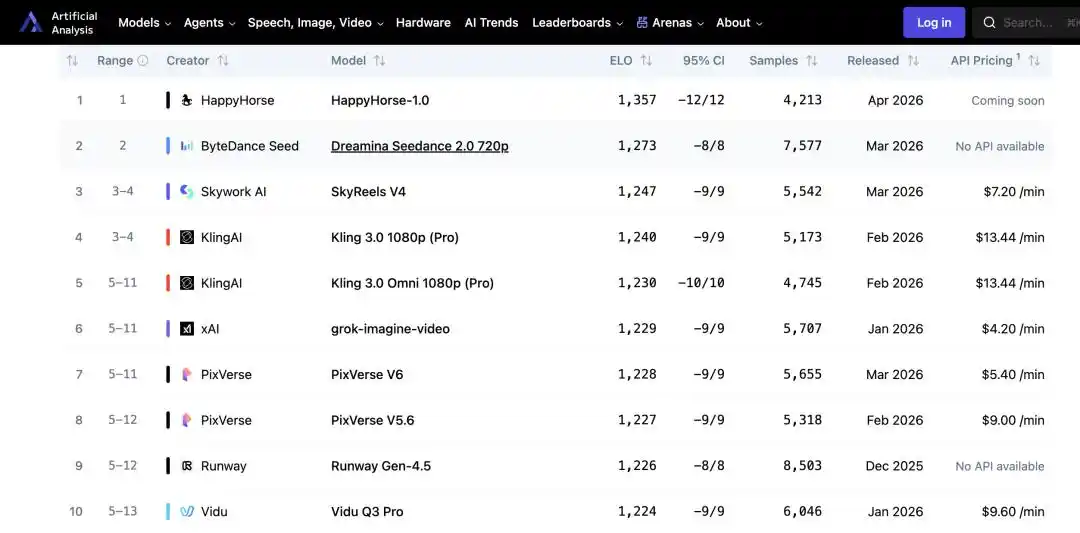
No launch event, no technical blog, no corporate backing—a text-to-video model named HappyHorse-1.0 quietly topped the AI Video Arena rankings on the authoritative AI evaluation platform Artificial Analysis, surpassing Seedance 2.0 with a higher Elo score and leaving mainstream players like Keling and Tiangang far behind, sparking a "decryption race" in the tech community.

Artificial Analysis' ranking is not based on technical parameter evaluations but on aggregated blind test results from real users, reflected through Elo scores. This makes the ranking harder to question than typical benchmark scores and turns "Who made this?" into an unavoidable question.

"Happy Horse" Quietly Tops the Chart, Sparking a Guessing Game in Tech Circles

Speculations on X emerged quickly. The first clue noticed was the language order on the official website: Mandarin and Cantonese were listed before English. For a product targeting global users, this order is unusual—if the team were U.S.-based, English would almost certainly be first. This strongly suggests the team behind it is from China.
The name itself is also a clue. 2026 is the Year of the Horse in the lunar calendar, and the name "HappyHorse" subtly references this, similar to the earlier "Pony Alpha." Suspects quickly piled up: Tencent and Alibaba's founders both have the surname Ma" (horse), putting them naturally on the list; some bet on Xiaomi, noting Lei Jun's low-key style and penchant for surprise reveals; others felt it aligned more with DeepSeek, which had quietly released a visual model before taking it down. Speculations ran wild, but no one had solid evidence.

The real breakthrough came from technical comparisons. X user Vigo Zhao cross-referenced HappyHorse-1.0's public benchmark data with known models and found a highly matching candidate: daVinci-MagiHuman, an open-source model called "DaVinci Magic Human" launched on GitHub in March.
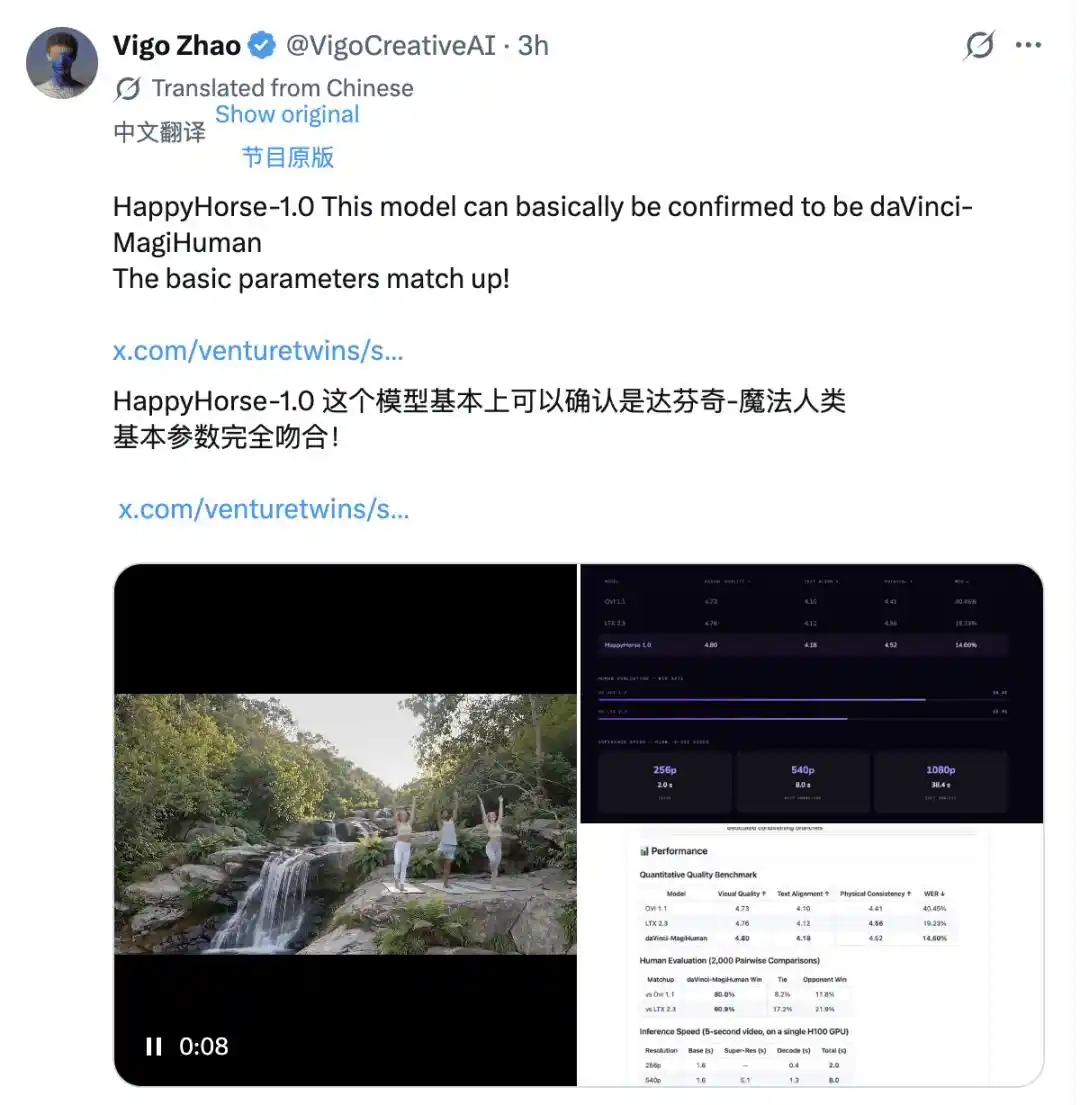
Visual quality 4.80, text alignment 4.18, physical consistency 4.52, word error rate in speech 14.60%—each metric matched. The official website structure was nearly identical too: architecture descriptions, performance tables, and demo video styles all seemed to follow the same template. Both use a single-stream Transformer architecture, both support joint audio-video generation, and both support the same list of languages. This level of overlap is hard to dismiss as coincidence.

The most widely accepted conclusion in tech circles is that HappyHorse is an optimized iteration of the open-source model daVinci-MagiHuman, developed by Sand.ai, one of the joint developers. The core goal is to validate the model's performance上限 under real user preferences, paving the way for future commercialization.

daVinci-MagiHuman was officially open-sourced on March 23, 2026, a collaboration between two young teams. One is from the Generative Artificial Intelligence Research Laboratory (GAIR) at Shanghai Institute of Intelligence (SII), led by scholar Liu Pengfei; the other is Beijing-based Sand.ai (San Dai Tech), founded by Cao Yue, who also has an academic background, with a focus on autoregressive world models.

The model uses a 15-billion-parameter pure self-attention single-stream Transformer, packing text, video, and audio tokens into the same sequence for joint modeling—no one in the open-source community had previously attempted true joint pre-training of audio and video from scratch, as most efforts involved stitching together single-modal bases.

How Did an Open-Source Video Model Achieve a Two-Week Comeback?

Once the identity was clarified, another question became even harder to answer: daVinci-MagiHuman was only open-sourced in late March, so how did HappyHorse-1.0 manage to secure a higher Elo score than Seedance 2.0 in just two weeks?

Based on information disclosed on the official website, it's reasonable to speculate that HappyHorse made targeted adjustments to the default generation strategy for the evaluation scenario.

The Elo system essentially accumulates user preferences. Slight improvements in perceptually sensitive areas—like stable facial expressions, audio-visual alignment, and visual appeal—can make a big difference in blind tests. The model's capability上限 remains unchanged, but its "evaluation performance" can be polished.

In fact, over 60% of the blind test samples on Artificial Analysis involve portrait generation and voice-over content. daVinci-MagiHuman was trained with a focus on portrait performance, giving it a natural advantage in such scenarios, which is the main reason for its领先 blind test win rate. If blind test samples are dominated by portrait close-ups, models skilled in portraits will systematically benefit, unrelated to their actual performance in multi-character, complex camera work, or long-term narrative scenarios.

The result is a noticeable gap between the ranking numbers and actual test experiences, splitting X discussants into two camps. Skeptics, after testing, believe that HappyHorse-1.0 still lags behind Seedance 2.0 in character details and motion coherence, questioning the representativeness of the Elo score itself.

Supporters, however, hold high hopes for HappyHorse's potential, hoping it can address the industry pain point of "visual consistency across multi-shot sequences," something current mainstream video models haven't solved well. If daVinci-MagiHuman truly makes a breakthrough here, it could be far more significant than a ranking.
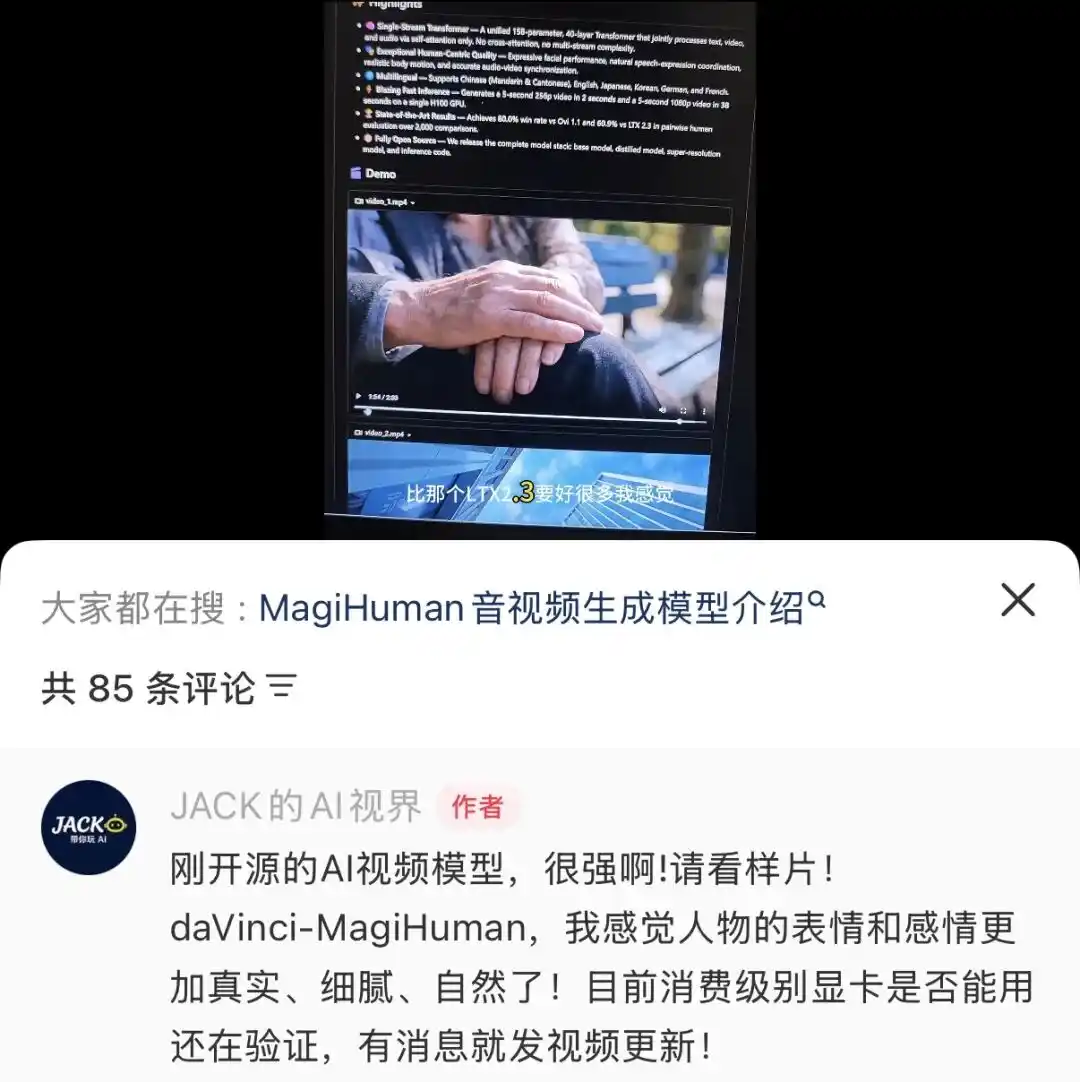
The model's limitations shouldn't be overshadowed by the numbers. Xiaohongshu blogger @JACK's AI World was among the first to deploy and test daVinci-MagiHuman. He found that it requires an H100 to run, making it nearly impossible for consumer-grade GPUs. Although the community is researching quantization solutions, local deployment for individual users remains challenging in the short term.

In terms of scenarios, it currently excels mainly with single characters; once multiple people appear or the scene becomes high, the quality drops—this isn't something tuning parameters can fix, as it's directly related to its design focus on portraits. Generation length is typically around 10 seconds; going longer risks instability, and high-definition output requires super-resolution plugins.

@JACK's AI World concluded: daVinci-MagiHuman's overall usability is not as good as LTX 2.3; it will only be suitable for daily use after the community successfully implements quantization.

Has the Video Generation Arena Finally Welcomed a True "Game Changer"?

Of course, leading the rankings once doesn't say much. Next, HappyHorse will need to undergo more thorough testing in areas like stability, high-concurrency access speed, cross-scene consistency, character control precision, and generalization beyond the test set. These are the core metrics that determine whether a model can truly enter creators' workflows.

But if we zoom out to the broader industry landscape, the signal this event sends is already clear enough.

Open-source video models themselves aren't new. But a visible gap in effectiveness has long existed between open-source and closed-source models—in scenarios requiring delivery to clients, the generation quality of open-source models has consistently failed to cross the threshold from "usable" to "deliverable." The pricing power of closed-source products like Keling and Seedance is, to a considerable extent, built upon this gap.

The significance this time lies in the fact that a product based on an open-source model has, for the first time, matched mainstream closed-source competitors in a blind test ranking based on real user perception. Regardless of how much tuning was done for the evaluation scenario, for closed-source vendors relying on this gap to maintain pricing power, this is at least a signal worth taking seriously.

For developers, the implications of this turning point are more concrete. In vertical scenarios like portraits, digital humans, and virtual anchors, once the generation quality of an open-source base reaches the "deliverable" threshold, the cost structure of self-deployment will undergo substantial changes—not just compressing API call costs, but more importantly, bringing data, models, and the entire inference pipeline under one's own control, offering customization depth and privacy compliance flexibility that closed-source solutions can hardly match.

HappyHorse-1.0 won't shake the market positions of Seedance 2.0 or Keling in the short term. But once the perception that open-source models can rival closed-source ones is established, subsequent quantization optimizations, vertical fine-tuning, and inference acceleration will be pushed forward by the community at a pace far exceeding that of closed-source products.

In this Year of the Horse, what's truly worth watching might not be which horse runs the fastest, but the fact that the track itself is widening.

This article is from the WeChat public account "AI Value Official," author: Xingye, editor: Meiqi


Related Questions

QWhat is the name of the text-to-video model that recently topped the AI Video Arena leaderboard on Artificial Analysis?

AHappyHorse-1.0

QWhich open-source model is HappyHorse-1.0 highly suspected to be based on, according to technical comparisons?

AdaVinci-MagiHuman

QWhat is the core architectural approach used by the daVinci-MagiHuman model for joint audio-video modeling?

AA single-stream Transformer architecture that models text, video, and audio tokens in a unified sequence.

QWhat is the primary reason HappyHorse-1.0 performed so well in the user-blind-test-based Elo ranking system?

AIt was likely optimized for the evaluation scenarios, particularly excelling in human portrait generation and narration content, which made up over 60% of the test samples.

QWhat broader industry signal does HappyHorse-1.0's performance send, according to the article?

AIt signals that open-source models can achieve user-perceived quality comparable to closed-source commercial products, potentially changing cost structures and offering greater flexibility for developers in vertical scenarios.

Related Reads

KOL's Perspective: Why Is SOL Set to Rise from This Point?

**Summary: Why SOL is Positioned for Growth at This Level** The article argues that SOL is poised for an upward move from its current price point, citing several key factors. Primarily, SOL has just broken out of a 4-month consolidation phase. This breakout signals a return of risk appetite to the broader crypto market, as SOL is seen as a key indicator of overall crypto health. The token's ownership has reportedly shifted from short-term traders and tourists to long-term accumulators, leading to low volume. Any meaningful increase in trading activity could thus trigger significant upward momentum. Fundamental strengths include strong institutional adoption, integration with DeFi and RWAs (Real-World Assets), and the potential benefits from the Clarity Act. Despite its high volatility—having dropped 70% from its all-time high but still up 12x from its bear market low—SOL is highlighted as one of the few tokens from the last cycle to reach new highs. It boasts a robust ecosystem of applications, users, and protocols. Future catalysts include the expected influx of AI developers following the Miami Accelerate conference, which focused on AI on Solana. Furthermore, Solana is positioned as the premier chain for memecoin activity, a trend expected to continue and drive network usage and fees. The article concludes that recent price action reflects a healthy transfer to long-term holders, setting the stage for growth.

marsbit2m ago

KOL's Perspective: Why Is SOL Set to Rise from This Point?

marsbit2m ago

Those Pre-Bitcoin PoW Protocols Have Recently Been Reimplemented

This article details a recent surge in replicating pre-Bitcoin Proof-of-Work (PoW) protocols, specifically focusing on Hal Finney's 2004 RPOW (Reusable Proofs of Work). Within five days in May 2026, multiple independent builders in the Bitcoin/cypherpunk community launched projects inspired by this early electronic cash proposal. The initiative began with Fred Krueger's `rpow2.com`, a centralized but auditable system that replaced RPOW's original IBM 4758 hardware with Ed25519 signatures. Initially a faithful replica, it later adopted Bitcoin-like features (21M supply cap, difficulty adjustment) and a controversial 5.24% founder allocation. This sparked rapid forks, including `rpow4.com` which incorporated full Bitcoin parameters, a prediction market (`rpowmarket.com`), and a DEX (`rpow2swap.com`). Concurrently, Mike In Space created a prototype of Wei Dai's 1998 b-money proposal (`b-money.replit.app`), pushing the historical exploration even further back. The article contrasts these centralized, server-dependent experiments with Bitcoin's core innovation of decentralized, trustless consensus. It also highlights a parallel development: the `HASH` project on Ethereum, which uses smart contract hooks to enable a purely fair-launch, browser-mineable PoW token with 0% allocations to team or VCs. The collective activity is framed as a meme-driven, educational exploration of cypherpunk history rather than a serious financial movement, with all projects heavily disclaiming any investment value.

marsbit7m ago

Those Pre-Bitcoin PoW Protocols Have Recently Been Reimplemented

marsbit7m ago

South Korean Exchanges 'Battle' Regulators, Challenging the Boundaries of Enforcement and Legislation

South Korea's cryptocurrency industry is engaged in a rare, direct confrontation with regulators. The Financial Intelligence Unit (FIU), the primary anti-money laundering (AML) watchdog, has recently imposed heavy penalties on major exchanges like Upbit and Bithumb for alleged violations involving unregistered overseas VASPs and AML procedures. However, exchanges are now actively challenging these actions in court and through industry associations. In a significant shift, the Seoul Administrative Court ruled in favor of Upbit's operator, Dunamu, overturning part of an FIU-ordered business suspension. The court found the FIU's penalty criteria and justification insufficiently clear. Similarly, the court suspended the enforcement of a six-month business suspension against Bithumb pending a final ruling, citing potential irreversible harm to the exchange. Beyond legal battles, the industry is contesting proposed legislative amendments. The Digital Asset eXchange Alliance (DAXA) strongly opposes a draft rule that would mandate Suspicious Transaction Reports (STRs) for all crypto transfers over 10 million KRW (~$6,800). DAXA argues this "poison pill" clause violates legal principles and would overwhelm the STR system, increasing reports from 63,000 to an estimated 5.45 million annually for major exchanges, thereby crippling effective AML monitoring. This conflict highlights a structural tension in South Korea's crypto governance: comprehensive digital asset laws are still developing, while regulators rely heavily on AML enforcement. The industry's move from passive compliance to active legal and legislative challenges signifies a new phase, pressing for clearer rules and more proportionate enforcement. While short-term disputes may intensify, this clash could ultimately lead to a more mature and sustainable regulatory framework for South Korea's vibrant crypto market.

marsbit1h ago

South Korean Exchanges 'Battle' Regulators, Challenging the Boundaries of Enforcement and Legislation

marsbit1h ago

After 50x Storage Surge, Justin Sun Always Looks to the Next Decade

Sun Yuchen, known for his controversial stunts like a $30 million lunch with Warren Buffett (canceled due to a kidney stone) and eating a $6.2 million duct-taped banana, is often overshadowed by a significant fact: his decade-long track record of spotting major investment trends. In 2016, he famously advised young people to invest in Bitcoin, Nvidia, Tesla, and Tencent instead of buying property. A hypothetical $20,000 investment in Nvidia and Tesla from that list would now be worth over 50 million RMB. His latest major call was on November 6, 2025, predicting a "50x storage opportunity" tied to the AI boom, which materialized with Sandisk's stock surging nearly 50-fold by 2026. Looking ahead, Sun now focuses on the next frontier: Physical AI. He identifies four key areas: 1. **Embodied AI/Robotics**: He sees this reaching its "iPhone moment," with companies like UBTech and Galaxy General leading in commercialization. 2. **Drones**: Viewed as the first commercially viable form of Physical AI, revolutionizing sectors from warfare (e.g., AeroVironment's Switchblade) to logistics. 3. **Spatial Computing**: Beyond VR, it's about AI understanding physical space, a foundational technology for robotics and autonomous systems, exemplified by Apple's Vision Pro. 4. **Space Exploration**: After a 2025 suborbital flight with Blue Origin, Sun advocates for space as the ultimate frontier, discussing blockchain's potential role in space asset management and data transactions. His investment philosophy involves betting on entire, inevitable trends rather than single companies. For robotics, he sees Tesla (the body/manufacturer) and Nvidia (the brain/AI platform) as complementary plays. In defense drones, he highlights companies making tanks obsolete (AeroVironment) and those augmenting fighter jets (Kratos). For space, he participated in Blue Origin's flight and anticipates SpaceX's potential IPO to redefine the sector's valuation. Sun Yuchen's vision frames the next two decades not as a revolution in information flow (like the internet), but in the fundamental operation of the physical world through AI-powered robots, autonomous systems, and spatial intelligence, ultimately extending human and AI activity into space. While many still focus on conventional assets, he continues to look toward the next technological horizon.

marsbit1h ago

After 50x Storage Surge, Justin Sun Always Looks to the Next Decade

marsbit1h ago

Trading

Spot
Futures
活动图片