Myanmar Under Fire: The Dignity of the Dollar, Trapped Youth, and the Underground Financial Market

marsbitPublished on 2026-02-26Last updated on 2026-02-26

Abstract

In 2026, a two-week field investigation in Myanmar revealed a nation fractured by war, economic collapse, and extreme social inequality. The country exists in multiple layers of reality: the official state versus the black market, internet stereotypes versus on-the-ground simplicity, and a brutal economic disparity where a server in Hong Kong earns 18,000 RMB monthly, compared to just 300 RMB in Bagan. The economy is defined by a shattered financial system. The official exchange rate is a fiction; the black market rate of 1:550 (USD to MMK) is the real one. This instability manifests in an absurd reverence for physical US dollars, which must be pristine to be accepted, while the local currency is treated with contempt. Hyperinflation has crippled daily life. Prices have surged 5x in a decade, while wages have only doubled. A day's wage for an adult in Bagan is less than 10 RMB, meaning five bottles of water cost a full day's pay. This pressure forces children into labor. It's common to see 9-year-olds working in restaurants or children begging in streets. For the youth, escape is nearly impossible. The government restricts passport issuance for those aged 18-60, making legal departure a privilege. The only options are dangerous illegal routes or being "bought" as a bride by foreigners. The report concludes with a guide's stark summary of his existence: "A lifetime. No happiness." Men live in fear of being forcibly conscripted, and the relentless struggle for survival leav...

During the 2026 Spring Festival holiday, I traveled to Myanmar for a two-week field research trip.

Passing through Yangon, Bagan, and Mandalay, I attempted to uncover the true economic, financial, and social conditions of this country under the shadow of war. As the first record from the halfway point of my journey, this article will present the real Myanmar I witnessed.

Just in the first week in Yangon, the overwhelming density of information far exceeded my imagination:

A 9-year-old child who dropped out of school to carry plates, middle-aged men at constant risk of being forcibly conscripted, young people unable to obtain passports to leave the country, and foreigners who come here to "buy wives" by exploiting the economic disparity......

In Yangon, under the control of warlords, bars and KTVs still maintain the illusion of a bustling nightlife; yet in many other cities across Myanmar, as soon as the 7 p.m. curfew begins, the streets instantly fall silent, resembling a ghost town devoid of human activity.

This is a vast, folded system. War and corruption thrive in the cracks, while soaring prices are pushing ordinary lives to the brink.

Folded Myanmar

To understand this撕裂 (tearing/rift), one must first see the three layers of "folding" present in this country.

There are two Myanmars: one is the Myanmar seen through the internet filter, the other is the Myanmar in reality; one is the Myanmar whitewashed in official data sheets, the other is the Myanmar struggling in the black market.

The first fold is the profound fissure in exchange rates. Upon landing in Myanmar, I exchanged 2500 Chinese Yuan for 1.38 million Myanmar Kyat at a Chinese restaurant. The official rate boasts 1:300, while the real trading price on the black market has plummeted to 1:550.
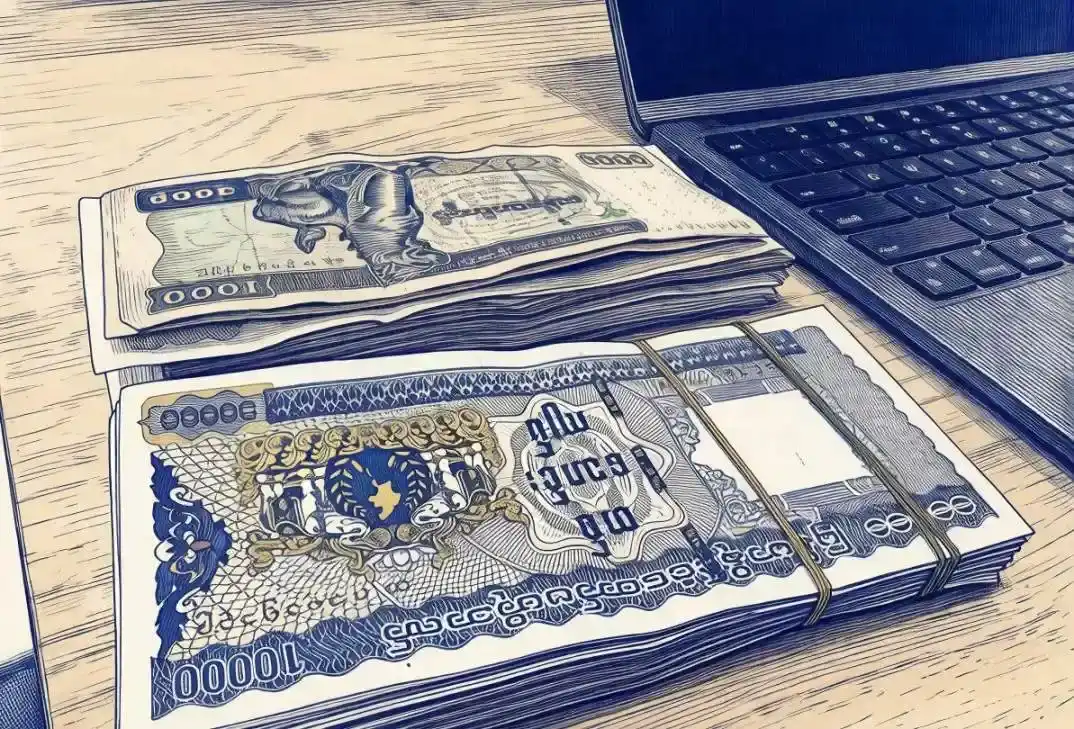
The national exchange rate is nominal; the black market rate reflects the people's reality.

The second fold is the cliff-like disparity in wages. A waiter carrying plates earns around 18,000 Chinese Yuan per month in Hong Kong, 8,000 in Shanghai, but in Bagan, Myanmar, this number plummets to a suffocating 300 Yuan.

Even within Myanmar, the urban-rural gap remains vast. An overseas Chinese long settled in a town told me that a waiter's monthly salary in a big city can reach 500 to 800 Yuan—this means that even the highest-paid low-wage earners in Myanmar receive only one-tenth of what their counterparts in Shanghai earn.

The third fold is the demonized internet labels versus the simple and honest reality. On the Chinese internet, Myanmar is simplistically and crudely reduced to synonyms for "kidney harvesting" and telecom fraud. But when you actually walk the streets of Yangon, Bagan, and Mandalay, you find that most people here still maintain extreme simplicity and peace. Northern Myanmar is indeed dangerous, filled with war and gray industries, but essentially, those crimes have nothing to do with the vast majority of ordinary Myanmar people—in this grand geopolitical and interest meat grinder, they are equally the most helpless victims.

The "Dignity" of the US Dollar

This underlying economic裂痕 (fissure/crack) and sense of insecurity is most absurdly manifested in the currency.

The underground financial market in Myanmar operates on an iron rule: US dollars must not be folded; any bill with marks or damage is rejected.

The economic常识 (common sense) that "a trampled $10 bill still has value" completely fails here. Even the slightest crease can cause the bill to be mercilessly refused by vendors. Every Myanmar person I've seen handling US dollars acts like a merchant examining expensive antiques with a magnifying glass; they hold their breath, carefully scrutinizing every inch of the bill's edges, every hidden line.

In stark contrast is the treatment of their own national currency—the Myanmar Kyat can be crumpled into a ball, stuffed into a pocket, even thrown into water for a wash, and still be spent afterward. But the US dollar must remain perfectly crisp. In the local subconscious, a damaged US dollar is equivalent to gold of inferior quality, subject to a 10% to 20% discount penalty.

This近乎病态的 (almost pathological) "fastidiousness" is precisely a concrete manifestation of the extreme fragility of this country's financial system. Long-term sanctions and complete financial isolation have driven the official and black-market exchange rates to an extreme撕裂 (tearing/rift). In this country that has lost all sense of security, the dignity of a green piece of paper is infinitely elevated; its perceived respectability甚至 (even) far surpasses that of a sweating, struggling living person.

5 Bottles of Water Equal an Adult's Daily Wage

The collapse of monetary信用 (credit/trust) directly translates into runaway inflation. After years of ongoing conflict, prices in Myanmar have become disordered.

In the memory of a local named Kosla, over the past decade, the price of most goods in Myanmar has surged about 5 times, while people's wages have only艰难地爬升 (painfully climbed) by 2 times. The specific numbers are冰冷 (chilling): In 2019, a JJ bus ticket (JJ Express is one of Myanmar's most well-known long-distance bus companies) cost only 11,000 Kyat; by 2026, the ticket price had risen to 50,000 Kyat; a bottle of mineral water, almost exclusively sold to foreigners, increased from 200 Kyat to 800-1000 Kyat.

Prices have quadrupled or quintupled, but human effort has become increasingly cheap. In Bagan, the daily wage for an ordinary adult waiter was 2500 Kyat ten years ago; now it is 5000 Kyat (less than 10 Chinese Yuan). Kosla confirmed this is the普遍 (common) daily wage for most restaurant waiters in Bagan. A service industry老板 (boss) in Yangon, Veraswami, also revealed a残酷的底线 (cruel baseline) to me: the monthly salary of an ordinary Myanmar person is typically only 200 to 300 Chinese Yuan.

Only heavy manual labor and working in big cities can buy a little more breathing room. Near the famous pagoda in Mandalay, a construction worker laboring under the scorching sun told me his daily wage is 30,000 Kyat (less than 60 Chinese Yuan).

The income of ordinary people is firmly pinned in place. In Myanmar, locals generally cannot afford to drink bottled water. Because just 5 bottles of the most ordinary mineral water can instantly consume the entire day's wages of an adult's hard work.

Myanmar Children, Already Reduced to the "Working Class"

When the meager wages of adults are squeezed dry by inflation, the heavy pressure of survival inevitably falls on the next generation.

In Bagan, Kosla calmly recalled his childhood to me. To survive, he started working in a restaurant at the age of 9. Toiling from 8 a.m. to 5 p.m. earned him a daily wage of 500 Kyat. It wasn't until he was 16 that this wage艰难地爬升 (painfully climbed) to 2500 Kyat.

This is not just Kosla's personal时代眼泪 (tears of the times), but the至今触目惊心的 (still shocking) reality of this country.

Traveling from Yangon and Bagan to the largest city in the north, Mandalay, "prematurely matured childhoods" are the most common sight on the streets.

In the middle of Yangon's heavy traffic, boys under 15 hold their 4 or 5-year-old brothers, begging by knocking on car windows amidst exhaust fumes and danger;

In Bagan, children under 10 work odd jobs in restaurant kitchens, underage waiters熟练地 (skillfully) carry plates and serve water, and beside the ancient pagodas, groups of teenagers can only earn meager change by taking photos for tourists; outside temples in Mandalay, children around 10 years old busy themselves helping their parents amidst the incense smoke.

Time seems to stand still here. Over a decade has passed, whether in remote villages or core cities, the situation似乎 (seems) unchanged. In this country, childhood is a luxury. Young children are早早 (early on) thrown into the cruel game of survival, remaining the heaviest and unsolvable daily reality of Myanmar.

Myanmar Youth, A Generation Unable to Redeem Themselves

And when these prematurely matured children grow up, what awaits them is another inescapable cage. For ordinary Myanmar youth, leaving is an exorbitantly expensive redemption.

The first shackle is economic. Meager wages are like stagnant water; merely coping with soaring living costs exhausts all their energy, making "saving money to go abroad" a distant, unattainable luxury.

And the iron fist of power directly severs any legal escape route for this generation. "If you are over 80 years old, you can leave Myanmar随意 (freely); but if you are between 18 and 60 years old, the country will absolutely not let you go,"老板 (boss) Veraswami in Yangon told me this残酷的潜规则 (cruel unwritten rule). The government strictly controls youth出境 (exit), making passports meaningless.

When normal channels are completely blocked,畸形 (deformed) "ways out" begin to滋生 (breed) in the shadows.

"Now many people specifically come to Myanmar to 'buy wives',"老板 (boss) Veraswami shared with a bitter laugh something he recently handled: to help the Myanmar wife of a foreign man leave the country顺利 (smoothly), he疏通 (greased palms)各方 (various parties), spending a total of 3000 Chinese Yuan in various打点费 (facilitation fees). For a foreigner, 3000 Yuan might be just an ordinary plane ticket; but for the底层 (bottom-level) people of Myanmar, it represents an entire 15 months of a普通人不吃不喝 (ordinary person's life, working without eating or drinking)辛勤劳作 (hard labor).

Even risking their lives to work illegally offers despair. A Myanmar monk无奈地 (helplessly) told me that many young people try to偷渡 (smuggle themselves) by boat to Thailand. But as border conflicts spread, Thailand not only doesn't welcome Myanmar refugees but has also begun strictly investigating and cracking down on the employment of illegal Myanmar workers.

Can't leave, can't stay. The national border here is no longer a dotted line on the map, but an abyss cast from absolute power and extreme poverty.

In Conclusion

The镜头定格 (lens focuses) on a little boy quietly looking out the train window.
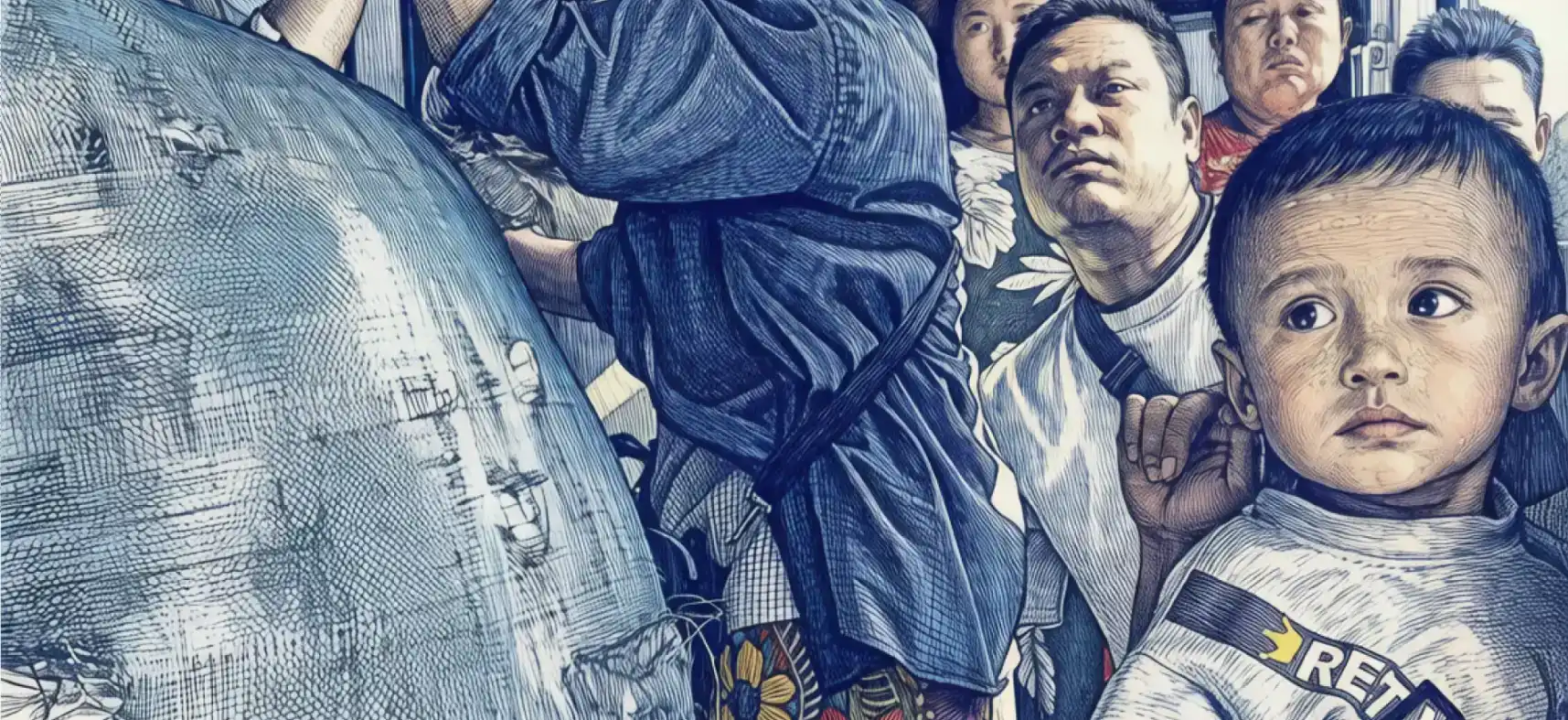
He is an缩影 (epitome) of the millions of ordinary boys in Myanmar. Time will irrevocably push him forward, making him grow into a youth, become a man, and ultimately, inevitably, become someone like my guide, Kosla.

I once asked this ordinary Myanmar man: "Are you happy?" Kosla didn't answer immediately. When I追问 (pressed) a second time, he only避重就轻 (evaded the important point) saying: "We are busy with making a living every day; we simply have no time to think about happiness."

Until much later, on the dusty roadside, he gave his third, and most complete, answer to this question:

"I could die tomorrow. They could grab me to become a soldier at any time, to go fight on the other side of the river. After 7 p.m., if a man is on the street in Bagan, he will likely be thrown in jail, then tossed onto the battlefield for no reason at all. I've been working since I was 9 years old, but the speed of wage increases can never keep up with inflation."

"A lifetime. No happiness." He said.

Related Questions

QWhat are the three main 'folds' or divisions in Myanmar's society and economy as described in the article?

AThe three main 'folds' are: 1) The deep chasm between the official and black market exchange rates, 2) The cliff-like disparity in wages compared to other countries and within Myanmar itself, and 3) The contrast between the demonized online perception of Myanmar (as a place for scams and organ harvesting) and the reality of a mostly peaceful and simple populace who are victims of the conflict.

QHow is the US dollar perceived and treated in Myanmar's underground financial market, and what does this signify?

AIn Myanmar underground financial market, the US dollar is treated with extreme care; it cannot be folded or have any marks, or it will be rejected or severely discounted. This 'pathological fastidiousness' is a concrete manifestation of the country's extremely fragile financial system, where the dollar's 'dignity' is valued more highly than that of a struggling human being, reflecting a complete loss of financial security.

QWhat does the price of five bottles of water represent in the context of a local worker's income?

AThe price of five bottles of the most common mineral water is equivalent to a full day's wages for an average adult worker in Myanmar, highlighting the severe impact of prices and the extreme devaluation of labor.

QWhy are Myanmar's youth described as 'a generation that cannot redeem itself'?

AMyanmar's youth are trapped because they face immense economic barriers (extremely low wages that make saving to leave impossible) and political restrictions (the government severely controls and often denies passports to those between 18 and 60 years old, effectively preventing legal emigration). This forces them to seek dangerous, illegal, and expensive alternatives to leave, which are often out of reach.

QWhat was the poignant response from the guide, Kosla, when asked if he was happy?

AKosla's final and most complete response was: 'I may die tomorrow. They can grab me to be a soldier at any time, to go fight on the other side of the river... I have worked since I was 9 years old, but my salary never catches up with inflation. A lifetime. No happiness.'

Related Reads

STAR 50 Soars 10.73%, Why Did A-Shares Stage a "V-Shaped Reversal"?

After a prolonged decline, the Chinese A-share market staged a strong rally on July 21. The STAR 50 index surged 10.73%, its largest single-day gain in nearly a year, leading a broad-based "V-shaped" reversal. The Shanghai Composite Index rose 1.79%, the Shenzhen Component Index gained 4.81%, and the ChiNext Index jumped 7.05%. Total market turnover reached 2.97 trillion yuan, an increase of 256.1 billion yuan from the previous session, with over 3,100 stocks advancing. The semiconductor sector spearheaded the rebound, with related ETFs posting significant gains. Analysts attribute the surge to three converging factors. First, coordinated capital inflows from "national team" institutions, insurance funds, listed company buybacks, and fund house self-purchases have bolstered market liquidity and confidence. Second, supportive policy signals, including commitments from regulators to ensure stable market operations, provided a favorable backdrop. Third, a stabilization and recovery in overseas markets, notably South Korea, created a positive external environment. Institutions suggest the most severe panic selling phase for the tech sector has likely passed, following a significant digestion of crowded positions and leveraged funds. While short-term volatility may persist, the medium to long-term outlook remains underpinned by enduring trends like AI computing demand expansion and semiconductor localization. The market's focus now shifts to the sustainability of supportive fund flows, earnings reports, and upcoming catalysts from the global AI industry chain.

marsbit37m ago

STAR 50 Soars 10.73%, Why Did A-Shares Stage a "V-Shaped Reversal"?

marsbit37m ago

U.S. Tech Momentum Stocks Post Largest Single-Day Gain Ever, But Is the Plunge Over?

US tech momentum stocks staged a sharp rebound on Tuesday (July 21st). Morgan Stanley's TMT Momentum Factor surged over 12%, marking its largest single-day gain on record, exceeding even peaks from the 2000 dot-com bubble. Key momentum indices from Goldman Sachs also posted their strongest daily performances in years. The rally was led by semiconductors, with the Philadelphia Semiconductor Index jumping 4.6%. This rebound followed three consecutive down days and a cumulative 33% plunge in momentum stocks, one of the steepest drawdowns since the dot-com era. Analysts attribute the surge largely to a short squeeze. Heavy selling had pushed high-beta momentum stocks into deeply oversold territory, forcing many short sellers, particularly in Asia, to cover their positions, creating a self-reinforcing buying spiral. However, the rebound's internals appear weak. Trading volume was notably low, and advancing stocks still lagged decliners on the S&P 500, indicating a narrow, concentrated rally rather than broad market participation. Diverging views emerge on the outlook. BTIG warns the bounce has hit key resistance and recommends selling into strength, citing extreme volatility and historical parallels to past market tops. Conversely, Goldman Sachs and UBS believe the momentum unwind is nearing its end, suggesting it may be time to gradually add exposure, as positioning has been significantly reduced. They caution, however, that high volatility warrants a measured approach, potentially using defined-risk strategies. The upcoming earnings season, particularly reports from major tech firms like Alphabet, is seen as a critical test for the rally's sustainability. Simultaneously, bond markets flashed a warning, with yields rising partly due to spiking oil prices. Analysts note that if long-term Treasury yields break decisively higher, it could pose a significant headwind for equities, especially growth stocks.

marsbit44m ago

U.S. Tech Momentum Stocks Post Largest Single-Day Gain Ever, But Is the Plunge Over?

marsbit44m ago

U.S. Tech Momentum Stocks Record Largest Single-Day Gain Ever, but Has the Rout Ended?

U.S. tech momentum stocks staged a dramatic rebound on Tuesday, July 21st. Key momentum indices like the Morgan Stanley TMT Momentum Factor and Goldman Sachs' High Beta Momentum Long Index posted historic or near-historic single-day gains, fueled largely by semiconductor stocks. This sharp rally followed a severe three-day sell-off that saw momentum stocks plunge 33%, marking one of the steepest pullbacks since the dot-com bubble. Analysts attribute the bounce primarily to a short squeeze, as forced covering from over-leveraged traders, particularly in Asia, created a buying spiral. However, the rally's health is questioned due to weak market breadth—overall trading volume was low, and decliners outnumbered advancers in the S&P 500 despite the index's gain—suggesting a narrow, concentrated surge rather than broad recovery. Opinions on the sustainability diverge. BTIG strategists warn the rebound has hit key resistance levels, citing extreme volatility and historic stock dispersion as signs of an ongoing broader correction, and recommend selling into strength. Conversely, Goldman Sachs and UBS view the aggressive momentum unwinding as nearing its end, noting reduced positioning and a lack of new fundamental catalysts. They suggest the sell-off presents a selective opportunity to add exposure, albeit cautiously and gradually using defined-risk strategies. The immediate trajectory hinges on the ongoing earnings season, with market focus on Alphabet's capital expenditure guidance for AI investment clarity. Meanwhile, bond markets present a risk, with rising Treasury yields—potentially heading toward 5.5%—and widening credit spreads for mega-cap tech companies posing a threat to equity valuations. The combination of technical factors, earnings results, and macro conditions leaves the durability of the rebound in doubt.

链捕手47m ago

U.S. Tech Momentum Stocks Record Largest Single-Day Gain Ever, but Has the Rout Ended?

链捕手47m ago

Long-Divided Must Unite, Long-United Must Divide: When L1 Becomes Its Own Rollup, What Is Ethereum's Endgame?

"The Inevitable Cycle: When L1 Becomes Its Own Rollup – What is Ethereum's Endgame?" For years, the Ethereum community grappled with concerns that L2s were fragmenting the ecosystem and eroding L1's value. While L2s provided cheaper execution, they also splintered liquidity and the unified user experience of a single chain. This has prompted a fundamental reassessment of the relationship between L1 and L2. Ethereum's roadmap is evolving. The "Scale" initiative merges L1 and L2 expansion into a holistic framework. L1 itself is advancing with higher gas limits, statelessness, and zkEVM verification, no longer content to be just a low-throughput settlement layer. Consequently, the primary value proposition of L2s is shifting from merely providing cheap blockspace to offering L1 cannot easily provide: application-specific optimizations, privacy features, and flexible governance models. L2s are becoming a spectrum of execution environments with varying degrees of security inheritance from Ethereum. A critical challenge in this multi-chain future is interoperability. The vision is to make Ethereum "feel like one chain again." This relies on advancements in native account abstraction (like EIP-7702) and intent-based architectures (Open Intents Framework), where users declare desired outcomes, and solvers handle the complex cross-chain execution. Furthermore, shortening Ethereum's finality time from minutes to seconds is crucial, as it underpins trust between chains for bridges, stablecoins, and cross-chain applications. Perhaps the most provocative idea is that Ethereum L1 itself could become a form of "its own Rollup." As zkEVM and proof systems mature, high-performance nodes could execute transactions and generate validity proofs. Regular validators would then verify these proofs instead of re-executing all transactions. This blurs the traditional L1/L2 hierarchy, making "Rollup" more of a general execution-verification architecture. Native Rollup aims to integrate L2 validation more directly into the Ethereum protocol, allowing L2s to inherit L1's security more fully and move away from reliance on security councils. In the end, L2s are not destined to replace L1 or be made obsolete by it. The likely future is a unified system where diverse execution environments—each optimized for specific use cases like DeFi, gaming, or privacy—coexist. They will share a common foundation of security, liquidity, and verifiable state, seamlessly connected to restore a cohesive user experience. The next phase for Ethereum is not just about scaling through separation, but about intelligently reintegrating what was separated back into a coherent whole.

链捕手1h ago

Long-Divided Must Unite, Long-United Must Divide: When L1 Becomes Its Own Rollup, What Is Ethereum's Endgame?

链捕手1h ago

Trading

Spot
活动图片