MY Group Completes Web4.0 First Stock Listing Layout, SEC Officially Discloses Form 8-K Announcement

marsbitPublished on 2026-05-17Last updated on 2026-05-17

Abstract

MY Group has completed the listing layout for the "Web4.0 First Share," with the U.S. Securities and Exchange Commission (SEC) formally disclosing a Form 8-K report. According to the filing, the company's board has officially appointed Mr. Zhang Dingwen as Chief Executive Officer (CEO) and Executive Director, marking a significant upgrade in management and the entry into a new phase of its global capital market strategy. The disclosure of Form 8-K, used for reporting major corporate events, coincides with market information indicating the company is advancing several key capital market initiatives. These include a global brand system upgrade, corporate strategic restructuring, and a change of its stock ticker symbol. These moves are viewed by industry experts as signals of accelerated internationalization and enhanced global market presence. Concurrently, MY Group's proposed "Web4.0 Ecosystem" is garnering market attention. The company is integrating core capabilities across social traffic portals, global payment systems, public blockchain infrastructure, digital asset trading, and AI-powered financial systems. Analysts suggest that by closing this ecosystem loop, MY Group has the potential to become a next-generation platform merging Web2 user scale with Web3 asset frameworks and AI financial capabilities. With the management upgrade finalized, the global brand strategy launched, and the stock ticker change pending, MY Group is positioning itself as a focal point in the g...

The Company to Advance Stock Ticker Change, Global Capital Strategy Enters New Stage

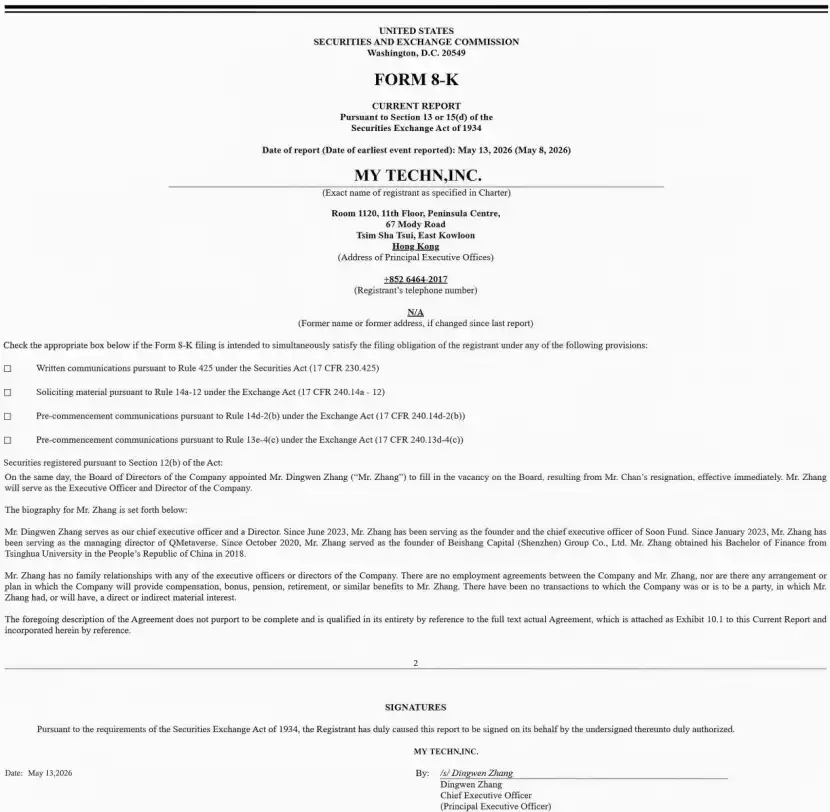
2026513日, The U.S. Securities and Exchange Commission (SEC) has officially disclosed the Form 8-K Current Report submitted by MY Technology Group.

According to the SEC announcement, the board of directors has formally appointed Mr. Zhang Dingwen as the company's Chief Executive Officer (CEO) and Executive Director of the board, with the appointment having taken effect.

The official disclosure of this Form 8-K also signifies that the company's management upgrade and its global capital market strategy have entered a new phase.

Public information indicates that Form 8-K is an immediate disclosure document for significant events of U.S. listed companies, typically used to report important information including management changes, board adjustments, and major capital market matters.

Simultaneously, market sources indicate the company is also currently advancing several key capital market actions, including: global brand system upgrade, corporate strategic structure optimization, stock ticker symbol change, and international capital market positioning upgrade.

Industry insiders believe such actions typically indicate that a listed company is accelerating its international capital market strategy and further enhancing its global market recognition and long-term capitalization capabilities.

Notably, following the disclosure of this Form 8-K, market attention towards the company's subsequent stock ticker change and brand upgrade plans has also increased significantly.

Capital market participants stated: After completing a management upgrade, a listed company simultaneously advancing brand and ticker system optimization is often seen as an important signal of the company entering a new stage.

Public records show that Mr. Zhang Dingwen has long been deeply involved in the fields of technology, digital finance, and international business, possessing extensive experience in corporate strategy and capital markets.

Following the completion of this management upgrade, the company's pace in advancing its international capital market strategy is expected to accelerate further.

As of now, the company has not disclosed its new stock ticker, but related matters are expected to proceed according to SEC regulations and exchange processes.

It is widely believed within the industry that with the official disclosure of this Form 8-K, the company's global capital market layout is continuously deepening, and its subsequent strategic moves are expected to receive further market attention.

"Web4.0 First Stock" Garnering Market Attention

With the ongoing integration of AI, digital payments, Web3, and social ecosystems, the global capital market is searching for the next generation of internet platform companies.

The "Web4.0 Ecosystem" proposed by MY Group is also becoming a key focus in the industry.

Currently, the company has gradually developed core capabilities including: social traffic entry points, global payment systems, public chain infrastructure, digital asset trading ecosystems, and AI-powered financial systems.

Market observers believe: If MY Group can further complete its ecosystem loop, it has the potential to become one of the few new-generation technology platforms in the global capital market that truly integrates "Web2-scale user base + Web3 asset systems + AI financial capabilities."

With the SEC officially disclosing the Form 8-K, management upgrade completed, global brand strategy launched, stock ticker change imminent, and Web4.0 strategy advancing, MY Group may become one of the Web4.0 platform-level companies drawing significant attention in the global technology capital market.


Related Questions

QWhat significant SEC filing was disclosed for MY Tech Group, and what was the key announcement within it?

AThe U.S. Securities and Exchange Commission (SEC) formally disclosed a Form 8-K Current Report for MY Tech Group. The key announcement was the official appointment of Mr. Zhang Dingwen as the company's Chief Executive Officer (CEO) and an executive director of the board, with the appointment already in effect.

QAccording to the article, what other strategic moves is MY Group reportedly advancing alongside the management change?

AAlongside the management change, MY Group is reportedly advancing several key capital market actions, including a global brand system upgrade, corporate strategic structure optimization, a stock ticker symbol change, and an upgrade to its international capital market positioning.

QWhat core capabilities make up MY Group's proposed 'Web4.0 ecosystem'?

AMY Group's proposed 'Web4.0 ecosystem' is built on core capabilities including social traffic portals, a global payment system, public chain infrastructure, a digital asset trading ecosystem, and an AI-powered intelligent financial system.

QWhy is the Form 8-K filing considered significant for a publicly traded company?

AForm 8-K is a significant filing because it is used for the immediate disclosure of major events by U.S. listed companies, typically covering important information such as management changes, board adjustments, and significant capital market matters.

QWhat market potential does the article suggest for MY Group in relation to the Web4.0 concept?

AThe article suggests that if MY Group can further complete its ecosystem, it has the potential to become one of the few next-generation technology platforms in the global capital market that truly integrates 'Web2 user scale, Web3 asset systems, and AI financial capabilities,' positioning it as a key Web4.0 platform-level company for market focus.

Related Reads

Bernstein Analysis: Can the $142 Billion Long-Term Order Hold Up the Memory Cycle?

Bernstein revisits long-term agreements (LTAs) in the memory industry, highlighting new contracts with purchase commitments, minimum prices, and financial guarantees signed by Micron and SanDisk. These aim to provide an earnings floor for the coming years. Micron has 16 strategic customer agreements, with 14 representing approximately $100 billion in minimum revenue and about $22 billion in cash deposits/commitments. SanDisk has contracts for around $42 billion in minimum revenue and over $11 billion in guarantees. Combined, these ~$33 billion in guarantees make it more costly for major clients to walk away. However, Bernstein models that the potential revenue needing protection over 3-5 years is around $5.2 trillion. The existing guarantees thus cover only about 0.6% of that scale. While LTAs provide a cushion, they cannot fully shield profits in a severe downturn, as clients may still find it cheaper to breach contracts if spot prices fall deeply below floor prices. LTAs are most suitable for large, credit-worthy customers like U.S. cloud service providers with stable, high-volume AI infrastructure needs. Consumer segments (phones, PCs) and some Chinese clients are less likely to adopt them, leaving an estimated 30-50% of the DRAM/NAND market exposed to spot price volatility. AI demand (e.g., HBM for training, storage for inference) supports higher valuations and makes LTAs more attractive for locking in high-demand customers. Yet, Bernstein stresses that LTAs soften, but do not eliminate, the memory cycle. Their true test will come in the next downturn, revealing whether clients honor contracts and whether guarantees provide sufficient pain to maintain supplier discipline.

marsbit28m ago

Bernstein Analysis: Can the $142 Billion Long-Term Order Hold Up the Memory Cycle?

marsbit28m ago

Dialogue with Jia Hang | Looking Back at Two Decades of Chinese Payment Going Global

**Summary: A Conversation with Jia Hang on Two Decades of China's Payment Globalization** Jia Hang, a veteran with over twenty years in payments, reflects on China's attempts to build a global payment network through three key phases: UnionPay (card networks), Alipay+ (digital wallets), and now, stablecoins. His journey began at UnionPay International, aiming to establish China's card network abroad. While successful in following Chinese tourists ("where Chinese go, UnionPay goes"), it struggled to achieve true global scale. The core lesson: card networks like Visa/Mastercard's unassailable advantage isn't just technical standards, but their deeply entrenched **governance and profit-sharing models** that create powerful network effects. Competing as the "same species" is nearly impossible. At Ant Group, he led Alipay+, a strategy to bypass card networks by interconnecting local e-wallets worldwide. While innovative, it faced a similar ceiling. Mobile QR payments and card swipes were essentially **the same species competing for the same pie**, lacking a disruptive value proposition for users or a sustainable new incentive model to replace the card networks' established flywheel. Today, at Singapore's DCS, Jia focuses on stablecoin-based payments. He argues stablecoins represent a fundamental shift. They are not competing with Visa for consumer payments but challenging the **traditional banking and account system for value movement**. Products like "U Cards" (stablecoin-linked payment cards) are transitional, leveraging existing card networks for acceptance while building new rails. The real potential lies in stablecoins enabling seamless, low-cost global value transfer, potentially reorganizing the financial infrastructure around **accounts rather than cards**. Jia believes stablecoin adoption for local retail payments, cross-border transactions, and as high-yield savings vehicles is becoming irreversible. This could gradually reduce reliance on traditional fiat channels, especially in regions with weak currencies or capital controls. The quest for the "next global payment network" continues, now centered on whether stablecoins can successfully bridge Web2 and Web3, establish new governance, and create compelling user value beyond mere cost reduction.

marsbit51m ago

Dialogue with Jia Hang | Looking Back at Two Decades of Chinese Payment Going Global

marsbit51m ago

Circle's Stock Price Plunges 76%, Hong Kong Dollar Stablecoin Set to Launch Within Two Weeks

Circle's stock price has plunged approximately 76% from its 2023 peak, reflecting a major market revaluation. Despite this, Circle President Heath Tarbert emphasized the company's focus on long-term execution and its dominant position with USDC's $73 billion circulation across 34 blockchains. The competitive landscape is intensifying. A new consortium-backed stablecoin, Open USD, is attempting to challenge incumbents by sharing reserve yields with partners. More significantly, Visa's new stablecoin platform, initially supporting Open USD while also being compatible with USDC, could erode Circle's network effects. In response, Circle is expanding into real-world payments through partnerships like the one with Japan's JCB. Separately, Tether (USDT) faces a two-year compliance window under new U.S. regulations, requiring it to adjust its reserve composition away from assets like Bitcoin and loans towards cash and U.S. Treasuries. Meanwhile, in Hong Kong, Standard Chartered-backed fintech firm Dian Dian is poised to launch a licensed HKD-pegged stablecoin (HKDAP), moving the industry into a phase where the real test is integrating licensed stablecoins into actual payment flows and corporate treasury systems. The sharp decline in Circle's stock underscores a broader shift: the stablecoin market is moving from a winner-takes-all dynamic to a multi-player competitive arena where execution, compliance, and real-world utility are becoming paramount.

marsbit52m ago

Circle's Stock Price Plunges 76%, Hong Kong Dollar Stablecoin Set to Launch Within Two Weeks

marsbit52m ago

Trading

Spot
活动图片