Multi-Chain Decentralized Over-Collateralized Stablecoin USDD Debuts at 2026 Istanbul Blockchain Week

marsbitPublished on 2026-06-02Last updated on 2026-06-02

Abstract

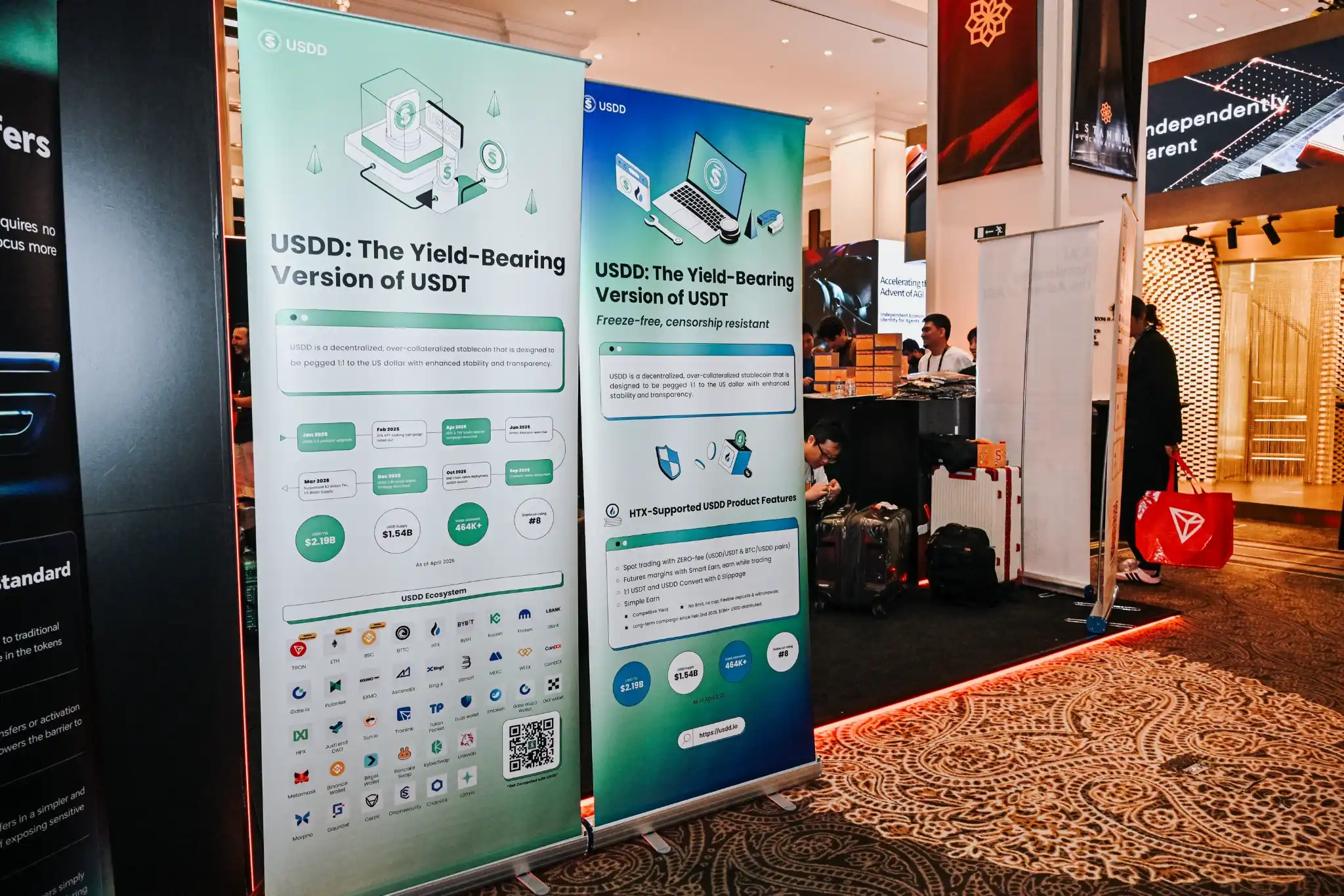
On June 2, 2026, the Istanbul Blockchain Week (IBW) commenced at the Istanbul Bomonti Hilton Hotel & Conference Center. During this major two-day Web3 industry event, the multi-chain over-collateralized decentralized stablecoin USDD made its appearance. USDD, in partnership with TRON, established a joint exhibition booth to showcase the latest developments in stablecoin and Web3 ecosystems to attendees. The event, now in its fifth year and organized by EAK Digital, focused on key topics including Real World Asset tokenization (RWA), Artificial Intelligence (AI), stablecoins, regulatory compliance, privacy protection, and Decentralized Finance (DeFi). It attracted numerous leading global Web3 institutions, industry leaders, and innovative projects. USDD aims to leverage this platform to deepen connections with global Web3 resources and further empower its global ecosystem expansion and application adoption.

On June 2, the 2026 Istanbul Blockchain Week (IBW) officially opened at the Hilton Istanbul Bomonti Hotel & Conference Center. The conference, spanning two days, will continue until June 3. The multi-chain decentralized over-collateralized stablecoin USDD made its appearance at this event, joining forces with TRON to set up a joint exhibition booth on-site, showcasing the latest developments in the stablecoin and Web3 ecosystem to attendees. Leveraging this premier industry gathering, USDD aims to further strengthen its deep connections with global Web3 resources, continuously empowering the global expansion and practical application of its ecosystem.

It is reported that IBW, organized by EAK Digital, has now successfully reached its fifth edition and is a globally renowned Web3 industry event. This year's conference focused on key topics such as real-world asset tokenization (RWA), artificial intelligence (AI), stablecoins, regulatory compliance, privacy protection, and decentralized finance (DeFi), attracting participation from numerous leading global Web3 institutions, industry leaders, and innovative projects.

Related Questions

QWhat was the main purpose of USDD and TRON establishing a joint booth at the 2026 Istanbul Blockchain Week?

AThe main purpose was to showcase the latest development achievements in the stablecoin and Web3 ecosystem fields to attendees.

QWhich company organizes the Istanbul Blockchain Week (IBW) event mentioned in the article?

AThe Istanbul Blockchain Week is organized by EAK Digital.

QWhere and when did the 2026 Istanbul Blockchain Week take place?

AIt took place at the Istanbul Bomonti Hilton Hotel & Conference Center and ran from June 2nd to June 3rd, 2026.

QWhat type of stablecoin is USDD described as in the article?

AUSDD is described as a multi-chain decentralized over-collateralized stablecoin.

QAccording to the article, what were some of the key topics focused on at the 2026 Istanbul Blockchain Week?

AKey topics included real-world asset tokenization (RWA), artificial intelligence (AI), stablecoins, regulatory compliance, privacy protection, and decentralized finance (DeFi).

Related Reads

Claude's Major New Feature: Screen Recording + Voice, Distilling Your Skills into AI Tasks in One Click

Claude has introduced a major new feature called "Record a Skill," available for Pro, Max, and Team users. This function, found in the Claude desktop app's CoWork menu, allows users to create reusable AI skills simply by recording their screen and providing voice narration while performing a task. Claude then automatically analyzes the recording and generates a functional Skill. A hands-on test confirmed the feature works seamlessly. Users start recording via the Skills manager, perform their workflow while verbally explaining the steps and logic, and avoid including sensitive information. After recording, Claude processes the content and creates the Skill, which can be saved and later invoked with a slash command (/). This eliminates the need for manual adjustments or writing complex instruction files. The innovation goes beyond mere efficiency. Previously, creating a Skill required writing a detailed SKILL.md file in Markdown—a significant barrier for non-technical users. "Record a Skill" bypasses this by directly capturing both actions and the implicit reasoning shared in the narration. This lowers the barrier to knowledge transfer and automation, addressing a core challenge in corporate knowledge management: the difficulty of getting experts to write and maintain documentation. However, the feature also highlights a shift in the nature of work. A case study from March 2026 showed a freelancer whose five-year client relationship was effectively replaced by a hand-coded Claude Skill automating their content workflow. With the even lower barrier of screen recording, the ability to distill personal expertise into automatable skills accelerates this trend. The "moat" for work is moving from simply knowing how to do a task to mastering tasks that are difficult or impossible to automate.

marsbit6m ago

Claude's Major New Feature: Screen Recording + Voice, Distilling Your Skills into AI Tasks in One Click

marsbit6m ago

Feeding AI "Noise" Can Also Boost Scores, This Work Enables Positive Transfer with Noise

Feeding "Noise" to AI Can Improve Performance: A Method Enables Positive Transfer from Noise This work, Semi-Supervised Noise Adaptation (SSNA), introduces a Noise Adaptation Framework (NAF) that challenges traditional transfer learning. Instead of requiring a labeled source domain of real data (e.g., images, text), NAF uses randomly generated Gaussian noise as the source. For a target task with C classes, it constructs C noise clusters by sampling from Gaussian distributions. Although this synthetic noise contains no semantic meaning, NAF trains it to form a discriminative class structure in a shared representation space—clustering same-class noise and separating different classes. The key is aligning this learned structure from the noise domain to the real, sparsely labeled target domain. A small number of target labels are still essential to establish the correspondence between noise clusters and actual classes. The training objective combines: 1) supervised loss on the few labeled target samples, 2) classification loss for the noise to build its structure, and 3) a distribution alignment loss (using Negative Domain Similarity) to minimize the gap between the noise and target domains in the shared space. Experiments show significant gains in few-label settings. With just 4 labels per class, NAF with a ResNet-18 backbone improves accuracy over a standard supervised baseline (ERM) by +12.35% on CIFAR-10, +7.61% on CIFAR-100, +4.38% on DTD-47, and +2.74% on Caltech-101. It also benefits fine-grained datasets and scales to ImageNet-1K (with 100 labels/class) and text classification (AG News). NAF can be integrated into existing semi-supervised methods like FixMatch for further gains. Ablation studies confirm the transferred benefit comes from the discriminative structure of the noise, not randomness itself. Collapsing all noise into a single point causes negative transfer, while increasing separation between noise cluster centers improves performance. The amount of noise per class is less critical once a basic structure forms. In conclusion, this work demonstrates that for positive transfer, the semantic content of source data may not be necessary. What can be effectively transferred is the *organizational structure* of categories within a representation space. This offers a promising alternative for scenarios where real source data is unavailable due to privacy, copyright, or procurement constraints.

marsbit7m ago
Feeding AI "Noise" Can Also Boost Scores, This Work Enables Positive Transfer with Noise

marsbit7m ago

Trading

Spot
活动图片