MuleRun CTO: The Moat of Agents Lies in Data Density and User Memory

marsbitPublished on 2026-05-14Last updated on 2026-05-14

Abstract

In a speech titled "Handing AI's Keys to the On-Chain Controllers," MuleRun CTO Shu Junliang discussed the evolution and security of AI Agents in finance and Web3. He outlined six dimensions for a complete AI assistant: dialogue, data input, agent capability, execution environment, user memory, and continuous learning. MuleRun's product integrates these through features like multi-platform IM bots, real-time multi-asset data, smart model routing, cloud sandboxes, persistent user profiles, and a shared knowledge network. Shu emphasized that while AI Agents are advancing from assisting to autonomously executing decisions—potentially enabling individuals to operate like small funds—safety remains paramount. He detailed MuleRun's security measures, including local key handling, isolated sandboxes, full audit trails, and strict permission controls. However, he acknowledged persistent risks like data exposure, model hallucinations, prompt injection, and the "black box" nature of AI decisions, advising manual confirmation for financial operations. He identified key trends: the shift from human-led to Agent-led on-chain interactions requiring infrastructure redesign; the erosion of information advantages replaced by competition in execution speed and strategy; and the balancing effect of Agents, which democratize access but ultimately advantage those with superior judgment. Shu concluded that an Agent's true moat lies in data density and accumulated user memory, not easily replicab...

On April 13, 2026, the risk control system of an agent named MuleRun issued an alert.

The influx of account registrations was so uniform it seemed rhythmic: an average of one every 23.6 seconds, with an extremely low standard deviation. Digging deeper, it turned out to be a young Filipino man claiming to have no programming experience, who used AI to write code and tweak prompts, building an automated swarm spanning 11 platforms and managing 900 accounts.

Its brain was called Cortex, which self-iterated for 219 generations within MuleRun's sandbox. Each time a host account's balance was depleted, it would reincarnate into a new account, carrying over all the knowledge accumulated from its previous generations. The operational cost of the entire system: $0.

MuleRun CTO Shu Junliang wrote a technical post-mortem about this incident, titled "The Platform Was Picked Clean, But This Man Pursuing AI Immortality Deserves Respect."

Less than two weeks later, at an event co-hosted by The Block and Zhihu in Hong Kong themed "Web4.0: When AI Agents Take Over On-Chain Permissions," he changed the direction of his speech: "Handing the Keys of Agents to the Masters of the Chain."

The connection between these two events is tighter than it appears.

Keynote Speech: "Handing Over AI's Keys: A Security Engineer's Perspective on Web 4.0 Infrastructure"

This keynote was divided into three parts: What MuleRun can do, where the security baseline lies, and where continued AI evolution is headed.

Part 1: Redefining what a "qualified AI assistant" needs.

Shu Junliang breaks down a complete AI assistant into six dimensions: mouth (conversational ability), eyes and ears (data acquisition), brain (agent capability), hands (runtime environment), memory (user understanding), and knowledge (continuous evolution). Most products only focus on one or two of these. MuleRun's proposition is: not breakthrough in a single point, but a systematic and complete solution.

Translated into the product, these six dimensions correspond to:

One-click IM Bot configuration (Telegram / Discord / Feishu / DingTalk / WeChat, no coding required), real-time data across all asset classes provided jointly with trading platforms—cryptocurrencies + US stocks + gold + crude oil + macroeconomic indicators, Agent Harness plus intelligent model routing (automatically selecting the most suitable model for the current task to complete it at the lowest cost), cloud sandbox for 7×24 unattended operation, persistent user profiling (the more you use it, the more AI understands your risk preference, position-building habits, exit logic, macroeconomic judgment), and the Knowledge network—any user can share trained Skills/Knowledge, and other users' Agents can automatically learn them without installation.

Two real cases were showcased on stage.

One called "Meng Meng Investment": 28 targets, 4 major sectors, the Agent performs a morning market scan at 09:00, a post-market review at 16:30, and a weekend strategy review monthly, with automatic iteration. Another called "Tianyan Pro": a full-currency monitoring platform plus an AI trading strategy self-growth platform, with an interface displaying a real-time strategy win rate of 57.7%.

Part 2: Switching from product manager back to security engineer.

The core of this part was, "AI is not omnipotent. In Web3 scenarios, the cost of a single security incident can be irreversible. Understanding the boundaries and security baseline of AI's capabilities is more important than understanding what it can do."

He listed what MuleRun does at the security level: local browser reuse (private keys and cookies do not leave the user's device), cloud sandbox isolation (each user has an independent virtual environment with no cross-leakage risk), full-chain logging (complete records of all Agent behaviors, supporting post-event audit and traceback), hierarchical permission control (Agents can only use tools and data sources explicitly authorized by the user, no unauthorized operations), and no private key custody (MuleRun does not store any user's private keys or seed phrases).

Simultaneously, risks were also listed. Data passes through model providers; hallucination issues have a higher probability on small-cap and low-liquidity assets due to sparse data; prompt injection risks always exist—if an Agent accesses a maliciously constructed webpage, it may be induced to perform unintended operations; AI's decision-making process is a black box, making it difficult to verify beforehand why it made a certain judgment.

The advice from this engineer with over a decade of cybersecurity experience was singular: for final decisions involving fund operations, retain a manual confirmation step at this stage.

Part 3: About the moving boundaries.

Shu Junliang presented three trends he believes are irreversible.

From "assisting decisions" to "autonomous execution": Now AI analyzes for you, and you place orders. In the not-too-distant future, AI will autonomously manage investment portfolios, with humans only setting risk parameters and strategic boundaries. One person plus a group of Agents equals the operational capability of a small fund.

From "information asymmetry" to "execution asymmetry": When everyone has AI processing information, information asymmetry will be quickly leveled. New alpha will come from whose Agent executes faster, whose strategies are more refined, and whose toolchain is more robust. The competitive dimension shifts from "who has better information" to "who has stronger AI infrastructure."

From "humans operating the chain" to "Agents operating the chain": The main actors in on-chain interactions are gradually shifting from humans to Agents. Wallets, DApps, and protocols all need to redesign their interaction interfaces for Agents, with the entire Web3 infrastructure being rebuilt around Agents.

Roundtable Discussion: The New Financial Paradigm Brought by AI Agents

Beyond the keynote, Shu Junliang participated in a roundtable discussion, talking about current Agent development and its impact on finance from an AI Agent perspective.

Which Agents do you use regularly?

Shu Junliang listed his tool matrix: For engineering tasks, he switches among Claude Code, Codex, and Opencode, choosing based on the speed and stability of Claude and GPT models on that day. For most other tasks, he uses MuleRun, due to its aggregated model APIs and sufficiently powerful agent-driven capabilities, handling writing, making PPTs, organizing articles, and data lookup all in one place.

He added: "I mostly proactively use Agents, rarely passively receiving scheduled tasks. Maybe I really do use Agents all day long."

What is the moat for an Agent?

Shu Junliang believes that models can be copied, frameworks can be copied, and tools can be copied. AI coding is now powerful enough to replicate a feature in just days. What's truly difficult for AI to replicate are: specialized data, the memory accumulated by users on the platform, and the experiential nuances iterated through product development.

In his view, the moat of an Agent product ultimately lies in data density and user memory, not in model selection or technical framework.

What impact will Agents bring to finance?

The framework Shu Junliang provided is: Agents level two dimensions among participants—capability and time investment.

In the past, capability relied on accumulation, and time relied on investment, both being scarce resources. Now, a beginner can quickly improve their financial understanding by conversing with AI, then delegate a large amount of execution work to Agents. Even with a busy primary job, they can maintain high-intensity time investment in finance.

Most people hearing this would think it's a story favoring retail investors.

But there's another side: if everyone can level up, the advantage returns to judgment itself, to those with a deeper understanding of the market. Agents won't eliminate information asymmetry; they merely shift its location from the data layer to the cognitive layer.

Cortex, which iterated for 219 generations but ultimately died due to exhausted account balances, gave Shu Junliang inspiration and led to his three core points at this event: The bottleneck for Agents is not the model; security is the absolute foundation; and regarding control over funds, it must remain in human hands.

Looking at the extended timeline, these three points point in the same direction: Agents are becoming the primary actors in on-chain interactions. Wallets, DApps, and protocols will all be redesigned around Agents, and the reconstruction of Web3 infrastructure has begun. Information asymmetry will be leveled, execution asymmetry will become the new competitive dimension, and one person plus a group of Agents can support the operational capability of a small fund.

We also know this is certainly not a distant prediction.

Related Questions

QWhat does MuleRun's CTO believe are the key moats for AI Agent products?

AHe believes the key moats are data density and user memory (the accumulated understanding and behavioral patterns learned from user interactions over time), rather than model selection or technical frameworks.

QWhat are the three irreversible trends regarding AI Agent evolution mentioned by MuleRun's CTO in the speech?

A1. From 'assisted decision-making' to 'autonomous execution'. 2. From 'information gap' to 'execution gap'. 3. From 'humans operating the chain' to 'Agents operating the chain'.

QAccording to the article, what security measures does MuleRun implement for its AI Agents?

AMuleRun's security measures include: local browser reuse (keeping private keys/cookies on the user's device), isolated cloud sandboxes, full-chain logging for audit trails, hierarchical permission controls, and no custody of user private keys or seed phrases.

QWhat was the core lesson learned from the 'Cortex' AI agent incident described at the beginning?

AThe core lesson is that while AI capabilities are advancing rapidly, ultimate control over financial decisions, especially those involving funds, should remain with humans. This necessitates human confirmation steps in the current stage.

QHow does the CTO describe the impact of AI Agents on financial markets in terms of participant equality?

AHe states that Agents level the playing field in terms of capability and time investment, allowing beginners to learn quickly and busy individuals to maintain high engagement. However, advantage shifts back to judgment and deeper market understanding, moving information asymmetry from the data layer to the cognition layer.

Related Reads

Blocked Its Own Treasure, WeChat AI Steps Up

Tencent's stock surged over 10% on June 2nd amid reports that WeChat, with 1.43 billion monthly users, is finalizing tests for a native AI Agent. The reported feature, accessible by swiping right from the main interface, allows users to issue commands in natural language. The AI then decomposes tasks and automatically calls upon relevant Mini Programs within WeChat to complete actions like ordering food, booking tickets, or making payments, creating a closed-loop service execution system. This strategic shift follows the internal conflict and subsequent "blocking" of Tencent's standalone AI app, Yuanbao, by WeChat for violating sharing rules during a 2026 Spring Festival promotion. The incident highlighted a lack of internal consensus and exposed the weakness of competing in the standalone AI assistant arena against rivals like ByteDance's Doubao (345M MAU) and Alibaba's Qianwen. The new WeChat AI Agent aims to leverage WeChat's unique assets—its massive user base, standardized Mini Program APIs, WeChat Pay, and identity system—to move from simple content generation to actual task execution. Analysts note this changes the competitive landscape from model benchmarks to which AI can connect to more real-world services. However, success depends on key variables: the capability of Tencent's underlying Hunyuan model, managing massive inference costs, and redesigning incentives for Mini Program developers whose traffic might be bypassed. The move is seen as an attempt to keep user service intent within WeChat's ecosystem as AI begins to redefine how users access services.

marsbit48m ago

Blocked Its Own Treasure, WeChat AI Steps Up

marsbit48m ago

ByteDance Adopts Arm CPUs, Jensen Huang: So Sad I Didn't Buy Arm

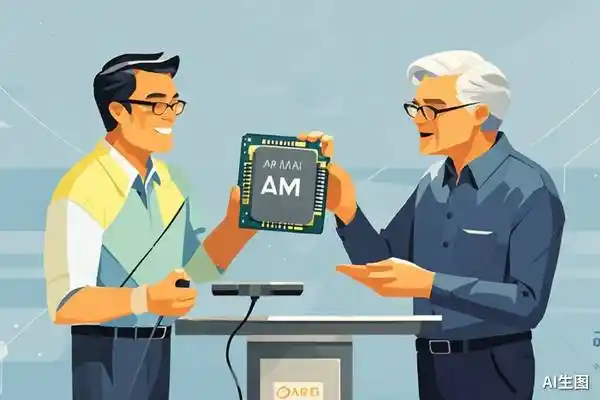
**Summary:** At Computex 2026, Arm CEO Rene Haas announced that ByteDance and Oracle have adopted Arm's self-designed Arm AGI data center CPU. The company expects significant revenue growth from this product, projecting $20 billion in demand for the 2027/2028 fiscal years. Haas noted that restricting AI-capable CPUs from the US to China is nearly impossible due to their widespread applications. Arm's stock has surged dramatically this year, notably rising 16% after NVIDIA's Arm-based Vera CPU and RTX Spark announcements. A highlight was the informal, humorous on-stage conversation between Haas and NVIDIA CEO Jensen Huang. Huang joked about NVIDIA's failed attempt to acquire Arm and playfully lamented selling his Arm shares. Both executives showed a clear sense of camaraderie and shared regret over the missed merger. Key technical topics were discussed: 1. **AI PC Design:** Huang explained NVIDIA's RTX Spark superchip (with a 20-core Arm CPU) is designed for future AI agents that will autonomously run and use tools on PCs, blending local and cloud processing. 2. **Agent vs. OS:** Huang emphasized the operating system remains crucial, as AI agents rely on its APIs and tools to function. 3. **Growth Constraints:** He identified the shift to "useful AI" that generates profitable tokens as a primary driver for immense, almost limitless, computational demand. Haas outlined Arm's strategy across PC and data centers. For PCs, Arm collaborates with partners like NVIDIA and MediaTek, offering its compute subsystem (CSS) for custom SoCs. In data centers, its Arm AGI CPU (built on TSMC's 3nm process) has gained major partners including OpenAI, Meta, and now ByteDance and Oracle. Arm presented a multi-year roadmap for its in-house CPU line. The article concludes that while GPUs dominated the AI training race, the explosion of AI agents is shifting significant focus to CPUs for inference, state management, and tool orchestration. The industry is trending towards vertical integration, with companies like cloud providers designing chips and chip/IP firms offering full solutions, all competing to deliver more efficient computing per watt.

marsbit1h ago

ByteDance Adopts Arm CPUs, Jensen Huang: So Sad I Didn't Buy Arm

marsbit1h ago

New Wall Street Play: Yen Shorts Still Adding, But Japan Stocks Don't Rely on Carry Trade Unwinding

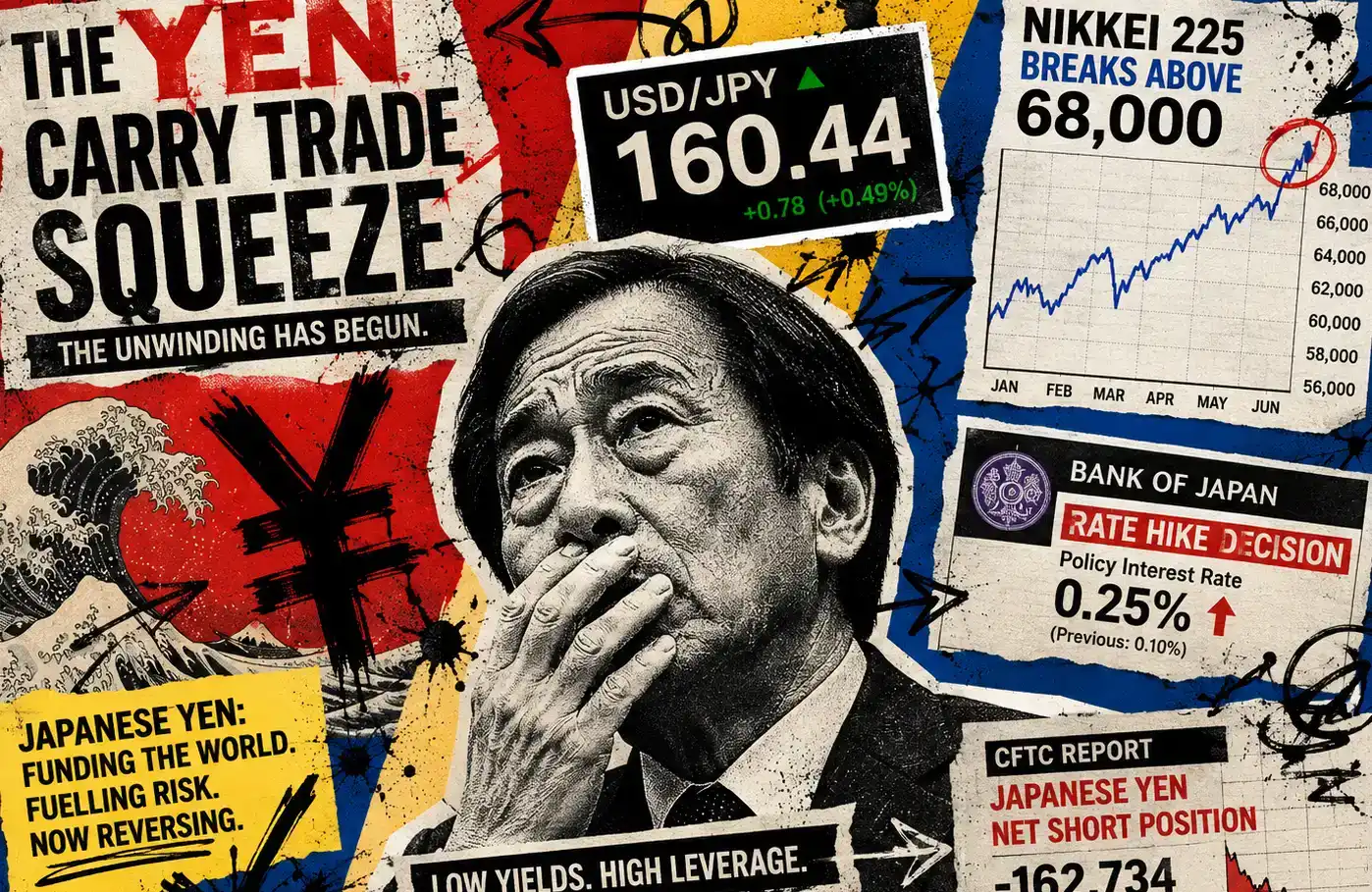
On June 3rd, USD/JPY hit 160.44, its highest level since July 2024, while the Nikkei 225 surged past 68,000 points. Contrary to popular narratives of an imminent "carry trade unwind" akin to August 2024, data reveals a more complex picture. Speculative net short positions in yen futures have actually increased, reaching -114,667 contracts by late May, suggesting traders are doubling down rather than retreating. Meanwhile, Japan's Finance Ministry conducted its largest-ever single-round FX intervention (11.73 trillion yen) in April-May but failed to hold the 160 yen line. The Nikkei's rally is not driven by carry trade dynamics. Foreign investors are aggressively buying Japanese stocks, with net purchases in 2026 running nearly 16 times higher than 2025 levels. This inflow is concentrated in AI and semiconductor-related stocks like SoftBank and Socionext, fueled by positive sector outlooks, rather than being a flight from unwinding yen shorts. Furthermore, the Nikkei has continued climbing despite the Bank of Japan's (BOJ) rate hikes to 0.75%. This disconnect exists because the current equity boom is fueled by AI-driven foreign investment, not reliant on cheap yen funding. However, this relationship remains fragile. Should the BOJ hike rates further (e.g., to 1.0%) while dollar weakness increases carry trade costs, the trajectories of the yen and Japanese stocks could reconverge, potentially triggering volatility.

marsbit1h ago

New Wall Street Play: Yen Shorts Still Adding, But Japan Stocks Don't Rely on Carry Trade Unwinding

marsbit1h ago

Broadcom's Q3 Guidance Misses Expectations by $12 Billion, After-Hours Trading Plummets Over 13%, AI Narrative "Cooling"?

On June 3, Broadcom released record Q2 FY26 results with revenue of $22.19B, up 48% YoY, and AI chip sales of $10.8B, up 143%. Adjusted EPS of $2.44 beat estimates. However, its Q3 AI semiconductor revenue guidance of $16B, while up over 200% YoY, fell roughly $1.2B (7%) short of analyst consensus expectations of $17.2B. This miss, coupled with slightly weaker-than-expected software revenue, triggered a severe market reaction. CEO Hock Tan maintained the FY26 AI revenue outlook of over $100B but did not raise it, disappointing investors who had priced in more robust growth. The stock plummeted over 13% in after-hours trading, erasing roughly $270B in market cap. The sell-off extended to peers like Marvell. A key concern for markets, particularly for Chinese optical module suppliers, was Tan's comment that the contribution of AI networking (e.g., Ethernet switches, optical interconnect chips) to AI revenue, currently near 40%, is expected to normalize to around 30% over time, signaling a potential peak in growth for that segment. Despite the guidance shortfall, Tan reiterated that AI demand remains "insatiable" and reaffirmed the long-term target of exceeding $100B in AI revenue by FY27. The reaction highlights the heightened sensitivity and premium valuation placed on AI-exposed stocks, where anything less than stellar guidance can prompt significant profit-taking. The broader question is whether this represents a cooling AI narrative or a correction in overstretched valuations.

marsbit1h ago

Broadcom's Q3 Guidance Misses Expectations by $12 Billion, After-Hours Trading Plummets Over 13%, AI Narrative "Cooling"?

marsbit1h ago

Trading

Spot
Futures
活动图片