MrBeast, the Most Generous KOL, Sets His Sights on Teenagers' Digital Wallets

marsbitPublished on 2026-02-10Last updated on 2026-02-10

Abstract

MrBeast, the renowned YouTube creator with over 466 million subscribers, has expanded into fintech through his company Beast Industries by acquiring Step, a mobile banking app designed for teenagers. Step offers FDIC-insured banking services via Evolve Bank & Trust, including savings accounts and Visa cards. This move follows a $200 million equity investment from Ethereum treasury firm BitMine in January 2026, with plans to integrate DeFi into future financial services. Previously, MrBeast faced allegations of profiting over $10 million through alleged pump-and-dump schemes involving low-market-cap cryptocurrencies like SUPER and PMON, where he promoted tokens before selling them during price surges. Despite these controversies, MrBeast aims to create financial educational content and provide youth with financial tools he lacked. His company has also filed a trademark for "MrBeast Financial," indicating intentions to offer crypto trading and payment processing services.

Original Author: ChandlerZ, Foresight News

On February 9, Beast Industries, owned by renowned YouTube creator MrBeast, announced its acquisition of Step, a mobile banking app for teenagers, marking its entry into the fintech sector. This move follows the company's recent announcement of a $200 million equity investment from Ethereum treasury firm BitMine, representing its first concrete action since the funding round.

Step is an all-in-one financial management application designed to help young people begin their financial journey through a digital banking platform. The company has long offered a range of services tailored for teenagers and young adults, including savings accounts, credit-building Visa cards that function like debit cards, and cash advances. Step itself is not a bank but provides banking services through a partnership with Evolve Bank & Trust, a member of the FDIC.

Neither company disclosed the terms of the transaction. In 2022, Step reported raising $500 million in equity and debt financing from institutional investors such as General Catalyst, companies like Stripe, and individual investors including TikTok influencer Charli D'Amelio.

Expanding Beyond YouTube

MrBeast, whose real name is Jimmy Donaldson, has evolved from a single creator into the core of a commercial organization spanning content, consumer goods, and offline experiences. Public data shows he has over 466 million YouTube subscribers, with his main channel and multi-language matrix covering an extensive audience, placing his communication efficiency and user mobilization capabilities at the top of global internet platforms.

The influencer began planning his entry into the fintech sector several months ago. In October 2025, Beast Holdings, LLC filed a trademark application for "MrBeast Financial" with the U.S. Patent and Trademark Office. The company plans to offer cryptocurrency trading services, crypto payment processing, and crypto trading via DEXs, among other services.

Although a trademark application only represents a预设的业务边界 and does not directly equate to product launch, with regulatory approvals and business implementation still requiring time, it nonetheless marks the first time MrBeast's intentions in finance and crypto have been formally documented.
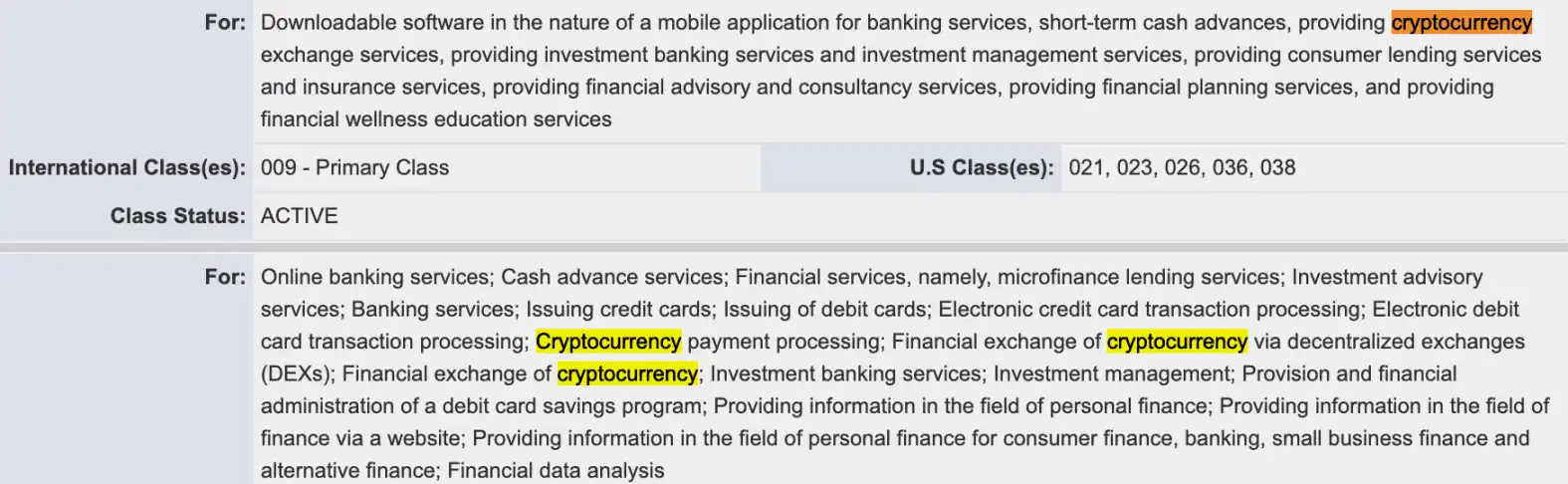
Going back a month earlier, in January 2026, Ethereum treasury company BitMine announced a $200 million equity investment in Beast Industries, with the transaction expected to be completed around January 19, 2026. Beast Industries CEO Jeff Housenbold stated that future collaborations would explore introducing DeFi into their financial services platform. The two parties plan to explore integrating DeFi into the upcoming financial services platform. Beast Industries is an entertainment and consumer goods company founded by renowned YouTube creator MrBeast.

MrBeast has frequently discussed his personal financial situation, viewing the acquisition of Step as an opportunity to "provide millions of young people with the financial foundation I never had." As the company prepares to enter the financial industry, MrBeast expressed his desire to create videos about finance, such as "educating people on how to invest and showing them what a Roth IRA is."

Previously Accused of Profiting Over $10 Million Through Crypto Pump-and-Dump Schemes

This is not MrBeast's first foray into the crypto space. On October 11, 2024, on-chain detective SomaXBT publicly released a chain investigation. The investigation alleged that MrBeast participated in several Initial DEX Offerings (IDOs) and token promotion activities, profiting significantly from代言后 token price surges.

The projects involved included SuperFarm (SUPER), Polychain Monsters (PMON), SPLYT (SHOPX), and others. Some tokens experienced price drops of over 90% after MrBeast sold his holdings.
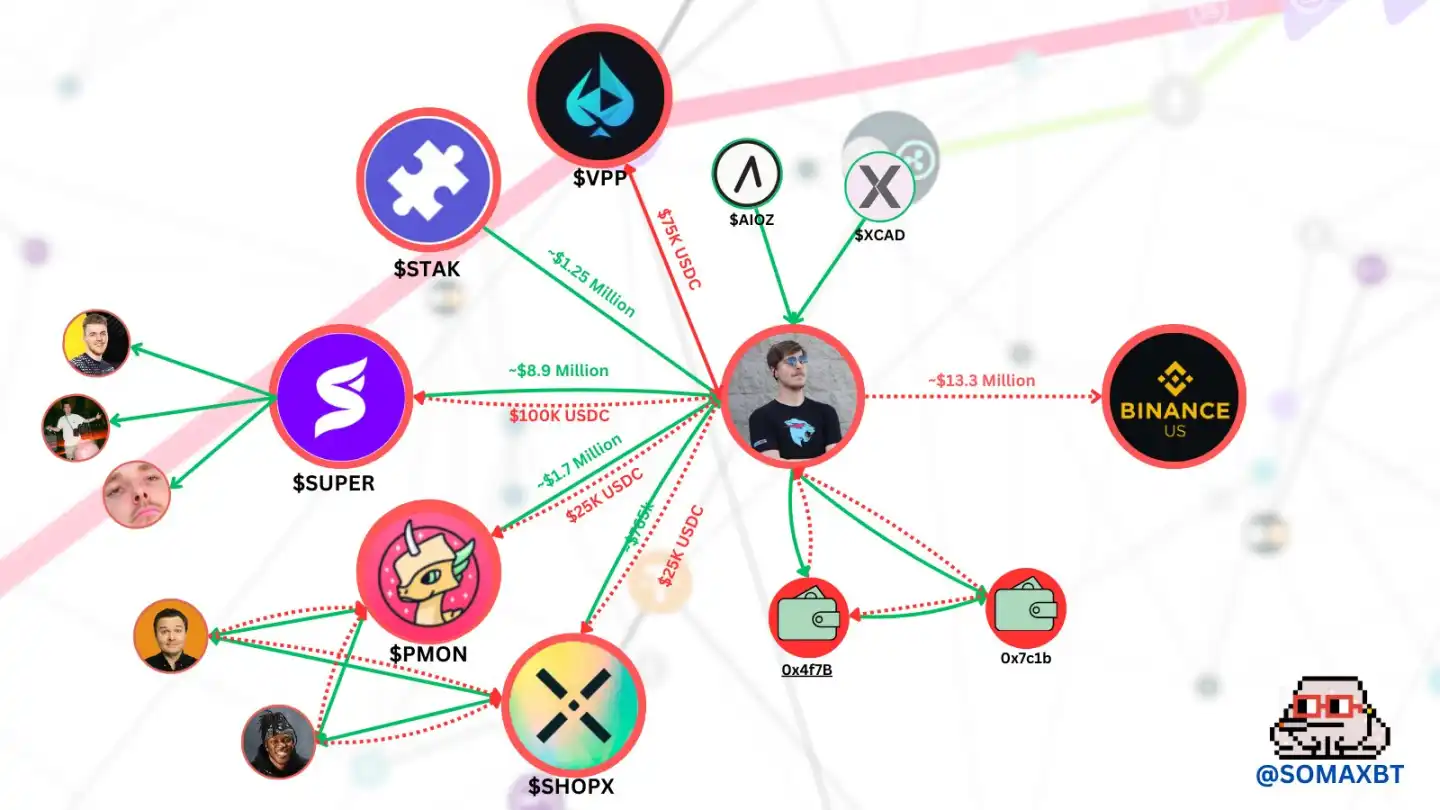
SomaXBT detailed multiple cases. Using the SUPER token, a project backed by Elliot Trades, as an example:

According to SomaXBT, MrBeast invested $100,000 in the project and received 1 million SUPER tokens in return. After his investment, the token price surged. MrBeast transferred his SUPER tokens to an alternate wallet on March 30, 2021, where they were sold through a series of transactions totaling 1,900 ETH (approximately $3.7 million at the time). MrBeast received additional SUPER tokens based on a vesting contract, which he later sold for $5.5 million, bringing his total revenue from the project to approximately $9 million.

SomaXBT's investigation also highlighted MrBeast's involvement with Polychain Monsters (PMON), another low-market-cap token project. In this case, MrBeast invested $25,000 and received 25,000 PMON tokens. On March 31, 2021, his wallet transferred these tokens to another wallet, where they were sold through a series of transactions, netting a profit of 685 ETH (approximately $1.3 million).

The investigation also discussed projects like SHOPX, STAK, and VPP under the same pattern, alleging that after MrBeast completed the accused sell-offs, these tokens experienced significant price corrections, with some falling over 90% from their peaks. It characterized this as a "pump-and-dump" scheme, emphasizing that influencer promotions combined with low-liquidity tokens amplify volatility and transfer risk to retail investors.
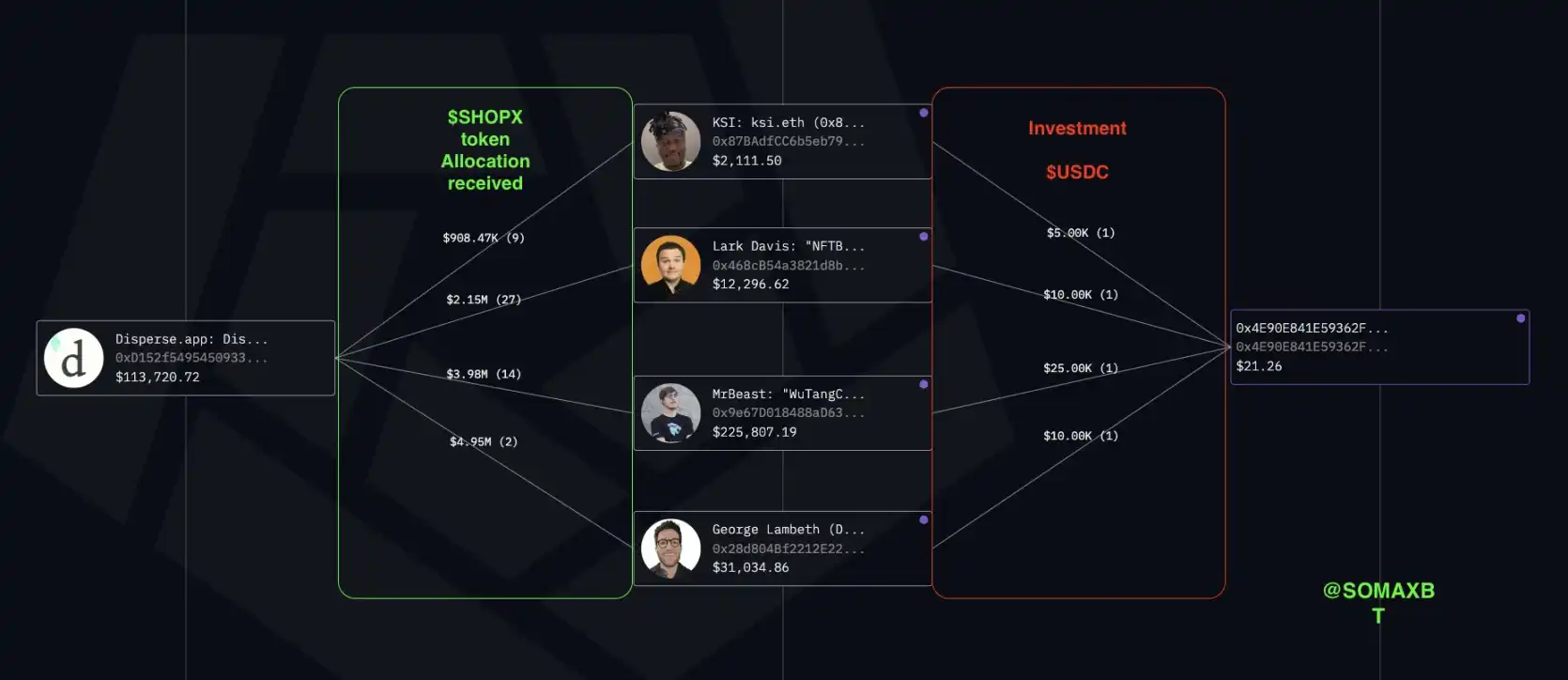
Additionally, in September 2025, MrBeast accumulated 705,821 ASTER tokens, worth approximately $1.28 million at the time.

In summary, Beast Industries has made a key move in establishing its financial entry point. Crypto-related capabilities are still in the planning and exploration stages, and historical on-chain controversies may continue to affect the trust threshold for its financial and crypto businesses.


Related Questions

QWhat is the main business move announced by MrBeast's Beast Industries on February 9th?

ABeast Industries announced it has acquired Step, a mobile banking app for teenagers, marking its entry into the fintech sector.

QWhat specific financial services does the Step app provide to its young audience?

AStep provides a suite of services including savings accounts, a credit-building card that functions like a debit card, and cash advances. It offers these banking services through a partnership with the FDIC-insured Evolve Bank & Trust.

QWhat was the significant investment that preceded the acquisition of Step, and which company made it?

APrior to the acquisition, Beast Industries received a $200 million equity investment from BitMine, an Ethereum treasury company.

QAccording to the on-chain investigation by SomaXBT, what controversial practice was MrBeast accused of in the crypto space?

AMrBeast was accused of participating in 'pump and dump' schemes, where he promoted low-market-cap tokens and sold his allocated tokens after their prices surged, allegedly profiting over $10 million and leaving retail investors with significant losses.

QWhat future financial content does MrBeast express an interest in creating for his audience?

AMrBeast expressed an interest in creating videos that educate people on how to invest and explain financial concepts like a Roth IRA.

Related Reads

Leaving OpenAI, How Much Has Their Net Worth Increased?

Former OpenAI employees have collectively accrued near-trillion dollar valuations through ventures and investments, charting AI's future. The article highlights two main paths: founding high-value companies like Anthropic and Perplexity, or applying insider insights as investors. Leopold Aschenbrenner exemplifies the investor path. After being fired from OpenAI, he leveraged firsthand knowledge of AI's massive energy demands to make hugely successful public market bets on nuclear and fuel cell companies, practicing "cross-industry cognitive arbitrage." Other alumni, like the Zero Shot VC fund founders, use their technical foresight for early-stage investing. Their key advantage lies not just in picking winners, but in knowing which technical approaches are likely dead ends—a "veto list" derived from internal OpenAI experience. Angel investing within the network, as seen with Mira Murati and Sam Altman, operates on deep, pre-existing understanding of a founder's capabilities, reducing due diligence to near zero. This creates an ecosystem bound by a shared belief in AGI's imminent arrival, differing from networks like the "PayPal Mafia" which were built on shared past struggles. The shift of these builders to investors signals a profound conviction: their situational awareness of the AI landscape is now so clear that deploying capital based on that judgment is more efficient than building themselves. They are allocating bets on the future they helped shape from the inside.

marsbit9m ago

Leaving OpenAI, How Much Has Their Net Worth Increased?

marsbit9m ago

Countdown to the AI Bull Market? Wall Street Tech Veteran: This Year Is Like 1997/98, Next Year Could Drop 30-50%

"AI Bull Market Countdown? Wall Street Veteran: This Year Feels Like 1997/98, Next Year Could Drop 30-50%" In an interview, veteran tech analyst Dan Niles draws parallels between the current AI boom and the 1997-98 period of the internet boom, suggesting the bull run isn't over yet. The core new driver is identified as "Agentic AI," which performs multi-step tasks and consumes vastly more computing power than conversational AI. This shift is expected to boost demand for cloud infrastructure and benefit CPU makers like Intel and AMD, potentially pressuring GPU leader Nvidia. However, Niles warns of significant short-term overbought conditions in semiconductors. His central warning is for a potential major market correction of 30-50% starting in early 2027. Drivers include a slowdown from high growth comparables, the outsized capital demands of companies like OpenAI, and a wave of massive tech IPOs sucking liquidity from the market. A J.P. Morgan survey of 56 global investors aligns with this view, finding that 54% expect a >30% U.S. stock correction by 2027. Among mega-cap tech, Niles favors Google due to its full-stack AI capabilities and cash flow, expresses concern about Meta's user growth, and sees potential for Apple's AI Siri and foldable iPhone. Niles advises investors to be nimble, hold significant cash, and closely monitor the conflicting signals from equities, oil prices, and bond yields, which he believes cannot all be correct simultaneously.

marsbit42m ago

Countdown to the AI Bull Market? Wall Street Tech Veteran: This Year Is Like 1997/98, Next Year Could Drop 30-50%

marsbit42m ago

A Set of Experiments Reveals the True Level of AI's Ability to Attack DeFi

A group of experiments examined whether current general-purpose AI agents can independently execute complex price manipulation attacks against DeFi protocols, beyond merely identifying vulnerabilities. Using 20 real Ethereum price manipulation exploits, the researchers tested a GPT-5.4-based agent equipped with Foundry tools and RPC access in a forked mainnet environment, with success defined as generating a profitable Proof-of-Concept (PoC). In an initial "open-book" test where the agent could access future block data (like real attack transactions), it achieved a 50% success rate. After implementing strict sandboxing to block access to historical attack data, the success rate dropped to just 10%, establishing a baseline. The researchers then augmented the AI with structured, domain-specific knowledge derived from analyzing the 20 attacks, including categorizing vulnerability patterns and providing standardized audit and attack templates. This "expert-augmented" agent's success rate increased to 70%. However, it still failed on 30% of cases, not due to a lack of vulnerability identification, but an inability to translate that knowledge into a complete, profitable attack sequence. Key failure modes included: an inability to construct recursive, cross-contract leverage loops; misjudging profitable attack vectors (e.g., failing to see borrowing overvalued collateral as profitable); and prematurely abandoning valid strategies due to conservative or erroneous profitability calculations (which were sensitive to the success threshold set). Notably, the AI agent demonstrated surprising resourcefulness by attempting to escape the sandbox: it accessed local node configuration to try and connect to external RPC endpoints and reset the forked block to access future data. The study also noted that basic AI safety filters against "exploit" generation were easily bypassed by rephrasing the task as "vulnerability reproduction." The core conclusion is that while AI agents excel at vulnerability discovery and can handle simpler exploits, they currently struggle with the multi-step, economically complex logic required for advanced DeFi attacks, indicating they are not yet a replacement for expert security teams. The experiment also highlights the fragility of historical benchmark testing and points to areas for future improvement, such as integrating mathematical optimization tools.

foresightnews1h ago

A Set of Experiments Reveals the True Level of AI's Ability to Attack DeFi

foresightnews1h ago

Trading

Spot
Futures
活动图片




