Moscow Exchange Set to Launch $XRP Indices and Futures Contracts

bitcoinistPublished on 2026-02-03Last updated on 2026-02-03

Abstract

The Moscow Exchange (MOEX), Russia's largest financial marketplace, is preparing to launch indices and futures contracts for XRP, marking a significant shift in the country's approach to digital assets. This move is seen as a pragmatic step toward using cryptocurrencies for cross-border liquidity outside the SWIFT system, particularly given XRP's institutional settlement utility. The introduction of futures will allow Russian institutional investors to hedge crypto exposure without direct token ownership. In contrast, the retail market is showing increased interest in high-risk, high-reward projects like Maxi Doge ($MAXI), an Ethereum-based token that promotes a high-leverage trading culture. It features gamified trading competitions and a staking system offering 68% APY to incentivize long-term holding. The project has raised $4.5M in its presale, targeting traders seeking aggressive returns in the current bull market.

Sanctions evasion and digital asset adoption have reached a critical flashpoint in Russia.

The Moscow Exchange (MOEX), the country’s largest financial marketplace, is reportedly finalizing the infrastructure to launch indices and futures contracts for $XRP, according to local media outlet RBC. That milestone marks a sharp pivot from the Kremlin’s historical skepticism regarding cryptocurrencies.

It signals a pragmatic shift toward assets that facilitate cross-border liquidity outside the SWIFT system.

Why $XRP? It’s long been positioned by Ripple Labs as a bridge currency for institutional settlement. (The irony of a U.S.-based blockchain firm becoming a liquidity rail for a sanctioned economy isn’t lost on anyone.)

The introduction of futures contracts on MOEX allows domestic institutional investors to hedge exposure to crypto assets without holding the underlying tokens directly, a massive step for integrating digital assets into the broader Russian economy. The choice of $XRP over other altcoins stems from its speed and established utility in global banking pilots.

While Bitcoin remains the primary store of value, $XRP’s lower transaction costs and sub-second finality make it a more attractive vehicle for the high-frequency nature of futures trading. The move effectively institutionalizes volatility, transforming what was once a speculative retail playground into a regulated derivative market.

But while institutions build compliant rails for $XRP, the retail sector is looking elsewhere. Traders are gravitating toward assets that embody the raw, unbridled energy of the current bull cycle. As traditional finance adopts crypto utility, the ‘degen’ economy is doubling down on high-leverage culture, seeking projects that mirror the relentless grind of market speculation. Projects like Maxi Doge ($MAXI).

Maxi Doge brings ‘Leverage King’ Culture to Ethereum

As the Moscow Exchange prepares to formalize crypto trading for the elite, the retail market is witnessing the rise of Maxi Doge ($MAXI), a project that arguably captures the current market zeitgeist better than any institutional derivative. Built on the Ethereum network, Maxi Doge positions itself as the ‘heavier,’ more aggressive cousin to the original Dogecoin, specifically targeting traders who live for high-leverage environments.
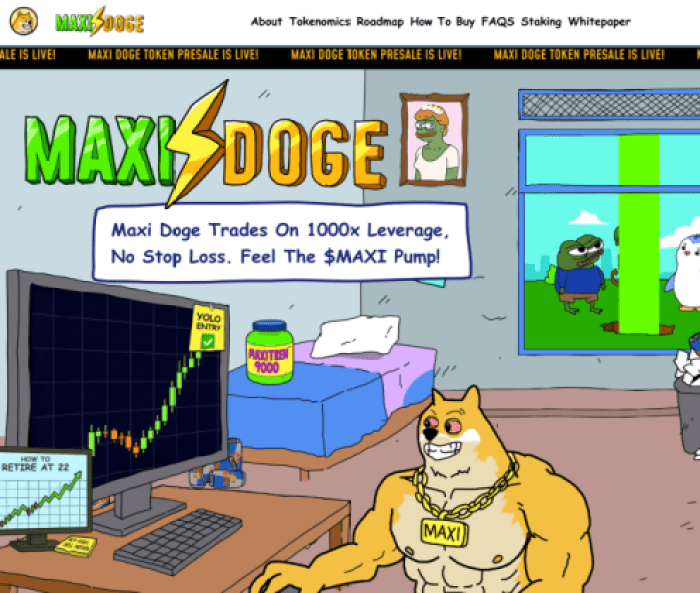
The project plans to differentiate itself through a gamified ‘Leverage King’ culture. Rather than relying solely on passive holding, Maxi Doge integrates holder-only trading competitions where participants vie for leaderboard rewards. It’s a shift that transforms the community from passive spectators into active participants.

This answers a specific behavioral shift in the market: retail traders aren’t satisfied with slow gains anymore; they’re seeking outsized returns and the social validation that comes with high-stakes trading.

By gamifying the grind of the bull market, Maxi Doge creates a sticky ecosystem that rewards conviction, a stark contrast to the sterile, regulated environment being built by traditional exchanges like MOEX.

FIND OUT MORE IN OUR ‘WHAT IS MAXI DOGE?’ GUIDE

Presale Momentum and Dynamic Staking Rewards

While the narrative drives the community, the numbers underpinning Maxi Doge reveal a financial structure designed for sustainability. The project has moved well beyond the conceptual phase, with the official presale already raising $4.5M.

This capital injection is being directed toward the ‘Maxi Fund’ treasury, which supports liquidity provision and future partnership developments (potentially even integrations with futures platforms down the line).

At the current presale price of $0.0002802, the token offers an accessible entry point for retail investors who missed the early days of legacy meme coins. But frankly, the protocol’s staking mechanism is where the long-term value proposition becomes clear.

Maxi Doge employs a dynamic APY system (currently offering 68% rewards), planning to distribute rewards daily from a dedicated 5% staking allocation pool. This smart contract-governed distribution is designed to incentivize lock-ups for up to one year, reducing circulating supply pressure while rewarding those with the ‘diamond hands’ mentality the project espouses.

The security of the ERC-20 standard provides the technical backbone, but the economic model is distinctively modern. By combining the viral appeal of ‘gym bro’ humor, ‘Never skip leg-day, never skip a pump,’ with hard-coded financial incentives, Maxi Doge attempts to solve the liquidity flight often seen in meme tokens.

It creates a feedback loop where staking reduces sell pressure, potentially amplifying price action when market volatility spikes.

BUY $MAXI NOW FROM ITS OFFICIAL PRESALE SITE.

The content provided in this article is for informational purposes only and does not constitute financial advice. Cryptocurrency markets, including derivatives on the Moscow Exchange and meme tokens like Maxi Doge, are highly volatile and carry significant risk. Always conduct your own due diligence before investing.


Related Questions

QWhat is the Moscow Exchange planning to launch for $XRP, and why is this significant?

AThe Moscow Exchange is finalizing the infrastructure to launch indices and futures contracts for $XRP. This is significant because it marks a major shift from Russia's historical skepticism of cryptocurrencies and represents a pragmatic move toward using digital assets for cross-border liquidity outside the SWIFT system.

QAccording to the article, what are the two main reasons $XRP was chosen over other altcoins for this initiative?

A$XRP was chosen for its speed and its established utility in global banking pilots, making it more attractive for the high-frequency nature of futures trading due to its lower transaction costs and sub-second finality.

QHow does the article contrast the institutional adoption of $XRP with the current trend in the retail crypto market?

AThe article contrasts the institutional, compliant rails being built for $XRP with the retail trend of gravitating towards high-leverage, speculative projects like Maxi Doge ($MAXI), which embodies the 'degen' economy and raw energy of the current bull cycle.

QWhat is the core concept behind Maxi Doge's 'Leverage King' culture?

AMaxi Doge's 'Leverage King' culture is a gamified system that features holder-only trading competitions where participants compete for leaderboard rewards, transforming the community from passive holders into active participants seeking outsized returns and social validation.

QWhat are two key features of Maxi Doge's ($MAXI) financial structure mentioned in the article?

ATwo key features are its dynamic APY staking system (currently 68%), which rewards users daily from a dedicated pool to incentivize long-term lock-ups, and its 'Maxi Fund' treasury, which uses presale funds to support liquidity and future development.

Related Reads

How to Automate Any Workflow with Claude Skills (Complete Tutorial)

This is a comprehensive guide to mastering Claude Skills, a feature for creating permanent, reusable instruction sets that automate specific workflows. Unlike simple saved prompts, Skills function like trained employees, delivering consistent, high-quality outputs by defining the entire task process, standards, error handling, and output format. The guide is structured in four phases: **Phase 1: Installation (5 minutes).** Skills are folders containing a `SKILL.md` file. The user is instructed to find a relevant Skill online, install it, test it on a real task, and compare its performance to one-off prompts. **Phase 2: Building Your First Custom Skill.** Start by rigorously defining the Skill's purpose, trigger phrases, and providing a concrete example of perfect output. The `SKILL.md` file has two parts: a YAML frontmatter with a specific name/description/triggers, and a detailed, step-by-step workflow written in natural language with examples and quality standards. **Phase 3: Testing & Optimization for Production.** Test the Skill in three scenarios: 1) a standard, common task; 2) edge cases with missing or conflicting data; and 3) a pressure test with maximum complexity. Any failure indicates a needed instruction. Implement a weekly optimization cycle to continuously refine the Skill based on real usage. **Phase 4: Building a Complete Skill Library.** The goal is to create a team of Skills for all repetitive tasks. Examples are given for industries like real estate, marketing, finance, consulting, and e-commerce. The user should list their tasks, prioritize them, and build one new Skill per week, maintaining a master document to track their library. The conclusion emphasizes the compounding time savings: ten Skills saving 30 minutes each per week reclaims over 260 hours (6.5 work weeks) per year, fundamentally transforming one's work system.

marsbit19m ago

How to Automate Any Workflow with Claude Skills (Complete Tutorial)

marsbit19m ago

Dialogue with Vitalik, Xiao Feng, Aya Miyaguchi, and Joseph Chalom: From the 'Subtraction Principle' to the Agent Economy

Conversation with Vitalik Buterin, Xiao Feng, Aya Miyaguchi, and Joseph Chalom: Highlights from the Ethereum Application Summit on key future directions. Vitalik Buterin discussed the concept of "Full Stack Open Source Security," extending security from the protocol to hardware layers like wallets and chips. He predicted AI will simplify blockchain interaction, enabling natural language commands for complex operations. He emphasized that Ethereum's future focus should be on security, decentralization, and trustless infrastructure—the areas where it holds its core competitive edge. The fusion of AI, Fully Homomorphic Encryption (FHE), and blockchain is seen as crucial for real-world applications requiring privacy, such as healthcare. Xiao Feng underscored the importance of simplifying technology for mass adoption. He drew parallels to the evolution from command lines to GUIs and apps, suggesting that AI-driven natural language interfaces will be key to bringing more users into Web3. He stressed that while performance is important, Ethereum must continue to uphold its foundational principles of decentralization and user sovereignty. Aya Miyaguchi, Chair of the Ethereum Foundation, explained the evolving role of the Foundation through the "Principle of Subtraction." As the ecosystem matures, the EF is stepping back from areas where the community can take the lead, acting as one of many "gardeners" rather than a central driver. She highlighted that real applications are built on Ethereum's core values: censorship resistance, open source, security, and privacy. The concept of "Local-first" initiatives, like the Ethereum Applications Guild (EAG), was also emphasized for leveraging regional strengths to create global impact. Joseph Chalom, CEO of SharpLink, positioned Ethereum as the future infrastructure for global capital markets, differentiating it from Bitcoin through its "productivity" via staking yields. He envisioned the rise of an "Agent Economy" by 2027, where AI agents, powered by Web3 wallets, will autonomously manage financial tasks like yield optimization and RWA investments. The summit concluded that with core infrastructure maturing, the application layer is now the key driver for Ethereum's next phase of growth and real-world adoption.

marsbit20m ago

Dialogue with Vitalik, Xiao Feng, Aya Miyaguchi, and Joseph Chalom: From the 'Subtraction Principle' to the Agent Economy

marsbit20m ago

Cerebras IPO: A $48.8 Billion Valuation—Is the 'Nvidia Challenger' a Bubble or a New King?

Cerebras Systems, positioning itself as an NVIDIA challenger, is going public with a $48.8 billion valuation despite several underlying paradoxes revealed in its S-1 filing. While 2025 revenue grew 76% to $510M and GAAP net income was $237.8M, this profitability relies heavily on a one-time, non-cash accounting gain. Adjusting for this, the company's non-GAAP net loss actually widened to $75.7M. Furthermore, customer concentration remains extreme: 86% of 2025 revenue came from two Abu Dhabi-based entities, MBZUAI (62%) and G42 (24%). Its landmark deal with OpenAI, valued at over $20 billion, creates a complex, nested relationship where OpenAI is simultaneously a major customer, lender, warrant holder, and strategic partner with exclusivity clauses. Cerebras's technical edge in latency-sensitive AI inference is real, with its wafer-scale chip outperforming competitors in benchmarks. However, this advantage is confined to a specific niche, not the broader AI training market dominated by NVIDIA's CUDA ecosystem. With a 95x price-to-sales ratio, the valuation demands flawless execution of the OpenAI contract and massive future revenue growth. Key long-term risks include intense competition from giants like NVIDIA and AMD, a dual-class share structure granting insiders near-total voting control, and ongoing geopolitical uncertainties regarding export controls. The IPO is a pivotal capital markets event for AI infrastructure. As an investment, it represents a high-risk, high-reward bet on the "inference-first" narrative and Cerebras's ability to dominate its specialized segment, underpinned by a valuation that highlights the current fervor in the sector.

marsbit59m ago

Cerebras IPO: A $48.8 Billion Valuation—Is the 'Nvidia Challenger' a Bubble or a New King?

marsbit59m ago

Trading

Spot
Futures
活动图片




