Compiled by: ChainCatcher
Important News:
- Hong Kong SFC: Licensed companies in Hong Kong can continue to serve existing mainland China clients but cannot provide services within mainland China.
- Asset management giant Janus Henderson Investors announces strategic investment in Ethena, and both parties reach multiple cooperation agreements.
- CME Group launches Nasdaq CME Cryptocurrency Index futures.
- Data: Q2 2026 could become the worst quarter for crypto public fundraising, with IC0/IDO/IEO raising only $58 million.
- U.S. senators seek to delay SpaceX IPO and have it reviewed by the SEC.
- Robotics company NEURA Robotics completes $1.4 billion Series C funding round led by Tether.
What significant events happened in the past 24 hours?
Robotics company NEURA Robotics completes $1.4 billion Series C funding round led by Tether.
ChainCatcher News, according to an official announcement, Tether Investments announced it is the lead investor in NEURA Robotics' Series C funding round of up to approximately $1.4 billion, making it one of the largest private financing rounds in robotics and physical AI history. Multiple industry and financial investors participated, with some industrial giant partners also co-investing.
NEURA Robotics focuses on multi-form cognitive robots, including humanoid robots, industrial arms, and mobile robots, and has built a unified software platform, Neuraverse, connecting robots, components, AI models, and computing power. Besides investment, Tether will also integrate its self-developed Wallet Development Kit (WDK) into NEURA robots, providing them with self-custodial wallet functionality. It will also test and deploy its QVAC edge AI runtime in Neuraverse to enable local inference and automated settlement, promoting the implementation of "machine economy" infrastructure.
Previously in March, robotics company NeuraRobotics received a funding round of about 1 billion euros led by Tether, valuing the company at 4 billion euros.
U.S. senators seek to delay SpaceX IPO and have it reviewed by the SEC.
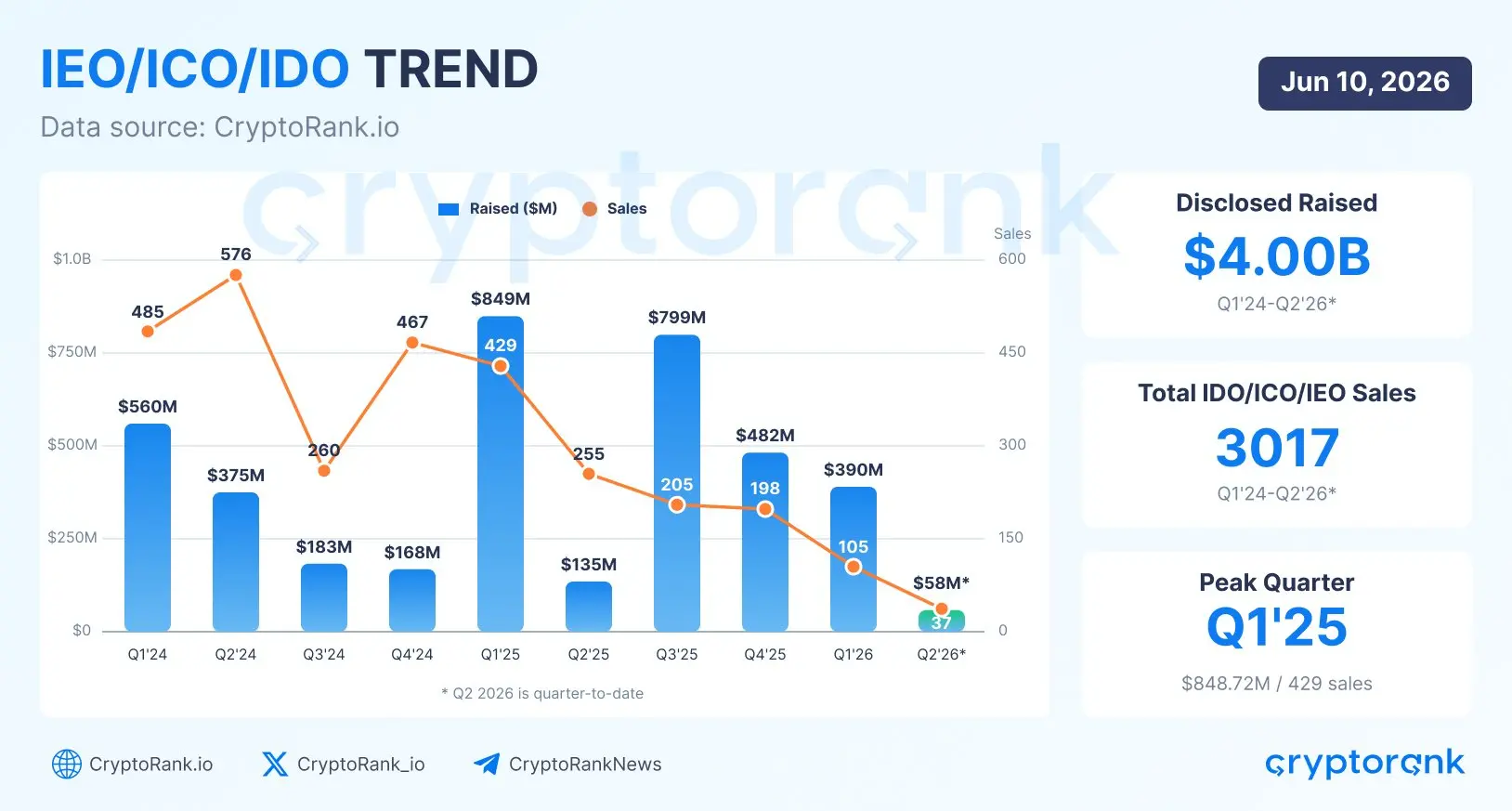
Data: Q2 2026 could become the worst quarter for crypto public fundraising, with IC0/IDO/IEO raising only $58 million.
ChainCatcher News, according to CryptoRank.io data, the second quarter of 2026 raised only $58 million through methods like Initial Exchange Offerings (IEO), Initial Coin Offerings (IC0), and Initial DEX Offerings (IDO), an 85% decrease quarter-over-quarter. The number of fundraising projects also plummeted from 105 in Q1 to 37, a 65% year-over-year decrease.
Only 13 public fundraising events occurred in May alone, the lowest level since December 2020. Since peaking in Q1 2025 (raising $849 million, 429 events), the public fundraising market has remained sluggish.
Tom Lee: Chip stock sell-off primarily related to fund reallocation ahead of SpaceX IPO; current pullback will see buying support.
ChainCatcher News, Tom Lee, Chairman of BitMine, the largest Ethereum treasury, stated in an interview with CNBC that current market nervousness stems mainly from fund reallocation ahead of the SpaceX IPO and the market digesting previous gains. The SpaceX IPO is valued at $75 billion and will be included in the Nasdaq 100 Index, requiring many institutional funds to raise capital in advance not only to participate in the IPO but also to reserve cash for establishing sufficient position weightings in the secondary market post-listing. He believes this means institutions may sell some recently high-performing stocks, putting pressure on chip stocks.
Tom Lee noted that memory chip stocks and the semiconductor sector still held last Friday's lows, indicating related charts haven't completely broken down. He sees the current pullback as healthy and doesn't believe it will disrupt the main tech stock trading trend. SpaceX's first-day trading performance is crucial. If SpaceX performs poorly, it will provide ammunition for those believing the market has peaked. However, he said that since many already view the SpaceX IPO as a market top, from a contrarian perspective, this might not be the peak.
Tom Lee still believes tech stocks will continue to lead the market's upward trend and stated the current pullback will be bought. He expects the market to follow a "three-phase" trajectory this year, with a strong uptrend continuing for the foreseeable future, but a pullback may occur later this year, potentially around the time of IPO lock-up expirations and related supply pressures. The subsequent market phase two pullback may be driven by three factors: market testing of the new Fed Chair Kevin Warsh's policy path, stock supply from major IPO lock-up expirations, and potential energy shortage pressures later this year.
US CFTC proposing new rules to regulate prediction markets, aiming to avoid obvious manipulation.
ChainCatcher News, according to informed sources, the CFTC is proposing a comprehensive set of new rules to regulate prediction markets. These rules' parameters will continue to allow most sports-related betting while aiming to avoid obvious manipulation.
According to a copy of the proposed rules seen by The Wall Street Journal, the U.S. CFTC will propose new rules on Wednesday seeking to block predictive wagers it deems not in the public interest or highly susceptible to manipulation, such as situations where a single person could have undue influence over the outcome.
The agency's proposal does not directly ban trading in any specific type of so-called event contract but outlines factors the regulator will use to review certain types of contracts on a case-by-case basis.
The CFTC previously provided some preliminary guidance on which types of bets to avoid, and prediction platforms like Kalshi have acted preemptively.
Furthermore, sources reveal the CFTC is considering other rules, including those designed to protect retail traders.
CME Group launches Nasdaq CME Cryptocurrency Index futures.
ChainCatcher News, according to a PR Newswire report, CME Group announced the launch of Nasdaq CME Cryptocurrency Index futures. This contract will be cash-settled at expiration based on the index value of the Nasdaq CME Cryptocurrency Settlement Price Index.
According to the announcement, the index includes Bitcoin, Bitcoin Cash, Ethereum, SOL, XRP, ADA, LINK, and Lumens.
Asset management giant Janus Henderson Investors announces strategic investment in Ethena, and both parties reach multiple cooperation agreements.
ChainCatcher News, Janus Henderson Investors, managing $480 billion in assets, announced a multi-faceted collaboration with the synthetic dollar protocol Ethena.
- Integrate its AAA-rated Collateralized Loan Obligation (CLO) product, the JAAA strategy, into the USDe reserve portfolio, introducing institutional-grade credit exposure.
- Make a strategic investment (undisclosed amount) in Ethena's governance token ENA through its blockchain investment arm ANTIK.
- Commit to incorporating the staked version, sUSDe, into the company's financial cash management to earn native protocol yields.
- Co-develop regulated investment vehicles (including ETFs and ETPs) targeting USDe and ENA, aiming for launch in the second half of 2026.
According to DefiLlama data, the Ethena protocol TVL is approximately $4.95 billion. Market reaction was muted after the news, with ENA falling about 7% that day to around $0.082, market cap approximately $760 million. This collaboration makes Janus Henderson the traditional asset manager with the deepest integration with Ethena to date.
Specter: Old liquidity pool on Raydium suspected of attack; hacker steals approximately $1.34 million in assets.
ChainCatcher News, on-chain investigator Specter issued a security alert. An old liquidity pool on the Solana DeFi protocol Raydium is suspected of being attacked, with the attacker stealing approximately $1.34 million in assets, mainly consisting of USDC, RAY, and wSOL. The hacker has bridged the stolen funds to Ethereum and subsequently deposited them into Tornado Cash for mixing.
Polymarket FIFA World Cup champion prediction market cumulative trading volume surpasses $1.8 billion.
ChainCatcher News, as the 2026 FIFA World Cup group stage kicks off, the cumulative trading volume on Polymarket's World Cup champion prediction market has surpassed $1.8 billion, with over $66 million traded in the past 24 hours and liquidity in the pool reaching $352.7 million. France leads slightly with an implied probability of winning at 16.2%, followed by Spain at 16.0%. The two teams combined account for about 32% of the market and, being in the same group, will face each other directly in the group stage, making that match a key pricing moment for the entire tournament market.
Trading volume for the France champion market reached $40.9 million, and Spain's reached $33.6 million, the highest among single-country markets. Trading volume for the host nation, the United States, reached $50.9 million, but its implied probability of winning is only about 3%, reflecting high retail participation.
Additionally, the combined trading volume for the 12 group champion markets is about $3.4 million. Weekly volume reached $342 million, and monthly volume reached $881 million, showing clear acceleration in trading volume as the tournament approaches.
OpenAI in talks for a 20-year lease agreement; Nvidia may provide credit support.
Hong Kong SFC: Licensed companies in Hong Kong can continue to serve existing mainland China clients but cannot provide services within mainland China.
ChainCatcher News, the Hong Kong Securities and Futures Commission (SFC) provided further interpretation of its May 22 circular. Frequently Asked Question (9) in the circular mentioned that licensed companies in Hong Kong can continue to open new accounts for Mainland Chinese investors (i.e., investors using Chinese resident ID cards and/or Chinese passports as identification documents) but must comply with all account opening requirements.
The SFC stated that licensed companies in Hong Kong can continue to serve existing Mainland Chinese clients, provided such services are not provided within Mainland China and they have complied with all relevant laws and regulatory requirements in Hong Kong and applicable jurisdictions. The SFC also noted it is aware of the joint notice issued by Mainland authorities on May 22, 2026, and its relevant requirements also apply to financial institutions in other jurisdictions (i.e., not limited to Hong Kong) regarding their activities in serving Mainland Chinese investors.
Securitize CEO: Tokenized stocks could drive RWA market size to $5 trillion.
ChainCatcher News, according to CoinDesk, Securitize CEO Carlos Domingo stated that tokenized stocks could drive the RWA market from its current size of about $30 billion to $5 trillion. He pointed out that the global market for stocks and ETFs is about $150 trillion. Even if only 2% to 3% move on-chain, it would approach $5 trillion. Domingo believes tokenized stocks, rather than private credit or treasury products, will be the key driver of this growth.
He distinguished between "real" tokenized stocks and many offshore blockchain stock products that rely on derivatives or synthetic structures rather than direct ownership of the underlying shares. He believes the long-term goal should be for blockchain-based securities to offer investors the same rights as traditional stocks while enjoying instant settlement, 24/7 transferability, and deep integration with DeFi. Domingo maintains that public blockchains, particularly Ethereum, remain the preferred infrastructure for institutional tokenization.
Meme Trending Rankings
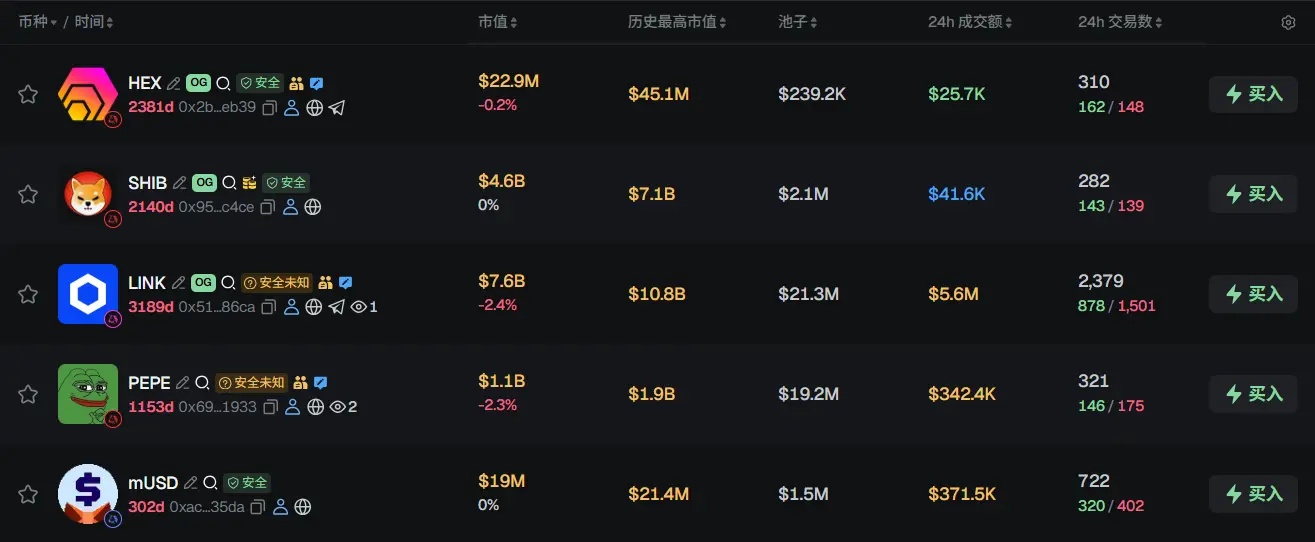
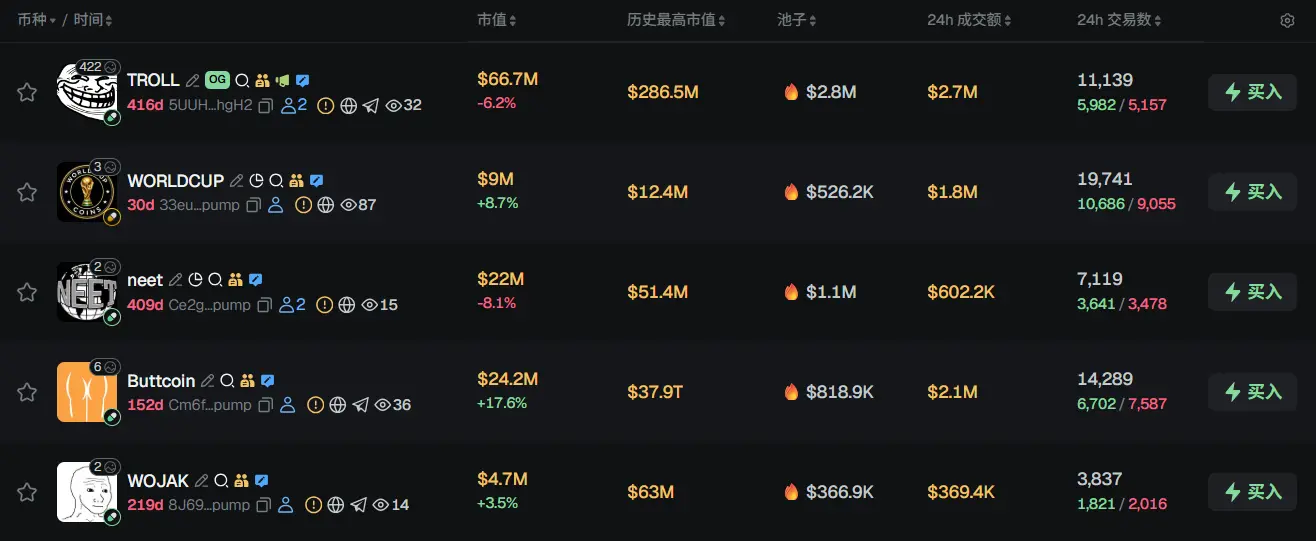
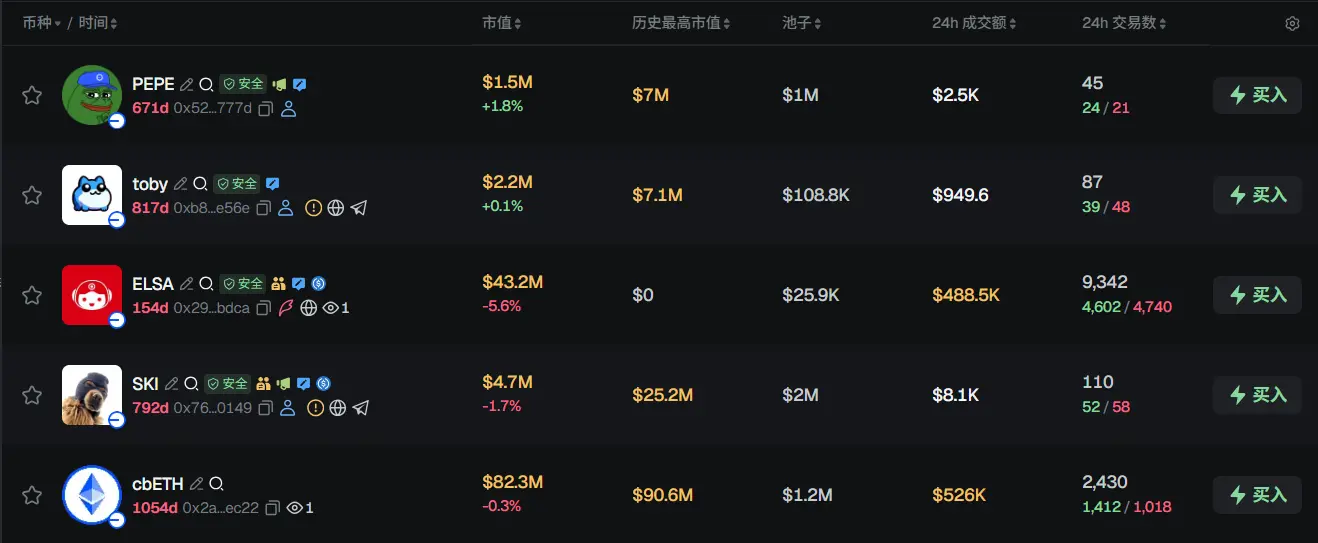
According to data from the Meme token tracking and analysis platform GMGN, as of 09:00 on June 11,
Top 5 trending ETH-based tokens in the past 24h are: HEX, SHIB, LINK, PEPE, mUSD
Top 5 trending Solana-based tokens in the past 24h are: TROLL, WORLDCUP, neet, Buttcoin, WOJAK
Top 5 trending Base-based tokens in the past 24h are: PEPE, toby, ELSA, SKI, cbETH
What are some noteworthy articles from the past 24 hours worth reading?
Galaxy In-depth Research Report: How does Hyperliquid's HIP-4 upgrade change the prediction market landscape?
Hyperliquid's HIP-4 protocol upgrade marks the arrival of a third prediction market model. Among existing track giants, Polymarket possesses a native consumer-facing discovery mechanism, while Kalshi has regulated U.S. exchange access. Hyperliquid announced HIP-4 in February this year, aiming to bring outcome prediction markets into this "house of all finance," and activated the proposal on the mainnet on May 2.
It turns out that, for hedgers and speculators, prediction markets are one of the most practical new financial primitives in recent years. With Hyperliquid's established industry standards in perpetual contract execution and infrastructure, it is now poised to compete for event trading volume share.
Latest research from Cornell University and 12 other top institutions: The current state, challenges, and misconceptions of Crypto x AI convergence.
AI and crypto convergence is still in its early stages; the two are complementary "middleware": AI translates human intent into executable programs, while cryptographic technology provides verifiable, tamper-proof guarantees for the computation process and results. In the direction of AI-enhanced crypto, machine learning is already being used for smart contract audits, fraud detection, and AI oracles; in the direction of crypto-enhanced AI, verifiable execution is relatively mature, while decentralized computing power, data markets, and governance mostly remain conceptual.
Traditional Finance's Counterattack: Consortium chains are quietly making a comeback.
In June 2026, more than a dozen of the largest U.S. banks jointly announced plans to build a shared tokenized deposit network by 2027, directly countering the erosion of deposits by stablecoins. This system hasn't been named yet; insiders call it "the bridge" or "the chain."
This reflects a concept long neglected by the market but now quietly regaining traction: consortium chains.
Pantera Capital Partner: How can tokenization reshape the private equity and early-stage investment ecosystem?
For the world's fastest-growing tech companies, the public markets are not what they used to be. Thirty years ago, Amazon went public three years after its founding with a valuation of $438 million. Netscape went public just eighteen months after its founding.
But today, the fastest-growing companies (Stripe, SpaceX, OpenAI, Ramp) typically stay private for over a decade. The exposure to high-growth periods that investors once easily accessed in public markets has now been quietly intercepted by private capital at ever-increasing paper valuations.