More Than a Madman: Trump's 11 Unchanging Decision-Making Principles Over 40 Years

marsbitPublished on 2026-01-22Last updated on 2026-01-22

Abstract

Donald Trump's 40-year decision-making framework, as detailed in his book "The Art of the Deal," consists of 11 consistent principles. These include thinking big to achieve higher outcomes, protecting downside risks while pursuing upside gains, maximizing options to avoid early commitments, and leveraging market knowledge and momentum. He emphasizes using leverage strategically, enhancing asset value, and aggressively promoting his actions. Trump is known for fighting back fiercely, delivering on promises, minimizing personal costs while maximizing gains, and maintaining an energetic, enjoyable approach. The analysis concludes that Trump is a calculated strategist rather than impulsive; investors should focus on his actions, not his rhetoric, to navigate market volatility effectively.

Author: Levi 💎⚡️

Compiled by: Deep Tide TechFlow

Deep Tide Introduction: Is Trump an unpredictable madman or an extremely rational calculator? After reading the book The Art of the Deal, written by Trump when he was 41, crypto researcher Levi discovered that this president has actually been using the same playbook from his real estate developer days for the past 40 years.

Whether it's extreme tariff threats, the TikTok divestiture negotiations, or his "smoke and mirrors" political fundraising, there are clear 11 principles hidden behind them. Levi believes that only by seeing through the "smoke screens" Trump sets up and focusing on his actions rather than his words can investors remain clear-headed amidst future market fluctuations. This article will deconstruct the "underlying code" Trump uses to handle all matters.

Main Body:

When Donald Trump was 41 years old, he wrote a book called The Art of the Deal. I read it from cover to cover, so you don't have to.

After reading it, I realized: Trump today is the same person he was 40 years ago. The playbook he uses now to make deals as President of the United States is exactly the same one he used as a real estate developer.
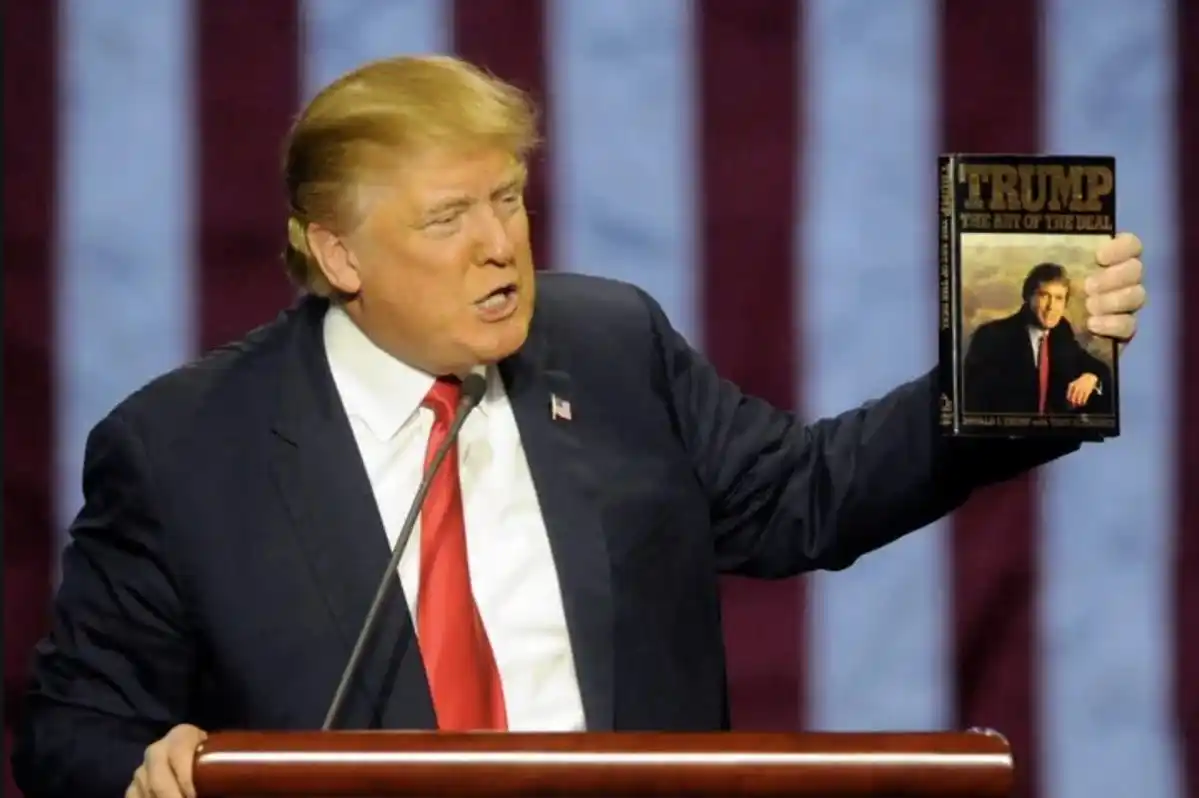
Caption: Trump praised his own book as the "number one bestselling business book of all time"

Below are the 11 steps he wrote himself. After reading them, you will be able to clearly see through his smoke screens, better cope with market volatility, and gain a "Trump advantage" in the game that surpasses the market.

1. Think Big

Trump likes to set grand goals. Because even if they aren't fully achieved, the accomplishment will be higher than if the goal was set too low. This is why you always see him proposing crazy objectives.

2. Protect the Downside and the Upside Will Take Care of Itself

Trump is very good at annoying people, but he is equally good at leaving room for recovery. Take China policy as an example: he would first announce 100% tariffs to force the other side back to the negotiating table, then soften his tone and extend tariff deadlines as details are finalized.

3. Maximize Your Options

Trump knows he is playing a high-stakes game, so he never locks himself in too early. In the TikTok sale case, he met with every executive, maximizing US equity and interests, while creating a sense of urgency through a tight ban deadline, extending it as needed.

4. Know Your Market

Trump won the election because he understood the voter market better than anyone else. You might not know that the "Make America Great Again (MAGA)" trademark was registered by him back in 2012. He has an astonishing intuition for the direction of momentum, going from a perceived "clown candidate" to serving two terms.

5. Use Your Leverage

Trump knows that factory jobs are the pillar of the Chinese economy, so the other side is eager to make a deal. This is why Trump applies high pressure. US wholesalers can order inventory in bulk to prepare for a breakdown in relations, but China, after a year of pandemic, cannot afford factory closures.

6. Enhance Your Location

Coming from a real estate background, Trump knows the US is sitting on a gold mine, but in the past chose to bow to the moral high ground of environmentalism. He reopened drilling, making US land more valuable and thus attracting new foreign investment.

7. Get the Word Out

This one is deeply felt by everyone. Trump's use of social media is an order of magnitude more intense than all previous presidents combined. He has "normalized" modern politics. This is why you feel he is always in the news—because he really is always there.

8. Fight Back

No words can surpass the impact of this moment:

Caption: The moment after Trump was shot at a rally in Pennsylvania on July 13, 2024

9. Deliver the Goods

Trump delivered on almost every campaign promise through executive orders. Whether they will have long-term effects remains to be seen.

10. Contain the Costs

If you study how Trump does real estate deals, you'll find he is famous for "not investing personal capital." Instead, he finds landlords to provide funding, construction companies to develop, management companies to operate, and walks away with tens of millions in profit, with his name on the building.

Caption: The Trump Soho project, where Trump gained 18% equity and a $6 million salary solely through brand licensing and management deals. He contributed no capital, only his time.

He spent $66 million on his 2016 campaign (because he was a nobody then), but did you know that in the 2020 and 2024 campaigns, he spent not a single penny of his own money?

11. Have Fun

I respect that Trump always seems full of energy. He has lived an extraordinary life and is clearly enjoying it.
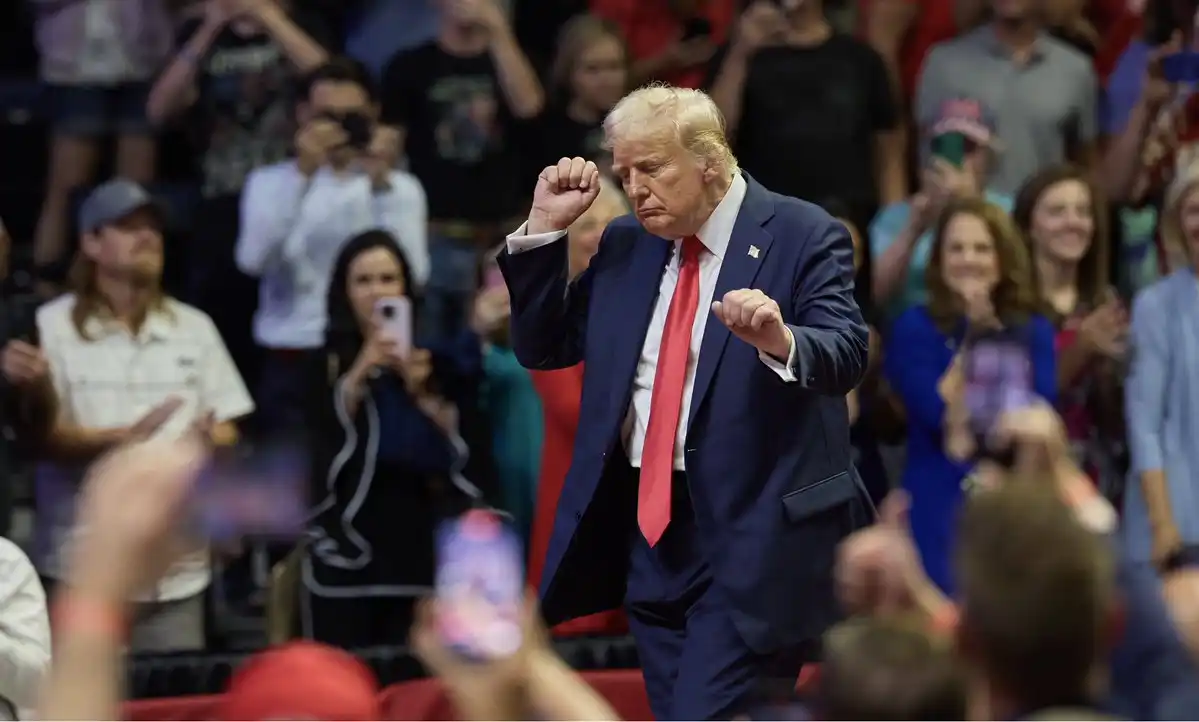
Caption: Trump doing his signature dance at a 2024 Michigan rally

Summary: How to Navigate the Future Trump Era

Trump is not the "reckless fool" portrayed by the media. On the contrary, beneath his impulsive exterior lies highly calculated and purposeful consideration.

Before reading his book, my impression of Trump was the same as everyone else's—a stupid, reckless, arrogant guy who would only ruin the country.

But now I know: Ignore his words, focus on his actions.

This has given me unprecedented clarity in dealing with the markets, and I no longer lose sleep at night. If you are troubled by Trump's actions in the future, come back to this article and understand what he is really trying to do.


Related Questions

QWhat are the 11 decision-making principles that Donald Trump has consistently used for 40 years, according to the article?

AThe 11 principles are: 1. Think Big, 2. Protect the Downside and the Upside Will Take Care of Itself, 3. Maximize Your Options, 4. Know Your Market, 5. Use Your Leverage, 6. Enhance Your Location, 7. Get the Word Out, 8. Fight Back, 9. Deliver the Goods, 10. Contain the Costs, 11. Have Fun.

QHow does the article suggest one should interpret Trump's actions to better understand his strategy and navigate market volatility?

AThe article advises to ignore his rhetoric and focus on his actions, as his impulsive exterior masks a highly calculated and purposeful approach. This perspective provides clarity for dealing with market fluctuations.

QAccording to the article, what is an example of Trump 'Containing the Costs' in his business and political ventures?

AIn business, he was known for not investing personal capital in real estate deals, instead having others fund projects while he profited. In politics, he spent $66 million of his own money in 2016 but spent none of his personal funds in the 2020 and 2024 campaigns.

QWhat book did Trump write at age 41 that outlines his deal-making philosophy, and what does the article claim about its relevance to his presidency?

AHe wrote 'The Art of the Deal'. The article claims that the playbook he uses to make deals as President is exactly the same as the one he used as a real estate developer.

QHow does the article describe Trump's use of leverage in negotiations, using the China trade policy as an example?

AHe uses leverage by applying high pressure, knowing the other party's vulnerabilities. For example, he announced 100% tariffs on China to force them back to the negotiating table, knowing that factory jobs are the pillar of the Chinese economy and they could not afford factory closures.

Related Reads

How to Do Research Well: Deliberately Practice the Real Skills That Matter

No one truly teaches you how to do research. You're often given a desk, a pre-selected problem, and vague instructions to "create something new." Consequently, many people reverse-engineer the job based on visible outputs—papers, posts, announcements—learning only how to *appear* like a researcher rather than how to *become* one. True research capability is built from stacking small, trainable skills, nearly all of which can be developed through deliberate practice. **Pick Your Own Problem:** Most researchers absorb problems from advisors or trends, lacking the underlying reasoning. Choosing a problem you genuinely care about, as John Schulman advises, leads to original work. Develop "taste" like a muscle: predict experiment outcomes, guess paper results from methods, and track which findings remain important over time. **Upgrade Your Inputs:** Relying on shared reading lists (arXiv hot lists, filtered group chats) leads to unoriginal conclusions. Undervalued old literature often holds crucial insights (e.g., MoE, LSTM, backpropagation). Richard Sutton's "The Bitter Lesson" or Claude Shannon's 1952 talk on creative thinking are more predictive than lengthy modern surveys. Breadth matters as much as depth: draw from neuroscience, mechanism design, hardware knowledge, and honest statistics. Read papers directly, especially appendices and limitations sections. **Write Everything Down:** As Paul Graham noted, writing exposes flaws in seemingly mature ideas. Writing is the cheapest defense against self-deception. Following Feynman's principle, Darwin programmatically wrote down facts contradicting his theory to combat memory bias. Maintain a detailed log of hypotheses, setups, predictions, results, and updated understandings. Reviewing past logs fosters essential humility.

marsbit5m ago

How to Do Research Well: Deliberately Practice the Real Skills That Matter

marsbit5m ago

Following US Ban on Fable 5, Zhipu AI's Stock Soars 47%

On June 15th, shares of Zhipu AI surged dramatically on the Hong Kong stock market, peaking at a 47.6% gain before closing 32.82% higher. This sharp increase was directly triggered by two recent industry events. On June 12th, Anthropic announced it was suspending global access to its latest flagship models, Claude Fable 5 and Claude Mythos 5, to comply with a U.S. government export control order. The next day, Zhipu AI announced it would open access to its latest open-source flagship model, GLM-5.2, under the permissive MIT license. The Anthropic incident highlighted a critical issue beyond raw model capability: the risk of sudden, unpredictable loss of access to advanced AI models, especially for developers and enterprises deeply integrated with them. This has shifted industry and market focus toward factors like stability, sustainable access, and controllability. Zhipu's move, promoting "frontier intelligence for all," positions its openly available model as a reliable and accessible alternative. The GLM-5.2 model emphasizes "Long Horizon Task" capabilities with a 1M context window, targeting complex, multi-step coding and engineering workflows where maintaining context is crucial. Analysts note this event exposes the risk of dependency on closed-source models subject to single jurisdictional controls, potentially accelerating a shift toward domestic base models and localized deployments. The market's reaction signals a new valuation dimension in AI: providers who can offer stable, long-term, and sustainably accessible AI capabilities are gaining strategic importance.

marsbit29m ago

Following US Ban on Fable 5, Zhipu AI's Stock Soars 47%

marsbit29m ago

Fully Entering the AI Era: Alipay Bets on Conversation, WeChat Holds Fast to Social

In May 2026, Alipay announced over 300 million AI payment transactions. Shortly after, WeChat opened its mini-programs for AI integration, sparking controversy by requiring developer source code access. This highlights their diverging approaches to AI integration. Alipay is testing "Project Treasure," an optional AI-native interface replacing traditional app grids with a conversational window. Users can command complex tasks (e.g., "book a ride and order coffee") handled end-to-end by AI. This shift follows an abandoned standalone AI app, focusing instead on enhancing its existing user base. For unmodified mini-programs, Alipay's AI uses "screen-reading" to simulate user interactions, bypassing the need for developer overhaul. It also introduced "Token Pay" for micro-transactions and "AI Wallets" for autonomous agent spending. WeChat, prioritizing its core social function, is taking an embedded approach. Its AI agent will operate within existing contexts like group chats and official accounts, assisting without a separate interface. To enable this, WeChat offers developers two paths: granting source code access for direct AI control ("Automatic Mode") or manually encapsulating services into standardized "Skills." Both place significant burden on developers. Key differences emerge in handling legacy services: WeChat demands developer cooperation (code or labor), while Alipay's screen-reading offers immediate, if potentially less stable, compatibility. Alipay's 3 billion AI transactions demonstrate user acceptance of AI-driven commercial actions. The divergent strategies may reshape mini-program ecosystems—Alipay passively "AI-fying" services, WeChat potentially favoring resource-rich developers—and set competing technical standards. Ultimately, the competition centers on where users entrust the command to "help me get things done."

marsbit29m ago

Fully Entering the AI Era: Alipay Bets on Conversation, WeChat Holds Fast to Social

marsbit29m ago

Trading

Spot
Futures
活动图片




