More Popular Than SpaceX, Oversubscribed Over 6,586 Times, What's the Meme Power Behind Liuliu Mei (06658.HK)?

marsbitPublished on 2026-06-15Last updated on 2026-06-15

Abstract

Liumeimei, a popular Chinese snack brand known as "Liuliumei" in China, listed on the Hong Kong Stock Exchange (stock code: 06658.HK). On its debut, the stock price surged dramatically, opening 116% above the issue price and peaking with gains over 190%. This surge is widely attributed not to its traditional consumer goods business, but to a "Meme stock" phenomenon. Its stock ticker abbreviation "LLM" coincidentally matches the acronym for "Large Language Model," the core technology of the ongoing AI boom. This association, coupled with a strong same-day performance by another AI-related stock, triggered a massive wave of speculative retail investment. The IPO itself saw extreme oversubscription in the public offering segment, exceeding 6,586 times, though retail investors were allocated only 10% of shares. Analysts and the article frame this event as part of a broader "stock Meme-ification" trend in global markets, where stocks can experience volatile price movements based on viral narratives, wordplay (like homophones or abbreviations), celebrity mentions, or fleeting social media attention—similar to dynamics seen in the cryptocurrency meme coin sector. Examples cited include the 2021 GameStop saga, stocks linked to political figures like Donald Trump, and other companies benefiting from AI hype or谐音梗 (homophone puns). While such trends can create significant short-term wealth for some, the article notes they also carry risks of market manipulation, "pump and dump" schem...

Original|Odaily Planet Daily(@OdailyChina)

Author|Wenser(@wenser2010 )
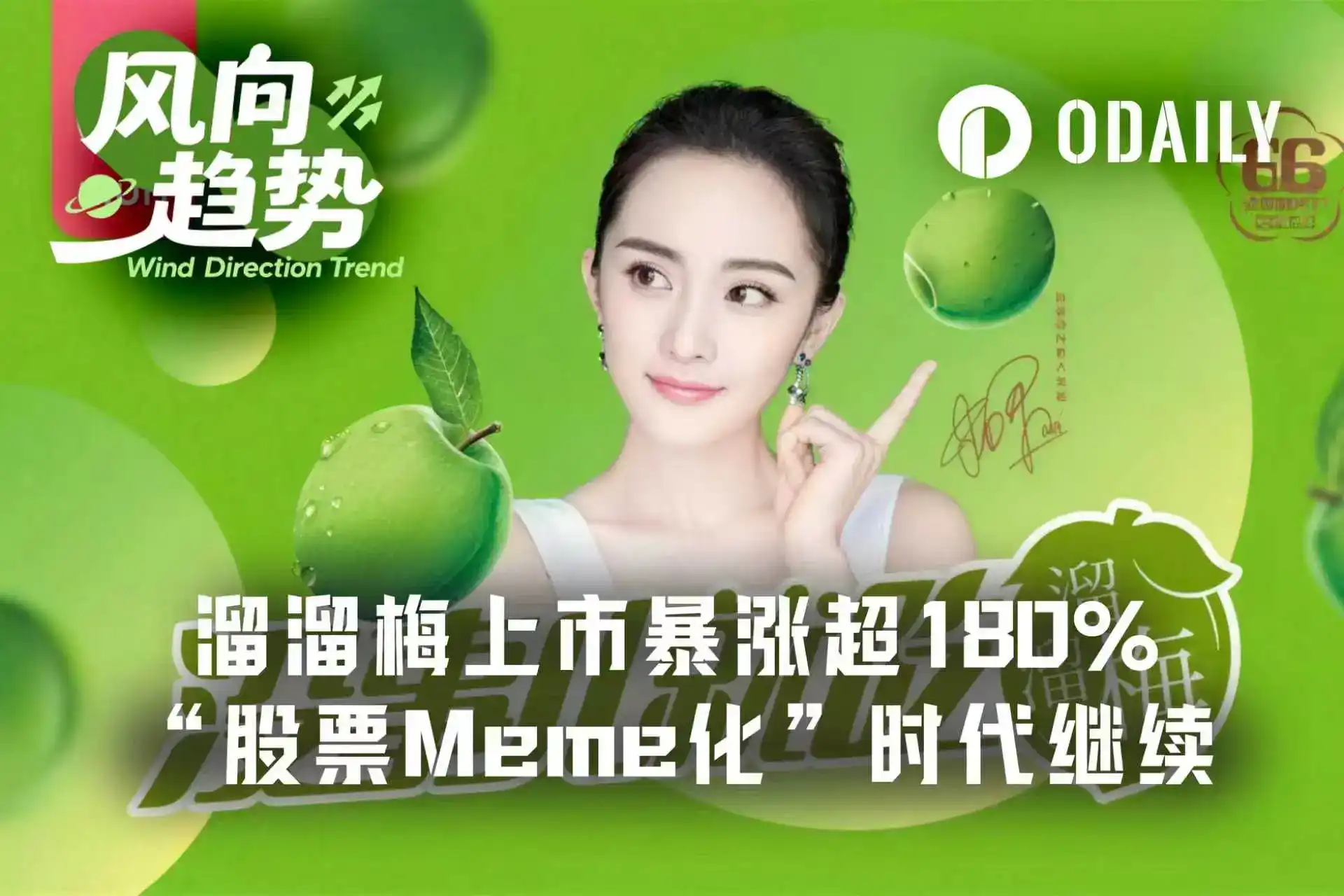
"Are you okay? Are you okay? If you're okay, have some Liuliu Mei!"

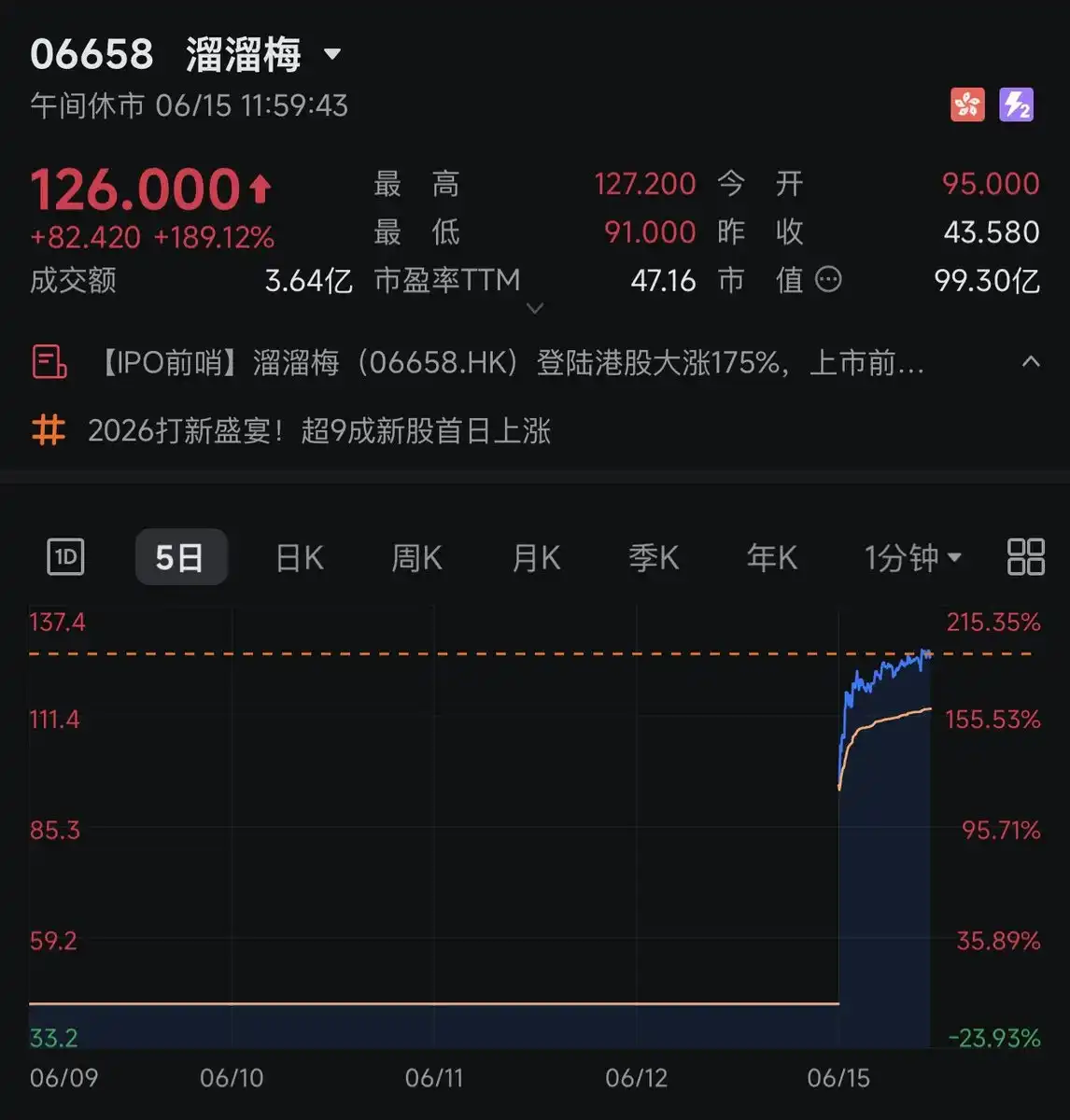
Once upon a time, a catchy slogan from actress Yang Mi brought Liuliu Mei into countless households. Now, after decades of accumulation, the company behind it has officially listed on the Hong Kong Stock Exchange today, becoming the "first plum snack stock" on the market. It is reported that its issue price was 43.58 HKD, opening at 95 HKD, a surge of about 116% from the offering price of 42 HKD; it reached an intraday high of 127.50 HKD, a gain of over 190%; it has since retreated to 125 HKD, still up over 186%.

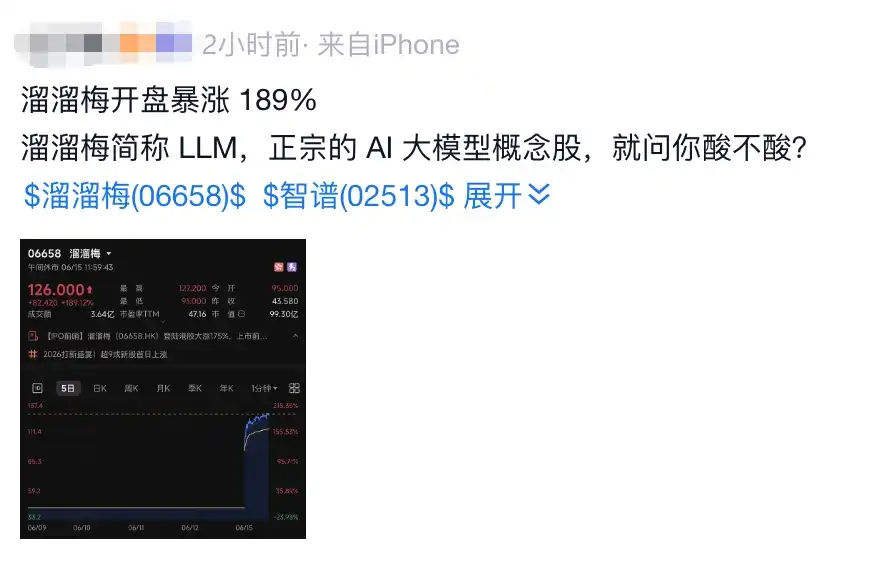
Contrary to what many expected, the sharp rise in Liuliu Mei's (06658.HK) stock price is not a revival of "new consumption, new retail, new snacks" concepts. Instead, it's because its initials coincidentally match "LLM" (Large Language Model), riding the wave of today's 45% surge by Zhipu AI (02513.HK).

Many have dubbed it the "authentic AI Large Language Model stock," attracting a flood of hot money and capital. Whether acknowledged or not, perhaps global stock markets are entering the "Stock Meme-fication Era."

A New Era for Global Stock Markets: When Stocks Collide with Memes

First, let's look at the basics of Liuliu Mei's IPO: This marks its fourth attempt to enter the capital market.

In 2019, its attempt to list on the A-share market was unsuccessful; in 2025, its two applications to the Hong Kong Stock Exchange lapsed; it wasn't until May 21 this year, after updating its filing for the third time and changing its entity name from "Liuliu Mei Group Co., Ltd." to "Liuliu Mei Co., Ltd.," that it succeeded in listing in less than a month. It must be said, sometimes a name can indeed seem like a mystical force.

According to the company's allocation results, the public offering portion of this IPO recorded approximately 6,586.73 times oversubscription. The final number of public offering shares was 1.1465 million, accounting for about 10% of the total global offering. It received approximately 180,500 valid applications, with about 11,465 applications accepted. The ratio for allocating one board lot was only 1.5%, meaning the probability of getting one lot was as low as 1.5%, indicating extremely fierce competition. For the international placement, Liuliu Mei received 2.64 times subscription. The final number of international offering shares was 10.3176 million, accounting for 90% of the total offering shares. Comparing this data, the heat of Liuliu Mei's IPO has surpassed that of Mixue Bingcheng, the "first bubble tea store chain stock" listed in Hong Kong last March, whose Hong Kong public offering was oversubscribed 5,258.21 times.

In other words, institutions were not optimistic but held 90% of the shares; retail investors were optimistic but only held 10% of the shares. The main driving force behind the opening surge came more from the open market's "dance between retail investors and market makers." And this is precisely the power of a "Meme stock"—converting the attention attracted by the meme into buying pressure in the capital market.

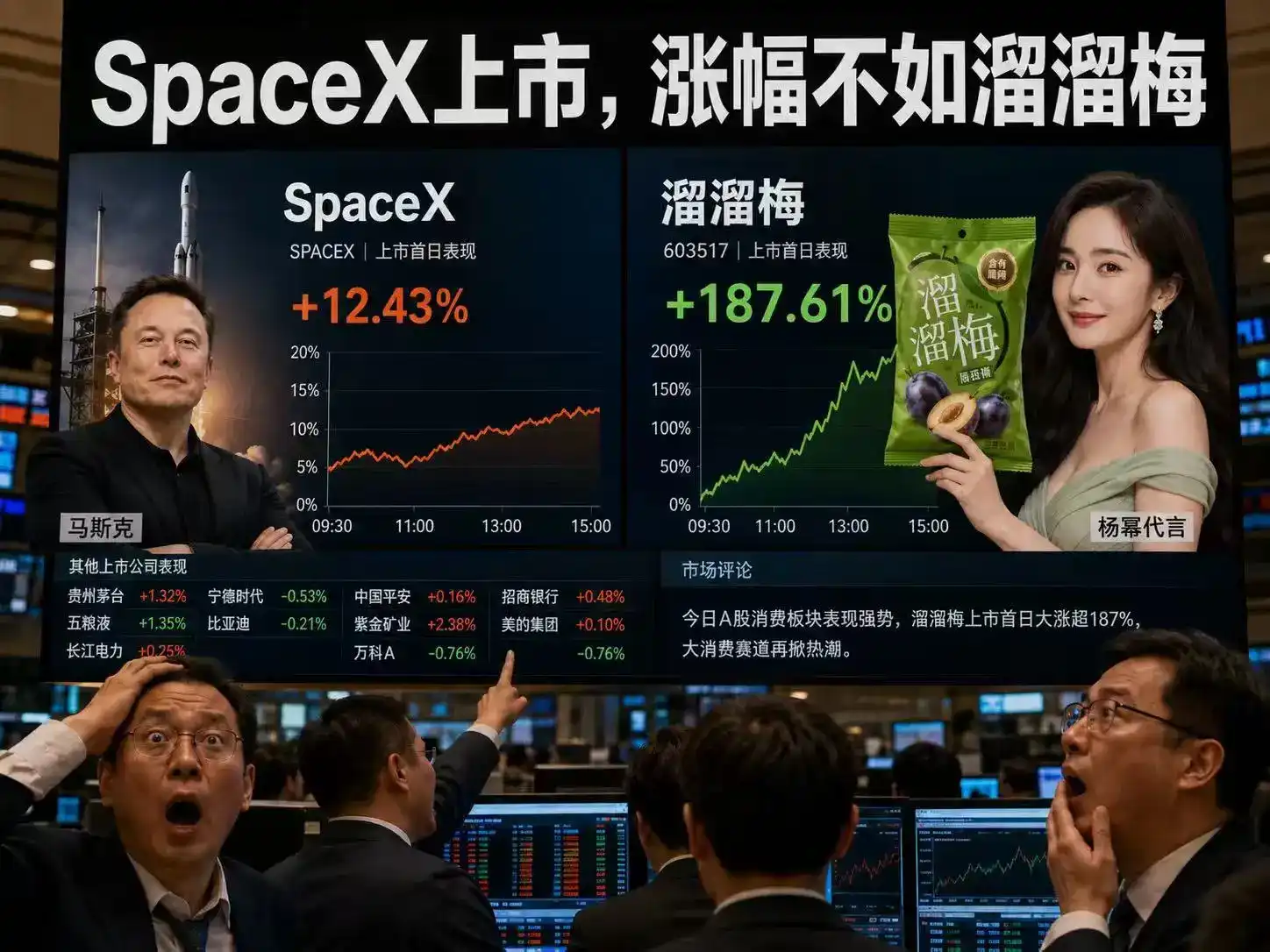
Some netizens even compared Liuliu Mei's opening performance to SpaceX's, finding its market gains far more dazzling.
It's worth noting that "Meme stocks" are not a new term but an objectively existing category in major capital markets like the US, Hong Kong, and A-shares. However, the "Stock Meme-fication Era" is undoubtedly the latest trend emerging in the last 1-2 years, driven in part by factors also related to the crypto market.

The earliest Meme stocks are lost to history, so let's discuss some representative individual stocks from recent years.

2021's Gamestop might be the starting point for many people's Meme stock enlightenment in the US market. Led by figures like Roaring Kitty, retail investors worldwide united against Wall Street institutions, forcing a short squeeze that led many brokerages and exchanges to halt trading to avoid the storm. Recently, news of Gamestop's potential acquisition of eBay also caused market fluctuations and a brief price spike.

Tesla and the recently IPOed SpaceX have also been viewed as a type of Meme stock, as these companies and their stocks are deeply tied to the highly topical "world's first trillionaire," Elon Musk. Before their businesses could provide strong performance proof, they were seen as "narrative-driven companies with sky-high price-to-dream ratios."

Before Donald Trump won the US presidential election in 2024, the A-share market showed early anomalies. "Chuanda Zhisheng" frequently topped trending lists, even hitting the daily limit up multiple times. That same year, when Trump was shot during his campaign, with his ear injured by shattered glass from a stray bullet, Goertek (whose Chinese name sounds like "cut ear") also saw its stock price surge during the session.

Last year, when Sino-Japanese relations deteriorated, defense stock Furihong briefly soared due to a patriotic pun where its name sounds like "capture Japan," pulling eight consecutive daily limit-ups and accumulating over 100% gains, becoming one of the short-term "hot stocks" in the A-share market.

Today's capital market, much like the crypto market with its fragmented attention and concentrated emotions, sees individual stocks and sectors that can trigger the widest discussion and attention becoming the "attention focal points" that stir funds and liquidity.
Liuliu Mei's surge is another example of the "Stock Meme-fication" era.

The Dawn of the Stock Meme-fication Era: Puns, Abbreviations, and the AI Era Dividend

With OpenAI and Anthropic's valuations nearing the trillion-dollar mark, companies and stocks closely related to the AI industry chain—including optics, communications, materials, and computing power—have entered an explosive phase:

  • NVIDIA became the first listed company with a market cap exceeding $5 trillion.
  • Micron, SanDisk, etc., saw their stock prices break new highs consecutively, with institutions raising their target prices.
  • SK Hynix and Samsung Electronics' price fluctuations dictate the rise and fall of South Korea's KOSPI index.
  • NVIDIA founder's comment about "seeing Marvell as a future trillion-dollar giant" caused Marvell (MRVL) stock to rise accordingly.
  • Innolight (Zhongji Xuchuang) mentioned by the new stock god Serenity was misread due to translation as Inno Laser, causing the latter's stock price to surge 10% after 300 million in hot money flooded in.

In the great tide of "Stock Meme-fication," being related to AI,蹭上 (riding on) "large language model"热度 (heat), having homophones with popular stocks, or getting mentions from celebrities have all become reasons for market attention and the perfect stage for synchronized attention and capital influx.
"Trump concept stocks," "U.S. stock government concept stocks," "TACO-style trading beneficiary targets," etc., are also连带表现 (associated manifestations) of this industry trend. And this is precisely the common玩法 (playbook) of the "attention-intensive industry" highly推崇 (advocated) by the crypto market—the Meme coin赛道 (track).

However, the capital markets are different now, the rules are different, and the scale of funds and liquidity is also incomparable to the crypto market. After all, compared to the trading scales of the US, Hong Kong, A-share, Japanese, and Korean markets, the crypto market's overall size of less than $3 trillion seems somewhat pitiful.

SpaceX一跃成为 (leapt to become) a top 10 global asset upon its IPO, while相对地 (in contrast), BTC has fallen to the 17th position on that list. It must be said,数字层面 (on a numerical level)的对比 (comparisons) always look so残酷 (harsh)—over a decade of diligent development in the crypto industry couldn't match the市值体量 (market cap scale) of a single company's IPO.

Now, the emergence and increase of Meme stocks might have become an industry trend. Earlier, when Joyoung Company produced对应产品 (corresponding products) and saw its stock price rise due to the hot梗 (meme) "Hakimi North-South Mung Beans," it说明了一件事 (illustrated one thing): for the young demographic and investor群体 (groups) in today's society, investment targets that can trigger emotional波动 (fluctuations), attract market attention, and stir liquidity are more值得买入 (worth buying) objects.

Even if this短暂追逐情绪 (brief chase of emotions) is only temporary火热 (hot), for most people, "if you can't beat them, join them" is the better choice. Of course, objectively speaking, the emergence of Meme stocks does not mean one-sided benefits, like wealth creation effects or industry booms; sometimes, this process is also accompanied by negative phenomena like pump-and-dumps, one-sided harvesting, and emotional marketing.

Just like Liuliu Mei's opening surge, some angrily accuse it of拉高 (pumping the price) to "harvest韭菜 (retail investors)"; others分析认为 (analyze and believe) it might be because Liuliu Mei joined the "Stock Connect," allowing A-share market funds to buy, which pushed up its stock price. The truth, the reasons, are必定是 (certainly) multidimensional and chaotic. For us, perhaps all we can do is顺应 (go with) this trend of the times and寻找 (seek) our own path to致富 (wealth).

Related Questions

QAccording to the article, what is the main reason for the surge in Liuliumei's (06658.HK) stock price on its debut?

AThe article states that the main reason for Liuliumei's stock price surge is not a revival of the 'new consumption, new retail, new snacks' concept, but rather its stock ticker abbreviation 'LLM' coincidentally aligning with the popular 'Large Language Model' (AI) theme, riding on the coattails of the strong performance of AI-related stocks like Zhipu AI (02513.HK).

QWhat was the oversubscription rate for Liuliumei's IPO public offering, and how does it compare to Mixue Ice City?

AThe oversubscription rate for Liuliumei's IPO public offering was approximately 6586.73 times. This surpasses the 5258.21 times oversubscription rate recorded by Mixue Ice City for its Hong Kong listing last year.

QWhat does the article suggest is the primary characteristic defining the emerging 'Stock Meme-ification Era'?

AThe article suggests the primary characteristic of the 'Stock Meme-ification Era' is the ability of stocks to attract significant market attention and capital inflows based on factors like catchy memes, attention-grabbing narratives, name abbreviations, homophones, celebrity mentions, or connections to trending themes (like AI), rather than just fundamental business performance.

QBesides Liuliumei, name two other examples of 'Meme stocks' mentioned in the article and the reasons behind their market movements.

A1. GameStop (GME): Its stock movement in 2021 was driven by coordinated retail investor action, famously led by figures like Roaring Kitty, aiming to squeeze short-selling institutions. 2. Geer Stock (Goertek Inc.): In 2024, its stock price surged due to the homophonic pun 'Ge Er' (meaning 'cut ear'), which was associated with an incident where former U.S. President Donald Trump's ear was injured.

QWhat contrasting view does the article present about the rise of 'Meme stocks'?

AThe article presents a contrasting view that while Meme stocks can create wealth effects and industry hype, their rise is also accompanied by negative phenomena such as 'pump and dump' schemes, one-sided harvesting of retail investors, and emotional marketing. It cautions that the reasons behind stock movements like Liuliumei's are complex and multi-dimensional.

Related Reads

2029 Finale Prediction: When Cryptocurrency Completely "Vanishes", Who Can Remain in This Financial Upheaval?

By 2029, the crypto industry will have transformed into a largely invisible but foundational layer for traditional finance. This timeline outlines the key shifts from now until then. By mid-2026, the most sought-after assets on-chain will not be traditional tokens, but synthetic perpetual contracts for private, high-growth companies (like SpaceX, OpenAI). These become primary price discovery tools, highlighting the market's craving for real-world asset value. Most altcoins enter a sustained bear market as their fundamental lack of asset-backed value is exposed. In late 2026, the "AI + Crypto" narrative largely fades as AI giants prove they don't need crypto infrastructure, except for prediction markets betting on model performance. Simultaneously, a quiet but significant wave of tokenization for institutional assets (money market funds, private credit) begins. The industry splits into a noisy speculative economy and a silent institutional one. Throughout 2027, major public blockchain foundations pivot decisively to serve institutional clients, building compliance toolkits and sales teams. However, key sectors hit growth ceilings: private perpetual contracts are legally restricted from public promotion, stable币 growth is capped by looming political uncertainty, and tokenization projects remain cautious. In 2028, following a U.S. election assumed to maintain a regulatory (not prohibitive) stance, a pivotal change occurs. After a major liquidation crisis exposes the flaws of synthetic contracts lacking a real-asset anchor, new regulations allow the *public solicitation* of private security sales (secondary market shares) to accredited investors. This creates a legitimate, direct on-ramp for retail capital into previously illiquid private equity. By 2029, the resulting bull market is driven by trading in real, innovative company shares (biotech, robotics, AI labs), not speculative tokens. "Crypto" as a distinct asset class recedes; it becomes the mundane, unseen plumbing for this new global private markets infrastructure. Tokens that survive are those capturing real cash flows from this infrastructure. Speculation persists but is marginalized. The core questions posed at the start are answered: token value is tied to legally enforceable claims on real assets, frontier tech adoption happens via private market channels, and crypto's absorption into traditional finance is marked by its becoming boring and invisible. The key validation for this entire thesis is whether, by late 2028, a legal pathway exists for ordinary accredited investors to access private assets directly.

marsbit30m ago

2029 Finale Prediction: When Cryptocurrency Completely "Vanishes", Who Can Remain in This Financial Upheaval?

marsbit30m ago

After the U.S. Banned Fable 5, Zhipu's Stock Soared 47%

On June 15, Chinese AI company Zhipu's stock surged up to 47.6% in Hong Kong, closing with a 32.82% gain. This sharp rise followed two key industry events. On June 12, Anthropic was compelled by a U.S. government export control order to suspend global access to its latest flagship models, Claude Fable 5 and Claude Mythos 5, impacting developers and businesses reliant on them. The next day, Zhipu announced it was opening access to its new open-source flagship model, GLM-5.2, for all Coding Plan users, with API and model weights (under the MIT license) to follow. The Anthropic incident highlighted a critical shift in the AI industry: beyond raw capability, the stability, continuous accessibility, and control over AI models are becoming equally vital, especially as AI integrates deeper into business workflows. Zhipu's move, emphasizing that "frontier intelligence should not belong to a few nor be subject to arbitrary revocation," positioned its open, accessible model as an alternative. GLM-5.2 focuses on "Long Horizon Tasks" with a 1M context window, aiming for consistency in complex, extended projects. Market analysts suggest this event exposes the risk of dependency on closed-source models subject to single jurisdiction policies, potentially accelerating a shift toward domestic base models and localized deployments. The investment response indicates a new valuation metric is emerging—prioritizing which companies can provide AI capabilities that are not only advanced but also reliably and sustainably accessible.

marsbit31m ago

After the U.S. Banned Fable 5, Zhipu's Stock Soared 47%

marsbit31m ago

PANews Column Registration and Article Submission Guide

"PANews Column Registration and Submission Guide" provides instructions for users to register as columnists and publish articles on the PANews platform. Key application requirements are emphasized: content should focus on in-depth analysis within Crypto, Web3, blockchain, data, and viewpoints. Content primarily for brand/product introductions will not be approved, and heavily AI-generated content will be rejected. Promotional (PR/soft) content is directed to the business channel. **Registration Process:** * **Web:** Go to the official website footer, click "Apply for Column," and register with a phone number or email (login via verification code, no password). Fill in the column name, description, upload an avatar, and submit links to previously published work. * **Mobile:** Navigate to "My" -> "Contribute & Create" and complete the form. **Article Submission Tutorial:** 1. Log in to the PANews website. 2. Access the "Creator Center" from your personal homepage. 3. Use the editor to create and publish articles. **Video Upload:** The platform supports embedding videos from third-party sites (e.g., Bilibili). Copy the embed code from the source video, use the editor's "Insert/Edit media" button, paste the code under the "Embed" tab, and adjust the display size (recommended: width 100%, height 560px). **PANews Skills (AI Agent Tool):** PANews offers an official AI Agent skill set called PANews Skills, enabling AI tools to query platform content, track trends, and publish column articles directly. It includes three main skills: 1. `panews`: For tracking daily must-read lists, popular articles, and funding news. 2. `panews-creator`: For managing columns, publishing articles, and uploading images. 3. `panews-web-viewer`: For parsing PANews webpages into Markdown. These skills are compatible with various AI Agent tools (OpenClaw, Cursor, Claude Code, ChatGPT, Gemini, etc.). To use the `panews-creator` skill, users must obtain a specific authentication value from the PANews website after logging into their columnist account.

marsbit42m ago

PANews Column Registration and Article Submission Guide

marsbit42m ago

I Built Myself an Investment Workbench Using AI

For the past two weeks, I've been immersed in Vibe Coding—using AI to write code from natural language descriptions. This process has enabled me to quickly build functional tools that address long-standing personal ideas. Previously, I had many concepts but found execution too cumbersome. Key ideas included a unified dashboard for assets across US stocks, Crypto, HK stocks, and A-shares; a real-time alert system for price movements; an investment map visualizing sector relationships; and a tool to correlate prediction market bets with news and market data. Traditional development hurdles meant these often remained unrealized. Using AI (Codex, Claude Code, and DeepSeek API), I built four initial tools: 1. A **Cross-Market Asset Dashboard** showing total assets, daily P&L, and holdings by market, with added features for alerts and sector mapping. It's deployed locally for privacy. 2. A **Prediction Market (PM) Monitor** tracking bets on events (e.g., company valuations) and correlating probability shifts with news and market movements. I categorize bets by conviction to filter noise. 3. A **Simple Operations Backend** for managing my writing workflow (topics, progress, publishing). It's cloud-deployed for mobile access. 4. A **One-Click Formatting Tool** that automates converting drafts into various platform-specific formats, saving manual effort. While these tools are basic, they represent a significant shift: AI lowers the barrier to creating personalized systems. I believe individual investors can now feasibly build core systems for: * **Asset Observation** (tracking holdings and changes) * **Signal Monitoring** (watching for key market shifts) * **Sector Mapping** (understanding network relationships within a sector) * **Performance Review** (documenting rationale and outcomes) The power of Vibe Coding is its fast feedback loop. Ideas can be implemented, tested, and iterated on rapidly, turning "want-to-do" into "done." This marks the start of my new phase, where I'll share investment thoughts, tool tests, on-chain operations, and educational Web3 content.

marsbit58m ago

I Built Myself an Investment Workbench Using AI

marsbit58m ago

Trading

Spot
Futures

Hot Articles

Discussions

Welcome to the HTX Community. Here, you can stay informed about the latest platform developments and gain access to professional market insights. Users' opinions on the price of MEME (MEME) are presented below.

活动图片