The higher limit applies to buyback operations aimed at supporting liquidity in Treasury bond segments with maturities of 10 to 20 years and 20 to 30 years. The new set of rules from the U.S. Department of the Treasury will take effect on September 9 and will be in force for the current refinancing quarter, which ends on November 4.
The Treasury Department stated that this change reflects consistently high participant activity in operations with longer-dated maturities. Market participants have submitted significant volumes of high-quality offers, giving the Treasury Department reason to increase the amount it is willing to purchase.
An updated buyback schedule will be published later. The Treasury Department plans to provide more detailed information about the volumes of future operations during the next quarterly refinancing announcement on November 4. This news comes as long-term government bonds, not just in the US, are showing warning signals not seen for several decades.
Treasury Targets Older Bonds
The program is designed to ease trading in older Treasury securities. These bonds, known as "off-the-run," were issued before the newest benchmark bonds and may be less liquid, meaning they can be harder to buy or sell without affecting prices.
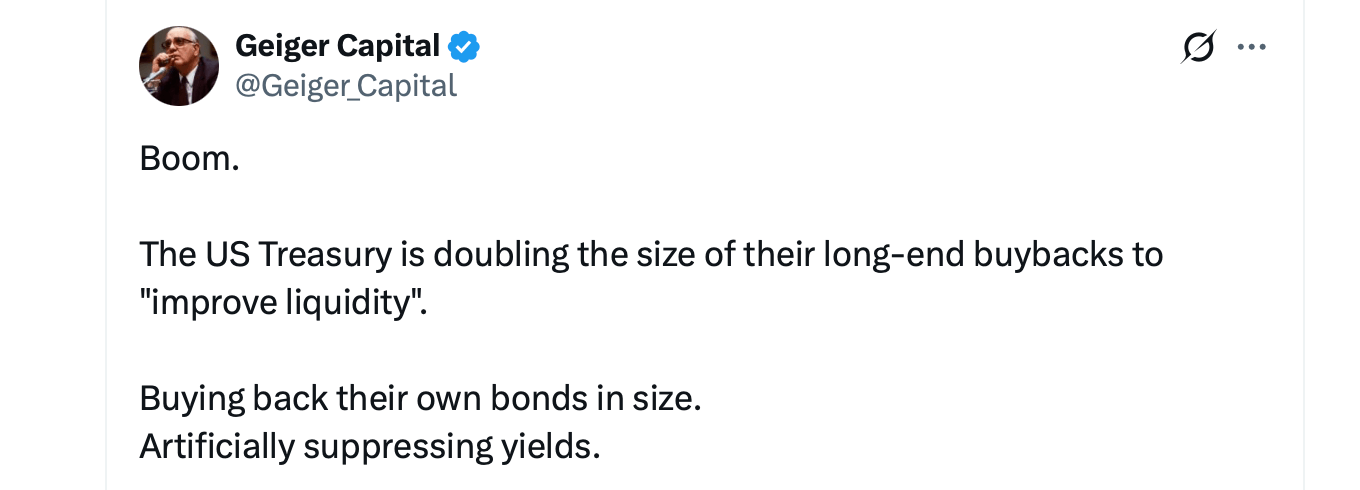
The U.S. Treasury Department resumed regular buybacks in May 2024 after a long hiatus. Its cash management operations primarily target short-term securities and help regulate fluctuations in the government's cash balance. Liquidity support operations are designed to improve trading in the secondary market across the Treasury yield curve.
The Treasury can buy back older securities from dealers and other market participants and then retire them. It continues to issue new debt to finance the federal government, so these operations are more about altering the debt structure and supporting market functioning than leading to a significant reduction in outstanding debt volume.
The Department does not acquire newly issued benchmark bonds, securities that are particularly scarce in the repo market, or bonds used for delivery against Treasury futures contracts. It also remains a price-sensitive buyer and may purchase less than the stated maximum if the submitted offers are not attractive.
Yield Rise Prompted Swift Response
The expansion of the program followed a sharp rise in long-term Treasury yields. The yield on 30-year bonds recently exceeded 5.33%—the highest level since 2007—while 10-year yields climbed as investors priced in a significant volume of government borrowing, budget concerns, and a shift in the buyer base. The military conflict in the Middle East is only exacerbating the situation.
The rise in long-term yields affects far more than just bond investors. It can lead to higher U.S. mortgage rates and borrowing costs for companies, while simultaneously reducing the real value of future profits in today's dollars. This pressure may particularly impact technology and other high-growth company stocks.
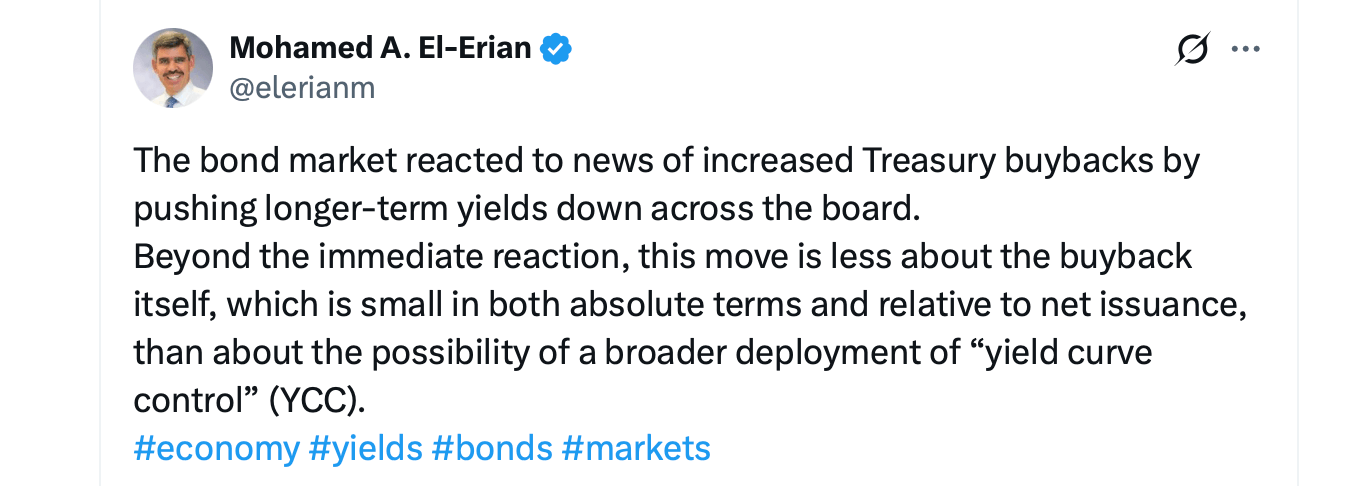
The initial market reaction was swift. The yield on 10-year Treasury bonds fell by about 6 basis points to around 4.647%, and the yield on 30-year bonds decreased by about 9 basis points to around 5.196%.
Market observers quickly characterized these larger-scale purchases as "mini-QE"—a term reflecting the timing of the decision: The U.S. Treasury Department increased demand for long-term bonds just as their yields approached multi-year highs. This characterization also reflects the potential of buyback operations to reduce the volume of long-term bonds that private investors must purchase.
"The U.S. Treasury Department is at least doubling the size of liquidity support buyback operations for long-term nominal coupon securities; the current maximum of $2 billion per operation will be increased to at least $4 billion per operation," wrote the X account managed by the financial publication Zerohedge on Wednesday.
They also added:
"Yields are falling, USDJPY is plummeting. Well, this settles the debate once and for all on whether Treasury buyback operations are 'mini-QE.'"
Stocks and Bitcoin Join the Rally
Amid the decline in yields, U.S. stock markets traded higher. However, the Nasdaq Composite was at 26,251.49, down 38.22 points. The New York Stock Exchange Index was at 24,779.71, up 150.57 points at 10:00 AM ET on Wednesday morning.
The Dow Jones Industrial Average rose 145.50 points to 53,488.90. The S&P 500 gained 28.12 points, reaching 7,719.88. Falling yields typically ease pressure on stock valuations and provide short-term relief for stocks sensitive to borrowing costs and discount rates.
Bitcoin was also trading in the $65,000 range after briefly returning to that price zone at the time of writing. This rise followed a hold of the $62,000 to $63,000 zone and occurred against the backdrop of recent inflows into U.S. spot Bitcoin exchange-traded funds (ETFs).
Short covering in derivatives markets also fueled the BTC rebound, accelerating a modest rise. The actions of the U.S. Treasury were not the sole driver of this move, but the decline in yields may support Bitcoin by reducing the appeal of safer dollar-denominated assets. Bitcoin still faces resistance in the $65,600 to $66,000 range, where sellers have recently emerged. The higher the price rises, the stronger the resistance.
November Presents the Next Test
On November 4, the Treasury Department will decide whether to maintain, expand, or scale back the increased volume of long-term bond buybacks. Investors will be watching to see if high-quality offerings in the bond market persist, if the yield on 30-year bonds continues to decline, and if the rally in U.S. stocks and Bitcoin solidifies.
end-content