Migrating Bitcoin to post-quantum may 'easily' take 5-10 years: Crypto exec

cointelegraphPublished on 2025-12-21Last updated on 2025-12-21

Abstract

Bitcoin core developer Jameson Lopp estimates that migrating Bitcoin to post-quantum cryptographic standards could easily take 5 to 10 years. He and other experts, including Blockstream CEO Adam Back, believe there is no immediate quantum threat to Bitcoin. However, Lopp emphasizes the need for preparation due to the complexity of upgrading Bitcoin’s distributed consensus system. The debate continues within the community, with Bitcoin maximalists urging caution and downplaying the urgency, while some venture capitalists warn of imminent risks and potential price impacts. For instance, Capriole founder Charles Edwards suggested BTC could fall below $50,000 by 2028 if not quantum-ready.

Migrating Bitcoin (BTC) to post-quantum standards will take at least 5-10 years, according to Bitcoin core developer and co-founder of crypto custody company Casa, Jameson Lopp, who weighed in on the ongoing quantum computer debate.

Lopp agreed with Adam Back, the CEO of crypto infrastructure company Blockstream, that there is no near-term threat to Bitcoin from quantum computers. Lopp said in an X post.

“Quantum computers won't break Bitcoin in the near future. We'll keep observing their evolution. Yet, making thoughtful changes to the protocol and an unprecedented migration of funds could easily take 5 to 10 years.
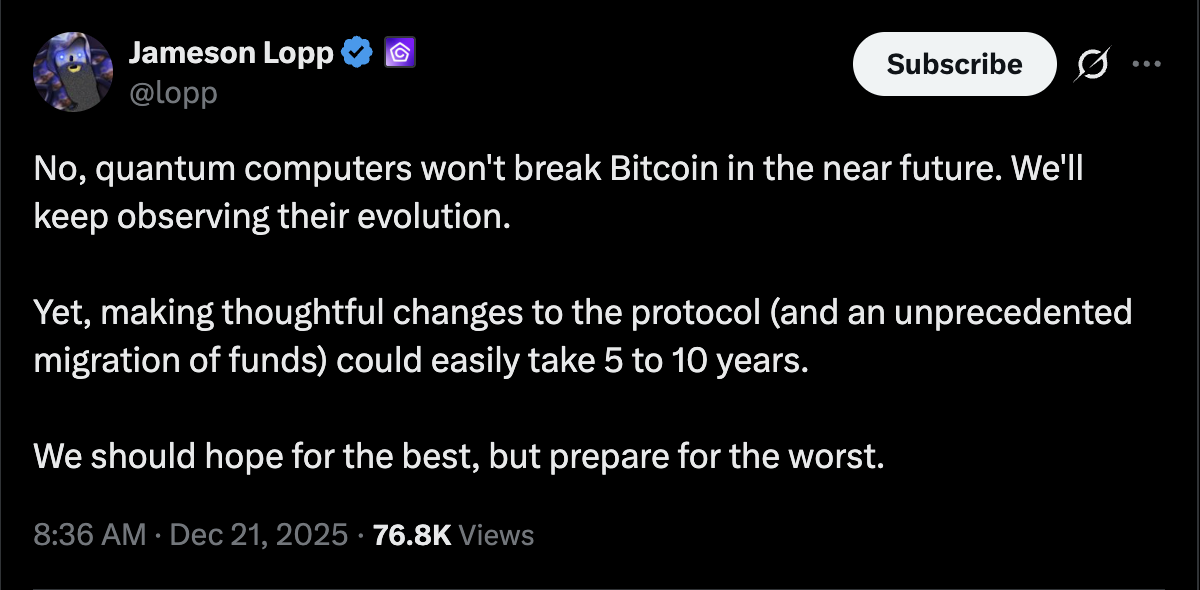
Source: Jameson Lopp

We should hope for the best, but prepare for the worst,” he added. In a separate post, he said the Bitcoin protocol is more challenging to upgrade to post-quantum standards than centralized software because of its distributed consensus model.

The debate over the quantum threat and possible solutions continues to be a major topic of discussion in the Bitcoin community, with a growing schism between Bitcoin maximalists, who urge caution in prompting changes to the protocol, and venture capitalists (VCs), who say the quantum threat is imminent.

Related: Blockchains quietly prepare for quantum threat as Bitcoin debates timeline

Bitcoin OGs, developers and whales clash with venture capitalists

“Quantum-resistance solutions are affordable enough to be financed by non-profits and VCs,” Bitcoin maximalist Pierre Rochard said.

Rochard added that it would be so expensive to attack Bitcoin through quantum computers that the government would be forced to “subsidize it as a collective action problem.”
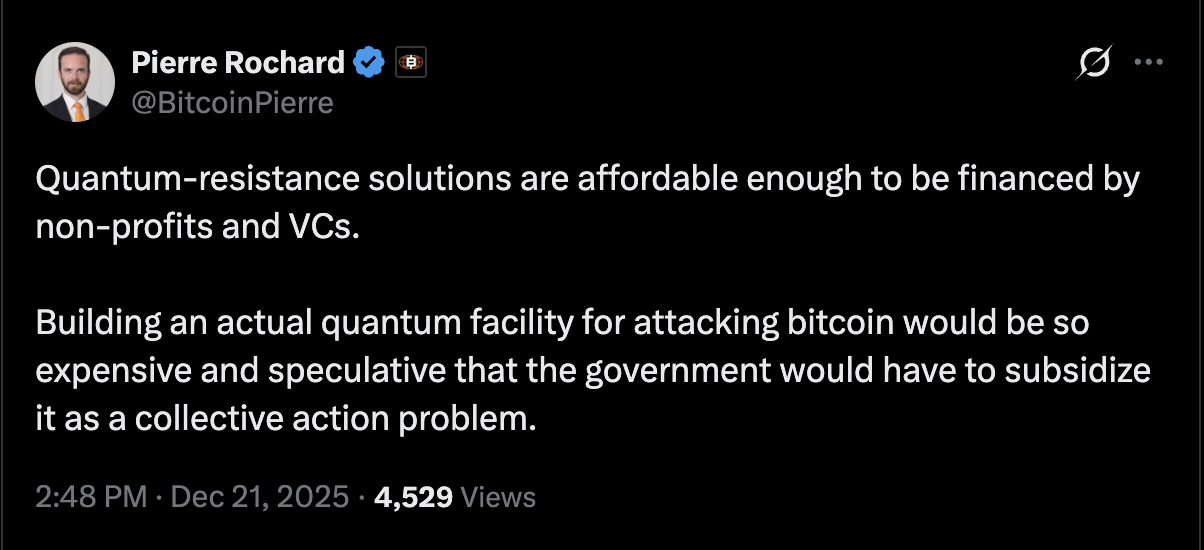
Source: Pierre Rochard

Samson Mow, a Bitcoin investor and CEO of wallet company and advocacy group JAN3, also cast doubt on the ability of a quantum computer to crack Bitcoin’s security.

“In reality, quantum computers can’t factor the number 21 — not 21 million — 21, without heavy customization to the algorithm,” Mow said.

Despite this, venture capitalists and other investment firms warn that BTC’s price is being impacted by the threat, or perceived threat, from quantum computers.

The price of BTC could dip below $50,000 if the protocol is not quantum-ready by 2028, according to Charles Edwards, the founder of digital asset investment fund Capriole.

Edwards called for Bitcoin node operators to enforce Bitcoin Improvement Proposal (BIP) 360, which introduces a quantum-ready signature scheme for BTC.

Magazine: Quantum attacking Bitcoin would be a waste of time: Kevin O’Leary

Related Questions

QAccording to Jameson Lopp, how long could migrating Bitcoin to post-quantum standards take?

AAccording to Jameson Lopp, migrating Bitcoin to post-quantum standards could easily take 5 to 10 years.

QWhy is upgrading the Bitcoin protocol to post-quantum standards more challenging than upgrading centralized software?

AIt is more challenging because of Bitcoin's distributed consensus model, which requires widespread agreement for any protocol changes.

QWhat is the main point of disagreement between Bitcoin maximalists and venture capitalists regarding the quantum threat?

ABitcoin maximalists urge caution in making changes to the protocol, while venture capitalists believe the quantum threat is imminent and that it is already impacting Bitcoin's price.

QWhat did Samson Mow claim about the current capabilities of quantum computers?

ASamson Mow claimed that quantum computers cannot even factor the number 21 without heavy customization to the algorithm, casting doubt on their ability to crack Bitcoin's security.

QWhat specific proposal did Charles Edwards call for to address the quantum threat?

ACharles Edwards called for Bitcoin node operators to enforce Bitcoin Improvement Proposal (BIP) 360, which introduces a quantum-ready signature scheme for BTC.

Related Reads

Yao Shunyu's 88 Days

Yao Shunyu, a 27-year-old AI expert with a background from Princeton and OpenAI, joined Tencent in September 2025. Within 88 days, he led a major overhaul of Tencent’s AI strategy and organization, resulting in the release of Hunyuan Hy3 preview—a MoE model with 295B total parameters and 21B active parameters, supporting up to 256K context length. The launch came after Tencent leadership, including CEO Ma Huateng and President Martin Lau, openly criticized Hunyuan's earlier underperformance—citing slow development, over-reliance on superficial benchmark optimization, and poor generalization in real-world applications. Internal adoption was low, with key business units like WeChat and gaming seeking external AI solutions. Yao reshaped Tencent’s AI approach by integrating previously siloed teams, dissolving the ten-year-old Tencent AI Lab, and establishing new units focused on AI infrastructure and data. Hy3 preview was developed using co-design principles, closely aligned with product teams to ensure practical usability from the start. It has already been integrated into core products like Yuanbao, QQ, and enterprise tools. The release signals a shift from chasing rankings to building usable, scalable AI grounded in Tencent’s ecosystem. While external partnerships (like with DeepSeek and OpenClaw) helped retain users temporarily, the focus is now on making Hunyuan a reliable internal foundation. The real test lies in sustaining this new organizational momentum amid fierce competition from Alibaba, DeepSeek, and others.

marsbit55m ago

Yao Shunyu's 88 Days

marsbit55m ago

Trading

Spot
Futures

Hot Articles

What is $BITCOIN

DIGITAL GOLD ($BITCOIN): A Comprehensive Analysis Introduction to DIGITAL GOLD ($BITCOIN) DIGITAL GOLD ($BITCOIN) is a blockchain-based project operating on the Solana network, which aims to combine the characteristics of traditional precious metals with the innovation of decentralized technologies. While it shares a name with Bitcoin, often referred to as “digital gold” due to its perception as a store of value, DIGITAL GOLD is a separate token designed to create a unique ecosystem within the Web3 landscape. Its goal is to position itself as a viable alternative digital asset, although specifics regarding its applications and functionalities are still developing. What is DIGITAL GOLD ($BITCOIN)? DIGITAL GOLD ($BITCOIN) is a cryptocurrency token explicitly designed for use on the Solana blockchain. In contrast to Bitcoin, which provides a widely recognized value storage role, this token appears to focus on broader applications and characteristics. Notable aspects include: Blockchain Infrastructure: The token is built on the Solana blockchain, known for its capacity to handle high-speed and low-cost transactions. Supply Dynamics: DIGITAL GOLD has a maximum supply capped at 100 quadrillion tokens (100P $BITCOIN), although details regarding its circulating supply are currently undisclosed. Utility: While precise functionalities are not explicitly outlined, there are indications that the token could be utilized for various applications, potentially involving decentralized applications (dApps) or asset tokenization strategies. Who is the Creator of DIGITAL GOLD ($BITCOIN)? At present, the identity of the creators and development team behind DIGITAL GOLD ($BITCOIN) remains unknown. This situation is typical among many innovative projects within the blockchain space, particularly those aligning with decentralized finance and meme coin phenomena. While such anonymity may foster a community-driven culture, it intensifies concerns about governance and accountability. Who are the Investors of DIGITAL GOLD ($BITCOIN)? The available information indicates that DIGITAL GOLD ($BITCOIN) does not have any known institutional backers or prominent venture capital investments. The project seems to operate on a peer-to-peer model focused on community support and adoption rather than traditional funding routes. Its activity and liquidity are primarily situated on decentralized exchanges (DEXs), such as PumpSwap, rather than established centralized trading platforms, further highlighting its grassroots approach. How DIGITAL GOLD ($BITCOIN) Works The operational mechanics of DIGITAL GOLD ($BITCOIN) can be elaborated on based on its blockchain design and network attributes: Consensus Mechanism: By leveraging Solana’s unique proof-of-history (PoH) combined with a proof-of-stake (PoS) model, the project ensures efficient transaction validation contributing to the network's high performance. Tokenomics: While specific deflationary mechanisms have not been extensively detailed, the vast maximum token supply implies that it may cater to microtransactions or niche use cases that are still to be defined. Interoperability: There exists the potential for integration with Solana’s broader ecosystem, including various decentralized finance (DeFi) platforms. However, the details regarding specific integrations remain unspecified. Timeline of Key Events Here is a timeline that highlights significant milestones concerning DIGITAL GOLD ($BITCOIN): 2023: The initial deployment of the token occurs on the Solana blockchain, marked by its contract address. 2024: DIGITAL GOLD gains visibility as it becomes available for trading on decentralized exchanges like PumpSwap, allowing users to trade it against SOL. 2025: The project witnesses sporadic trading activity and potential interest in community-led engagements, although no noteworthy partnerships or technical advancements have been documented as of yet. Critical Analysis Strengths Scalability: The underlying Solana infrastructure supports high transaction volumes, which could enhance the utility of $BITCOIN in various transaction scenarios. Accessibility: The potential low trading price per token could attract retail investors, facilitating wider participation due to fractional ownership opportunities. Risks Lack of Transparency: The absence of publicly known backers, developers, or an audit process may yield skepticism regarding the project's sustainability and trustworthiness. Market Volatility: The trading activity is heavily reliant on speculative behavior, which can result in significant price volatility and uncertainty for investors. Conclusion DIGITAL GOLD ($BITCOIN) emerges as an intriguing yet ambiguous project within the rapidly evolving Solana ecosystem. While it attempts to leverage the “digital gold” narrative, its departure from Bitcoin's established role as a store of value underscores the need for a clearer differentiation of its intended utility and governance structure. Future acceptance and adoption will likely depend on addressing the current opacity and defining its operational and economic strategies more explicitly. Note: This report encompasses synthesised information available as of October 2023, and developments may have transpired beyond the research period.

363 Total ViewsPublished 2025.05.13Updated 2025.05.13

What is $BITCOIN

Discussions

Welcome to the HTX Community. Here, you can stay informed about the latest platform developments and gain access to professional market insights. Users' opinions on the price of BTC (BTC) are presented below.

活动图片