Michael Saylor Identifies Bitcoin's 'Most Significant Breakthrough' in History

cryptonews.ruPublished on 2026-08-23Last updated on 2026-08-23

Abstract

Michael Saylor, Executive Chairman of Strategy Inc., identifies Bitcoin's most significant breakthrough as its ability to transform economic energy into digital form and securely anchor it to individuals, families, companies, machines, or nations. He positions Bitcoin as a monetary technology enabling digital control of economic value, rather than merely a tradable cryptocurrency. This builds on his previous thesis describing Bitcoin as digital monetary energy, characterized by proof-of-work, fixed supply, digital transferability, and owner-controlled keys. Technically, Bitcoin does not legally tie coins to an identity but enables controlled digital ownership through cryptographic credentials. Ownership depends on securing private keys, which authorize transactions. While blockchain analysis allows for transaction tracking, Saylor's concept emphasizes the control aspect. Strategy Inc. serves as a corporate example, holding a large Bitcoin reserve. As of mid-August, the company reported owning 840,447 BTC. It has executed several sales in recent weeks. Saylor also outlines a four-tier digital money model with Bitcoin at the equity level. Beyond corporate adoption, U.S. banking regulators note increasing interest, with many recent bank charter applicants proposing digital asset-related activities, including stablecoin payments. Institutional analyses, like one from Fidelity Digital Assets, assess Bitcoin's properties such as scarcity and decentralization but caution about it...

According to Michael Saylor, Executive Chairman of Strategy Inc. (Nasdaq: MSTR), Bitcoin enables the placement of economic value under the digital control of individuals, institutions, automated systems, and governments alike. In an August 23 post on X, Saylor stated:

"Bitcoin's most significant breakthrough is the ability to transform economic energy into digital form and securely tie it to a person, family, company, machine, or country."

This statement is an extension of Saylor's long-standing efforts to position Bitcoin as a monetary technology, not merely a cryptocurrency traded on markets. He has previously described Bitcoin as digital monetary energy, linking value preservation to proof-of-work, a fixed supply, digital transferability, and owner-controlled keys. In his latest post, this broad thesis is condensed into a single stated breakthrough.

Assessment from an institutional investor provides an additional benchmark for comparing the several characteristics underlying Saylor's claim about Bitcoin. An evaluation of Bitcoin by Fidelity Digital Assets considers aspects such as scarcity, decentralization, censorship resistance, and proof-of-work, while containing a warning that digital assets remain speculative, volatile, and could lose all their value. This analysis does not endorse Saylor's energy metaphor.

How Bitcoin Ties Value to an Owner

Technically, Bitcoin does not tie coins to a legal person, family, corporation, machine, or country. Instead, the network's original architecture defines an electronic coin as a chain of digital signatures, with transactions transferring control according to cryptographic rules rather than recording an owner's name. Thus, the term "tying" used by Saylor describes controlled digital ownership, not identity registration.

Control depends on possessing and safeguarding the cryptographic credentials required to authorize each transaction. A Bitcoin wallet uses private keys to generate digital signatures, allowing the network to verify spending authority without obtaining the secret key itself. Custodial arrangements can delegate authority to an individual, family, company, or government agency, while software can automate a machine's use of cryptographic keys.

Public ledgers also provide transparency that contradicts any simple description of ownership as permanently private or untraceable. The U.S. Department of the Treasury has determined that blockchain analytics enables tracking transactions, correlating addresses, identifying suspicious patterns, and assessing counterparties. It also noted that such tools rely on probabilistic methods, face gaps in data coverage, and can lose fidelity across services or blockchains.

Strategy Reduces Its Reserves as Banks Focus on Digital Assets

Strategy represents the most prominent corporate example of holding a large Bitcoin reserve cited by Saylor. The company's August 17 Form 8-K states that as of August 16, it held 840,447 $BTC, acquired for $63.36 billion at an average price of $75,385 per Bitcoin, including fees and expenses. The company's own accounting shows no purchases since June 22, with four sales recorded over the subsequent eight weeks totaling 6,916 $BTC.
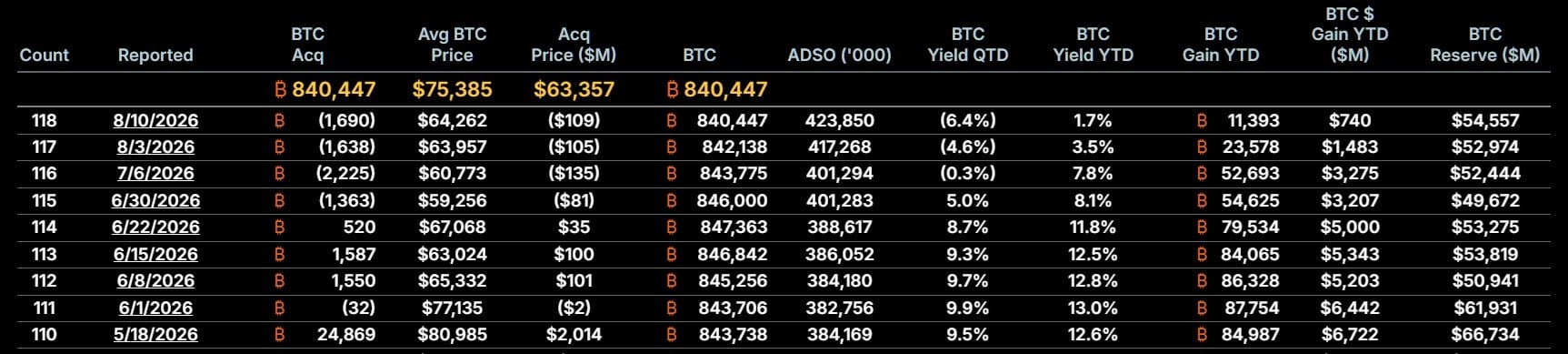
Strategy's Recent $BTC Transactions. Source: Strategy Inc.

Saylor has also argued that Bitcoin can serve as a foundation for financial products designed with different owners and risk preferences in mind. In his four-layer model of digital money, $BTC resides in the equity layer, Strategy preferred stock (STRC) in the credit layer, an income token in the money layer, and USDT in the currency layer. These instruments carry issuer and counterparty risks beyond those related to Bitcoin's price and custody, with liquidity conditions potentially impacting both.

Government attention is now extending beyond individual ownership, as bank license applicants propose incorporating digital assets into their business models. Comptroller of the Currency Jonathan Gould stated on August 19 that 23 of 40 bank license applications received over the past 18 months involved some form of digital asset activity. He noted that integrating payment stablecoins is becoming a common component of prospective applicants' plans.

end-content

Related Questions

QAccording to Michael Saylor, what does he consider to be the most significant breakthrough in the history of Bitcoin?

AMichael Saylor considers the most significant breakthrough of Bitcoin to be its ability to convert economic energy into a digital form and securely tie it to a person, family, company, machine, or country.

QWhat is the specific technical explanation of how Bitcoin 'ties' value to an owner, as opposed to Michael Saylor's metaphorical description?

ATechnically, Bitcoin does not tie coins to a legal entity. Instead, control depends on the possession and protection of cryptographic credentials (private keys). A Bitcoin wallet uses private keys to create digital signatures, authorizing transactions. Ownership is defined by control over these keys, which can be managed through custodial agreements for individuals, families, companies, or governments.

QWhat details are revealed about Strategy Inc.'s Bitcoin holdings in its recent 8-K filing mentioned in the article?

AAs of August 16, Strategy Inc. held 840,447 BTC, acquired for $63.36 billion at an average price of $75,385 per Bitcoin (including fees and expenses). The company's accounting shows no purchases since June 22 and records four sales totaling 6,916 BTC over the subsequent eight weeks.

QIn Michael Saylor's four-tier model of digital money, what does each tier represent?

AIn Michael Saylor's four-tier model of digital money, $BTC is at the capital level, Strategy's preferred stock (STRC) is at the credit level, a yield token is at the money level, and USDT is at the currency level.

QWhat trend regarding digital assets did the Comptroller of the Currency, Jonathan Gould, report about recent bank license applications?

AComptroller of the Currency Jonathan Gould reported that 23 out of 40 applications for a national bank charter received in the last 18 months involved some form of digital asset activity. He noted that integrating payment stablecoins is becoming a common component of applicants' plans.

Related Reads

Hardware Wallet Owners Lose Money: The Nuances of Cold Bitcoin Storage in 2026

The article discusses a wave of distrust towards hardware wallets by the summer of 2026, primarily triggered by security incidents. The most significant involved Coldcard wallets from Coinkite, where a firmware bug dating back to 2021 drastically reduced the cryptographic entropy for seed phrase generation. This allowed attackers to brute-force private keys, leading to losses estimated between $115-$153 million in Bitcoin. While Coldcard issued a fixed firmware, the incident damaged the reputation of all hardware wallets. Other manufacturers like Trezor and Ledger issued statements assuring their devices' security, citing their use of secure hardware elements for true random number generation. However, separate data breaches affected SafePal (exposing personal data of ~40,000 users) and Trezor (via a logistics partner, compromising data for ~14,000 users), though no private keys or crypto assets were stolen in these cases. The article clarifies that hardware wallets themselves don't "hold" crypto but store the keys to access it on the blockchain. It argues against abandoning hardware wallets entirely, pointing out that alternatives like paper, memory, or custodial exchange storage have their own significant risks. It concludes that these incidents should be viewed as specific failures, not a condemnation of the entire category. A key underlying challenge highlighted is the dual role of advancing AI, which empowers both defenders to enhance security and attackers to find vulnerabilities more efficiently.

cryptonews.ru23m ago

Hardware Wallet Owners Lose Money: The Nuances of Cold Bitcoin Storage in 2026

cryptonews.ru23m ago

Trading

Spot
活动图片