Michael Saylor claims, ‘Bitcoin has won’ – But the market is yet to decide

ambcryptoPublished on 2026-04-05Last updated on 2026-04-05

Abstract

Michael Saylor's claim that "Bitcoin has won" is being tested as the market faces significant macro volatility. While he argues that Bitcoin is evolving from a speculative asset into a digital credit instrument within institutional financial systems, recent market behavior suggests otherwise. The 2024 halving did not produce the expected post-halving rally, and Bitcoin's price has fallen nearly 32% from its yearly peak, showing it remains sensitive to external risk factors. On-chain data reveals declining transaction fees—the lowest since 2011—indicating reduced network activity and demand. Additionally, persistent institutional selling pressure and distribution by short-term holders further challenge the idea that Bitcoin has matured into a resilient digital credit system. Despite growing institutional adoption, Bitcoin continues to behave like a risk asset, putting Saylor’s bullish thesis under scrutiny.

Michael Saylor’s latest bullish thesis is now facing its real test.

From a macro perspective, though, his view on Bitcoin [BTC] doesn’t seem far-fetched. The idea that BTC’s traditional four-year cycle is “dead” actually holds some weight.

Technically speaking, the 2024 halving didn’t deliver the kind of post-halving rally seen in previous cycles, disrupting the usual supply narrative.

That naturally brings us to the digital credit angle. Michael Saylor argued in his post that Bitcoin’s credibility increasingly depends on DeFi as TradFi institutions integrate BTC as a digital asset and shape its future evolution.

Put simply, rather than functioning as a speculative asset, Bitcoin is gradually positioning itself as a credit instrument within institutional financial systems.


Source: X

The timing of the tweet is also notable. On the macro side, volatility is still firmly in play. U.S. President Donald Trump’s warning to Iran to open the Strait of Hormuz is set to expire on Monday at 10:05 a.m. ET.

More importantly, that’s about 35 minutes after U.S. markets reopen following the three-day weekend.

In fact, analysts are now calling for a highly eventful session, with geopolitical uncertainty likely to drive sharp moves across risk assets, including Bitcoin.

Against this backdrop, Michael Saylor’s post starts to make more sense, especially as he argues that institutional adoption will drive Bitcoin’s next phase. That naturally raises the bigger question: Will Saylor’s “Bitcoin has won” thesis actually play out?

Has Bitcoin matured into DeFi?

For Bitcoin to truly mature into digital credit, it needs to show resilience against macro FUD. However, recent price action suggests the market hasn’t fully reached that stage yet.

Macro uncertainty has already dragged BTC nearly 32% down from its yearly $97k peak, reinforcing how strongly external liquidity conditions still shape price behavior. More importantly, this trend is now visible on-chain as well.

At the micro level, Bitcoin’s transaction fees have dropped to 2.5 BTC per day, the lowest since 2011.

Since fees act as a direct signal of network activity, declining fees point to softer demand, lower transaction pressure, and reduced participation. Meanwhile, conviction off-chain doesn’t look much stronger either.
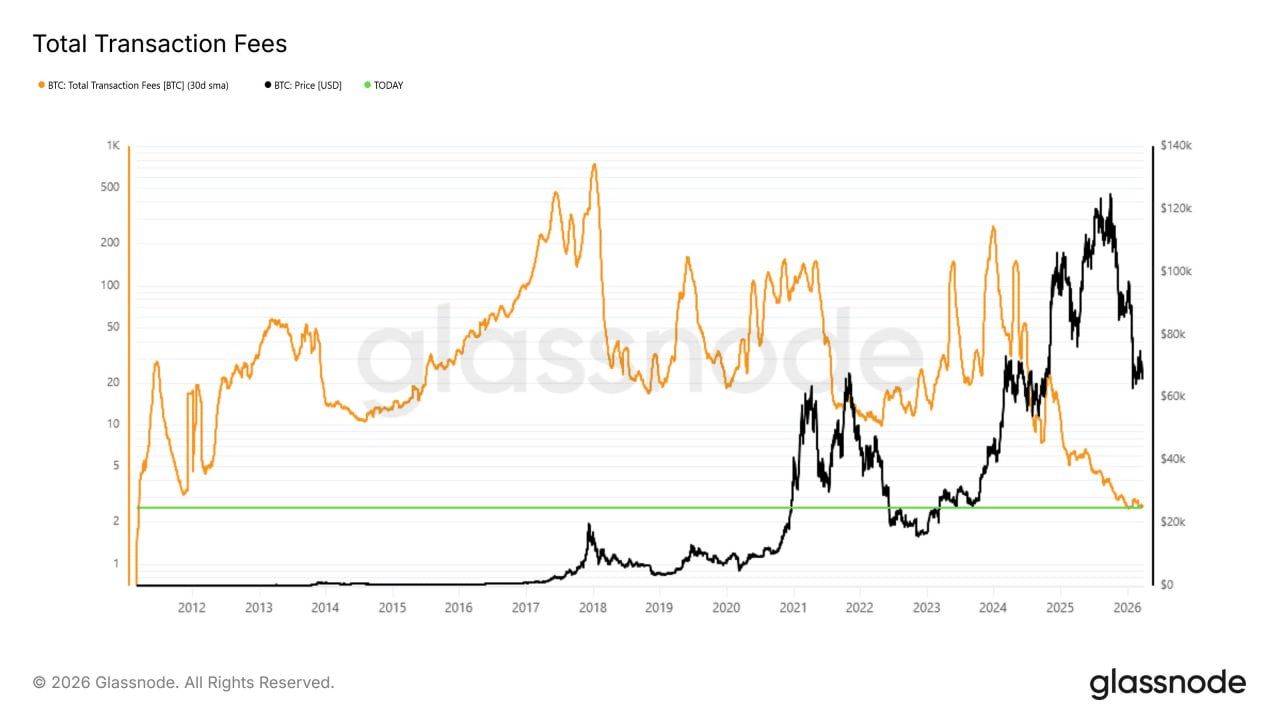
Source: Glassnode

According to CryptoQuant data, institutional selling pressure continues to linger as the Coinbase Premium Index (CPI) remains in negative territory, signaling persistent selling from U.S.-based institutional flows.

In fact, the only brief relief in this pressure appeared when Bitcoin retested the $75,000 level.

Meanwhile, Short-Term Holder Net Position Change (both on daily readings and across the 90-day trend) shows distribution, indicating STHs are still rotating Bitcoin back into the market rather than accumulating.

Taken together, falling fees, weak accumulation, and ongoing capitulation, alongside Bitcoin’s 22% correction in Q1 and an additional 2.04% drop so far in April, show that BTC hasn’t been fully insulated from macro risk.

That, in turn, puts Michael Saylor’s broader thesis under real market scrutiny.


Final Summary

  • Bitcoin’s institutional narrative is gaining traction, but macro volatility continues to dominate price action.
  • Weak on-chain activity and ongoing distribution suggest BTC still behaves like a risk asset rather than a fully matured digital credit system, challenging Saylor’s “Bitcoin has won” thesis.


Related Questions

QWhat is Michael Saylor's main argument about Bitcoin in the article?

AMichael Saylor argues that 'Bitcoin has won' and is gradually positioning itself as a credit instrument within institutional financial systems, rather than functioning as a speculative asset, with its future evolution being shaped by TradFi institutions integrating it as a digital asset.

QAccording to the article, why is the traditional four-year Bitcoin cycle considered 'dead'?

AThe traditional four-year Bitcoin cycle is considered 'dead' because the 2024 halving did not deliver the kind of post-halving rally seen in previous cycles, thereby disrupting the usual supply narrative.

QWhat on-chain metric indicates weak network activity and demand for Bitcoin?

ABitcoin's transaction fees have dropped to 2.5 BTC per day, the lowest since 2011, which signals softer demand, lower transaction pressure, and reduced participation on the network.

QWhat does the negative Coinbase Premium Index (CPI) signify for Bitcoin?

AA negative Coinbase Premium Index (CPI) signifies persistent selling pressure from U.S.-based institutional flows, indicating that institutional investors are continuing to sell Bitcoin.

QHow has macro uncertainty affected Bitcoin's price according to the analysis?

AMacro uncertainty has dragged Bitcoin nearly 32% down from its yearly peak of $97k, causing a 22% correction in Q1 and an additional 2.04% drop in April, showing that BTC's price action is still strongly influenced by external liquidity conditions and geopolitical events.

Related Reads

Trading

Spot
Futures

Hot Articles

What is $BITCOIN

DIGITAL GOLD ($BITCOIN): A Comprehensive Analysis Introduction to DIGITAL GOLD ($BITCOIN) DIGITAL GOLD ($BITCOIN) is a blockchain-based project operating on the Solana network, which aims to combine the characteristics of traditional precious metals with the innovation of decentralized technologies. While it shares a name with Bitcoin, often referred to as “digital gold” due to its perception as a store of value, DIGITAL GOLD is a separate token designed to create a unique ecosystem within the Web3 landscape. Its goal is to position itself as a viable alternative digital asset, although specifics regarding its applications and functionalities are still developing. What is DIGITAL GOLD ($BITCOIN)? DIGITAL GOLD ($BITCOIN) is a cryptocurrency token explicitly designed for use on the Solana blockchain. In contrast to Bitcoin, which provides a widely recognized value storage role, this token appears to focus on broader applications and characteristics. Notable aspects include: Blockchain Infrastructure: The token is built on the Solana blockchain, known for its capacity to handle high-speed and low-cost transactions. Supply Dynamics: DIGITAL GOLD has a maximum supply capped at 100 quadrillion tokens (100P $BITCOIN), although details regarding its circulating supply are currently undisclosed. Utility: While precise functionalities are not explicitly outlined, there are indications that the token could be utilized for various applications, potentially involving decentralized applications (dApps) or asset tokenization strategies. Who is the Creator of DIGITAL GOLD ($BITCOIN)? At present, the identity of the creators and development team behind DIGITAL GOLD ($BITCOIN) remains unknown. This situation is typical among many innovative projects within the blockchain space, particularly those aligning with decentralized finance and meme coin phenomena. While such anonymity may foster a community-driven culture, it intensifies concerns about governance and accountability. Who are the Investors of DIGITAL GOLD ($BITCOIN)? The available information indicates that DIGITAL GOLD ($BITCOIN) does not have any known institutional backers or prominent venture capital investments. The project seems to operate on a peer-to-peer model focused on community support and adoption rather than traditional funding routes. Its activity and liquidity are primarily situated on decentralized exchanges (DEXs), such as PumpSwap, rather than established centralized trading platforms, further highlighting its grassroots approach. How DIGITAL GOLD ($BITCOIN) Works The operational mechanics of DIGITAL GOLD ($BITCOIN) can be elaborated on based on its blockchain design and network attributes: Consensus Mechanism: By leveraging Solana’s unique proof-of-history (PoH) combined with a proof-of-stake (PoS) model, the project ensures efficient transaction validation contributing to the network's high performance. Tokenomics: While specific deflationary mechanisms have not been extensively detailed, the vast maximum token supply implies that it may cater to microtransactions or niche use cases that are still to be defined. Interoperability: There exists the potential for integration with Solana’s broader ecosystem, including various decentralized finance (DeFi) platforms. However, the details regarding specific integrations remain unspecified. Timeline of Key Events Here is a timeline that highlights significant milestones concerning DIGITAL GOLD ($BITCOIN): 2023: The initial deployment of the token occurs on the Solana blockchain, marked by its contract address. 2024: DIGITAL GOLD gains visibility as it becomes available for trading on decentralized exchanges like PumpSwap, allowing users to trade it against SOL. 2025: The project witnesses sporadic trading activity and potential interest in community-led engagements, although no noteworthy partnerships or technical advancements have been documented as of yet. Critical Analysis Strengths Scalability: The underlying Solana infrastructure supports high transaction volumes, which could enhance the utility of $BITCOIN in various transaction scenarios. Accessibility: The potential low trading price per token could attract retail investors, facilitating wider participation due to fractional ownership opportunities. Risks Lack of Transparency: The absence of publicly known backers, developers, or an audit process may yield skepticism regarding the project's sustainability and trustworthiness. Market Volatility: The trading activity is heavily reliant on speculative behavior, which can result in significant price volatility and uncertainty for investors. Conclusion DIGITAL GOLD ($BITCOIN) emerges as an intriguing yet ambiguous project within the rapidly evolving Solana ecosystem. While it attempts to leverage the “digital gold” narrative, its departure from Bitcoin's established role as a store of value underscores the need for a clearer differentiation of its intended utility and governance structure. Future acceptance and adoption will likely depend on addressing the current opacity and defining its operational and economic strategies more explicitly. Note: This report encompasses synthesised information available as of October 2023, and developments may have transpired beyond the research period.

363 Total ViewsPublished 2025.05.13Updated 2025.05.13

What is $BITCOIN

Discussions

Welcome to the HTX Community. Here, you can stay informed about the latest platform developments and gain access to professional market insights. Users' opinions on the price of BTC (BTC) are presented below.

活动图片














