MetaMask Co-founder Departs, Leaving Behind a Little Fox Packaged in an IPO Prospectus

marsbitPublished on 2026-04-23Last updated on 2026-04-23

Abstract

MetaMask co-founder Dan Finlay has left Consensys after a decade, citing burnout and a desire to spend more time with family. MetaMask, launched in 2016, is one of the most recognizable crypto wallets with over 100 million installs and 30 million monthly active users. Despite its dominant position, the wallet faces growing competition from newer entrants like Phantom, which has expanded beyond Solana and reportedly generates more than double MetaMask’s annual revenue. The timing of Finlay’s departure coincides with Consensys’s plans for an IPO, advised by J.P. Morgan and Goldman Sachs. The company, last valued at $7 billion in 2022, has undergone multiple rounds of layoffs amid slowing growth and internal challenges. Employee reviews on Glassdoor point to low morale and management issues. MetaMask’s delayed expansion into chains like Solana and the long-promised but unreleased $MASK token have also drawn criticism. While the wallet remains the default option for many Ethereum dApps, its product-market fit is weakening as new users increasingly choose alternatives. Consensys appears to be prioritizing monetizing MetaMask’s strong brand recognition through a public listing while its market position is still valuable. Finlay’s quiet exit reflects both personal fatigue and broader shifts in the competitive landscape of crypto wallets.

Author: Curry, Deep Tide TechFlow

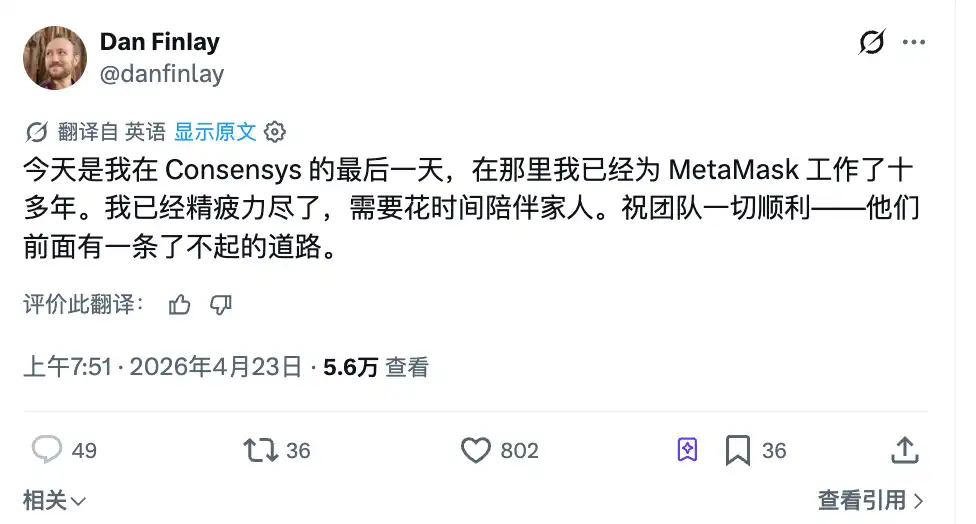
The person who built this little fox doesn't want to build anymore.

On April 23, MetaMask co-founder Dan Finlay officially announced his departure from Consensys, ending a decade-long development career. The reason given was professional burnout and a desire to spend more time with family.

MetaMask is perhaps the most recognizable product application in the crypto world. That little orange fox logo is known to almost everyone who has ever installed a crypto wallet. In 2016, Finlay and another co-founder, Aaron Davis, created this browser plugin within Consensys, allowing ordinary people to interact with Ethereum without running a full node.
Over the past ten years, according to statistics from multiple third-party platforms, it has achieved over 100 million global installs, with approximately 30 million monthly active users. Its swap function has cumulatively generated over $325 million in fee revenue.

A look at public information reveals that Finlay has hardly given any interviews in the past decade. Previously a coder at Apple, he is fundamentally an engineer at heart, not someone who builds a public persona.

When such a person says they are tired, they usually mean it. It's just that the timing of his departure is hard not to overthink.

Just a few months ago, Consensys hired J.P. Morgan and Goldman Sachs as IPO advisors, with a target to go public as soon as this year, according to an Axios report.

The company's last funding round was in 2022, when it was valued at $7 billion. It has since undergone at least two rounds of layoffs. And the $MASK token, promised since 2021, still hasn't materialized after five years.

Issuing a token doesn't seem that necessary for a wallet. More frighteningly, it seems like the little fox isn't that necessary for everyone either.

The Default, But Not the Preferred Choice

In the past, the first step in many dApp development documents was "Please install MetaMask first." It was the default wallet for the industry, like the blue IE browser on your Windows desktop ten years ago.

The problem is, the default and the preferred choice have long ceased to be the same thing.

Phantom started out only as a Solana wallet, later expanding to Ethereum and Bitcoin. In January 2025, it raised a $150 million Series C, valuing the company at $3 billion.

According to estimates by whales.market based on on-chain data, Phantom's annualized revenue is approximately $108 million;相比之下 MetaMask's is about $46 million. More than double the difference, and Phantom is five years younger than MetaMask.

Phantom started on Solana in 2021, catching the entire process of the Solana ecosystem's recovery and explosion. According to Helius statistics, Solana's DEX trading volume surpassed Ethereum's in 2024, and on-chain application revenue reached $2.39 billion in 2025, a 46% year-on-year increase. 725 million new wallets conducted their first Solana transaction in 2025. Phantom was waiting at the door when these users came in.
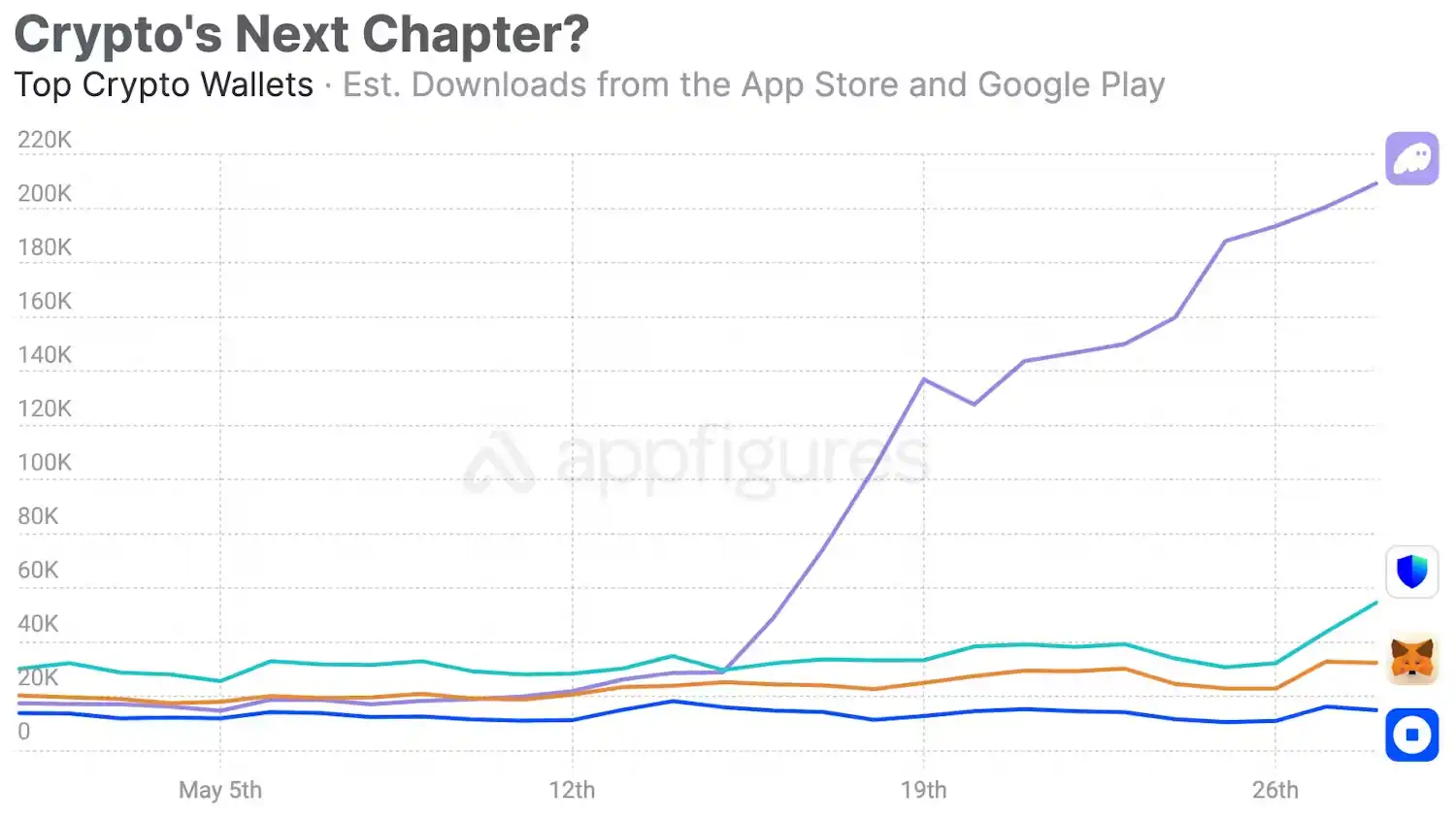
And MetaMask? It only launched native Solana support in May 2025. Before that, users who wanted to access Solana through MetaMask had to install a third-party plugin called Snaps, an experience akin to installing a Chrome kernel on the IE browser...

In these five years, Solana went from a chain that nearly died due to the FTX crash to, at one point, the chain with the largest trading volume. Phantom's valuation rose accordingly, securing a $150 million Series C funding round in early 2025 with a $3 billion valuation.

The author believes MetaMask's slowness wasn't due to technical inability, but also an issue of identity. MetaMask is Ethereum's favored child; its parent company Consensys was founded by Ethereum co-founder Joe Lubin.

Supporting Solana was an expansion for Phantom, but a betrayal for MetaMask. By the time the Ethereum ecosystem's growth indeed slowed down and cross-chain became necessary, the window of opportunity had long passed.

Of course, MetaMask's compatibility within the Ethereum ecosystem is still the strongest. Almost all dApps on EVM chains test it as the default option. The 30 million monthly active users are real.

But this stickiness doesn't come from product strength; it comes from switching costs. And switching costs can only prevent old users from leaving, not stop new users from going elsewhere.

A person who started playing on-chain in 2025 is probably not being recommended MetaMask by their friends when they go to install a wallet.

The Little Fox Up for Sale

The product is falling behind, people are leaving, but Consensys is pursuing an IPO.

According to an Axios report in October 2025, Consensys hired J.P. Morgan and Goldman Sachs as IPO advisors, targeting a public listing as soon as this year. If successful, this would be the first company deeply tied to Ethereum core infrastructure to list on the US stock market.

But in the same year it hired the investment banks, Consensys underwent at least two rounds of layoffs.

In October 2024, it cut 20% of its staff, about 160 people, with CEO Joe Lubin citing macroeconomic pressures and regulatory uncertainty. Another round occurred mid-2025, this time justified as "driving profitability."

On the well-known job review community Glassdoor, employee reviews are uglier than the layoffs themselves.

Someone wrote that the company lays off people at least twice a year, always cutting frontline contributors, never management. Another said that after sharing their promotion aspirations with their superior, their name appeared on the next layoff list.

It's unclear how much of these reviews are emotion and how much is fact. But a company conducting significant layoffs while employee morale hits rock bottom, all while sprinting towards an IPO, is itself a signal.

Then there's the story of the MASK token.

In 2021, Lubin tweeted "Wen $MASK?", causing a stir in the community. In 2022, he further explained plans for a token and DAO to promote "progressive decentralization." In May 2025, Finlay was interviewed by The Block and asked when the token would come; his answer became maybe.

For users, the MASK token is a carrot, dangled to keep using, interacting, and contributing on-chain data to MetaMask. For Consensys, the token is a card not yet played before the IPO.

Issuing it too early dilutes the valuation narrative; issuing it too late loses community support. Now the co-founder has left, the token hasn't been issued, but the IPO is coming.

MetaMask's product competitiveness is declining, a trend difficult to reverse in the short term. But MetaMask's brand recognition remains; that little orange fox is still the world's most recognizable crypto logo.

Brand value and product value decay at different rates; brand decays slower.

For crypto companies, an IPO often sells not the product, but the brand plus the narrative. "Ethereum infrastructure," "Web3 gateway," "World's largest self-custody wallet"... These labels still work well on pitch decks, even years later. Lubin himself is an Ethereum co-founder, an identity that carries its own halo effect in front of traditional investors.

So Consensys's choice is to package MetaMask into a public company shell while the brand is still valuable, while the regulatory window is still open, while Wall Street still has enthusiasm for crypto infrastructure, and let the public market set the price.

Silence is Not Golden

The reaction to co-founder Finlay's departure was muted in Crypto Twitter (CT). No long farewell posts went viral, no laments about "the end of an era," most people didn't even care about the news.

The comings and goings of Metamask's co-founder generated less buzz than some KOL complaining about shrunken conference swag in Hong Kong.

This in itself says something.

MetaMask is a rare case in the crypto industry. It possesses one of the industry's largest brands, but its founders have almost no personal brand.

In an industry where the founder is often the biggest marketing resource, MetaMask's two founders chose to remain invisible. The product spoke for them, until the product could no longer speak effectively.

The author believes MetaMask's story is essentially one about being the "default."

In the technology industry, becoming the default option is the most powerful competitive advantage, and the most dangerous sedative. When you are the default, user growth happens without you to do anything.

But this growth masks the fact that the product itself is aging. By the time you notice users leaving, the exodus has often been ongoing for a long time.

IE was the default browser, lost to Chrome. Nokia was the default phone, lost to iPhone.

Windows Media Player was the default media player, lost to everyone. These products lost while their market share was still high, brand recognition still strong, but new users were no longer choosing them.

MetaMask is now in this position. The existing user base remains, the brand is still loud, but the growth has gone elsewhere. Consensys's IPO plan is, ultimately, about monetizing the existing user base.

When brand value exceeds product value, selling is indeed the rational choice.
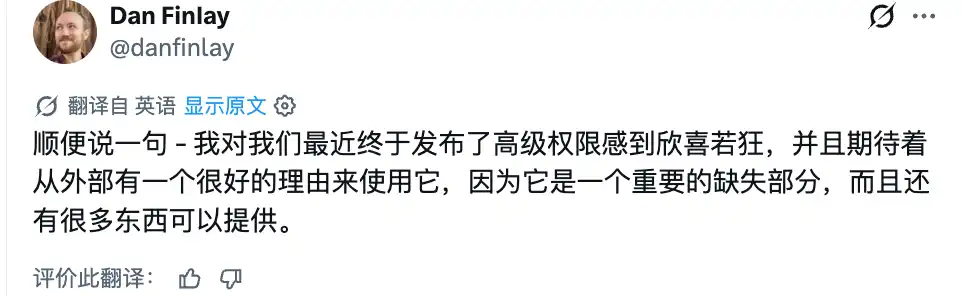
On the day Finlay left, MetaMask just launched a new feature called ERC-7715 for advanced permissions. He said he looked forward to experiencing it as a regular user in the future.

A product's creator becoming its ordinary user is probably the most朴实 (simple/unadorned) and quietest farewell in the crypto industry.

But for MetaMask, how many ordinary users will still click on that little fox every day next year? Are you still using it?


Related Questions

QWhy did Dan Finlay, the co-founder of MetaMask, leave Consensys?

ADan Finlay left Consensys due to professional burnout and a desire to spend more time with his family.

QHow does MetaMask's revenue compare to its competitor Phantom's revenue?

AAccording to data from whales.market, Phantom's annualized revenue is approximately $108 million, while MetaMask's is about $46 million, making Phantom's revenue more than double that of MetaMask.

QWhat is the significance of the timing of Finlay's departure in relation to Consensys's corporate plans?

AFinlay's departure coincides with Consensys's plans for an IPO, as the company has reportedly hired J.P. Morgan and Goldman Sachs as advisors with the goal of going public as soon as this year.

QWhy was MetaMask slow to support the Solana blockchain, and what was the consequence?

AMetaMask was slow to support Solana due to its identity as an Ethereum-native product and its close ties to the Ethereum ecosystem. This delay allowed competitors like Phantom, which launched on Solana first, to capture a significant share of the new user growth on that chain.

QWhat does the article suggest is the primary motivation behind Consensys's push for an IPO?

AThe article suggests that Consensys is pursuing an IPO to monetize MetaMask's strong brand recognition and narrative value while it is still high, even though the product's competitive edge and user growth are declining.

Related Reads

STAR 50 Soars 10.73%, Why Did A-Shares Stage a "V-Shaped Reversal"?

After a prolonged decline, the Chinese A-share market staged a strong rally on July 21. The STAR 50 index surged 10.73%, its largest single-day gain in nearly a year, leading a broad-based "V-shaped" reversal. The Shanghai Composite Index rose 1.79%, the Shenzhen Component Index gained 4.81%, and the ChiNext Index jumped 7.05%. Total market turnover reached 2.97 trillion yuan, an increase of 256.1 billion yuan from the previous session, with over 3,100 stocks advancing. The semiconductor sector spearheaded the rebound, with related ETFs posting significant gains. Analysts attribute the surge to three converging factors. First, coordinated capital inflows from "national team" institutions, insurance funds, listed company buybacks, and fund house self-purchases have bolstered market liquidity and confidence. Second, supportive policy signals, including commitments from regulators to ensure stable market operations, provided a favorable backdrop. Third, a stabilization and recovery in overseas markets, notably South Korea, created a positive external environment. Institutions suggest the most severe panic selling phase for the tech sector has likely passed, following a significant digestion of crowded positions and leveraged funds. While short-term volatility may persist, the medium to long-term outlook remains underpinned by enduring trends like AI computing demand expansion and semiconductor localization. The market's focus now shifts to the sustainability of supportive fund flows, earnings reports, and upcoming catalysts from the global AI industry chain.

marsbit15m ago

STAR 50 Soars 10.73%, Why Did A-Shares Stage a "V-Shaped Reversal"?

marsbit15m ago

U.S. Tech Momentum Stocks Post Largest Single-Day Gain Ever, But Is the Plunge Over?

US tech momentum stocks staged a sharp rebound on Tuesday (July 21st). Morgan Stanley's TMT Momentum Factor surged over 12%, marking its largest single-day gain on record, exceeding even peaks from the 2000 dot-com bubble. Key momentum indices from Goldman Sachs also posted their strongest daily performances in years. The rally was led by semiconductors, with the Philadelphia Semiconductor Index jumping 4.6%. This rebound followed three consecutive down days and a cumulative 33% plunge in momentum stocks, one of the steepest drawdowns since the dot-com era. Analysts attribute the surge largely to a short squeeze. Heavy selling had pushed high-beta momentum stocks into deeply oversold territory, forcing many short sellers, particularly in Asia, to cover their positions, creating a self-reinforcing buying spiral. However, the rebound's internals appear weak. Trading volume was notably low, and advancing stocks still lagged decliners on the S&P 500, indicating a narrow, concentrated rally rather than broad market participation. Diverging views emerge on the outlook. BTIG warns the bounce has hit key resistance and recommends selling into strength, citing extreme volatility and historical parallels to past market tops. Conversely, Goldman Sachs and UBS believe the momentum unwind is nearing its end, suggesting it may be time to gradually add exposure, as positioning has been significantly reduced. They caution, however, that high volatility warrants a measured approach, potentially using defined-risk strategies. The upcoming earnings season, particularly reports from major tech firms like Alphabet, is seen as a critical test for the rally's sustainability. Simultaneously, bond markets flashed a warning, with yields rising partly due to spiking oil prices. Analysts note that if long-term Treasury yields break decisively higher, it could pose a significant headwind for equities, especially growth stocks.

marsbit22m ago

U.S. Tech Momentum Stocks Post Largest Single-Day Gain Ever, But Is the Plunge Over?

marsbit22m ago

U.S. Tech Momentum Stocks Record Largest Single-Day Gain Ever, but Has the Rout Ended?

U.S. tech momentum stocks staged a dramatic rebound on Tuesday, July 21st. Key momentum indices like the Morgan Stanley TMT Momentum Factor and Goldman Sachs' High Beta Momentum Long Index posted historic or near-historic single-day gains, fueled largely by semiconductor stocks. This sharp rally followed a severe three-day sell-off that saw momentum stocks plunge 33%, marking one of the steepest pullbacks since the dot-com bubble. Analysts attribute the bounce primarily to a short squeeze, as forced covering from over-leveraged traders, particularly in Asia, created a buying spiral. However, the rally's health is questioned due to weak market breadth—overall trading volume was low, and decliners outnumbered advancers in the S&P 500 despite the index's gain—suggesting a narrow, concentrated surge rather than broad recovery. Opinions on the sustainability diverge. BTIG strategists warn the rebound has hit key resistance levels, citing extreme volatility and historic stock dispersion as signs of an ongoing broader correction, and recommend selling into strength. Conversely, Goldman Sachs and UBS view the aggressive momentum unwinding as nearing its end, noting reduced positioning and a lack of new fundamental catalysts. They suggest the sell-off presents a selective opportunity to add exposure, albeit cautiously and gradually using defined-risk strategies. The immediate trajectory hinges on the ongoing earnings season, with market focus on Alphabet's capital expenditure guidance for AI investment clarity. Meanwhile, bond markets present a risk, with rising Treasury yields—potentially heading toward 5.5%—and widening credit spreads for mega-cap tech companies posing a threat to equity valuations. The combination of technical factors, earnings results, and macro conditions leaves the durability of the rebound in doubt.

链捕手25m ago

U.S. Tech Momentum Stocks Record Largest Single-Day Gain Ever, but Has the Rout Ended?

链捕手25m ago

Long-Divided Must Unite, Long-United Must Divide: When L1 Becomes Its Own Rollup, What Is Ethereum's Endgame?

"The Inevitable Cycle: When L1 Becomes Its Own Rollup – What is Ethereum's Endgame?" For years, the Ethereum community grappled with concerns that L2s were fragmenting the ecosystem and eroding L1's value. While L2s provided cheaper execution, they also splintered liquidity and the unified user experience of a single chain. This has prompted a fundamental reassessment of the relationship between L1 and L2. Ethereum's roadmap is evolving. The "Scale" initiative merges L1 and L2 expansion into a holistic framework. L1 itself is advancing with higher gas limits, statelessness, and zkEVM verification, no longer content to be just a low-throughput settlement layer. Consequently, the primary value proposition of L2s is shifting from merely providing cheap blockspace to offering L1 cannot easily provide: application-specific optimizations, privacy features, and flexible governance models. L2s are becoming a spectrum of execution environments with varying degrees of security inheritance from Ethereum. A critical challenge in this multi-chain future is interoperability. The vision is to make Ethereum "feel like one chain again." This relies on advancements in native account abstraction (like EIP-7702) and intent-based architectures (Open Intents Framework), where users declare desired outcomes, and solvers handle the complex cross-chain execution. Furthermore, shortening Ethereum's finality time from minutes to seconds is crucial, as it underpins trust between chains for bridges, stablecoins, and cross-chain applications. Perhaps the most provocative idea is that Ethereum L1 itself could become a form of "its own Rollup." As zkEVM and proof systems mature, high-performance nodes could execute transactions and generate validity proofs. Regular validators would then verify these proofs instead of re-executing all transactions. This blurs the traditional L1/L2 hierarchy, making "Rollup" more of a general execution-verification architecture. Native Rollup aims to integrate L2 validation more directly into the Ethereum protocol, allowing L2s to inherit L1's security more fully and move away from reliance on security councils. In the end, L2s are not destined to replace L1 or be made obsolete by it. The likely future is a unified system where diverse execution environments—each optimized for specific use cases like DeFi, gaming, or privacy—coexist. They will share a common foundation of security, liquidity, and verifiable state, seamlessly connected to restore a cohesive user experience. The next phase for Ethereum is not just about scaling through separation, but about intelligently reintegrating what was separated back into a coherent whole.

链捕手41m ago

Long-Divided Must Unite, Long-United Must Divide: When L1 Becomes Its Own Rollup, What Is Ethereum's Endgame?

链捕手41m ago

Trading

Spot
活动图片




