McKinsey x Artemis Joint Report: Only 1% of Stablecoin's $35 Trillion Transaction Volume is Real Payments, C-Side Usage Negligible

marsbitPublished on 2026-03-18Last updated on 2026-03-18

Abstract

McKinsey and Artemis's joint report reveals that out of $35 trillion in annual stablecoin transaction volume, only about 1% ($390 billion) represents genuine payments. The majority (58%) of these real payments are B2B transactions—such as cross-border settlements and corporate treasury operations—which grew 733% year-over-year. Consumer usage, including retail payments and card spending, remains negligible. The report identifies five structural reasons for this institutional dominance: 1) Greater financial efficiency incentives for businesses; 2) Programmable payments suit B2B workflows, not consumer use cases; 3) Regulatory frameworks favor institutional adoption; 4) Closed-loop B2B systems avoid network effects needed for retail; 5) Corporations prioritize internal benefits over expanding to retail networks. While B2B stablecoin adoption continues accelerating, consumer usage faces significant friction and may remain secondary. The analysis suggests stablecoins may evolve primarily as an institutional settlement layer rather than a mainstream retail payment tool.

Author: Stablecoin Insider / McKinsey×Artemis

Compiled by: Deep Tide TechFlow

Deep Tide Introduction: The McKinsey and Artemis joint report did something rare in the industry: breaking down the stablecoin transaction volume data. The conclusion: of the approximately $35 trillion in annual on-chain transaction volume, only about $390 billion (about 1%) represents real payment behavior, of which 58% is business-to-business financial operations, with an annual growth of 733%. Consumer-side stablecoin usage is almost negligible, and this is no accident—the article summarizes five structural reasons explaining why the gap between institutions and individuals is not just a temporary disparity.

Full text as follows:

The stablecoin industry has a headline problem.

On one hand, raw on-chain data shows tens of trillions of dollars flowing on-chain annually, a figure that fuels endless comparisons with Visa and Mastercard, and predictions of SWIFT's imminent replacement.

On the other hand, a landmark report released in February 2026 by McKinsey & Company and Artemis Analytics stripped all this away and asked a more direct question: how much of it is real payments?

The answer is about 1%.

Of the approximately $35 trillion in annualized stablecoin transaction volume, only about $390 billion represents genuine end-user payments, such as supplier invoices, cross-border remittances, payroll disbursements, and card swipes. The rest is trading activity, internal fund shuffling, arbitrage behavior, and automated smart contract loops.
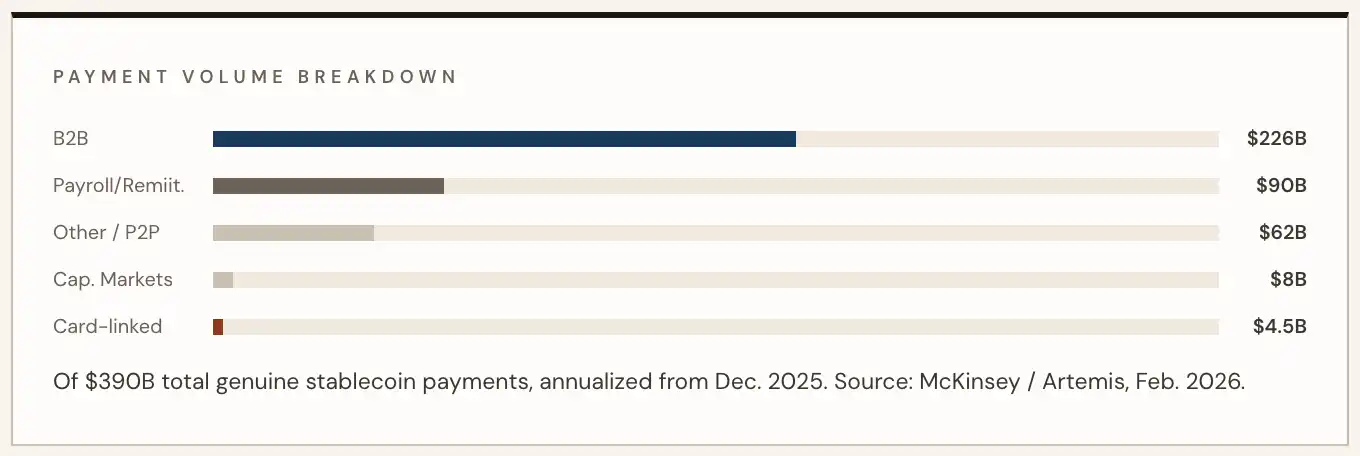
The report concludes that the inflated headline numbers should be "the starting point for analysis, not a proxy for measuring payment adoption."

But within this real $390 billion baseline, there is a story worth examining closely, and it almost entirely revolves around corporate finance, not consumer wallets.

B2B Dominates: What the Data Actually Shows

According to the McKinsey/Artemis analysis (benchmarked to activity data from December 2025), business-to-business transactions account for $226 billion of all real stablecoin payment volume, about 58%.

This figure represents a 733% year-on-year increase, primarily driven by supply chain payments, cross-border supplier settlements, and financial liquidity management. Asia leads in geographic activity, but adoption is also accelerating in Latin America and Europe.

The remainder of the real payment space is distributed among payroll and remittances ($90 billion), capital market settlements ($8 billion), and linked card spending ($4.5 billion).

According to McKinsey, card spending associated with stablecoins grew an astonishing 673% year-on-year, but in absolute terms, it remains only a small fraction of B2B flow.
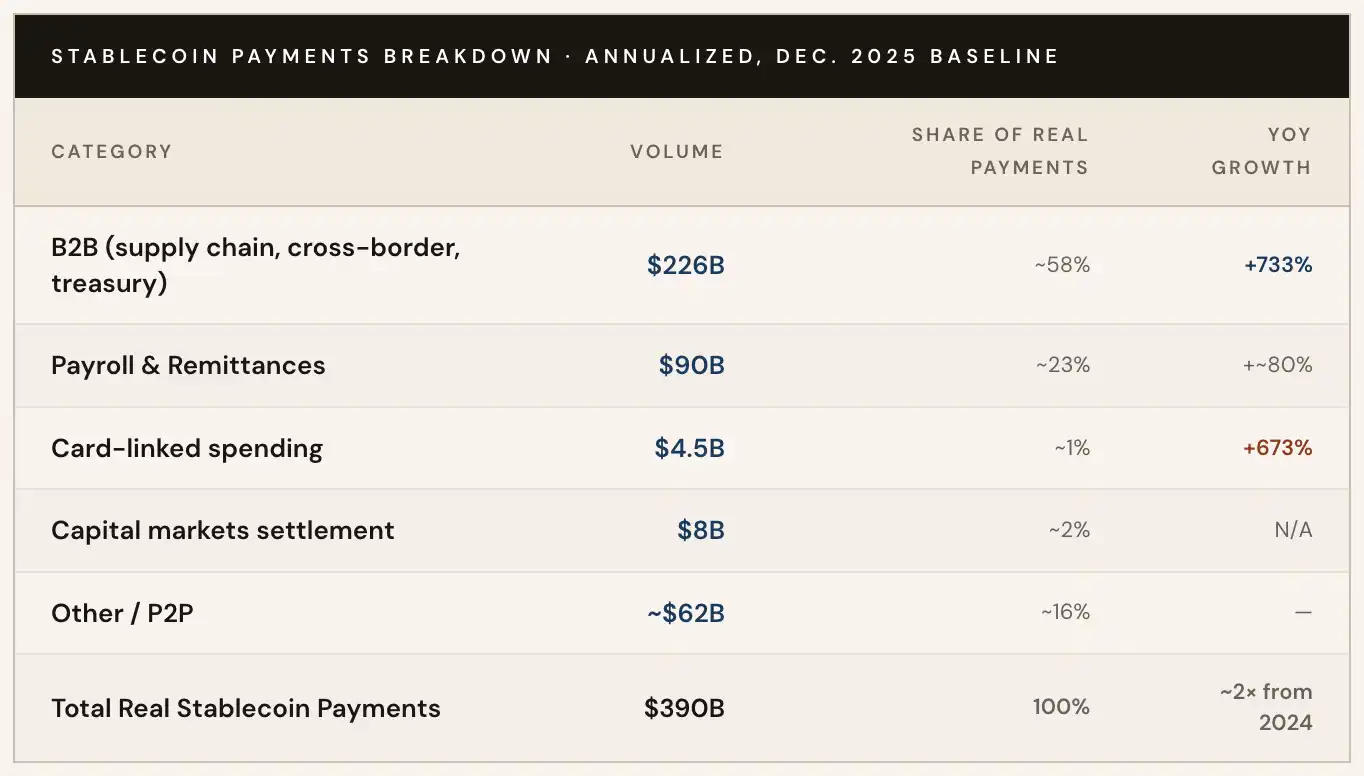
For context: this total of $390 billion represents only 0.02% of McKinsey's estimated global annual payment total of over 2 quadrillion dollars. Specifically, B2B stablecoin flow accounts for about 0.01% of the global $160 trillion B2B payment market.

These numbers are large in the context of stablecoins but remain minuscule in the context of the global financial system.

Monthly run-rate data more intuitively shows where the momentum lies. According to data cited by BVNK from the McKinsey/Artemis report, stablecoin monthly payment volume was only $5 billion in January 2024; by early 2026, this number had exceeded $30 billion—a sixfold increase in less than two years, with the steepest acceleration occurring in the second half of 2025.

Annualized, this run rate now exceeds $390 billion.

"The fact that real stablecoin payments are far lower than conventional estimates does not diminish the long-term potential of stablecoins as a payment rail; it simply establishes a clearer baseline for assessing where the market stands." — McKinsey/Artemis Analytics, February 2026

Why the Gap Exists: Five Structural Forces Excluding Retail

The divergence between the explosive adoption in B2B and the negligible consumer usage is not coincidental but the product of structural asymmetries that systematically favor corporate use cases over retail ones.

Here are the five forces driving the institutional gap:

1) Financial Efficiency Beats Consumer Convenience

Corporate treasurers are driven by specific, quantifiable pain points: SWIFT correspondent banking chains that take one to five business days to settle, currency exchange windows that tie up working capital, and intermediary fees layered on at every transaction point.

Stablecoins solve all three problems simultaneously. For a company paying suppliers in fifteen countries, the economic case is clear; for a consumer buying coffee, it is not. The incentive to switch is orders of magnitude greater on the enterprise side.

2) Programmability Has No Equivalent Value on the Retail Side

The B2B explosion is partly a story of programmable payments. Smart contracts enable conditional logic—invoice triggering, delivery confirmation, escrow release—that can automate entire accounts payable processes at scale.

This is naturally suited to corporate finance operations, as high-value, structured, repetitive payment processes benefit immensely from automation. Retail payments lack similar trigger use cases at any scale.

Consumers buying groceries don't need programmable conditions; they need something that works like swiping a card. The cognitive complexity of blockchain-native payments remains a barrier on the retail side, and programmability does nothing to help that.

3) Regulatory Architecture Favors Institutions

Post the GENIUS Act, institutional operators have adapted to the compliance architecture—AML/CFT, Travel Rule, licensing requirements—and built the legal infrastructure to operate confidently.

Corporate finance teams have dedicated compliance functions that can absorb onboarding friction; individual consumers cannot. The result is that, in most jurisdictions, on-ramps for stablecoins remain operationally complex for retail users, and the merchant acceptance gap persists globally.

Every frictionless B2B payment today is a data point institutions use to justify further investment; the consumer ecosystem, meanwhile, awaits a compliant, user-experience-smooth entry point that has not yet emerged at scale.

4) Closed-Loop Advantage

B2B stablecoin payments succeed precisely because they are closed-loop: business sends to business, both have wallets, both have compliance infrastructure, and neither needs a universal merchant network.

Consumer payments face the classic chicken-and-egg problem: merchants won't invest in stablecoin acceptance infrastructure until consumers demand it; consumers won't enable wallets until they can spend widely.

The institutional world completely bypasses this problem by operating in bilateral or consortium environments, requiring no open merchant network.

5) Institutional Incentives Point Upstream

Corporate treasurers holding stablecoins gain yield, reduce FX exposure, and improve liquidity management—advantages that accrue internally and, if shared downstream, introduce complexity or competitive vulnerability.

Extending stablecoin use to a supplier's supplier, employees, or end consumers requires building a network that benefits those downstream parties, which is not necessarily in the interest of the originating finance team.

In the absence of a clear ROI driving network expansion outward, companies rationally choose to consolidate internal gains.

Market Context

BVNK's own infrastructure data corroborates the dominance of B2B from an operator's perspective. The company processed $30 billion in annualized stablecoin payment volume in 2025, a 2.3x year-on-year increase, with one-third of the volume coming from the US market.

Its client list (Worldpay, Deel, Flywire, Rapyd, Thunes) consists of leaders in cross-border B2B and payroll, not consumer applications.

As BVNK stated in its 2025 year-end review:

"The initial assumption that remittances and consumer transfers would lead stablecoin growth did not materialize as the primary driver; B2B instead assumed that role."

When Will Retail Catch Up—If Ever

The McKinsey/Artemis baseline makes the current situation clear. What it cannot answer is whether the institutional gap will narrow, widen, or permanently solidify.

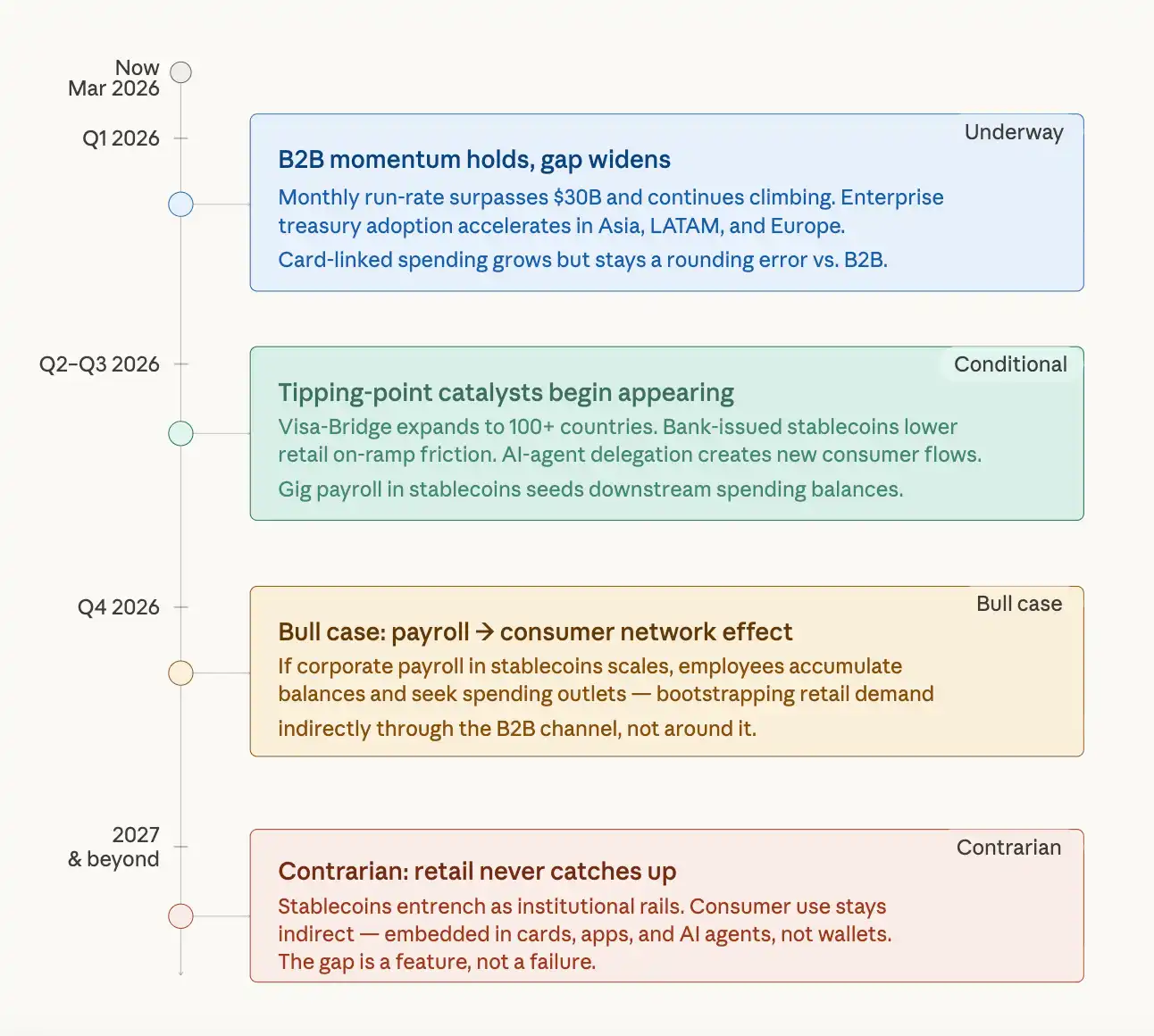
Here are three possible scenarios for the next 18 months:
Near Term 2026—The Gap Widens Further

B2B momentum shows no signs of slowing. The monthly run rate of over $30 billion continues its trajectory as more companies use stablecoin rails for cross-border accounts payable and financial operations. Consumer stablecoin card spending grows modestly but remains negligible in absolute terms compared to B2B flow. Even if retail adoption advances slowly in percentage terms, the gap widens in absolute dollar terms.

Mid-Term End-2026 to 2027—Inflection Points Begin to Appear

Several catalysts could begin to bridge the gap: bank-issued multi-currency stablecoins reduce retail on-ramp friction; programmable features extend to consumer applications via AI Agent payment delegation; gig economy wages paid in stablecoins create downstream spending balances for employees.

US Treasury Secretary Scott Bessent predicted that stablecoin supply could reach $3 trillion by 2030, a trajectory implying consumer network effects will eventually emerge.

Counterview—Retail May Never 'Catch Up,' and That Might Be the Point

The most honest reading of the McKinsey data is that stablecoins may be evolving into what the report faintly hints at: a programmable settlement layer on the internet for machines, finance departments, and institutions, with consumer adoption being an indirect, embedded benefit, not the primary use case.

If this framework holds, then the institutional gap is not a failure of adoption but a feature of the technology's natural architecture. Corporate wages paid in stablecoins may eventually create downstream consumer spending, but the path from B2B infrastructure to retail wallets is long, circuitous, and dependent on user experience breakthroughs that have not yet emerged at scale.

An Honest Baseline

The McKinsey/Artemis report did something more valuable than recording stablecoin growth: it established an honest baseline the industry has clearly been missing.

Stripping away trading noise, internal shuffling, and automated smart contract loops reveals a genuinely growing market—real payment volume doubled from 2024 to 2025—but one that is highly concentrated on the institutional side in a structural, non-accidental way.

The 733% growth in B2B is not a deferred consumer story; it is a maturing finance story.

The enterprises building on stablecoin rails today are solving real operational problems—cross-border friction, correspondent banking inefficiencies, working capital delays—problems that have nothing to do with whether consumers hold stablecoin wallets. They will continue building, regardless.


Related Questions

QAccording to the McKinsey and Artemis report, what percentage of the $35 trillion in annual stablecoin transaction volume represents real payments?

AOnly about 1% of the $35 trillion in annual stablecoin transaction volume, or approximately $390 billion, represents real payments.

QWhich segment dominates the real stablecoin payment volume, and what was its growth rate?

ABusiness-to-business (B2B) transactions dominate the real stablecoin payment volume, accounting for 58% ($226 billion) and experiencing a growth rate of 733% year-over-year.

QWhat are the five structural reasons identified for the gap between institutional and consumer adoption of stablecoins?

AThe five structural reasons are: 1) Financial efficiency beats consumer convenience, 2) Programmability has no equivalent value in retail, 3) Regulatory architecture favors institutions, 4) Closed-loop advantages, and 5) Institutional incentives point upstream.

QHow does the real stablecoin payment volume compare to the global payment market?

AThe $390 billion in real stablecoin payments represents only 0.02% of the global annual payment volume of over $2 quadrillion, and the B2B stablecoin volume is about 0.01% of the global $160 trillion B2B payment market.

QWhat is one potential future scenario where the gap between institutional and consumer stablecoin use might begin to narrow?

AA potential scenario for narrowing the gap includes catalysts such as bank-issued multi-currency stablecoins reducing retail onboarding friction, programmable features extending to consumer applications via AI Agent payments, and gig economy wages paid in stablecoins creating downstream consumer spending balances.

Related Reads

The Essence of AI Layoffs: Why More AI Adoption Leads to More Corporate Anxiety?

The author, awaiting potential inclusion on an 8000-person layoff list, analyzes the true nature of recent "AI-driven" layoffs. They argue that while AI use, particularly tools like Claude for code generation, has skyrocketed and boosted developer output (e.g., 2-5x more code commits), this has not translated into proportional business growth or revenue. The core issue is a misalignment between increased "Input" (code) and tangible "Outcomes" (user value, revenue). AI acts as a costly B2B SaaS, inflating operational expenses without guaranteed returns. Two key problems emerge: 1) The friction that once filtered out bad ideas is gone, as AI allows cheap pursuit of even weak concepts. 2) Organizational "alignment tax"—the difficulty of coordinating across teams—becomes crippling when development velocity outpaces consensus-building. Thus, layoffs serve two immediate purposes: 1) To offset ballooning AI costs (Token consumption) and maintain cash flow, as rising input costs without outcome growth destroys unit economics. 2) To reduce organizational bloat and alignment friction by simply removing teams, thereby speeding up execution in the short term. Therefore, these layoffs are fundamentally caused by AI, even if AI doesn't directly replace roles. They represent a painful correction until companies learn to convert AI-driven productivity into real business outcomes and streamline organizational coordination to match the new pace of work. The cycle will continue until this learning curve is mastered.

marsbit7m ago

The Essence of AI Layoffs: Why More AI Adoption Leads to More Corporate Anxiety?

marsbit7m ago

Can the Solana Foundation and Google's Collaboration on Pay.sh Bridge the Payment Link Between Web2 and Web3 in the Agent Economy?

Solana Foundation, in collaboration with Google Cloud, has launched Pay.sh, a payment gateway designed to bridge the gap between AI agents and enterprise-grade service infrastructure. The initiative aims to solve a key bottleneck in the "agent economy": existing payment systems are ill-suited for autonomous AI agents. Traditional methods like credit cards require human verification, while newer on-chain protocols like x402 and MPP create a separate, Web3-native system that raises barriers for service providers. Pay.sh functions as a universal payment layer. It allows users to fund a Solana wallet via credit card or stablecoin, which then acts as an identity and payment proxy for AI agents. When an agent needs to access a paid API service (e.g., Google Cloud, Alibaba Cloud), Pay.sh handles the transaction seamlessly. It leverages the HTTP 402 status code ("Payment Required") to initiate payments, intelligently choosing between one-time transfers (x402-style) or session-based authorizations (MPC-style) based on the service's billing model. This spares agents from manual account registration and API key management. A key feature for service providers is low integration effort. They can adopt Pay.sh by providing a declarative configuration file, enabling features like tiered pricing, free tiers, and automatic revenue splitting to multiple addresses (e.g., for royalties, cloud costs). Providers can also list their APIs in a central Pay Skill Registry for agent discovery. The collaboration with Google Cloud provides crucial infrastructure for API proxying, traffic routing, and compliance logging, aiming to keep agent activities within regulated boundaries. By connecting Web2 services with Web3 payment rails, Pay.sh positions the Solana wallet as a foundational identity and payment tool for AI agents, potentially driving more transaction volume to the Solana ecosystem. However, the report notes challenges. The service registry currently lacks robust vetting, risking exposure to unauthorized or malicious third-party APIs. Pay.sh also inherits security and compatibility risks from its underlying payment protocols (x402, MPC). Furthermore, adoption may be hindered by varying regional data privacy and payment compliance regulations among API providers. Despite these hurdles, Pay.sh represents a significant step towards integrating Web2 and Web3 for autonomous agent commerce.

marsbit14m ago

Can the Solana Foundation and Google's Collaboration on Pay.sh Bridge the Payment Link Between Web2 and Web3 in the Agent Economy?

marsbit14m ago

Bitcoin's Bull-Bear Cycle Indicator Turns Positive for the First Time in 7 Months: End of Bear Market or False Breakout?

Bitcoin's "Bull-Bear Market Cycle Indicator" from CryptoQuant has turned positive for the first time since October 2025. This gauge, based on the P&L Index relative to its 365-day moving average, suggests a potential shift from a bear market phase. Concurrently, the Bull Score Index rose to a neutral reading of 50 in late April. The indicator's move into positive territory follows a roughly 35% price rebound from a low near $60,000 in February to above $81,000. The recovery over approximately three months was faster than the 12-month period observed during the 2022 bear market. However, analysts caution against premature optimism, citing a historical precedent from March 2022. Back then, the Bull Score Index briefly hit 50, but it proved to be a false signal as Bitcoin's price subsequently plunged further. Structural differences exist in the current cycle, including consistent inflows into spot Bitcoin ETFs and an increase in large holder addresses. Yet, some models, referencing the four-year halving cycle, suggest a potential deeper bottom near $50,000 might still be possible around late 2026. In summary, while on-chain data shows marked improvement and the worst panic may be over, market participants remain cautious. A convincing trend reversal confirmation likely requires Bitcoin to sustainably break above key resistance, such as the 200-day moving average near $82,000.

marsbit21m ago

Bitcoin's Bull-Bear Cycle Indicator Turns Positive for the First Time in 7 Months: End of Bear Market or False Breakout?

marsbit21m ago

How to Automate Any Workflow with Claude Skills (Complete Tutorial)

This is a comprehensive guide to mastering Claude Skills, a feature for creating permanent, reusable instruction sets that automate specific workflows. Unlike simple saved prompts, Skills function like trained employees, delivering consistent, high-quality outputs by defining the entire task process, standards, error handling, and output format. The guide is structured in four phases: **Phase 1: Installation (5 minutes).** Skills are folders containing a `SKILL.md` file. The user is instructed to find a relevant Skill online, install it, test it on a real task, and compare its performance to one-off prompts. **Phase 2: Building Your First Custom Skill.** Start by rigorously defining the Skill's purpose, trigger phrases, and providing a concrete example of perfect output. The `SKILL.md` file has two parts: a YAML frontmatter with a specific name/description/triggers, and a detailed, step-by-step workflow written in natural language with examples and quality standards. **Phase 3: Testing & Optimization for Production.** Test the Skill in three scenarios: 1) a standard, common task; 2) edge cases with missing or conflicting data; and 3) a pressure test with maximum complexity. Any failure indicates a needed instruction. Implement a weekly optimization cycle to continuously refine the Skill based on real usage. **Phase 4: Building a Complete Skill Library.** The goal is to create a team of Skills for all repetitive tasks. Examples are given for industries like real estate, marketing, finance, consulting, and e-commerce. The user should list their tasks, prioritize them, and build one new Skill per week, maintaining a master document to track their library. The conclusion emphasizes the compounding time savings: ten Skills saving 30 minutes each per week reclaims over 260 hours (6.5 work weeks) per year, fundamentally transforming one's work system.

marsbit45m ago

How to Automate Any Workflow with Claude Skills (Complete Tutorial)

marsbit45m ago

Trading

Spot
Futures
活动图片