$MAXI: The Next Crypto to 1000X? How Political Scandal is Driving Eyes to New Defi Projects

bitcoinistPublished on 2026-02-03Last updated on 2026-02-03

Abstract

U.S. political scandals, like Senator Chris Murphy’s allegations of "potentially criminal conduct" in crypto deals, are shifting investor attention from institutional projects to decentralized finance (DeFi). This distrust is driving capital toward community-driven, politically independent assets. Maxi Doge ($MAXI), a meme token emphasizing transparency, leverage, and high-risk growth, is positioned to benefit. With over $4.5M raised in its presale and a focus on active community participation, it appeals to traders seeking alternatives to politically influenced cryptocurrencies. However, such investments carry significant risk.

When U.S. Senators start tossing around terms like ‘potentially criminal conduct’ to describe high-profile crypto deals, the market listens.

But perhaps not in the way regulators intend. Senator Chris Murphy’s recent grilling of potential UAE investments, citing ‘brazen, open corruption’, has dominated headlines. Yet, this geopolitical friction highlights a growing fracture. It’s the widening gap between ‘corporate’ crypto and the wild, permissionless world of DeFi.
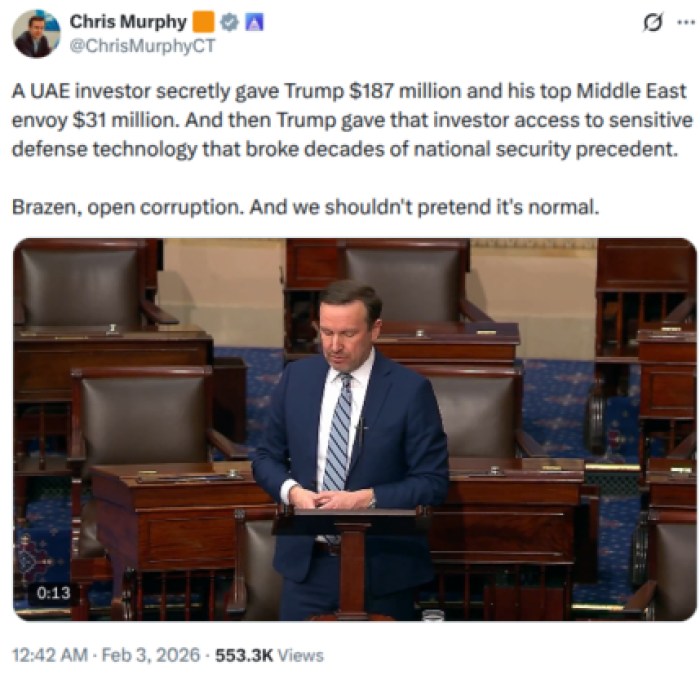
Source: X

The fear? Foreign entities are buying influence through blockchain projects tied to political figures. For the average retail trader, that signals a familiar danger: becoming exit liquidity for backroom deals. Trust is the only real currency here.

When that erodes at the institutional level, bogged down by regulatory scrutiny and conflicts of interest, capital historically flees toward the ‘wild west’ of the market.

We’re already seeing this migration on-chain. While institutional projects stall under the weight of Senate hearings, traders are rotating liquidity into assets that prioritize raw community strength. The narrative is shifting from ‘who do you know in Washington?’ to ‘how strong is your community?’

In this trust vacuum, high-leverage meme tokens are emerging as vehicles for retail conviction. So, who is leading this charge? Maxi Doge ($MAXI) , a project capitalizing on the market’s appetite for assets that operate far outside the sphere of political influence. It could be the next crypto to 1000x.

Escaping The Political Theater Through High-Leverage DeFi

The allure of DeFi during political scandals is simple: transparency. There are no backroom deals in a smart contract; there is only code. This environment has paved the way for Maxi Doge ($MAXI), a project that strips away the pretense of ‘institutional adoption’ to focus on what you actually want: volatility, leverage, and aggressive growth.

Traders familiar with previous cycles know that during periods of regulatory FUD (Fear, Uncertainty, and Doubt), meme coins often outperform utility tokens precisely because they’re uncorrelated with government policy. Maxi Doge leans into this.

Branding itself as a ‘240-lb canine juggernaut’ with a ‘lift, trade, repeat’ mentality, it creates a distinct psychological separation from the suit-and-tie narrative of Washington-linked crypto. The selling point isn’t a treaty; it’s a ‘Leverage King Culture,’ something wildly different from other kawaii dog-themed coins.

Source: Maxi Doge

Through planned holder-only trading competitions and a gamified ‘Maxi Fund’ treasury, the project plans to incentivize active participation rather than passive speculation. It hopes to solve a critical problem for retail traders lacking whale-tier capital: offering a playground where conviction pays better than connections.

Plus, the plan to integrate futures platform partnerships suggests a roadmap designed to capture the high-risk, high-reward segment alienated by current political discourse.

Learn ‘how to buy maxi doge’ in our guide.

Retail Hype Signals Shift Toward Retail-First Assets

While headlines focus on Senators and foreign treaties, social media and project engagement show where investors are looking. Political scandal appears to be driving investors toward fresh presales offering better risk-to-reward ratios than established, politically sensitive coins.

Maxi Doge has already secured over $4.5M in its ongoing presale, suggesting significant liquidity is rotating into this new sector. Even more telling is the social media following it’s managed to garner. Boasting over 6K followers on X, and over 3.3K subscribers on Telegram, $MAXI clearly has its fans.

Don’t get us wrong, these aren’t numbers to break a bank, but it’s still something to note for a hype project still in presale, that’s mainly thriving on vibes alone.

Beyond the socials, the protocol’s staking mechanics offer shelter for its capital. With dynamic APY fueled by daily automatic smart contract distribution, investors can compound holdings while waiting for the broader market to stabilize.

It fits the project’s ‘Never skip leg-day’ ethos: steady accumulation regardless of external conditions. If you’re exhausted by the volatility of political news cycles, the straightforward mechanics of a meme-driven ecosystem offer a refreshing (if high-risk) alternative.

CHECK OUT THE MAXI DOGE ($MAXI) PRESALE.

The information provided in this article is for educational purposes only and does not constitute financial advice. Cryptocurrency investments, particularly in meme tokens and presales, carry high risks, including the potential for significant loss. Always perform independent due diligence.


Related Questions

QWhat is the main reason the article suggests that DeFi projects like Maxi Doge ($MAXI) are gaining attention during political scandals?

AThe article suggests that DeFi projects gain attention during political scandals because they offer transparency through smart contracts, operating outside the sphere of political influence and backroom deals, which attracts capital fleeing institutional crypto due to eroding trust, regulatory scrutiny, and conflicts of interest.

QAccording to the article, what specific feature of Maxi Doge ($MAXI) is designed to incentivize active participation rather than passive speculation?

AMaxi Doge plans to incentivize active participation through holder-only trading competitions and a gamified 'Maxi Fund' treasury, creating a playground where conviction is rewarded more than connections.

QHow does the article describe the performance of meme coins compared to utility tokens during periods of regulatory FUD (Fear, Uncertainty, and Doubt)?

AThe article states that during periods of regulatory FUD, meme coins often outperform utility tokens because they are uncorrelated with government policy, making them a more attractive option for traders seeking assets detached from political influence.

QWhat evidence does the article provide to show that Maxi Doge ($MAXI) is attracting significant interest from retail investors?

AThe article cites that Maxi Doge has secured over $4.5M in its ongoing presale and has garnered a social media following of over 6K followers on X and 3.3K subscribers on Telegram, indicating significant retail investor interest and liquidity rotation.

QWhat is the core ethos or mentality that the Maxi Doge ($MAXI) project brands itself with, according to the article?

AMaxi Doge brands itself with a 'Leverage King Culture' and a 'lift, trade, repeat' mentality, creating a psychological separation from traditional finance and emphasizing steady accumulation and high-risk, high-reward dynamics, encapsulated in its 'Never skip leg-day' ethos.

Related Reads

The Value Distribution of Stablecoins

**Summary: The Value Distribution of Stablecoins** The article argues that stablecoins are evolving from mere trading tools into broader channels for dollar access. It divides the stablecoin ecosystem into four layers to analyze how value is distributed: 1. **Issuance Layer:** Mints stablecoins, holds reserve assets, and captures the spread between reserve yield and user costs (e.g., Tether, Circle). This layer currently earns the largest profit margin. 2. **Infrastructure Layer:** Connects stablecoins to the traditional financial system, handling fiat on/off-ramps, banking integration, compliance (KYC/AML), and asset management (e.g., Bridge, BVNK). This is the "unglamorous" but critical work, building the essential bridges between crypto and real-world finance. 3. **Acquiring/Distribution Layer:** Integrates stablecoins into merchant systems, manages payment flows, and provides enterprise financial software (e.g., Stripe, Coinbase). They act as the access point for businesses. 4. **Application Layer:** The end-users and businesses that ultimately use stablecoins for payments, settlements, or as a store of value. They benefit from convenience but have little pricing power. The core thesis is that while the issuance layer currently dominates profits, the often-overlooked **infrastructure layer holds significant long-term potential**. The real challenge and barrier to mass adoption is not the on-chain transfer of stablecoins (which is simple), but the complex "last mile" integration into existing business workflows, banking systems, and regulatory frameworks across different countries. Companies in this layer are currently in a "land grab" phase, investing heavily to build networks, secure bank partnerships, and establish compliance pathways. While their position is currently pressured by the profitable issuers above and distribution platforms below, the article suggests that if stablecoins become a default financial rail for businesses, the infrastructure providers who have done the hard work of integration will ultimately gain strong pricing power and become entrenched, essential players.

marsbit6h ago

The Value Distribution of Stablecoins

marsbit6h ago

The Value Distribution of Stablecoins

The Value Distribution of Stablecoins The article argues that stablecoins are evolving from a mere trading tool into a broad "dollar channel." It analyzes the industry's value chain through four layers: 1. **Issuance Layer (e.g., Tether, Circle):** The top layer that mints stablecoins, holds reserve assets, and captures the thickest interest rate spread. 2. **Infrastructure Layer (e.g., Bridge, BVNK):** Connects stablecoins to the traditional financial system, handling critical but complex "dirty work" like fiat on/off-ramps, banking integration, compliance (KYC/AML), and cross-border settlement. 3. **Acquiring/Distribution Layer (e.g., Stripe, Coinbase):** Embeds stablecoins into merchant systems, manages payment flows, and integrates with enterprise software. 4. **Application Layer:** End-users and businesses that ultimately use stablecoins for payments, settlement, or storing value. The author posits that while the issuance layer currently captures the most profit, the most overlooked and potentially critical layer is infrastructure. The core challenge for stablecoin adoption isn't the on-chain transfer (which is simple), but bridging the gap between blockchain and the real-world financial system. This involves solving practical problems for businesses: fiat conversion, reconciliation, tax handling, and user onboarding. Infrastructure companies are currently in a difficult "land-grab" phase—building networks, securing banking relationships, and achieving compliance country-by-country. They face pressure from both the profitable issuance layer above and distribution platforms below. However, the author suggests this layer is building a crucial moat. Once stablecoins become a default business rail, the infrastructure players who have done the hard work of integration may gain significant, durable value and pricing power.

链捕手6h ago

The Value Distribution of Stablecoins

链捕手6h ago

Trading

Spot
Futures
活动图片




