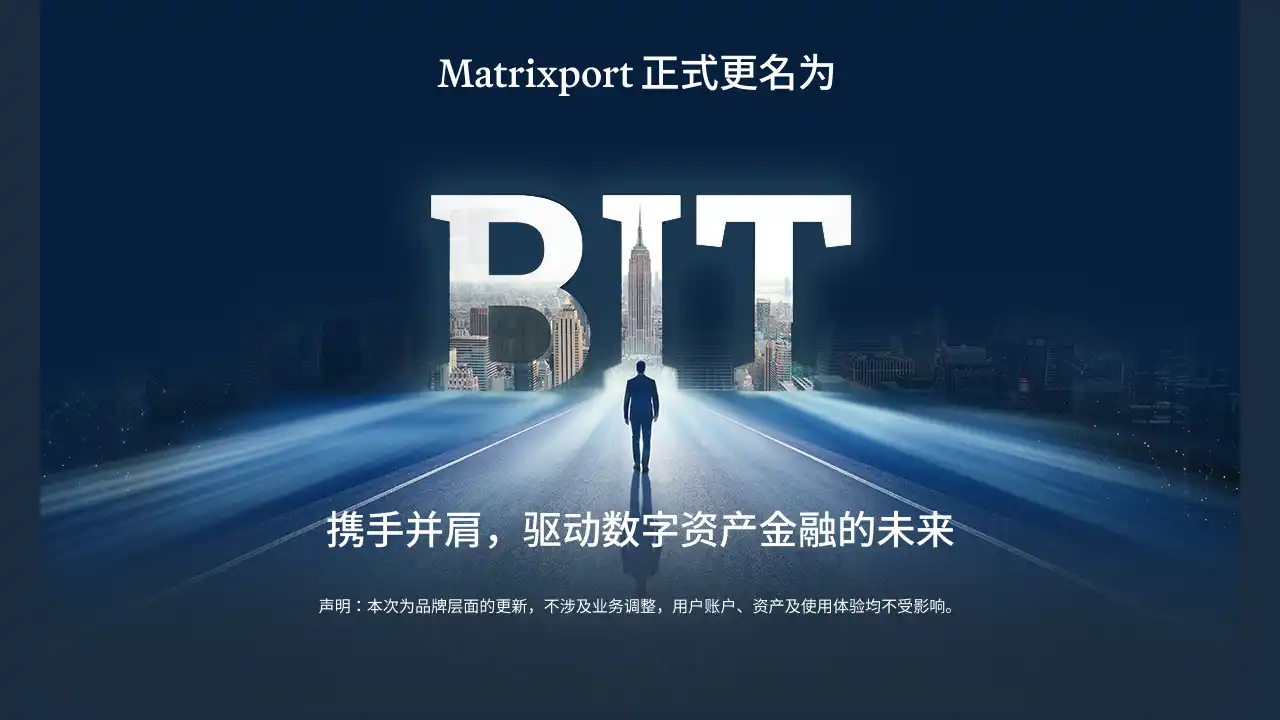
Matrixport Officially Rebrands as BIT, Clarifying New Strategic Positioning

marsbitPublished on 2026-03-20Last updated on 2026-03-20

Abstract

Digital financial services group Matrixport has officially rebranded to BIT, marking a new phase in its strategic positioning. The company will now operate globally under the unified BIT brand. Alongside the rebranding, BIT released its "2026 Trust Whitepaper," which systematically details the group's established governance and risk control frameworks to provide a verifiable foundation of trust for clients and partners. As the digital asset industry undergoes increasing institutionalization and regulatory maturation, market demands for robust governance and compliance capabilities are growing. The new BIT brand better reflects the company's current business focus and strategic direction for future development. CEO John Ge stated that the industry is entering a stage where governance and compliance are increasingly critical. The name BIT represents the evolution of the company's business and its long-term commitment to building trusted digital asset financial infrastructure. The brand's tagline, "Bridge into Tomorrow," signifies its vision to connect traditional finance with digital asset markets and build lasting trust with clients. The rebrand does not affect existing customer accounts, products, or services, and all legal entities and contractual arrangements remain unchanged. As part of its next strategic phase, BIT is also exploring opportunities in U.S. capital markets, including a potential public listing. Founded in 2019 and headquartered in Singapore, BIT operates...

Digital financial services group Matrixport today announced its official rebranding as BIT and will operate globally under the unified BIT brand. Along with the brand upgrade, BIT simultaneously released the "2026 Trust Whitepaper," systematically disclosing for the first time the governance and risk control framework the group has established and continues to operate, providing customers and partners with a verifiable foundation of trust.

Currently, as the digital asset industry's institutionalization process accelerates and the regulatory system becomes increasingly完善, market demands for platform governance capabilities and compliant operations are continuously rising. The new BIT brand more clearly reflects the company's current business positioning and represents the strategic direction for the next phase of development.

BIT CEO John Ge stated: "The digital asset industry is entering a new phase where governance capabilities and compliant operations are becoming increasingly important. BIT embodies the成果 of the company's continuous business evolution and our long-term commitment to building a trusted digital asset financial infrastructure."

He added: "'Bridge into Tomorrow' is not only our brand proposition but also represents our vision of connecting traditional finance with the digital asset market and establishing long-term trust with our customers."

The company stated that this rebranding does not affect existing customer accounts, products, or services, with all relevant legal entities and contractual arrangements remaining unchanged.

As part of the next phase of its strategy, BIT is also actively exploring opportunities related to the U.S. capital markets, including a potential public listing.

About BIT

BIT (formerly Matrixport), founded in 2019, is a global digital asset financial services group built on integrity. The group is headquartered in Singapore and has offices in seven countries and regions worldwide. Through a robust governance system, technological capabilities, and compliant operations, it connects traditional finance with the digital asset market.

BIT provides global institutional and professional investors with services covering trading, custody, asset management, liquidity, and financing solutions, and supports the on-chain introduction and application of real-world assets (RWA). Its entities hold corresponding licenses and are regulated in Singapore, Hong Kong, Switzerland, the UK, the US, and Bhutan, including a Major Payment Institution (MPI) license in Singapore and a collective asset management license issued by Switzerland's FINMA.

Currently, the group manages over $6 billion in assets, with a monthly trading volume exceeding $7 billion. It has累计 paid over $2 billion in interest to customers, boasts a valuation exceeding $1 billion, and has been入选 the "2024 Hurun Global Unicorn List" and the "2025 Singapore FinTech Unicorn List."


Related Questions

QWhat is the new name of the digital financial services group formerly known as Matrixport?

AThe new name is BIT.

QWhat did the company release alongside its rebranding to BIT?

AThe company released its '2026 Trust Whitepaper', which systematically discloses the governance and risk control framework it has established and continues to operate.

QWhat is the significance of the new brand name 'BIT' according to the CEO?

AThe CEO stated that 'BIT' represents the company's evolved business focus and its long-term commitment to building trusted digital asset financial infrastructure. It also stands for the brand proposition 'Bridge into Tomorrow', symbolizing the vision to connect traditional finance with the digital asset market and build long-term trust with clients.

QDoes the rebranding to BIT affect existing customer accounts, products, or services?

ANo, the company stated that the rebranding does not affect existing customer accounts, products, or services, and all relevant legal entities and contractual arrangements remain unchanged.

QWhat is one of the strategic opportunities BIT is exploring as part of its next phase?

ABIT is exploring opportunities in the U.S. capital markets, including a potential public listing.

Related Reads

2026 New Policy Interpretation: The "Mutual Pursuit" of Intelligent Agents and AI Terminals, and the Three Major Value Reconstructions in the AIoT Industry

In May 2026, China's national ministries released two pivotal policy documents that jointly establish a strategic "dual-track" framework for the AIoT industry. The "Intelligent Agent Standardized Application and Innovation Development Implementation Opinions" defines the "soul"—positioning intelligent agents as core AI products. The "Artificial Intelligence Terminal Intelligence Grading" national standard defines the "body"—establishing a four-tier capability ladder (L1 to L4) for AI hardware. This synchronized policy approach is globally unique, moving beyond market-led (US) or risk-focused (EU) models. It frames AIoT as a new type of "intelligent infrastructure," comparable to electricity or the internet in historical significance. The core analysis identifies a value evolution from IoT 1.0 (connection) to AIoT 4.0 (collaboration, represented by the forward-looking L4 level). This "L4" signifies a paradigm shift: from users operating tools to delegating tasks to agent-like devices ("Intelligent Action of All Things"). The article outlines three strategic paths for companies: becoming Standard Definers, Scenario Integrators (focusing on 19 specified application areas), or Infrastructure Builders. A critical 18-24 month window is identified for strategic positioning. A "Four Levers" strategy is proposed: leveraging Standards (L-level certification), leveraging Scenarios (deep vertical focus), leveraging Open Source (for cost reduction and ecosystem influence), and leveraging Momentum (engaging in global protocol ecosystems). In conclusion, these policies are a starting gun for a decade-long industrial transformation, shifting the industry narrative from "Intelligent Connection of All Things" to "Intelligent Action of All Things," with companies needing to choose their赛道and execution strategy decisively.

marsbit39m ago

2026 New Policy Interpretation: The "Mutual Pursuit" of Intelligent Agents and AI Terminals, and the Three Major Value Reconstructions in the AIoT Industry

marsbit39m ago

Splashing Out 27 Billion Yuan, OpenAI Establishes New Company to Accelerate AI Deployment

On May 11th, OpenAI announced the formation of a new company, "OpenAI Deployment Company," with an initial investment of over $4 billion (approximately 27.2 billion RMB). This venture aims to help businesses build and deploy AI solutions. OpenAI is also acquiring the AI consulting firm Toromo to rapidly scale the deployment company's capabilities. This new entity, majority-owned by OpenAI, brings together 19 investment, consulting, and system integration partners, led by TPG with co-lead founding partners including Advent International, Bain Capital, and Brookfield. OpenAI's Chief Revenue Officer, Denise Dresser, stated that while AI is becoming increasingly capable, the current challenge lies in integrating these systems into core business infrastructure and workflows. The deployment company is designed to bridge this gap and translate AI capabilities into operational impact. This move comes as OpenAI emphasizes the next competitive phase will depend on the efficiency of deploying AI in real business scenarios. The company reports over 1 million businesses already use its products and APIs. OpenAI is significantly increasing its investments in computing power, with co-founder Greg Brockman stating the company expects to spend $50 billion on compute this year, a dramatic increase from $3 million in 2017. The announcement follows OpenAI's recent completion of a record $122 billion funding round in late March, led by Amazon, Nvidia, and SoftBank, valuing the company at $852 billion post-money. Major strategic investors committed $110 billion as a base for this round. Concurrently, OpenAI is advancing its core model development. It has shifted focus from its Sora video generator to developing advanced robotics and AI models that interact with the physical world. It has also begun allowing select users access to a new model specialized in identifying software vulnerabilities and is reportedly preparing to launch an enhanced image generation model in the coming weeks. According to reports citing founder Sam Altman, OpenAI is considering an IPO as early as 2027, with a potential valuation around $1 trillion.

marsbit55m ago

Splashing Out 27 Billion Yuan, OpenAI Establishes New Company to Accelerate AI Deployment

marsbit55m ago

Trading

Spot
Futures
活动图片




