Market Plunge, But These Crypto OGs Are Still 'Topping Up Their Faith'

marsbitPublished on 2026-02-06Last updated on 2026-02-06

Abstract

Summary: On February 6, Bitcoin plunged 15.48% to $60,000, marking its largest single-day drop since the FTX collapse. The Crypto Fear & Greed Index hit 9, indicating "extreme fear" and a new low since the 2022 bear market. Despite widespread panic, several crypto veterans reaffirmed their conviction. Michael Saylor encouraged buying Bitcoin as a form of support. The founder of Base emphasized long-term commitment to building. Lily Liu, President of the Solana Foundation, argued that blockchain's core purpose is financialization, stressing the importance of protecting liquidity unity. She criticized the "Web3 narrative" as overly simplistic and called for creating new markets rather than relying on speculative narratives. Balaji expressed strong bullishness, stating that "code-based order" is rising as "rules-based order" collapses, making short-term prices irrelevant. He emphasized the need for on-chain companies and internet-native systems. The founder of Helius shared similar optimism, advocating for filtering out "tourists" to improve signal-to-noise ratio in the space. Linda Xie shared her experience of a 75% drawdown in 2018, advising against emotionally-driven decisions and emphasizing holding assets with strong fundamental belief. Crypto influencer神鱼 (Shenyu) succinctly stated: "1 BTC = 1 BTC." Overall, these leaders urge perseverance, focus on fundamentals, and long-term belief in crypto's transformative potential despite market volatility.

Editor's Note: On February 6th, Bitcoin fell to a low of $60,000, plummeting 15.48% in a single day, marking its largest single-day drop since the FTX collapse. At the same time, the Crypto Fear & Greed Index dropped to 9, indicating a state of 'Extreme Fear' in the market, hitting a new low since the 2022 bear market.

However, as pessimism spreads, many veteran Builders and thought leaders in the crypto world are voicing a different perspective. This 'Crypto Faith Topping-Up List' compiles their thoughts and perseverance amidst the storm. Perhaps it can offer you a sliver of solace and direction to move forward during this market winter.

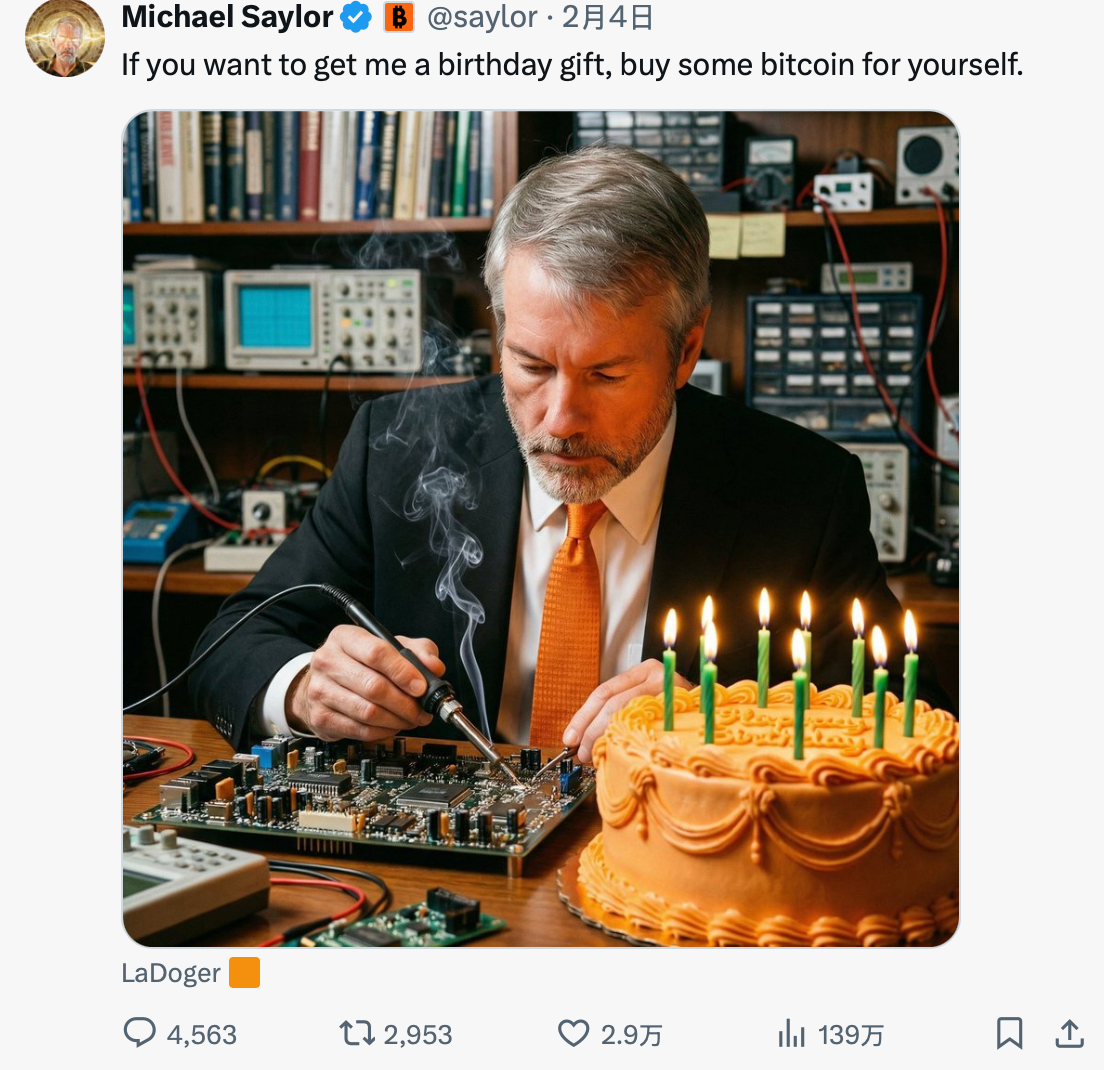
Michael Saylor:

If you want to give me a birthday present, buy yourself some Bitcoin!
Base Founder:

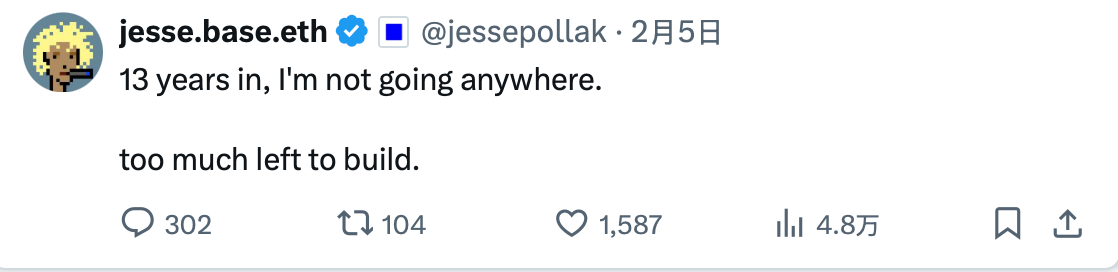
13 years have passed, and I'm not going anywhere.

There's still so much to build.
Solana Foundation President LilyLiu:

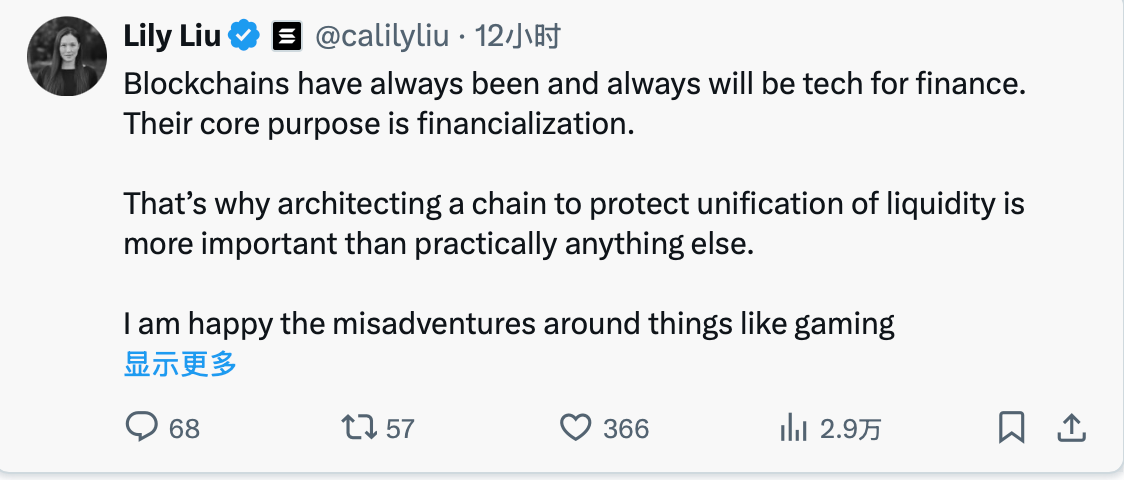
Blockchain was, is, and always will be financial technology. Their core purpose is financialization.

This is also why, when designing a chain, protecting the unity of liquidity is more important than almost anything else.

I'm glad the misguided focus on things like 'chain games' is finally over.

More broadly, the 'read write own' / 'Web3 narrative' is essentially too skeuomorphic and, to be honest, a bit intellectually lazy. New technology is never as simple as 'put something on-chain, and voilà—everything changes'; you must truly create new markets.

The old narrative was more of a fig leaf, used to justify VCs pouring money into various unnecessary infrastructures, hoping to create a private asset that could become 'magic internet money.'

The more projects try to attract prices through narrative packaging and take a share of the liquidity from the 'wild west' of the internet, the harder the 'narrative justification machine' has to work, shaping everything into the 'great third wave of applications'—'everything you do today can now earn you money.'

The reality is, the opportunities are indeed huge, far beyond what even our most creative minds can imagine, but not in the way they've been described over the past few years.

The blockchain journey has always been about finance: providing open financial infrastructure for anyone and everyone on the internet.

This enables capital formation and internet innovation to happen anywhere in the world, allowing the resulting innovation and progress to truly take root. Open finance brings greater economic freedom, and economic freedom brings individual sovereignty and autonomy.
Balaji:

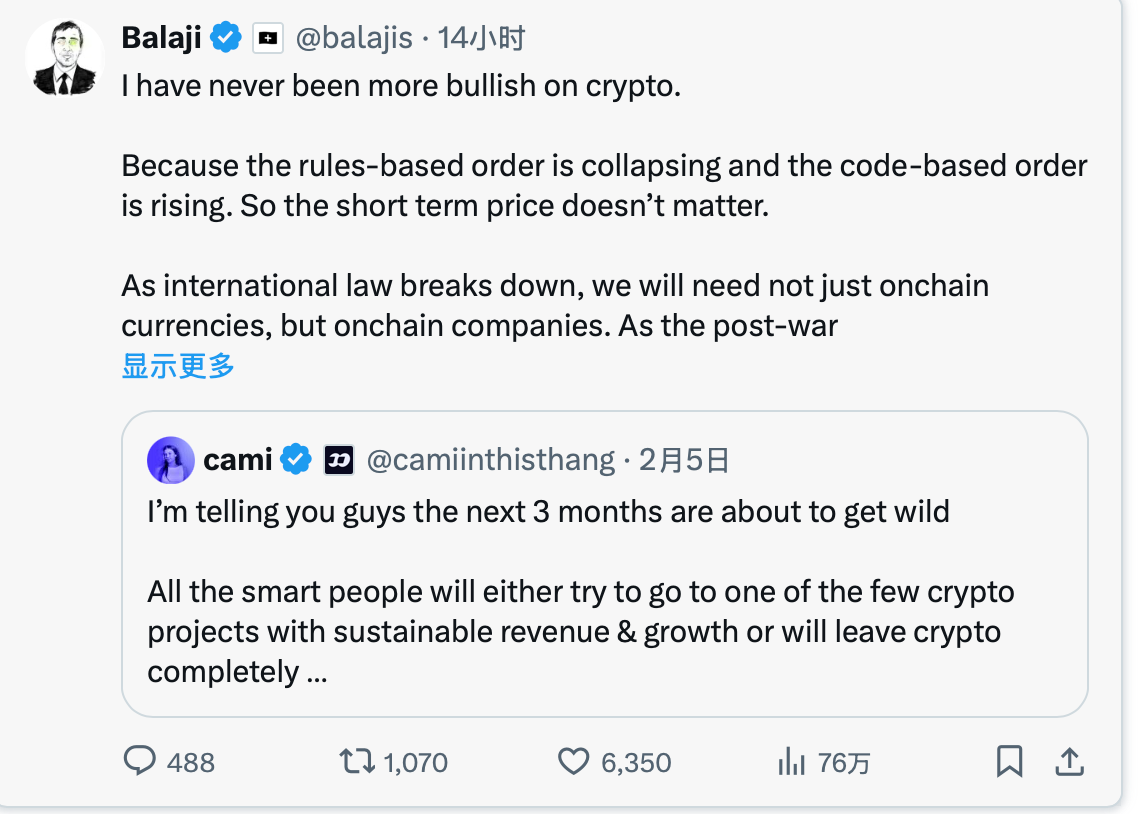
I have never been more bullish on cryptocurrency than I am now.

Because the 'rules-based order' is collapsing, and the 'code-based order' is rising. So short-term prices simply don't matter.

As the international legal system disintegrates, we need not only on-chain money but also on-chain companies. As the post-war order unravels, we similarly need a 'post-internet order.' Nations will fail, and networks will replace them.

We need internet capitalism, we need internet democracy, we need internet privacy.

So we need cryptocurrency.
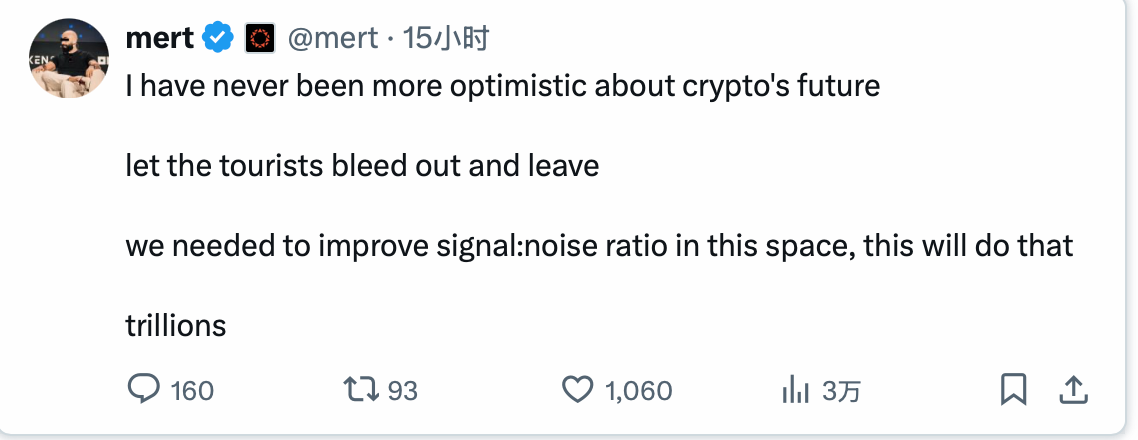
Helius Founder:

I have never been more confident about the future of cryptocurrency than I am now.

Let the tourists bleed out and leave.

We need to increase the signal-to-noise ratio in this space, and this will achieve that goal.

Trillion
Linda Xie:

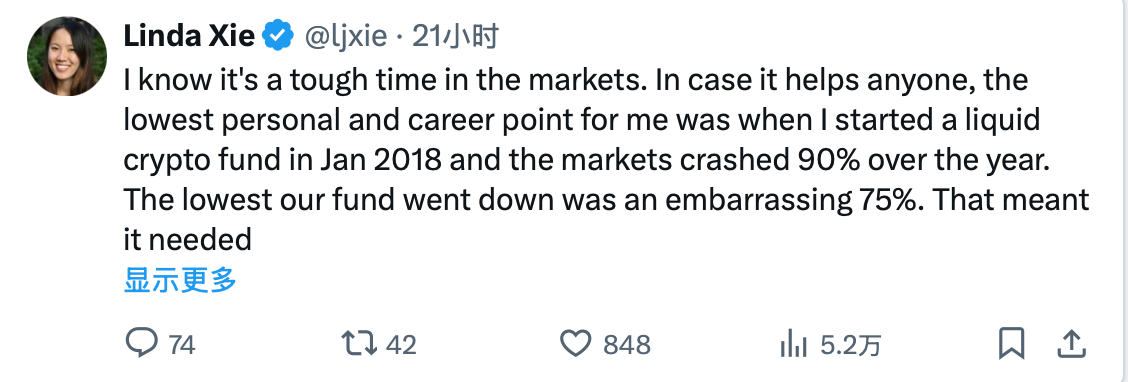
I know the current market environment is tough. I hope these experiences can be helpful to some. For me, the personal and professional low point was in January 2018, after launching a crypto liquidity fund, when the market fell 90% that year. Our fund experienced a maximum drawdown of a humiliating 75%, meaning the fund needed to quadruple just to break even.

At the time, many investors chose to trust us (this was after about 1,000 fundraising meetings), some of whom I deeply respected, and I felt I had let them down; some investors even yelled at me over the phone. I was extremely worried about what I had gotten everyone into, including employees. I had also invested almost all of my personal savings.

But we stuck to the direction we truly believed in, and it eventually paid off years later (currently delivering about 4x DPI for investors). Hold onto assets you genuinely believe in fundamentally, and don't make any extreme decisions driven by emotion.
Shenyu:

1btc = 1btc

Related Questions

QWhat was the significance of Bitcoin's price drop to $60,000 on February 6th?

AIt marked a 15.48% single-day drop, the largest since the FTX crash, and pushed the Crypto Fear & Greed Index to 9, indicating 'extreme fear' and a new low since the 2022 bear market.

QAccording to Solana Foundation's Lily Liu, what is the core purpose of blockchains?

ABlockchains are, and always will be, financial technology. Their core purpose is financialization, providing open financial infrastructure to anyone on the internet to enable capital formation and innovation globally.

QWhat is Balaji's main argument for being extremely bullish on cryptocurrency despite short-term price movements?

AHe believes the 'rules-based order' is collapsing and a 'code-based order' is rising. As international law and the post-war order disintegrate, there is a need for on-chain money, companies, and new systems like internet capitalism and democracy, which cryptocurrency enables.

QWhat personal experience did Linda Xie share to help others during the difficult market?

AShe shared that her crypto liquidity fund launched in Jan 2018 experienced a 90% market drop and a 75% drawdown, requiring a 4x return just to break even. By sticking to their convictions and not making emotional decisions, they eventually delivered about 4x DPI (Distributed to Paid-In Capital) to investors.

QWhat common sentiment is expressed by multiple figures like Michael Saylor, the Base founder, and the Helius founder?

AThey express unwavering confidence and a long-term commitment to cryptocurrency. Saylor encourages buying Bitcoin, the Base founder states he's 'not going anywhere,' and the Helius founder says he's 'never been more confident,' suggesting that weak hands (tourists) leaving will improve the space.

Related Reads

Bitcoin Withdrawals Continue: 8 Years of Storage in a Coldcard Cold Wallet Ended in Zero

Coldcard Hardware Wallet Hacked: Losses Mount Due to Vulnerable Seed Generation A critical vulnerability in Coldcard hardware wallets has led to a continued wave of fund thefts. According to Galaxy Research, the total stolen has reached 1,367.05 BTC (approx. $88.6 million) from 4,585 addresses, a significant increase from the initial 594.5 BTC reported on July 30, 2026. Most of the stolen funds remain on the attackers' addresses. The issue is not with the current firmware, which Coinkite has updated, but with seed phrases generated on vulnerable devices between March 2021 and the release of fixed firmware versions. Due to a programmer error, devices switched from using a hardware random number generator to the software-based Yasmarang generator, which was initialized with publicly accessible data like the chip's serial number. This made the seed phrases predictable through offline brute-force attacks, meaning wallets remain at risk until funds are moved to a new wallet generated with the patched firmware. Affected devices include Mk2/Mk3 with firmware 4.0.1–4.1.9 (and up to 5.0.3), Mk4/Mk5 up to version 5.6.0, and Q models up to 1.5.0Q. The only exceptions are seeds created with a high-entropy method like at least 50 independent dice rolls or a strong unique BIP-39 passphrase. All other owners must generate a new seed on the fixed firmware and transfer their assets. A case highlighting the human impact involves a 39-year-old long-term investor who lost 2 BTC (approx. $130,000) in minutes. He had accumulated the Bitcoin over eight years through physical labor, viewing it as a financial lifeline and a retirement plan in a country suffering from hyperinflation. His story underscores that even conservative "buy and hold in cold storage" strategies can be compromised by such underlying technical flaws. From a technical perspective, this incident echoes historical failures where weak random number generators undermined cryptographic security, challenging the assumption that offline storage is automatically foolproof.

cryptonews.ru2h ago

Bitcoin Withdrawals Continue: 8 Years of Storage in a Coldcard Cold Wallet Ended in Zero

cryptonews.ru2h ago

Trading

Spot
活动图片





