Making a Fortune of $10.32 Million: The World Cup Money-Printing Tactic of a Polymarket Whale

Foresight NewsPublished on 2026-07-13Last updated on 2026-07-13

Abstract

**Earning $10.32 Million: A Polymarket Whale's World Cup Profit Strategy** While teams battle for the World Cup trophy, a hidden whale nicknamed "swisstony" has been quietly making a fortune on the prediction market Polymarket. This account, created around July 2025, boasts total profits of $18.62 million, with $10.33 million earned in the past month alone. With a 52.9% win rate, it has placed over 139,600 predictions, averaging about 380 trades per day—indicating it is likely a high-frequency quantitative bot. The account's signature "trash panda" aptly describes its strategy: sifting through vast market data and tiny price discrepancies to build wealth. Its current holdings are heavily concentrated on the France vs. Spain semi-final, including a roughly $160,000 bet against France. Analysis shows two core tactics driving its success: 1. **High-Volume "Anti-Favorite" Bets:** Placing large wagers (often $400k-$1M) against overvalued favorites like Germany or England, buying "No" shares at favorable prices when market-implied win probability is 46%-64%. It has recorded over 17 individual profits exceeding $1 million using this method. 2. **"Lottery-Ticket" Bets on Extreme Long Shots:** Allocating small amounts (thousands of dollars) to buy shares priced as low as 0.2¢-1.2¢ on outcomes deemed nearly impossible. While most of these bets lose, the occasional win—like those with payouts over 100x—generates significant profits (over $100,000 per hit) that boost overall returns...


Written by: Ma He, Foresight News


On the World Cup field, while teams fiercely compete for the championship trophy, a hidden whale has been quietly making a fortune on the prediction market.


An account on Polymarket with the nickname swisstony has a total historical profit of $18.62 million, with nearly $10.33 million earned in the last month alone. The account was first registered around July 2025, a relatively short time ago, but due to its astonishing profits, its profile page views have surged to 922,200.
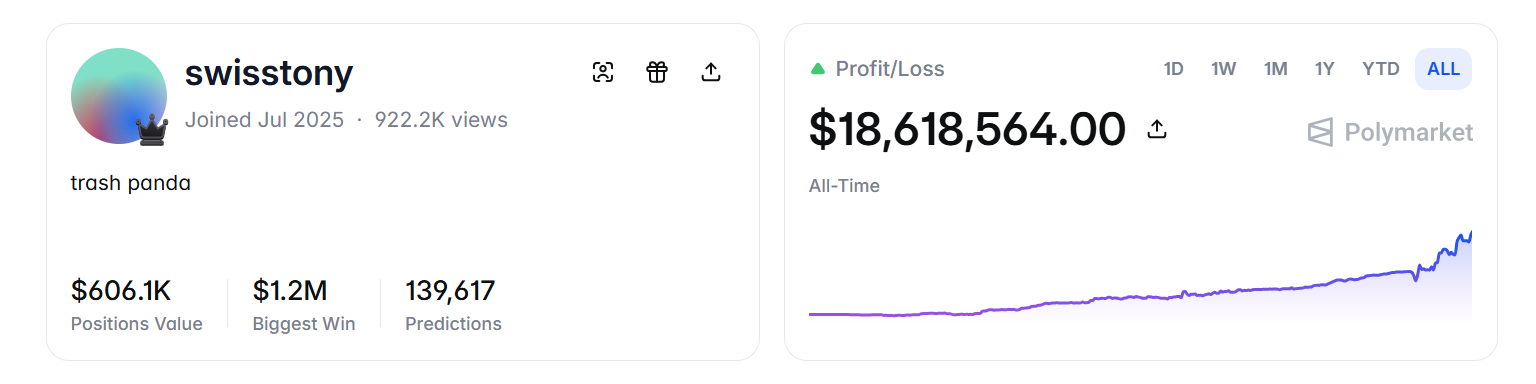


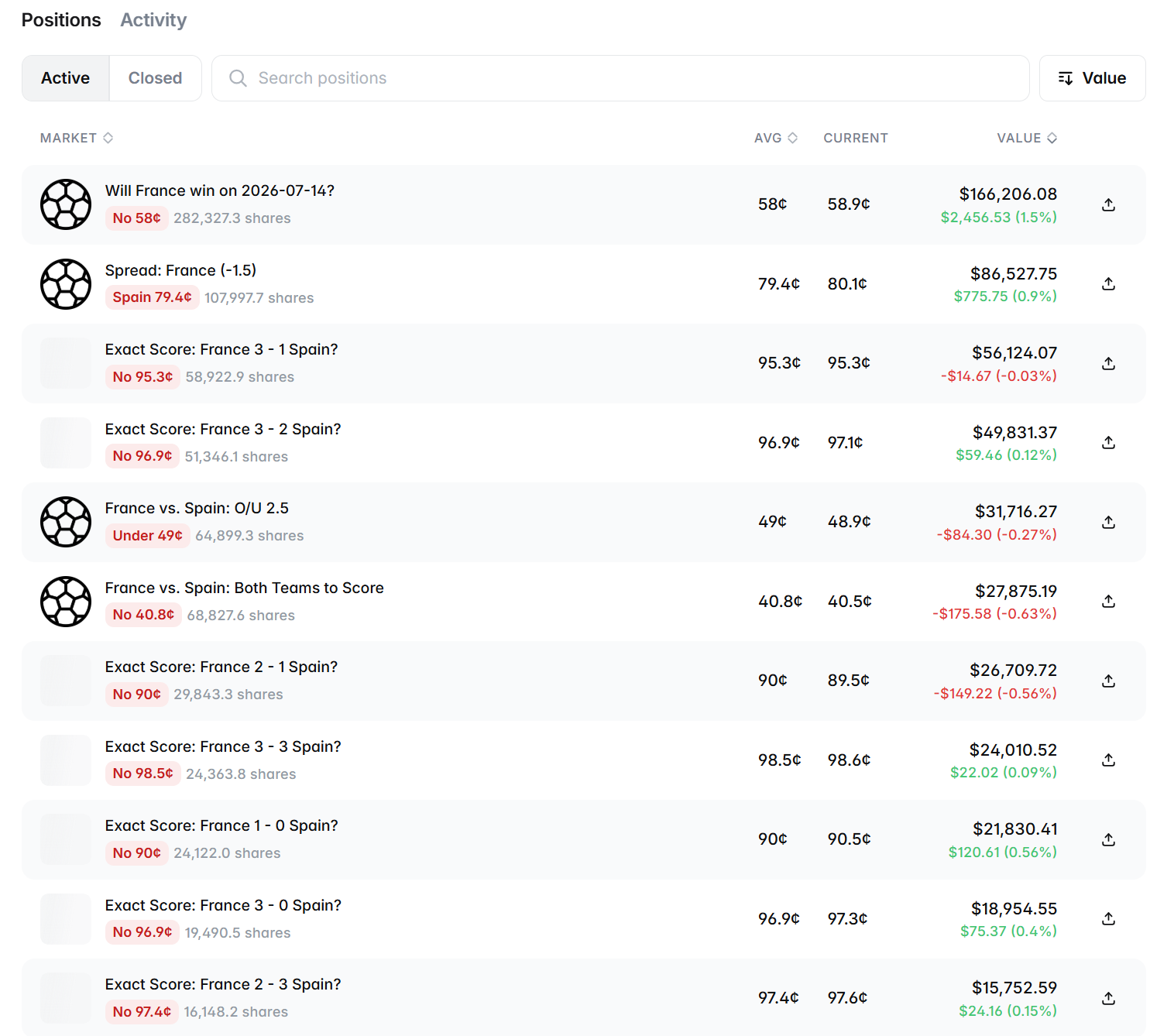
As of July 13, the account has made a total of 139,617 predictions, with its current portfolio valued at approximately $606,100. Notably, its current holdings are almost entirely concentrated on the FIFA World Cup semi-final match between France and Spain on July 14, 2026. This includes a bet of around $160,000 on France losing the match. Additionally, it has placed numerous bets, primarily "NO" positions, on specific score details, aiming for 5%-10% returns.


The account's win rate is maintained around 52.9%, with total trading positions exceeding 245,000 and trading volume reaching hundreds of millions of dollars. These figures place it in the top tier within the overall Polymarket ecosystem. Public research indicates that most retail addresses incur long-term losses, while a few high-frequency, systematic accounts achieve significant positive returns through scaled execution. swisstony's data win rate is not extremely high, but combined with extremely high trading frequency and position management, it amplifies its positive EV (Expected Value) edge.


Since creating the account about a year ago, this address has completed 139,617 prediction operations. On average, this translates to about 380 trades per day, 16 per hour, operating 24/7 without rest. It is highly likely an API-driven, ultra-high-frequency quantitative trading bot.


Its profile description reads "trash panda." In North American culture, raccoons are survival experts known for rummaging through trash bins. This signature perfectly summarizes its core strategy: making money from the vast data garbage and tiny price discrepancies on Polymarket, ultimately building a multi-million dollar empire.


Over 17 Profits Exceeding $1 Million


Looking through the account's profit history, its astonishing aspect is that it has recorded over 17 instances where profits exceeded $1 million. The largest single profit came from a bet on Germany's match on June 25. The whale bet "NO," earning $2,221,241 with a return of 111.67%.
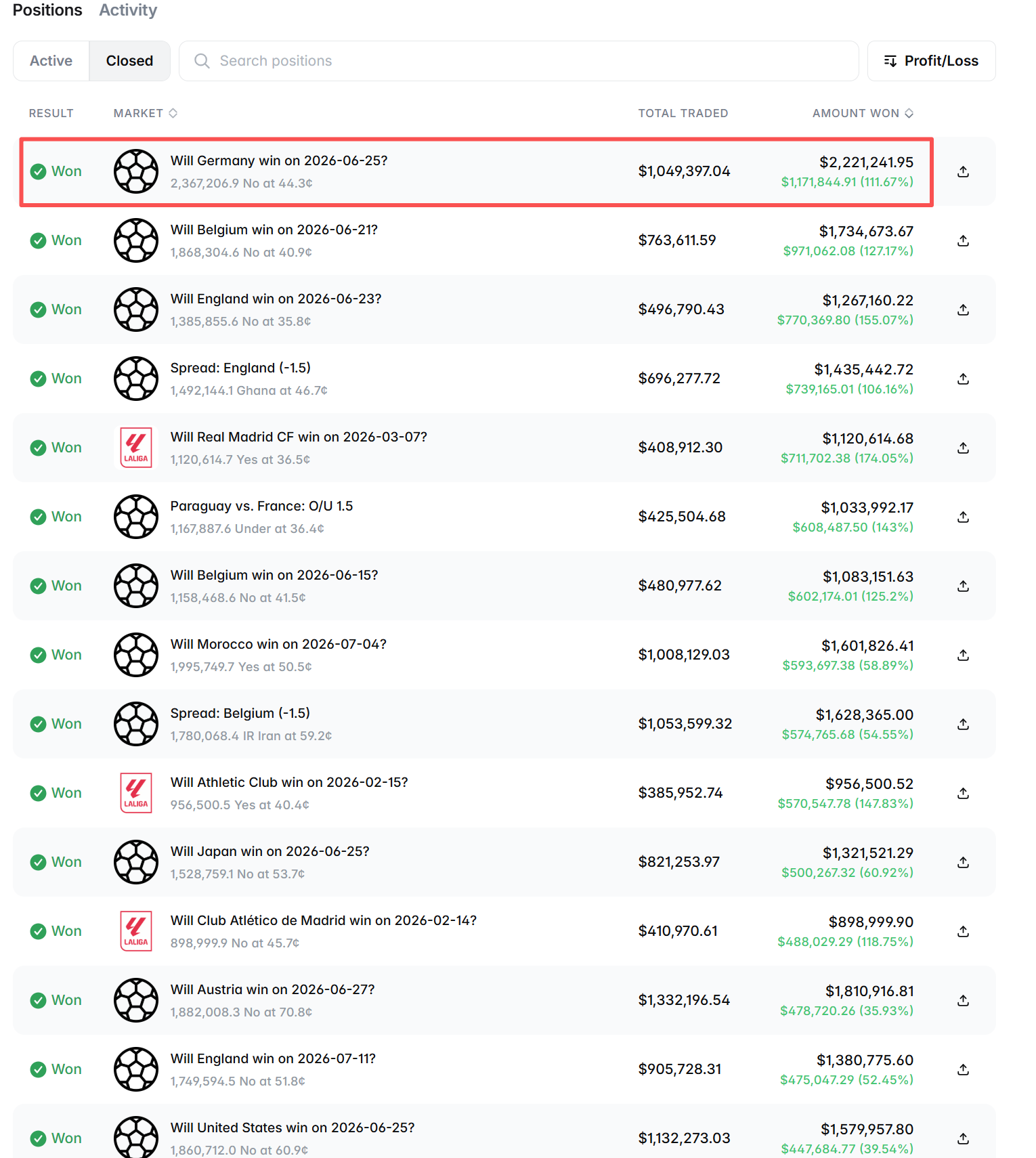


The ROI shown in the screenshot is generally very high, with clear advantages in entry prices. The investment scale is substantial, with single bets often in the $400,000 to $1 million range.


This whale favors placing large "NO" bets (against winning) on strong teams perceived as overvalued by the market: Germany, Paraguay (multiple appearances), England, and Japan. Entry prices mostly ranged from 35.8¢ to 53.7¢, implying market-implied win probabilities for these strong teams between 46% and 64% at the time, but the actual result was that they lost or did not win. This is a classic anti-favorite strategy.


100x Returns


On prediction markets, when events deemed impossible by the market actually occur, the profit returns can be extremely exaggerated. This whale excels not only at winning big with big bets but also demonstrates high skill in winning big with small bets.


Taking the matches in the image as examples, the entry prices were extremely low: 0.2¢ to 1.2¢ (market-implied probability only 0.2% to 1.2%). The invested capital per bet was mostly only a few thousand dollars, yet each contributed profits exceeding $100,000.
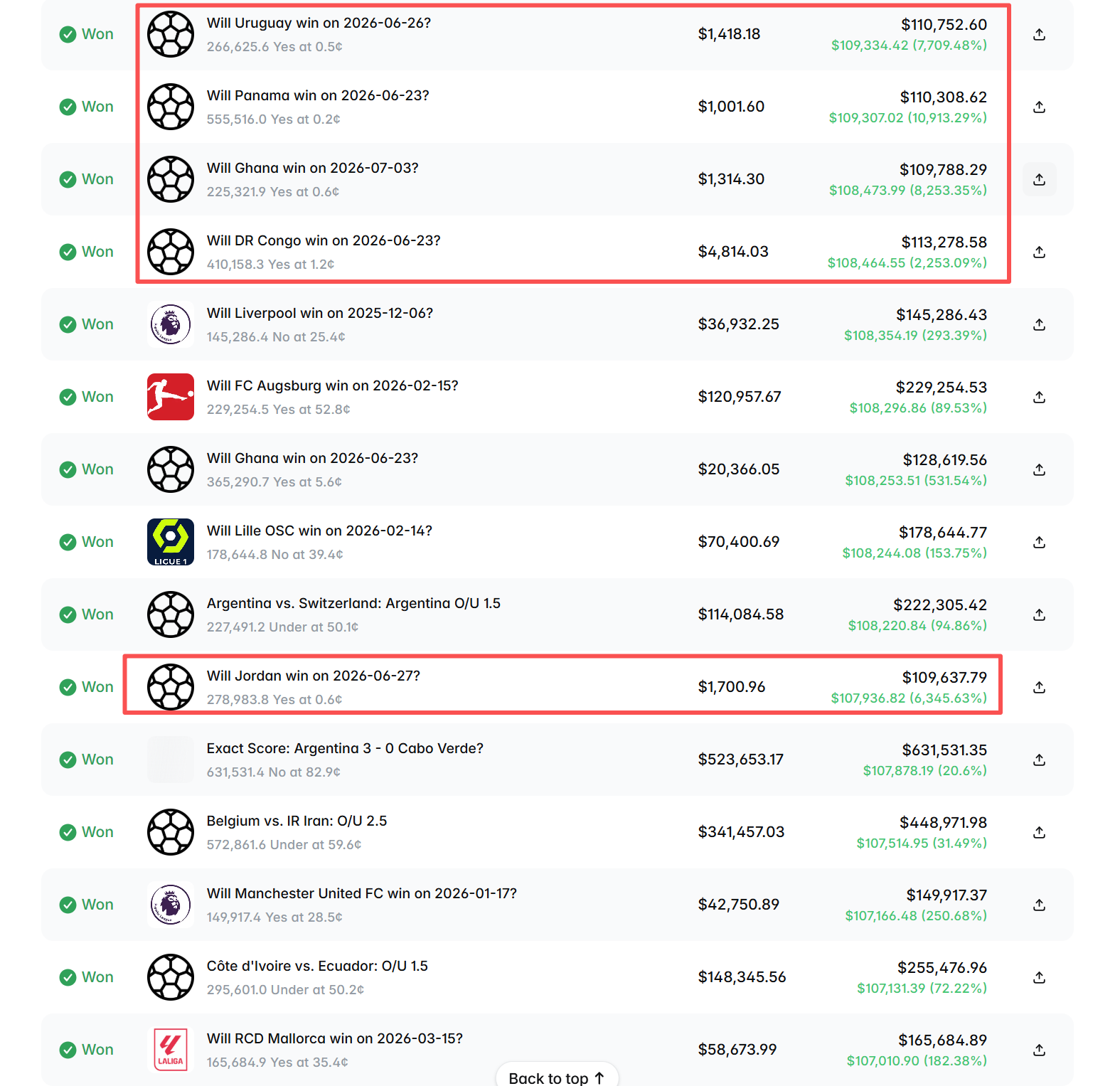


These events, originally considered nearly impossible by the market, actually happened. The account captured high returns with minimal cost.


Deploying small capital on extremely low-probability events is akin to a systematic "lottery ticket" approach. When it hits, it can contribute profits of $100,000+ with very low cost, serving as an excellent supplement to overall profitability. Although the risk capital per trade in such high-multiple trades is low, the win rate is extremely low. Most similar bets would lose all capital.


Even though most such bets will lose (because the probabilities are indeed very low), as long as a few hit occasionally, they can significantly boost total profit without costing too much principal.


Overall, it's highly likely that the account's automated system covers a large number of niche, low-liquidity markets where severe mispricing is more likely to occur. It then executes a dual-track strategy for profitability.


Large capital bets against popular strong teams, and small capital bets on extreme underdogs. The combination of both ensures stable, substantial profits while also enhancing overall returns through high-multiple trades.


Related Questions

QWhat is the total profit and recent one-month profit of the Polymarket account 'swisstony'?

AThe total historical profit of the Polymarket account 'swisstony' is 18.62 million USD, with a recent one-month profit of 10.33 million USD.

QWhat are the key characteristics of 'swisstony's' trading strategy on Polymarket?

A'swisstony' likely uses an API-driven, ultra-high-frequency quantitative trading bot. The strategy is characterized by high transaction frequency (approximately 380 trades per day), a focus on anti-favorite bets against overestimated strong teams, and a dual-track approach combining large, steady bets with small, high-multiplier 'lottery-style' bets on extreme longshots.

QHow many trades has the 'swisstony' account completed, and what does this imply about its operation?

AThe 'swisstony' account has completed 139,617 prediction trades. This implies the operation is highly automated, averaging about 380 trades per day or 16 trades per hour, running continuously.

QWhat is the significance of the 'trash panda' signature in the account's profile?

AIn North American culture, a 'trash panda' (raccoon) is a survival expert that forages in garbage bins. This signature metaphorically summarizes the account's core strategy: profiting from the vast amount of data 'trash' and tiny price discrepancies on Polymarket to build a multi-million dollar empire.

QDescribe the dual-track betting strategy mentioned in the article for generating profits.

AThe dual-track strategy involves two parallel approaches: 1) Using large amounts of capital to place 'No' bets (betting against victory) on overvalued favorite teams, securing stable, substantial profits. 2) Allocating small amounts of capital to place bets on extremely low-probability, high-odds outcomes (like specific match scores), aiming for massive, lottery-like returns when these longshots hit, thereby boosting the overall return rate.

Related Reads

The Price of DeFi Mass Adoption: Understanding the Profit Distribution and Hidden Risks of Aave Stable Vaults

**Title:** The Price of DeFi Mass Adoption: Understanding Aave Stable Vaults' Profit Distribution and Hidden Risks **Summary:** Aave Labs' new "Stable Vaults" product aims to simplify DeFi for mainstream users by offering fixed yields, a rarity in crypto. The model inserts a middleman layer between users and Aave's underlying lending pools. This layer, often a fintech app or digital bank, absorbs interest rate volatility, guaranteeing users a pre-set stable return while capturing any excess yield from Aave's underlying pools. In exchange for this predictable "peace of mind" and services like customer support and simplified onboarding, users sacrifice potential higher yields and take on new counterparty risks from the operating entity and its infrastructure. The article illustrates this with the example of payroll provider Rise, which transparently passes through most Aave yield, versus the higher profit margins possible through Stable Vaults. While a rational trade-off for many non-expert users prioritizing simplicity and security, the system centralizes risk and obfuscates true market yields. Aave benefits by attracting sticky, non-speculative capital crucial for its long-term economic model, highlighting the industry's shift towards catering to fundamental human preferences for convenience over complex, self-managed financial systems.

Foresight News9m ago

The Price of DeFi Mass Adoption: Understanding the Profit Distribution and Hidden Risks of Aave Stable Vaults

Foresight News9m ago

Stripe's $53.4 Billion Acquisition of PayPal: The Final Piece of the Stablecoin Empire Puzzle

Stripe has reportedly made a $53.4 billion acquisition offer for PayPal, a move that could signal a major shift in the stablecoin landscape from a "technology race" to a "customer war." Over recent years, Stripe has been quietly building nearly every layer of a stablecoin empire: acquiring the issuance platform Bridge, wallet provider Privy, co-incubating the payments-focused Layer 1 network Tempo with Paradigm, and joining the Open USD (OUSD) alliance stablecoin initiative. What it lacks, however, is a massive direct consumer user base. PayPal, with its hundreds of millions of active accounts, the Venmo app, and its own PYUSD stablecoin, would provide exactly that. The acquisition could create a closed-loop system where Stripe handles the merchant side, PayPal/Venmo serve consumers, and transactions are settled via stablecoins on a blockchain like Tempo, potentially bypassing traditional card networks and their fees. While the deal is not yet finalized and may face hurdles—including potential resistance from PayPal's board or a higher bid—the mere offer suggests Stripe's strategic focus may have evolved. It indicates that having superior infrastructure alone may not be enough; distribution and user access are critical battlegrounds. Questions remain about how PYUSD, OUSD, and Venmo would integrate with Stripe's stack, and whether private equity co-investor Advent International would prioritize such crypto experiments. If successful, this acquisition could significantly boost Tempo's position in the competitive public blockchain space and further push crypto-based payments into the mainstream, potentially fulfilling PayPal's original vision of an internet-native currency through a new, crypto-native infrastructure.

marsbit22m ago

Stripe's $53.4 Billion Acquisition of PayPal: The Final Piece of the Stablecoin Empire Puzzle

marsbit22m ago

Hyperliquid's "Stock Price" for ChangXin Memory Tech Hits $8.64: How Was This Price Determined Before the IPO?

Title: Hyperliquid's "Stock Price" for CXMT Hits $8.64: How is This Pre-IPO Price Determined? Summary: On Hyperliquid, a derivative contract tracking the pre-IPO value of Chinese chipmaker Changxin Xinqiao (CXMT) has been trading, with its price reaching $8.64. This price is not a real stock price or a direct IPO valuation, but the result of a specific market mechanism. Trade.xyz deployed this "Pre-IPO Perpetual" (IPOP) contract via Hyperliquid's HIP-3 framework. It tracks the expected USD value of one Changxin A-share post-listing. The contract started with an artificial "discretionary reference price" of $5 set by Trade.xyz. Subsequent trading prices are primarily determined by supply and demand on Hyperliquid's on-chain order book. Since there's no tradable现货 before the IPO, the contract price isn't forced to align with the official IPO price of 8.66 RMB (~$1.28). Key mechanics shape the price: 1. **Order Book-Driven**: The actual成交价 comes from limit orders matched on-chain. 2. **Internal Oracle & Smoothing**: An internal oracle, run by Trade.xyz, calculates a smoothed price based on the order book's "impact price" using a 30-minute exponential moving average (EWMA). This oracle price influences funding rates. 3. **Mark Price for Risk**: A separate Mark Price, derived from the median of the internal oracle and other inputs, is used for calculating profit/loss and liquidation. 4. **Discovery Bound (Price护栏)**: A 20% "Discovery Bound" limits how far the price can move from the current reference point. However, if the price hits the bound, the reference price can be re-anchored upward (or downward) up to 7 times. This explains the阶梯状 jumps to $6, $7.2, and $8.64. 5. **Low Funding Rate**: A minimal funding rate (0.005 multiplier) allows positions to be held with low cost before the IPO, but it provides a weak anchor. Post-IPO, the contract is expected to convert to a standard stock perpetual, with its oracle switching to the actual A-share price converted to USD. This transition could cause price jumps and potential liquidations if there's a significant gap between the pre-IPO contract price and the real market price. In essence, the $8.64 price is a composite of: a人为设定的起点 + on-chain order book supply/demand +内部 oracle 平滑 + low funding rate damping + a moving price护栏. It represents a collective bet by specific market participants on the future public market valuation, not the company's current or official IPO price.

marsbit23m ago

Hyperliquid's "Stock Price" for ChangXin Memory Tech Hits $8.64: How Was This Price Determined Before the IPO?

marsbit23m ago

Prices From the Future Fool the Oracle, Ostium Drained of $24 Million in Five Minutes

Ostium, a perpetual trading platform, suffered a security incident on July 15, resulting in significant losses from its public liquidity vault. Initial analyses from Blockaid, Cyvers, and PeckShield estimate losses of up to $24 million. The exploit occurred over a five-minute window. According to security firms, the core issue was not a missing signature, but a data integrity failure: a registered price oracle (PriceUpKeep) submitted authorized price reports with manipulated future timestamps, creating false trading profits. The protocol’s verification process confirmed the signatures as authorized but did not enforce price sanity checks or timestamp boundaries, allowing the manipulated data to be accepted for settlement. This caused the liquidity vault to pay out on these fraudulent profits. Ostium’s co-founder confirmed the team paused trading within an hour and is collaborating with law enforcement and security experts. The extracted funds were reportedly swapped for ETH, with a portion moved to Tornado Cash. The incident highlights risks in DeFi oracle designs where cryptographic signature verification is insufficient without additional safeguards for data validity, timestamp freshness, and price reasonableness. Ostium's response and planned fixes—including stricter timestamp validation, independent price checks, and circuit breakers—will be critical to preventing similar exploits.

marsbit45m ago

Prices From the Future Fool the Oracle, Ostium Drained of $24 Million in Five Minutes

marsbit45m ago

Trading

Spot
活动图片