Luno cuts 20% of staff as crypto layoffs spread across 12 firms in July

cointelegraphPublished on 2026-07-30Last updated on 2026-07-30

Abstract

Crypto exchange Luno is cutting 20% of its global workforce to restructure operations and focus more on institutional clients and B2B services. CEO James Lanigan cited investments in automation and operational improvements as changing the company's needs. This is Luno's second major round of layoffs, having cut 35% of staff in early 2023. The company, serving 16 million users, is part of a wider industry trend where crypto firms cite AI and automation for job cuts. In July alone, layoffs or restructuring affected 12 crypto and adjacent companies, impacting 894 jobs according to CryptoJobsList. The tracker has recorded over 7,254 disclosed job cuts across 47 companies in 2026, with market conditions being the most common reason. Other firms like Exodus and Gnosis have also recently announced staff reductions, highlighting the ongoing challenges in the crypto sector.

Crypto exchange Luno is reportedly cutting about 20% of its global workforce as it restructures operations and shifts more resources toward institutional clients, financial infrastructure and business-to-business services.

According to a Bloomberg report on Tuesday, Luno CEO James Lanigan said the company had invested in automation and broader operational improvements that changed the resources needed to run the business. Luno will also trim costs in line with market conditions while investing in compliance, core infrastructure and retail products.

Luno has previously made larger workforce reductions. In January 2023, the exchange cut 35% of its staff, affecting nearly 330 employees, as turbulence across the technology and crypto sectors weighed on its growth and revenue.

Founded in South Africa and owned by Digital Currency Group, Luno serves about 16 million users across Africa and the Asia-Pacific region. The company has expanded beyond retail trading into infrastructure and institutional services, including providing crypto infrastructure for banks and fintech firms.

Luno’s rationale for the layoffs reflects a wider industry trend, with several crypto companies citing AI, automation and operational efficiency when cutting staff.

Related: BitGo cuts 15% of staff to sharpen focus on AI, stablecoins

Crypto layoffs spread across industry

Jobs tracker CryptoJobsList recorded layoffs or restructurings at 12 crypto and crypto-adjacent companies in July, with disclosed figures totaling 894 jobs affected. CryptoJobsList has tracked more than 7,254 disclosed job cuts across 47 companies in 2026, with market conditions cited most often as the reason.

The data serves as a broad industry indicator rather than a definitive crypto-only total, as it includes adjacent financial technology companies and is heavily skewed by Block’s 4,000-person reduction in February.
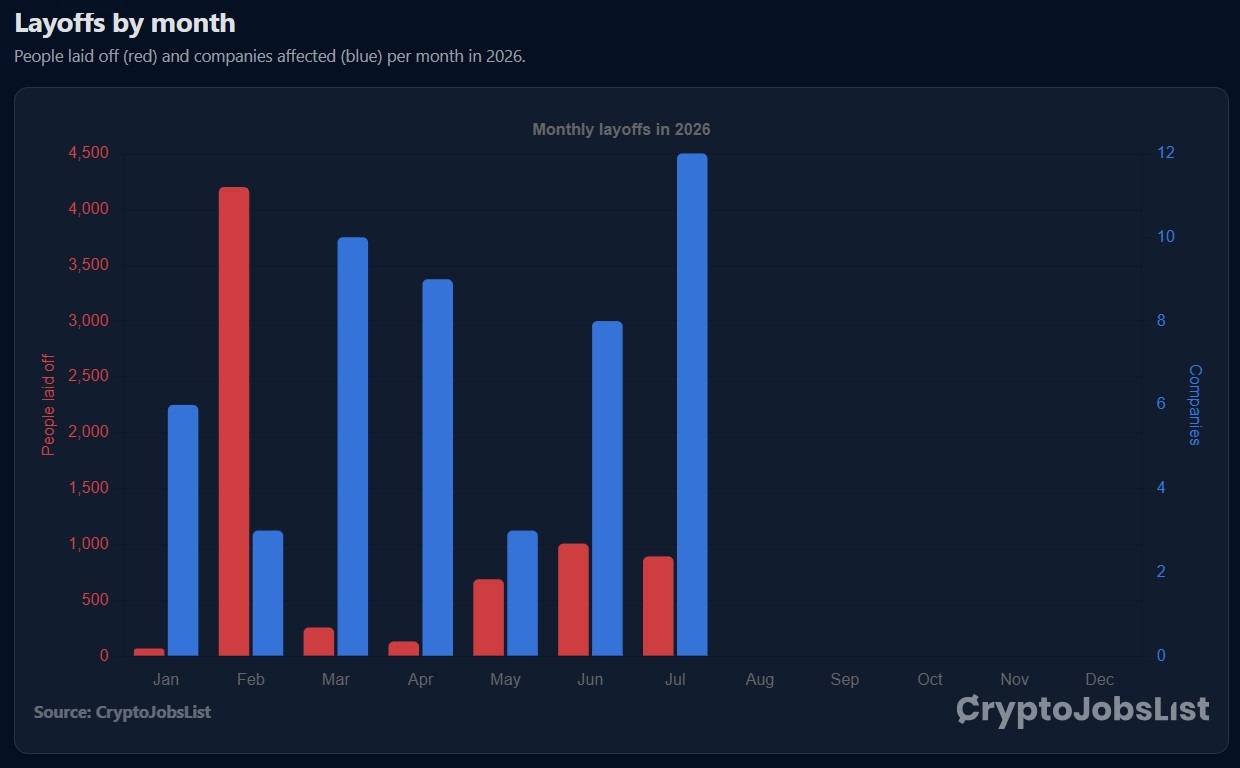
Layoffs by month. Source: CryptoJobsList

Earlier in July, crypto wallet company Exodus announced plans to cut 25% of its staff while reorganizing around a full-stack card-issuance and stablecoin-payments platform. Exodus said the move could produce between $10 million and $13 million in annual operating savings.

On Tuesday, blockchain infrastructure developer Gnosis invited companies hiring across engineering, product, design, marketing, developer relations and customer relations to contact it for introductions to former employees affected by a recent restructuring. The company said on July 17 that it had reduced its workforce following a review of its consumer-facing Gnosis App.

Magazine: Ethereum risks losing No. 2 spot as stablecoins gain ground

Related Questions

QWhat is the main reason given by Luno's CEO for the company's recent workforce reduction?

AAccording to CEO James Lanigan, the company invested in automation and broader operational improvements that changed the resources needed to run the business, and is restructuring to shift more resources toward institutional clients, financial infrastructure, and business-to-business services.

QAccording to the article, how many crypto and crypto-adjacent companies had layoffs or restructurings in July, and how many jobs were affected based on disclosed figures?

AIn July, 12 crypto and crypto-adjacent companies had layoffs or restructurings, with disclosed figures totaling 894 jobs affected.

QWhat larger industry trend does Luno's rationale for layoffs reflect, and what reasons are commonly cited?

ALuno's rationale reflects a wider industry trend where several crypto companies cite AI, automation, and operational efficiency when cutting staff.

QWhat specific area is the crypto wallet company Exodus reorganizing around after announcing staff cuts?

AExodus is reorganizing around a full-stack card-issuance and stablecoin-payments platform.

QWhich company's large workforce reduction heavily skews the 2026 layoff data tracked by CryptoJobsList, and when did it occur?

AThe data is heavily skewed by Block's 4,000-person reduction, which occurred in February 2026.

Related Reads

In Jinjiang, Fujian, a Storage Super Unicorn Lies Quiet

In Fujian's Jinjiang, a city known for sportswear, lies a quiet semiconductor giant: Fujian Jinhua Integrated Circuit Co. (JHICC). Once a promising domestic DRAM manufacturer alongside Yangtze Memory and ChangXin Memory Technologies (CXMT), its journey was derailed in 2018 when the U.S. placed it on an Entity List and filed criminal charges for alleged trade secret theft. This halted production for years. A turning point came in February 2024 when a U.S. federal court found JHICC not guilty. However, it had lost crucial time. While CXMT soared to become a top-valued A-share company in 2024, JHICC, with an estimated valuation of 80 billion RMB, was just restarting. Its current output is primarily customized DDR4 chips, not the advanced DDR5/HBM demanded for AI, but it still benefits from the broader memory chip upcycle. JHICC's story is tied to Chen Zhengkun, a veteran engineer who left Micron to lead the venture. Founded in 2016 with state-backed funding, JHICC partnered with Taiwan's UMC to develop DRAM technology. Rapid progress was cut short by the U.S. actions, which Micron initiated, partly due to its heavy reliance on the Chinese market. Post-sanctions, Chen's team worked to rebuild the production line with reduced reliance on U.S. technology. According to its records, JHICC achieved small-scale production and revenue growth under immense pressure. It now focuses on the stable "niche" DRAM market (e.g., TVs, routers) with a monthly capacity of ~40,000 wafers, aiming for 60,000 by 2026. It holds over 1,000 patents but remains on the Entity List. For Jinjiang, investing in JHICC was a bold industrial leap. The local government provided unwavering financial and logistical support during the crisis, helping the company survive. JHICC has become the anchor for a growing local semiconductor cluster. Though its scale lags behind domestic peers, JHICC's persistence symbolizes a hard-won foothold in a global market long dominated by Samsung, SK Hynix, and Micron. Having missed one boom, it seeks a place in the new AI-driven memory supercycle.

marsbit2h ago

In Jinjiang, Fujian, a Storage Super Unicorn Lies Quiet

marsbit2h ago

Trading

Spot
活动图片





