Lens and Farcaster "Change Hands": Can the Second Venture of On-Chain Social Break Through?

比推Published on 2026-01-23Last updated on 2026-01-23

Abstract

Two leading decentralized social protocols, Lens and Farcaster, have both undergone significant leadership changes this week. Lens, originally developed under Avara (Aave’s parent company), has transitioned to Mask Network, which aims to usher in a “product-centric” era for the protocol. Shortly after, Farcaster’s co-founder announced that infrastructure provider Neynar is acquiring Farcaster’s apps, protocol, and tech stack, with a renewed “developer-first” focus. While both Mask and Neynar possess deep expertise in their respective protocols, the broader challenge remains: achieving mass adoption and sustainable user engagement. Ethereum co-founder Vitalik Buterin commented on the shift, emphasizing the need for social tools that serve long-term user interests rather than short-term engagement. He advocates for decentralized social networks built on shared data layers with diverse clients and cultures. The success of these platforms hinges on creating overlapping “public squares” that foster innovation, community, and user agency. The new stewards now face the task of turning decentralized social ideals into engaging, daily-use realities—moving from theoretical potential to practical, culturally-rich ecosystems.

Source: Bankless

Author: William M. Peaster

Compilation and arrangement: BitpushNews


The landscape of Web3 consumer applications is undergoing dramatic changes.

Over the past few years, the two flagship on-chain social projects—Farcaster and Lens—both experienced a change in "leadership" this week.

A New Chapter for Lens

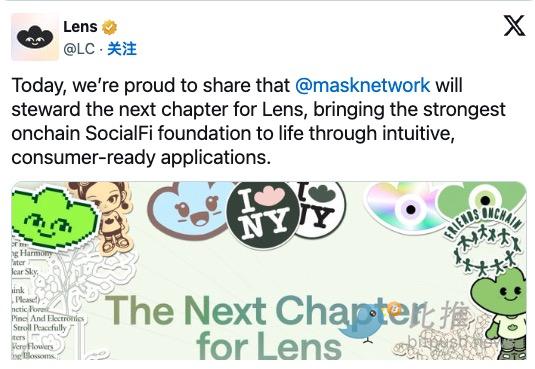
Avara (the parent company of Aave and Lens) just announced the transfer of the Lens protocol's management rights to Mask Network. The Mask team, with its rich experience, has previously developed on-chain social applications like Firefly and Orb. Avara will now focus entirely on DeFi business, while Mask's goal is to usher in a "product-centric" new era for Lens.
Farcaster Follows Suit

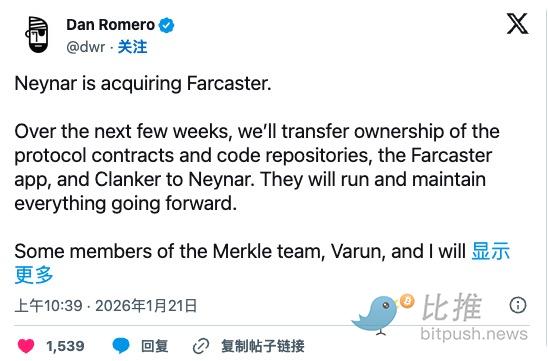
Just a day after the Lens news broke, Farcaster co-founder Dan Romero announced that Neynar, an infrastructure provider for Farcaster, is acquiring Farcaster's applications, protocol, and the Clanker tech stack. The original startup leadership team of Farcaster will not be joining the new company, but Neynar stated they are committed to reshaping the project into a "developer-first" social network.
Weighing the Pros and Cons

Mask knows Lens inside and out, and Neynar understands every detail of Farcaster. These two teams are undoubtedly among the top developers and thinkers in the on-chain social space. In the long run, Lens and Farcaster seem to be in the most capable hands.

However, the road ahead is far from smooth.

So far, on-chain social projects have struggled to become mass social networks with "gravitational mass." If this goal had been achieved, today's change of hands wouldn't have happened. Clearly, there are still some elements missing in the underlying structure, making some degree of "reboot" inevitable. Whether these changes can break through the bottlenecks and achieve lasting user retention remains to be seen.

Regarding the news of Lens's change of hands, Ethereum founder Vitalik Buterin (V God) shared his perspective. He wrote:

"What we need are social tools that serve the long-term interests of users, not just extract short-term engagement. [...] Decentralization is the way to achieve this: through a shared data layer, anyone can build their own client on top of it."

"But crypto social projects have tended to go the wrong way in the past. [...] Mixing 'money' and 'social' isn't inherently wrong: Substack has proven it's possible to build an economic system that supports high-quality content. But Substack's core is about subscribing to creators, not creating price bubbles around them."

"Decentralized social should be run by people who deeply believe in the essence of 'social' and are primarily driven by solving social problems. [...] I'm excited about Lens's development next year because I think the new team taking over is genuinely interested in 'social' itself."

"I encourage everyone to invest more time this year in Lens, Farcaster, and the broader decentralized social world. We need to move beyond the state where everyone is constantly tweeting in a global 'information war zone' and enter a reopened frontier where better, more novel forms of interaction become possible."

The Bigger Picture

For Lens and Farcaster, the key to this game lies in cultivating multiple overlapping "public squares"—connected by shared data but differentiated by different clients and cultures.

This diversity can foster innovation, innovation leads to more social interaction, social interaction attracts more users, which in turn drives more innovation, creating a virtuous cycle. Getting this "flywheel" spinning remains the core challenge.

Mask and Neynar seem ready to take on this task, and I am optimistic about their performance in their new roles. If you want to support their second launch and heed Vitalik's call, a great starting point is to try the Firefly application developed by Mask. It allows you to access platforms like X (Twitter), Farcaster, and Lens simultaneously without manually republishing content.

Looking Ahead

Crypto social is not dead. However, for the leaders of this new phase to successfully open a second chapter, they need to reflect on what worked and what didn't in the first chapter and iterate continuously based on that.

Overall, we have moved from the "what if" stage to the "what now" stage. In this sense, what Mask and Neynar have taken over is not just protocols, but also a mission: to transform decentralization from an abstract ideal into something many people are truly willing to spend time immersed in.

This is no easy task. But if these teams can continue to nurture lasting communities with unique cultures while empowering users with more agency in new ways, they have a chance to go far. Now, let's wait and see if they can truly realize this vision.


Twitter:https://twitter.com/BitpushNewsCN

Bitpush TG Discussion Group:https://t.me/BitPushCommunity

Bitpush TG Subscription: https://t.me/bitpush

Original link:https://www.bitpush.news/articles/7605336

Related Questions

QWhat major changes occurred in the management of Lens and Farcaster this week?

AAvara, the parent company of Aave and Lens, transferred the governance of the Lens protocol to Mask Network. Simultaneously, Farcaster's infrastructure provider Neynar acquired Farcaster's applications, protocol, and the Clanker tech stack, with the original founding team stepping down.

QAccording to Vitalik Buterin, what is the core problem with past crypto social projects?

AVitalik Buterin stated that past crypto social projects often went wrong by mixing 'money' and 'social' in a way that created price bubbles around creators, rather than focusing on building an economic system that supports high-quality content, similar to Substack's subscription model.

QWhat is the key challenge for Lens and Farcaster in their new phase of development?

AThe core challenge is to get the 'flywheel' effect spinning: cultivating multiple overlapping 'public squares' connected by shared data but differentiated by different clients and cultures, which can drive innovation, more social interaction, user growth, and further innovation.

QWhich application is recommended as a good starting point to support the new initiatives of Mask and Neynar?

AMask's Firefly application is recommended, as it allows users to access platforms like X (Twitter), Farcaster, and Lens simultaneously without manually reposting content.

QWhat overall shift in phase does the article describe for crypto social projects?

AThe article describes a shift from the 'what if' phase to the 'what now' phase, where the new leaders must reflect on what worked and what didn't in the first chapter, iterate continuously, and transform decentralization from an abstract ideal into something people genuinely want to immerse their time in.

Related Reads

2026 New Policy Interpretation: The "Mutual Pursuit" of Intelligent Agents and AI Terminals, and the Three Major Value Reconstructions in the AIoT Industry

In May 2026, China's national ministries released two pivotal policy documents that jointly establish a strategic "dual-track" framework for the AIoT industry. The "Intelligent Agent Standardized Application and Innovation Development Implementation Opinions" defines the "soul"—positioning intelligent agents as core AI products. The "Artificial Intelligence Terminal Intelligence Grading" national standard defines the "body"—establishing a four-tier capability ladder (L1 to L4) for AI hardware. This synchronized policy approach is globally unique, moving beyond market-led (US) or risk-focused (EU) models. It frames AIoT as a new type of "intelligent infrastructure," comparable to electricity or the internet in historical significance. The core analysis identifies a value evolution from IoT 1.0 (connection) to AIoT 4.0 (collaboration, represented by the forward-looking L4 level). This "L4" signifies a paradigm shift: from users operating tools to delegating tasks to agent-like devices ("Intelligent Action of All Things"). The article outlines three strategic paths for companies: becoming Standard Definers, Scenario Integrators (focusing on 19 specified application areas), or Infrastructure Builders. A critical 18-24 month window is identified for strategic positioning. A "Four Levers" strategy is proposed: leveraging Standards (L-level certification), leveraging Scenarios (deep vertical focus), leveraging Open Source (for cost reduction and ecosystem influence), and leveraging Momentum (engaging in global protocol ecosystems). In conclusion, these policies are a starting gun for a decade-long industrial transformation, shifting the industry narrative from "Intelligent Connection of All Things" to "Intelligent Action of All Things," with companies needing to choose their赛道and execution strategy decisively.

marsbit56m ago

2026 New Policy Interpretation: The "Mutual Pursuit" of Intelligent Agents and AI Terminals, and the Three Major Value Reconstructions in the AIoT Industry

marsbit56m ago

Splashing Out 27 Billion Yuan, OpenAI Establishes New Company to Accelerate AI Deployment

On May 11th, OpenAI announced the formation of a new company, "OpenAI Deployment Company," with an initial investment of over $4 billion (approximately 27.2 billion RMB). This venture aims to help businesses build and deploy AI solutions. OpenAI is also acquiring the AI consulting firm Toromo to rapidly scale the deployment company's capabilities. This new entity, majority-owned by OpenAI, brings together 19 investment, consulting, and system integration partners, led by TPG with co-lead founding partners including Advent International, Bain Capital, and Brookfield. OpenAI's Chief Revenue Officer, Denise Dresser, stated that while AI is becoming increasingly capable, the current challenge lies in integrating these systems into core business infrastructure and workflows. The deployment company is designed to bridge this gap and translate AI capabilities into operational impact. This move comes as OpenAI emphasizes the next competitive phase will depend on the efficiency of deploying AI in real business scenarios. The company reports over 1 million businesses already use its products and APIs. OpenAI is significantly increasing its investments in computing power, with co-founder Greg Brockman stating the company expects to spend $50 billion on compute this year, a dramatic increase from $3 million in 2017. The announcement follows OpenAI's recent completion of a record $122 billion funding round in late March, led by Amazon, Nvidia, and SoftBank, valuing the company at $852 billion post-money. Major strategic investors committed $110 billion as a base for this round. Concurrently, OpenAI is advancing its core model development. It has shifted focus from its Sora video generator to developing advanced robotics and AI models that interact with the physical world. It has also begun allowing select users access to a new model specialized in identifying software vulnerabilities and is reportedly preparing to launch an enhanced image generation model in the coming weeks. According to reports citing founder Sam Altman, OpenAI is considering an IPO as early as 2027, with a potential valuation around $1 trillion.

marsbit1h ago

Splashing Out 27 Billion Yuan, OpenAI Establishes New Company to Accelerate AI Deployment

marsbit1h ago

Trading

Spot
Futures
活动图片