Leading Crypto VCs See Collective AUM Shrink: a16z Crypto Fund Management Scale Plummets 40%, Multicoin Halved

marsbitPublished on 2026-04-18Last updated on 2026-04-18

Abstract

Headline: Top crypto funds including a16z Crypto and Multicoin saw their Assets Under Management (AUM) decline significantly in 2025, according to undisclosed SEC filings obtained by Fortune. Key Points: - a16z Crypto’s AUM dropped nearly 40% to $9.5 billion, partly due to returning capital to LPs at a market peak. Its first crypto fund achieved a 5.4x DPI. - Multicoin’s AUM was halved to approximately $2.7 billion, impacted by the crypto market downturn and its hybrid hedge/VC fund structure. - Pantera Capital also reduced AUM, influenced by successful exits including five portfolio company IPOs like Circle and BitGo. - Haun Ventures was the exception, with AUM growing over 30% to nearly $2.5 billion, driven by the successful acquisition of portfolio company BVNK by Mastercard. - Despite AUM contractions, major firms are raising new funds: Paradigm targeting up to $1.5 billion, a16z Crypto seeking up to $2 billion, and Dragonfly closing a $650 million fund. The data highlights the high volatility and cyclical nature of crypto VC investments, where AUM fluctuations are heavily tied to token prices and market cycles rather than solely reflecting fund performance.

Original Author: Ben Weiss

Original Compilation: Deep Tide TechFlow

Guide: Fortune reporters obtained a batch of previously undisclosed financial disclosure documents from the SEC for crypto VCs. The data shows that the Assets Under Management (AUM) of top firms like Paradigm, Pantera, a16z crypto, and Multicoin shrank across the board in 2025. However, the shrinkage isn't all bad news—a16z crypto returned money to LPs at the market peak, with its first fund's DPI reaching 5.4x. The only firm that bucked the trend was Haun Ventures, which capitalized on the stablecoin sector through BVNK's acquisition by Mastercard.

The leading players in crypto VC couldn't escape the market crash of 2025.

Fortune reporter Ben Weiss obtained a set of previously undisclosed investment advisor financial disclosure documents from the U.S. Securities and Exchange Commission (SEC). The data is straightforward: the AUM of top firms like Paradigm and Pantera Capital collectively shrunk in 2025.
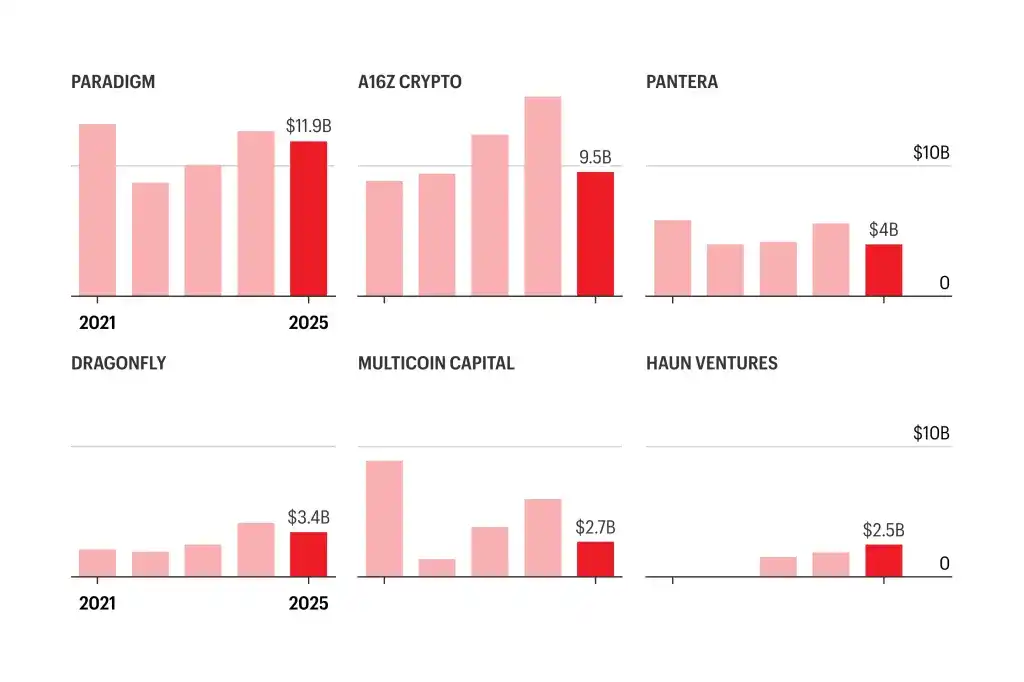
But the 2025 downturn pushed it back down. From 2024 to 2025, Multicoin's AUM was more than halved, dropping to approximately $2.7 billion. Since BTC began its plunge in October 2025, crypto assets have retreated across the board, and a structure like Multicoin's, which operates both hedge funds and VC funds, was hit particularly hard.

Additional context: Multicoin co-founder Kyle Samani left the company in February of this year to focus on other areas of technology investment.

Pantera: Five Portfolio Companies IPO, Capital Returned to LPs

Pantera Capital's AUM also shrank, but similar to a16z, part of the reason was主动 distributions back to LPs.

This institution, founded by former a16z crypto partner Katie Haun, saw its AUM increase by over 30% year-over-year, approaching $2.5 billion. On one hand, it was due to betting on the right sector—its investment in the stablecoin company BVNK was acquired by Mastercard for up to $1.8 billion. On the other hand, Haun Ventures itself also raised a new $1 billion fund in 2025.

Although AUM has shrunk, leading institutions have not stopped:

Paradigm is raising a new fund of up to $1.5 billion. a16z crypto is raising up to $2 billion. Dragonfly just closed its fourth fund of $650 million. Post-publication correction from Fortune: A Dragonfly spokesperson actually responded, confirming the data is "accurate" and stating "we are actively deploying capital".

Spokespersons for Paradigm, Pantera, a16z crypto, Multicoin, and Haun Ventures all declined to comment.

The Cyclical Destiny of Crypto VCs

The original article ends here, but a few background points are worth adding.

Crypto VCs are fundamentally different from traditional tech VCs. Traditional VCs invest in equity, with exits via IPO or M&A. Many crypto startups have their own tokens, exposing the VC's holdings directly to token price volatility.

According to Pantera Capital's outlook report earlier this year, the total crypto market cap excluding BTC (and excluding ETH and stablecoins) fell by about 44% from its late 2024 high. But following historical patterns, bear markets are also windows of opportunity for buying the dip. The密集 fund-raising by several leading institutions at this moment is a bet on the next cycle.

According to a previous Fortune exclusive, a16z crypto's fifth fund is planned to complete fundraising in the first half of 2026, led by Chris Dixon, and will continue to fully bet on the blockchain direction. Paradigm's new fund, according to The Wall Street Journal, will expand into AI and robotics technology. The divergence in the two strategies is clear: a16z continues all-in on crypto, while Paradigm chooses to hedge across sectors.


Related Questions

QAccording to the SEC filings obtained by Fortune, which major crypto VC firms experienced a significant decline in AUM in 2025?

AAccording to the SEC filings, major crypto VC firms including Paradigm, Pantera Capital, a16z crypto, and Multicoin all experienced significant declines in their Assets Under Management (AUM) in 2025.

QWhy did a16z crypto's AUM drop by nearly 40%, and what positive outcome did this represent?

Aa16z crypto's AUM dropped by nearly 40% partly because the firm began distributing returns from its first three funds back to its Limited Partners (LPs), intentionally doing so at a market high in 2025. The positive outcome was that its first crypto fund achieved a net DPI (Distributed to Paid-In capital) of 5.4x, representing strong returns for its investors.

QWhat was the primary reason for Haun Ventures being the only firm to see an increase in AUM, and by how much did it grow?

AHaun Ventures was the only firm to see an increase in AUM, growing by over 30% to nearly $2.5 billion. This growth was primarily due to a successful investment in the stablecoin company BVNK, which was acquired by Mastercard for up to $1.8 billion, and the firm's own fundraising of a new $1 billion fund in 2025.

QHow does the article explain the fundamental difference between crypto VC and traditional tech VC that leads to such volatile AUM changes?

AThe article explains that the fundamental difference is that traditional VCs invest in equity and exit via IPO or acquisition, while many crypto startups have their own tokens. This means a crypto VC's holdings are directly exposed to the extreme volatility of token prices, leading to massive swings in AUM that are unimaginable in traditional venture capital.

QDespite the AUM declines, what actions are firms like Paradigm and a16z crypto taking, indicating their continued belief in the market?

ADespite the AUM declines, firms like Paradigm and a16z crypto are actively raising new funds, indicating their continued belief in the market. Paradigm is raising a new fund of up to $1.5 billion, and a16z crypto is raising a new fund of up to $2 billion.

Related Reads

Bitcoin Withdrawals Continue: 8 Years of Storage in a Coldcard Cold Wallet Ended in Zero

Coldcard Hardware Wallet Hacked: Losses Mount Due to Vulnerable Seed Generation A critical vulnerability in Coldcard hardware wallets has led to a continued wave of fund thefts. According to Galaxy Research, the total stolen has reached 1,367.05 BTC (approx. $88.6 million) from 4,585 addresses, a significant increase from the initial 594.5 BTC reported on July 30, 2026. Most of the stolen funds remain on the attackers' addresses. The issue is not with the current firmware, which Coinkite has updated, but with seed phrases generated on vulnerable devices between March 2021 and the release of fixed firmware versions. Due to a programmer error, devices switched from using a hardware random number generator to the software-based Yasmarang generator, which was initialized with publicly accessible data like the chip's serial number. This made the seed phrases predictable through offline brute-force attacks, meaning wallets remain at risk until funds are moved to a new wallet generated with the patched firmware. Affected devices include Mk2/Mk3 with firmware 4.0.1–4.1.9 (and up to 5.0.3), Mk4/Mk5 up to version 5.6.0, and Q models up to 1.5.0Q. The only exceptions are seeds created with a high-entropy method like at least 50 independent dice rolls or a strong unique BIP-39 passphrase. All other owners must generate a new seed on the fixed firmware and transfer their assets. A case highlighting the human impact involves a 39-year-old long-term investor who lost 2 BTC (approx. $130,000) in minutes. He had accumulated the Bitcoin over eight years through physical labor, viewing it as a financial lifeline and a retirement plan in a country suffering from hyperinflation. His story underscores that even conservative "buy and hold in cold storage" strategies can be compromised by such underlying technical flaws. From a technical perspective, this incident echoes historical failures where weak random number generators undermined cryptographic security, challenging the assumption that offline storage is automatically foolproof.

cryptonews.ru5h ago

Bitcoin Withdrawals Continue: 8 Years of Storage in a Coldcard Cold Wallet Ended in Zero

cryptonews.ru5h ago

Trading

Spot
活动图片




