LayerZero rallies 11% as market activity overheats: Can ZRO push past $2.28?

ambcryptoPublished on 2026-03-17Last updated on 2026-03-17

Abstract

LayerZero (ZRO) surged over 11% in 24 hours, with trading volume jumping more than 140%, pushing its price toward the key $2.286 resistance level. The token recovered from a February low below $1.60, showing a sequence of higher lows and improved trend stability. Technical indicators like the positive MACD crossover and green histogram bars suggest growing buying momentum. However, spot market data signals overheating, with high speculative activity and persistent taker sell dominance creating short-term imbalance. Derivatives data shows higher short liquidations, amplifying volatility. While buyer interest is strong, overcoming the $2.286 barrier remains uncertain due to potential selling pressure. A breakout depends on sustained demand versus speculative activity.

LayerZero rallied more than 11% in the last 24 hours as trading activity intensified and 24-hour volume jumped over 140%, pushing ZRO toward key resistance.

Rising participation has pushed ZRO back into focus across spot and derivatives markets. Buyers have returned aggressively after weeks of choppy consolidation.

At the time of press, LayerZero [ZRO] traded at around $2.20, reflecting renewed speculative interest. Volume expansion usually signals strong participation; however, overheated conditions sometimes follow rapid spikes.

Traders therefore continue monitoring whether this surge reflects sustained demand or short-term speculation.

ZRO climbs toward major resistance barrier

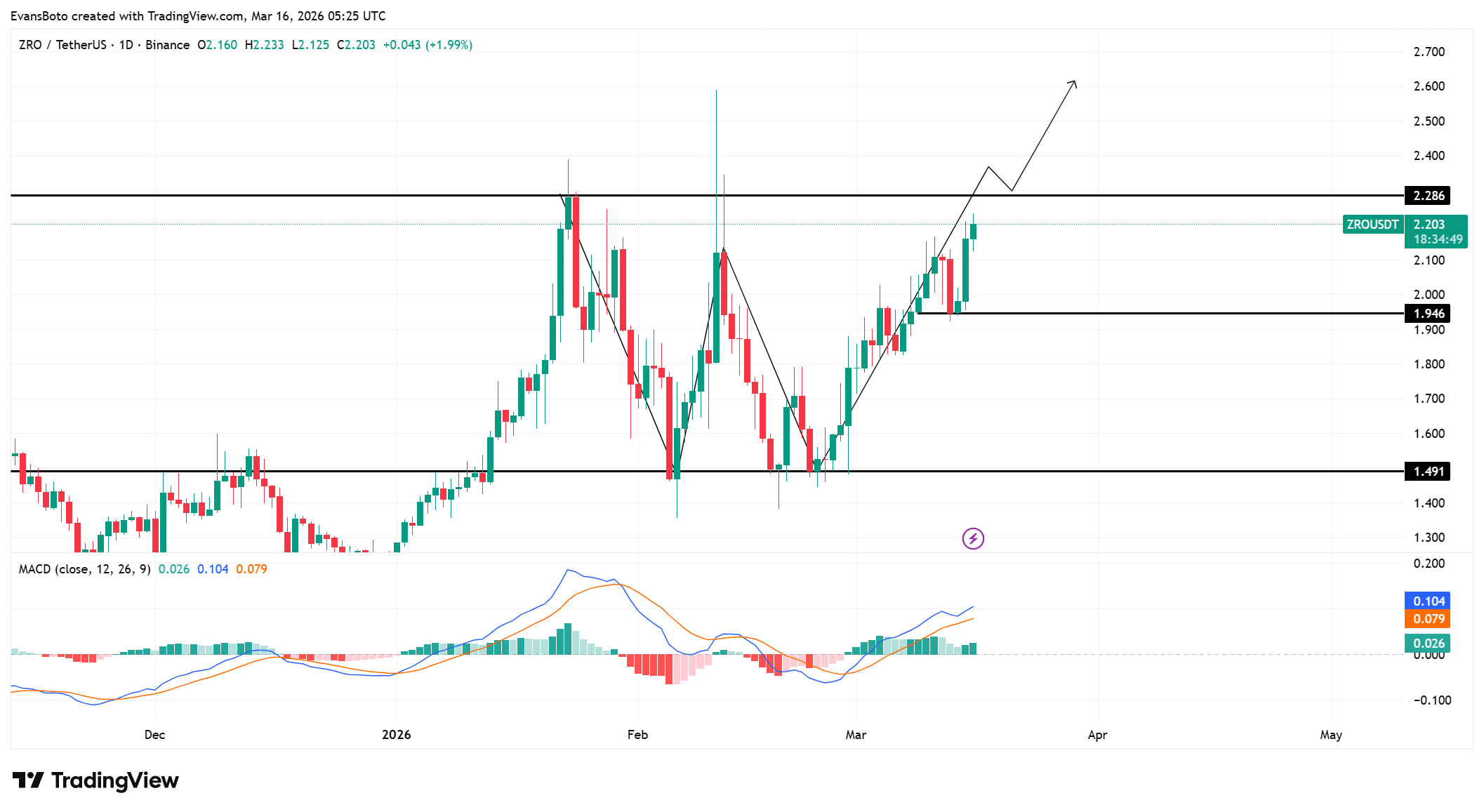
Recent price action shows LayerZero recovering strongly from the $1.491 support level and steadily advancing toward the $2.286 resistance zone.

Buyers regained control after the February decline pushed the price briefly below $1.60. Since then, a sequence of higher lows has developed across the daily chart.

This structure reflects improving trend stability. Price has already reclaimed the intermediate $1.946 level, which now acts as a support pivot.

However, the $2.286 region represents a major barrier where previous rallies stalled earlier this year. Sellers previously defended that zone aggressively.

If buyers maintain pressure near current levels, price could attempt another breakout toward higher targets.

The MACD line currently sits around 0.104, while the signal line remains near 0.079, confirming a positive crossover.

Histogram bars have also turned green near 0.026, showing strengthening buying pressure over recent sessions. This configuration normally appears during early trend recovery phases.
Source: TradingView

Spot market overheating raises caution signals

While price strength has attracted buyers, Spot market data suggests traders have started pushing activity into overheated territory.

The Spot Volume Bubble Map currently signals overheating conditions following the rapid surge in trading activity. Large bursts of volume often appear when speculative interest intensifies.

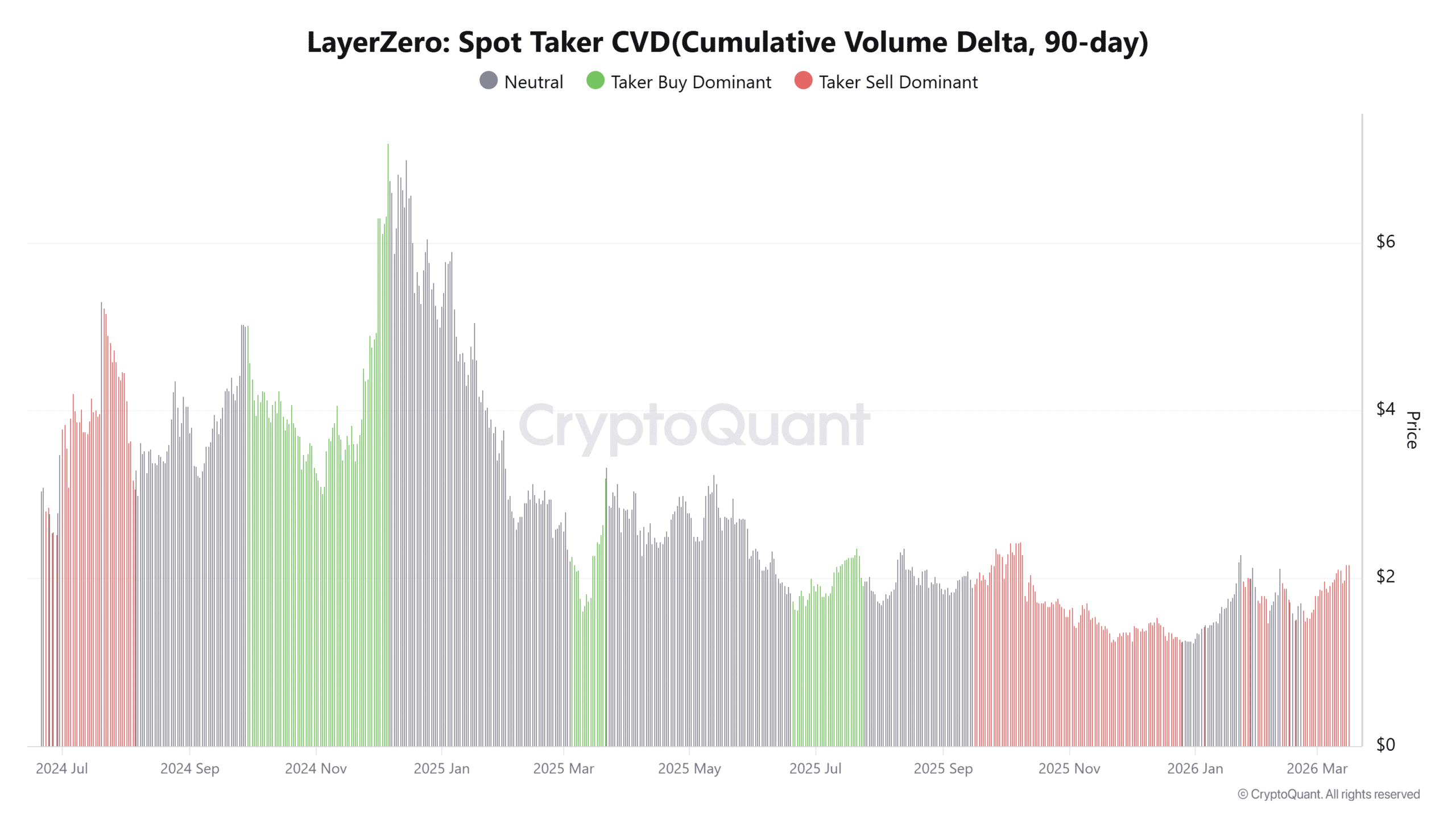
However, the 90-day Spot Taker CVD continues reflecting taker sell dominance, indicating that market sell orders still outweigh aggressive buying.

This imbalance creates a conflicting signal for short-term direction. Price rises while sellers remain active, which sometimes leads to brief volatility spikes.
Source: CryptoQuant

Short liquidations hint at growing volatility

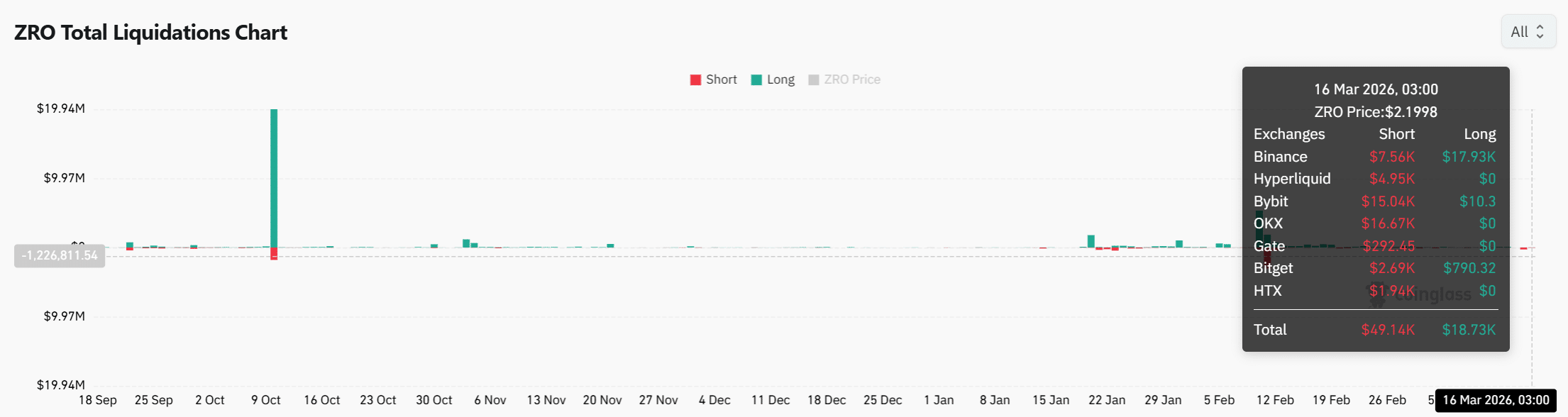
Derivatives data has also started reflecting the renewed price expansion across LayerZero markets. The total liquidation chart shows short positions absorbing slightly higher pressure during the latest move.

At the latest data point, short liquidations reached about $49.14K, while long liquidations remained near $18.73K.

This imbalance shows that rising prices have forced several short traders to close positions. Forced exits usually amplify volatility because liquidations trigger additional buying pressure.

Exchanges such as OKX and Bybit have recorded some of the largest short liquidations. However, the overall scale of liquidations remains moderate compared with earlier spikes.
Source: CoinGlass

LayerZero’s rally has pushed the price close to the $2.286 resistance, while indicators and liquidation data suggest strengthening market activity.

However, overheating spot signals and persistent taker sell dominance introduce short-term uncertainty.

If buyers sustain pressure near current levels, ZRO could challenge resistance again. However, heavy selling activity may still slow the advance before a confirmed breakout.


Final Summary

  • Growing participation has revived LayerZero interest; however, resistance pressure could still challenge sustained upside continuation soon.
  • Rising volatility and strong buyer activity could sustain ZRO’s recovery if resistance pressure weakens across markets.


Related Questions

QWhat was the percentage increase in LayerZero (ZRO) over the last 24 hours and what key resistance level is it approaching?

ALayerZero rallied more than 11% in the last 24 hours and is approaching the key resistance level of $2.286.

QWhat technical indicator is mentioned as confirming a positive crossover and what does this signal?

AThe MACD indicator is mentioned, with the MACD line at 0.104 and the signal line at 0.079, confirming a positive crossover which is a signal that often appears during early trend recovery phases.

QAccording to the Spot Volume Bubble Map, what condition is the market signaling and what does a 90-day metric show?

AThe Spot Volume Bubble Map is signaling overheating conditions, while the 90-day Spot Taker CVD continues to reflect taker sell dominance, indicating that market sell orders still outweigh aggressive buying.

QWhat does the imbalance between short and long liquidations suggest about recent market activity?

AThe imbalance, with short liquidations at $49.14K and long liquidations at $18.73K, suggests that rising prices have forced short traders to close positions, which can amplify volatility by triggering additional buying pressure.

QWhat are the two potential outcomes for ZRO's price mentioned in the final summary regarding resistance?

AThe final summary states that if buyers sustain pressure, ZRO could challenge the $2.286 resistance again, but heavy selling activity may slow the advance before a confirmed breakout occurs.

Related Reads

Anthropic Cries Wolf: Is the AGI Threat Real, or Just an IPO Story?

Anthropic has published an article titled "When AI builds itself," discussing the emerging concept of "recursive self-improvement," where AI begins to actively participate in designing, training, testing, and optimizing its own subsequent versions. The company presents internal data showing that by May 2026, over 80% of code merged into its codebase was written by Claude, its AI model. Claude's capabilities have expanded to handling complex, open-ended engineering tasks, achieving a 76% success rate in such areas, and even contributing to research processes, such as optimizing code performance and conducting AI safety experiments. Anthropic outlines an evolution from human-driven development to AI-assisted workflows, culminating in the current stage where AI agents can autonomously write, run, and delegate code. The company cautions that the path toward a "closed loop," where AI continuously improves itself, is becoming visible. It calls for coordinated global mechanisms to potentially slow or pause frontier AI development to allow safety research and societal structures to catch up. However, the timing of this warning coincides with Anthropic's preparations for an IPO, framing the narrative not just as a safety concern but also as a demonstration of Claude's advanced capabilities and its integral role in accelerating Anthropic's own R&D—creating a potential "flywheel" effect for competitive advantage. This contrasts with OpenAI's recent, more policy-oriented discussion of the same risks, highlighting the competitive dynamics in the AI industry as companies position themselves in both the technological and regulatory landscape.

marsbit41m ago

Anthropic Cries Wolf: Is the AGI Threat Real, or Just an IPO Story?

marsbit41m ago

BIT Research: ETF Purchases Have Slowed, Strategy (MicroStrategy) Has Slowed, What Else Can Drive Bitcoin's Rise?

Market Refocus on Inflation and Rate Expectations Weighs on Bitcoin Currently, the market is in a phase of macro-repricing dominated by inflation and interest rate expectations. Bitcoin, which previously benefited from easy liquidity and low inflation, is seeing its core bullish drivers weaken. These drivers were market expectations for interest rate cuts and strong inflows from Bitcoin ETFs and institutions like MicroStrategy (referred to as "Strategy" in the text). The logic has shifted. Recent high inflation data (e.g., CPI hitting 3.8% in a May 2026 report) has caused the market to sharply reduce its rate cut expectations for 2025 and even price in potential hikes. This is a key constraint for Bitcoin, as it lacks cash flows and is highly sensitive to rate expectations. Concurrently, institutional capital flows have slowed significantly. Following the hot CPI data, Bitcoin ETFs saw accelerated outflows, with around $4.3 billion leaving over a period. MicroStrategy's ability to keep adding substantial Bitcoin to its balance sheet is also diminishing. Together, ETF and MicroStrategy holdings total roughly $110 billion, but their momentum as growth engines is cooling. In summary, Bitcoin's current pressure stems not from its own fundamentals but from a changing macro environment. As long as inflation stays elevated, Bitcoin is likely to remain in a consolidating phase. However, historically, inflation eventually peaks. Once it recedes and rate cut expectations rebuild, institutional capital could return, potentially fueling a new and more robust recovery phase for Bitcoin.

marsbit48m ago

BIT Research: ETF Purchases Have Slowed, Strategy (MicroStrategy) Has Slowed, What Else Can Drive Bitcoin's Rise?

marsbit48m ago

Earning 1000 Trillion in Half a Year, 'Pocketing' 20 Million per Capita: This Round of Wealth Creation in the Korean Stock Market is Unprecedented in Scale

The South Korean stock market is experiencing an unprecedented wealth surge in 2026, with household equity and fund asset values soaring by over 1,000 trillion KRW (~$730bn) year-to-date. This translates to an average per capita wealth increase of roughly 20 million KRW, fueled by a historic 109% rally in the KOSPI index. The boom is driven by three converging forces: an AI-driven semiconductor supercycle boosting giants like Samsung and SK Hynix; the government's "Value-Up" market reforms addressing long-standing corporate governance issues; and aggressive real estate regulations that have locked capital within financial markets, preventing profits from flowing back into property. This has triggered a wealth effect, boosting high-end consumption significantly. However, the gains are highly concentrated. The two semiconductor behemoths account for over half the index's value, but retail investors own relatively low stakes in them, systematically missing the biggest rallies. Wealth and consumption benefits are skewed towards luxury goods and imported cars, bypassing mainstream retail. Further risks stem from excessive leverage, with high trading volume in leveraged ETFs, and a market sentiment heavily reliant on the AI sector's fortunes and speculative rumors. While this cycle marks a potential shift from real estate to equities as a primary wealth generator for Koreans, its sustainability, amid structural imbalances and leverage, remains a critical test.

marsbit54m ago

Earning 1000 Trillion in Half a Year, 'Pocketing' 20 Million per Capita: This Round of Wealth Creation in the Korean Stock Market is Unprecedented in Scale

marsbit54m ago

Trading

Spot
Futures
活动图片




