Larry Fink Says Tokenization Will Transform Markets in 2026 Investor Letter

TheNewsCryptoPublished on 2026-03-24Last updated on 2026-03-24

Abstract

In his annual investor letter, Larry Fink emphasized that tokenization will transform financial markets by 2026, addressing inefficiencies and lack of accessibility in traditional systems. He highlighted that tokenization can enable faster, more transparent transactions and broaden global participation in investment markets. Fink noted that expanding access is crucial for equitable wealth distribution and long-term economic growth. He also pointed out that tokenization could increase asset liquidity, improve market transparency, and bridge traditional finance with digital assets. This shift is expected to create new opportunities, especially in private markets, and marks a fundamental evolution in how assets are traded worldwide.

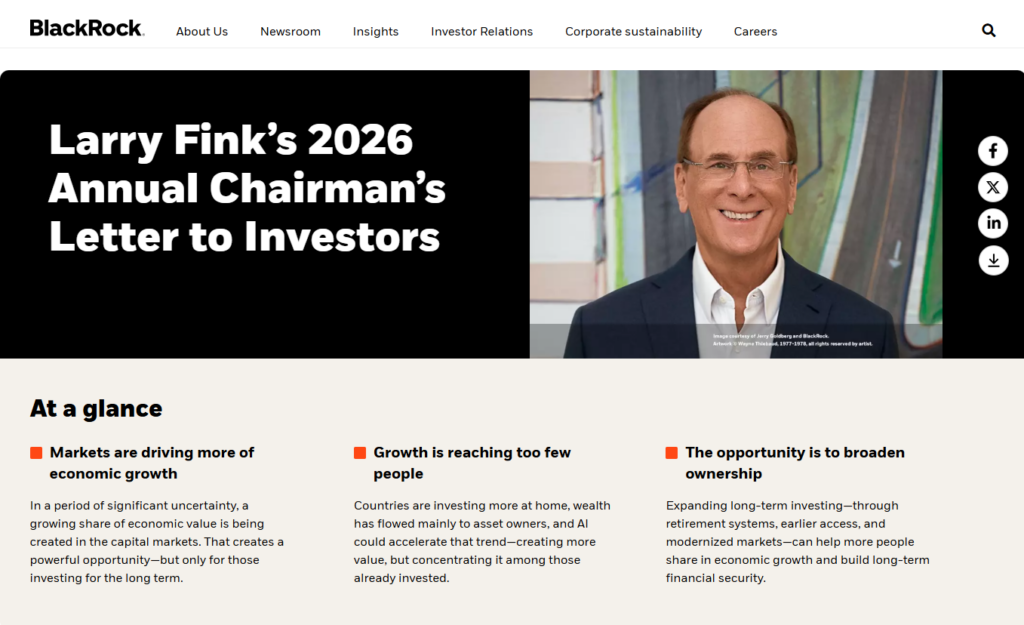
In the annual letter to investors, Larry Fink emphasized the importance of tokenization in transforming the financial markets. He explained that the traditional financial systems are based on an outdated infrastructure that lacks the required level of efficiency and accessibility for investors worldwide. He emphasized that the traditional financial systems can be transformed by the process of tokenization, which will help investors to make faster and more transparent transactions worldwide.

Fink highlighted the fact that tokenization can play a role in promoting broader participation by helping people access investment markets more easily. He noted that access to investment markets remains an important issue, considering that a majority of people still lack access to such markets. Fink noted that long-term investment remains a key aspect in helping people benefit from economic growth over a long period.
Source: Blackrock

Broader Participation and Financial System Evolution

Fink noted that financial markets need to evolve to ensure more people can access wealth creation opportunities in global markets. He noted that technology, such as tokenization, can play a role in helping people access investment markets. Fink noted that technology, such as digital wallets and blockchains, may one day enable people to invest as easily as making payments. He said that ensuring access to financial markets remains an important aspect in ensuring people benefit from economic growth.

Fink also warned that economic growth may result in asset holders benefiting disproportionately. He stressed that there is a need to expand asset ownership opportunities around the world. He explained that the expansion of asset ownership in capital markets around the world is essential to ensure the equitable distribution of economic growth in societies around the world.

Implications for Investors and Market Structure

Fink emphasized that tokenization has the potential to change the way assets are traded in financial markets around the world. He explained that assets may become more liquid and facilitate transparency in financial markets around the world. The letter explained that financial infrastructure has the potential to facilitate the interaction between traditional finance and digital asset markets.

Fink found that access to private markets may provide new investment opportunities to groups of investors who were previously unable to invest in private markets. Fink concluded that tokenization marks a fundamental shift like markets. This shift will provide long-term benefits to investors and economies. This message reflects a trend toward increased integration between traditional finance and blockchain technology.

Highlighted Crypto News:

Circle Urges Clarity in EU Market Integration Package to Strengthen Crypto Regulation

Tags#crypto investorsblackRockBlockchainBTCCryptocurrencyInvestorstokenization

Related Questions

QWhat is the main topic of Larry Fink's 2026 investor letter?

AThe main topic is the transformative potential of tokenization in financial markets.

QAccording to Fink, what problem does tokenization help solve in investment markets?

ATokenization helps solve the problem of limited accessibility and inefficiency in traditional financial systems, enabling faster and more transparent transactions.

QHow does Fink suggest tokenization can promote broader participation in financial markets?

AFink suggests that tokenization, along with technologies like digital wallets and blockchains, can make investing as easy as making payments, thereby expanding access to wealth creation opportunities.

QWhat potential impact does tokenization have on asset trading and market structure?

ATokenization can make assets more liquid, increase transparency, and facilitate integration between traditional finance and digital asset markets.

QWhy does Fink emphasize the need to expand asset ownership worldwide?

AFink emphasizes expanding asset ownership to ensure equitable distribution of economic growth benefits and prevent disproportionate gains for existing asset holders.

Related Reads

RWA First Stock's Major Acquisition: Why Buy a 'Traditional' Mortgage Company?

On June 10th, Figure Technology Solutions (Nasdaq: FIGR), a blockchain-native capital markets firm, announced a $717 million acquisition of Kiavi, a leading non-bank lender for residential real estate investors. The deal involves Figure acquiring Kiavi's technology and operations for approximately $538 million, while forming a joint venture with alternative asset manager Sixth Street to purchase Kiavi's existing loan portfolio. Sixth Street also provided a $3 billion forward purchase commitment. This acquisition marks a strategic shift for Figure, known as the "RWA (Real World Asset) first stock," allowing it to expand significantly into the larger market of first-lien mortgages. Kiavi specializes in non-qualified mortgage (Non-QM) loans, such as short-term fix-and-flip (RTL) and rental property (DSCR) loans—a segment traditionally underserved by major banks. The move is expected to increase Figure's first-lien loan origination to over $7 billion annually, aiming for these to constitute about 40% of its business by 2027. Both companies leverage AI for underwriting: Kiavi uses proprietary models to value renovated properties and automate document processing, dominating the fix-and-flip lending space. Figure plans to integrate these assets onto its blockchain platform, Provenance, using its new 'Adaptor' product to standardize and tokenize the loans for institutional investors on its Democratized Prime marketplace. While the integration poses challenges—including merging different asset types, interest rate sensitivity of Kiavi's loans, and post-IPO execution risks—Figure projects the deal to be accretive to earnings with a cash payback period under four years. The transaction is seen as a major step in scaling blockchain-based capital markets, moving RWA tokenization from concept validation toward large-scale operation.

Foresight News2m ago

RWA First Stock's Major Acquisition: Why Buy a 'Traditional' Mortgage Company?

Foresight News2m ago

Trend in US Stocks: A Post Triggers a 930-Point Rebound, Tonight Belongs to SpaceX

On Thursday (June 11, U.S. Eastern Time), Wall Street staged a textbook V-shaped reversal. The Dow Jones surged 929.97 points (+1.86%) to close above 50,000, while the Nasdaq and S&P 500 rose 2.54% and 1.75%, respectively. The rally occurred despite the hottest PPI report in years, with May data showing a 6.5% year-on-year surge, the highest since 2022. The market ignored the inflation data, focusing instead on reports that former President Trump called off a planned strike on Iran, hinting at a potential multi-party peace agreement draft. This sparked a sharp drop in oil prices, fueling hopes that inflation may have peaked. Sector rotations were stark: previously battered AI hardware and cyclical stocks led the gains, while defensive sectors that hit record highs the prior day were sold off. Chip stocks like Micron and Intel saw sharp rebounds. In contrast, software giant Oracle plunged nearly 10% despite beating earnings, with concerns over cloud revenue and cash flow. Adobe also fell after hours despite raising guidance, as its CFO announced departure. The rally's sustainability is questioned, driven largely by social media posts about unconfirmed geopolitical developments. Inflation risks remain, with pipeline pressures still high. Meanwhile, the market's risk appetite faces a major test with SpaceX's historic IPO. Priced at $135 per share, it aims to raise ~$75 billion with a $1.75 trillion valuation, becoming the largest U.S. IPO ever. It will join the Nasdaq 100 in 15 days, triggering massive index fund buying. However, critics cite extreme valuation (88x sales) and market liquidity concerns.

marsbit25m ago

Trend in US Stocks: A Post Triggers a 930-Point Rebound, Tonight Belongs to SpaceX

marsbit25m ago

The Trillion-Dollar Valuation Test: Are the Three Super IPOs a Tech Stock Frenzy or a Crypto Market Nightmare?

Trillion-Dollar Valuation Test: Are the Three Mega IPOs a Tech Stock Frenzy or a Crypto Market Nightmare? The capital market in 2026 is witnessing a highly anticipated wave of tech IPOs, centered on SpaceX, OpenAI, and Anthropic. Collectively valued at over $3.5 trillion, their potential listing represents one of the largest such waves in recent years. This raises concerns about market liquidity, valuation bubbles, and potential capital outflows from other assets like crypto. SpaceX's valuation narrative has shifted from rocket launches to becoming a global infrastructure play via its Starlink satellite network, which now drives most revenue. Despite ongoing losses, investors focus on its long-term growth potential. OpenAI and Anthropic represent the core productivity engines of generative AI. Their public listings would offer the first direct investment opportunity in large foundation model companies, potentially triggering a repricing within the AI sector. Market fears of a massive "capital drain" from these IPOs are likely overstated. Historical precedents like Alibaba and Saudi Aramco show that mega-listings primarily cause capital reallocation, not destruction, within the vast equities market. Systemic risk is rarely triggered by IPOs alone. For stock markets, short-term volatility and sector repricing are expected, especially for AI concept stocks. Long-term, these listings could reinforce the tech sector's importance. For crypto, direct competition for speculative capital exists, particularly affecting AI-themed tokens. However, crypto's trajectory remains more tied to its own cycles, macro liquidity, and Bitcoin ETF flows rather than a single IPO event. The real risk lies not in the listings themselves but in the sky-high growth expectations embedded in these valuations. If future revenue, profitability, or commercialization progress disappoints, significant valuation resets could follow, impacting high-growth tech stocks. Ultimately, the market's direction hinges on macroeconomic conditions and whether these companies can deliver on their ambitious promises.

链捕手41m ago

The Trillion-Dollar Valuation Test: Are the Three Super IPOs a Tech Stock Frenzy or a Crypto Market Nightmare?

链捕手41m ago

Trillion-Dollar Valuation Test: Are the Three Super IPOs a Tech Stock Frenzy or a Crypto Market Nightmare?

Title: Trillion-Dollar Valuations at Stake: Super IPOs of SpaceX, OpenAI, Anthropic – Tech Boom or Crypto Nightmare? TL;DR: A wave of mega-tech IPOs is approaching, featuring SpaceX (targeting a $1.75 trillion valuation), OpenAI (~$852B), and Anthropic (~$965B), with a combined potential valuation exceeding $3.5 trillion. This tests the market's pricing of innovation and sparks debate on liquidity impact. * **SpaceX**'s valuation is now driven more by its Starlink global communications infrastructure than its core rocket business. * **OpenAI & Anthropic** offer the first major public investment opportunities in foundational AI models, potentially repricing the entire AI sector. * Concerns about a market-wide "liquidity drain" are likely overblown; history shows large IPOs mainly cause fund reallocation, not disappearance, and rarely trigger systemic risk. * Crypto markets, especially some AI-themed tokens, may face short-term fund competition, but their long-term trajectory depends more on macro liquidity, regulation, and Bitcoin cycles. * The real risk lies not in the IPOs themselves, but in whether these companies can justify their sky-high valuations with future revenue growth and profitability. Unmet expectations could lead to significant repricing pressure. Ultimately, these IPOs represent a massive market pricing of next-gen tech infrastructure, not a prelude to a market crash. The broader market direction will be determined by macro conditions, corporate earnings, and risk appetite.

marsbit41m ago

Trillion-Dollar Valuation Test: Are the Three Super IPOs a Tech Stock Frenzy or a Crypto Market Nightmare?

marsbit41m ago

Trading

Spot
Futures
活动图片