Larry Fink Says Tokenization Will Transform Markets in 2026 Investor Letter

TheNewsCryptoPublished on 2026-03-24Last updated on 2026-03-24

Abstract

In his annual investor letter, Larry Fink emphasized that tokenization will transform financial markets by 2026, addressing inefficiencies and lack of accessibility in traditional systems. He highlighted that tokenization can enable faster, more transparent transactions and broaden global participation in investment markets. Fink noted that expanding access is crucial for equitable wealth distribution and long-term economic growth. He also pointed out that tokenization could increase asset liquidity, improve market transparency, and bridge traditional finance with digital assets. This shift is expected to create new opportunities, especially in private markets, and marks a fundamental evolution in how assets are traded worldwide.

In the annual letter to investors, Larry Fink emphasized the importance of tokenization in transforming the financial markets. He explained that the traditional financial systems are based on an outdated infrastructure that lacks the required level of efficiency and accessibility for investors worldwide. He emphasized that the traditional financial systems can be transformed by the process of tokenization, which will help investors to make faster and more transparent transactions worldwide.

Fink highlighted the fact that tokenization can play a role in promoting broader participation by helping people access investment markets more easily. He noted that access to investment markets remains an important issue, considering that a majority of people still lack access to such markets. Fink noted that long-term investment remains a key aspect in helping people benefit from economic growth over a long period.
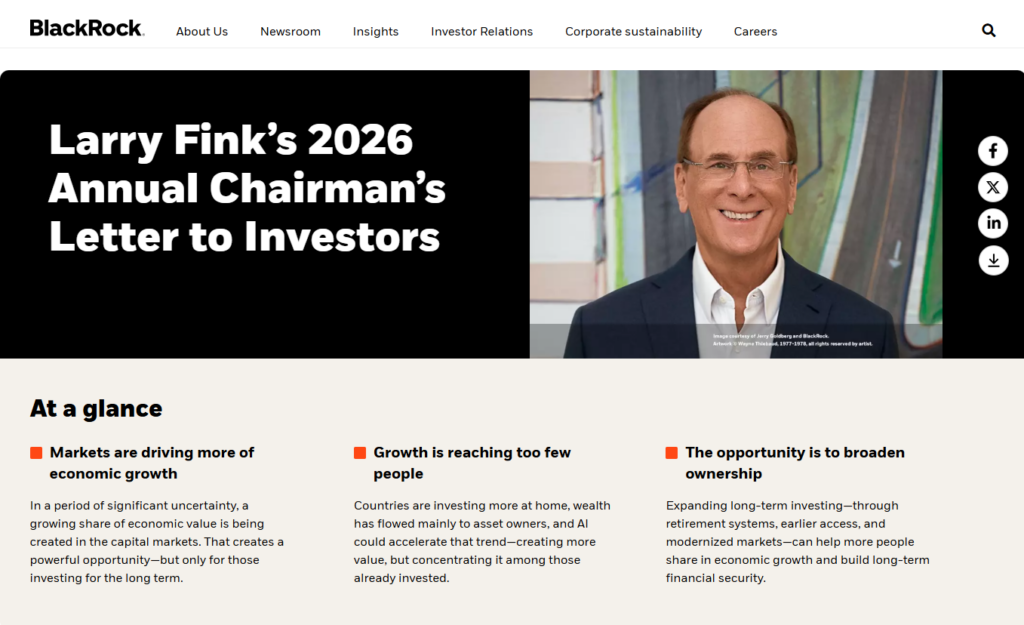
Source: Blackrock

Broader Participation and Financial System Evolution

Fink noted that financial markets need to evolve to ensure more people can access wealth creation opportunities in global markets. He noted that technology, such as tokenization, can play a role in helping people access investment markets. Fink noted that technology, such as digital wallets and blockchains, may one day enable people to invest as easily as making payments. He said that ensuring access to financial markets remains an important aspect in ensuring people benefit from economic growth.

Fink also warned that economic growth may result in asset holders benefiting disproportionately. He stressed that there is a need to expand asset ownership opportunities around the world. He explained that the expansion of asset ownership in capital markets around the world is essential to ensure the equitable distribution of economic growth in societies around the world.

Implications for Investors and Market Structure

Fink emphasized that tokenization has the potential to change the way assets are traded in financial markets around the world. He explained that assets may become more liquid and facilitate transparency in financial markets around the world. The letter explained that financial infrastructure has the potential to facilitate the interaction between traditional finance and digital asset markets.

Fink found that access to private markets may provide new investment opportunities to groups of investors who were previously unable to invest in private markets. Fink concluded that tokenization marks a fundamental shift like markets. This shift will provide long-term benefits to investors and economies. This message reflects a trend toward increased integration between traditional finance and blockchain technology.

Highlighted Crypto News:

Circle Urges Clarity in EU Market Integration Package to Strengthen Crypto Regulation

Tags#crypto investorsblackRockBlockchainBTCCryptocurrencyInvestorstokenization

Related Questions

QWhat is the main topic of Larry Fink's 2026 investor letter?

AThe main topic is the transformative potential of tokenization in financial markets.

QAccording to Fink, what problem does tokenization help solve in investment markets?

ATokenization helps solve the problem of limited accessibility and inefficiency in traditional financial systems, enabling faster and more transparent transactions.

QHow does Fink suggest tokenization can promote broader participation in financial markets?

AFink suggests that tokenization, along with technologies like digital wallets and blockchains, can make investing as easy as making payments, thereby expanding access to wealth creation opportunities.

QWhat potential impact does tokenization have on asset trading and market structure?

ATokenization can make assets more liquid, increase transparency, and facilitate integration between traditional finance and digital asset markets.

QWhy does Fink emphasize the need to expand asset ownership worldwide?

AFink emphasizes expanding asset ownership to ensure equitable distribution of economic growth benefits and prevent disproportionate gains for existing asset holders.

Related Reads

The Value Distribution of Stablecoins

**Summary: The Value Distribution of Stablecoins** The article argues that stablecoins are evolving from mere trading tools into broader channels for dollar access. It divides the stablecoin ecosystem into four layers to analyze how value is distributed: 1. **Issuance Layer:** Mints stablecoins, holds reserve assets, and captures the spread between reserve yield and user costs (e.g., Tether, Circle). This layer currently earns the largest profit margin. 2. **Infrastructure Layer:** Connects stablecoins to the traditional financial system, handling fiat on/off-ramps, banking integration, compliance (KYC/AML), and asset management (e.g., Bridge, BVNK). This is the "unglamorous" but critical work, building the essential bridges between crypto and real-world finance. 3. **Acquiring/Distribution Layer:** Integrates stablecoins into merchant systems, manages payment flows, and provides enterprise financial software (e.g., Stripe, Coinbase). They act as the access point for businesses. 4. **Application Layer:** The end-users and businesses that ultimately use stablecoins for payments, settlements, or as a store of value. They benefit from convenience but have little pricing power. The core thesis is that while the issuance layer currently dominates profits, the often-overlooked **infrastructure layer holds significant long-term potential**. The real challenge and barrier to mass adoption is not the on-chain transfer of stablecoins (which is simple), but the complex "last mile" integration into existing business workflows, banking systems, and regulatory frameworks across different countries. Companies in this layer are currently in a "land grab" phase, investing heavily to build networks, secure bank partnerships, and establish compliance pathways. While their position is currently pressured by the profitable issuers above and distribution platforms below, the article suggests that if stablecoins become a default financial rail for businesses, the infrastructure providers who have done the hard work of integration will ultimately gain strong pricing power and become entrenched, essential players.

marsbit4h ago

The Value Distribution of Stablecoins

marsbit4h ago

The Value Distribution of Stablecoins

The Value Distribution of Stablecoins The article argues that stablecoins are evolving from a mere trading tool into a broad "dollar channel." It analyzes the industry's value chain through four layers: 1. **Issuance Layer (e.g., Tether, Circle):** The top layer that mints stablecoins, holds reserve assets, and captures the thickest interest rate spread. 2. **Infrastructure Layer (e.g., Bridge, BVNK):** Connects stablecoins to the traditional financial system, handling critical but complex "dirty work" like fiat on/off-ramps, banking integration, compliance (KYC/AML), and cross-border settlement. 3. **Acquiring/Distribution Layer (e.g., Stripe, Coinbase):** Embeds stablecoins into merchant systems, manages payment flows, and integrates with enterprise software. 4. **Application Layer:** End-users and businesses that ultimately use stablecoins for payments, settlement, or storing value. The author posits that while the issuance layer currently captures the most profit, the most overlooked and potentially critical layer is infrastructure. The core challenge for stablecoin adoption isn't the on-chain transfer (which is simple), but bridging the gap between blockchain and the real-world financial system. This involves solving practical problems for businesses: fiat conversion, reconciliation, tax handling, and user onboarding. Infrastructure companies are currently in a difficult "land-grab" phase—building networks, securing banking relationships, and achieving compliance country-by-country. They face pressure from both the profitable issuance layer above and distribution platforms below. However, the author suggests this layer is building a crucial moat. Once stablecoins become a default business rail, the infrastructure players who have done the hard work of integration may gain significant, durable value and pricing power.

链捕手5h ago

The Value Distribution of Stablecoins

链捕手5h ago

How to Do Research Well: Deliberately Practice the Real Skills That Matter

No one truly teaches you how to do research. You're often given a desk, a pre-selected problem, and vague instructions to "create something new." Consequently, many people reverse-engineer the job based on visible outputs—papers, posts, announcements—learning only how to *appear* like a researcher rather than how to *become* one. True research capability is built from stacking small, trainable skills, nearly all of which can be developed through deliberate practice. **Pick Your Own Problem:** Most researchers absorb problems from advisors or trends, lacking the underlying reasoning. Choosing a problem you genuinely care about, as John Schulman advises, leads to original work. Develop "taste" like a muscle: predict experiment outcomes, guess paper results from methods, and track which findings remain important over time. **Upgrade Your Inputs:** Relying on shared reading lists (arXiv hot lists, filtered group chats) leads to unoriginal conclusions. Undervalued old literature often holds crucial insights (e.g., MoE, LSTM, backpropagation). Richard Sutton's "The Bitter Lesson" or Claude Shannon's 1952 talk on creative thinking are more predictive than lengthy modern surveys. Breadth matters as much as depth: draw from neuroscience, mechanism design, hardware knowledge, and honest statistics. Read papers directly, especially appendices and limitations sections. **Write Everything Down:** As Paul Graham noted, writing exposes flaws in seemingly mature ideas. Writing is the cheapest defense against self-deception. Following Feynman's principle, Darwin programmatically wrote down facts contradicting his theory to combat memory bias. Maintain a detailed log of hypotheses, setups, predictions, results, and updated understandings. Reviewing past logs fosters essential humility.

marsbit7h ago

How to Do Research Well: Deliberately Practice the Real Skills That Matter

marsbit7h ago

Trading

Spot
Futures
活动图片